
Kishan Patel
 This set of rues describes how data is transmitted
over a network.
 It is a formal description of message formats and the
rules that two computers must follow in order to
exchange messages.
 Protocols are needed for communication between any two
devices.
◦ In what format will the messages be transmitted?
◦ At what speed should messages be transmitted?
◦ What to do if errors take place?
◦ What to do if parts of a message are lost?
 Who made:
 International Standards Organization (ISO)
 “Open” means the concepts are non-proprietary; can be used
by anyone.
 OSI is not a protocol. It is a model for understanding and
designing a network architecture that is flexible and robust.
 The OSI model describes how data flows from one computer,
through a network to another computer.
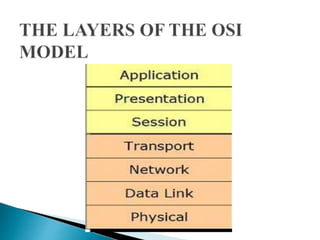
 The OSI model divides the tasks involved with moving
information between networked computers into 7 smaller,
more manageable sub-task .
 A task is then assigned to each of the seven OSI layers.
 Why so many layers?
◦ To reduce complexity, networks are organized as a stack of
layers, one below the other.
◦ Each layer performs a specific task. It provides services to
an adjacent layer.
 Functions of Physical Layer:
• Bit representation – Encode bits into electrical or optical
signals.
• Physical Topology – How devices are connected – ring,
star, mesh, bus topology.
 Responsible for delivery of data between two systems on the
same network.
 Main functions of this layer are:
• Framing – divides the stream of bits received from network
layer into manageable data units called frames.
• Physical Addressing – Add a header to the frame to define
the physical address of the source and the destination
machines.
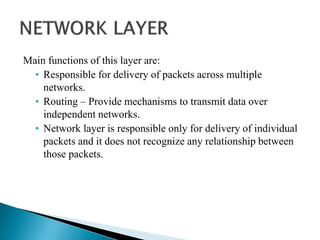
Main functions of this layer are:
• Responsible for delivery of packets across multiple
networks.
• Routing – Provide mechanisms to transmit data over
independent networks.
• Network layer is responsible only for delivery of individual
packets and it does not recognize any relationship between
those packets.
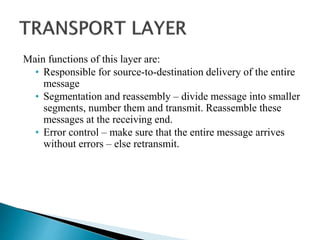
Main functions of this layer are:
• Responsible for source-to-destination delivery of the entire
message
• Segmentation and reassembly – divide message into smaller
segments, number them and transmit. Reassemble these
messages at the receiving end.
• Error control – make sure that the entire message arrives
without errors – else retransmit.
Main functions of this layer are:
• Mechanism for opening, closing and managing a
session between end-user application processes.
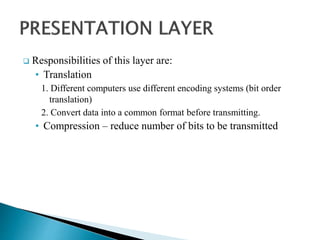
 Responsibilities of this layer are:
• Translation
1. Different computers use different encoding systems (bit order
translation)
2. Convert data into a common format before transmitting.
• Compression – reduce number of bits to be transmitted
 The application layer is the seventh layer of the OSI model
and the only one that directly interacts with the end user.
 The application layer provides many services, including:
I. Simple Mail Transfer Protocol
II. File transfer
III. Web surfing
IV. Web chat
V. Email clients
VI. Network data sharing
VII. Virtual terminals
VIII. Various file and data operations
 Computer Networks”,
Tanenbaum A (PHI)
 “Data Communications and Networking”.
Forouzan B (TMH)
Osi model

Osi model

  • 1.
  • 2.
     This setof rues describes how data is transmitted over a network.  It is a formal description of message formats and the rules that two computers must follow in order to exchange messages.
  • 3.
     Protocols areneeded for communication between any two devices. ◦ In what format will the messages be transmitted? ◦ At what speed should messages be transmitted? ◦ What to do if errors take place? ◦ What to do if parts of a message are lost?
  • 4.
     Who made: International Standards Organization (ISO)  “Open” means the concepts are non-proprietary; can be used by anyone.  OSI is not a protocol. It is a model for understanding and designing a network architecture that is flexible and robust.  The OSI model describes how data flows from one computer, through a network to another computer.  The OSI model divides the tasks involved with moving information between networked computers into 7 smaller, more manageable sub-task .  A task is then assigned to each of the seven OSI layers.
  • 5.
     Why somany layers? ◦ To reduce complexity, networks are organized as a stack of layers, one below the other. ◦ Each layer performs a specific task. It provides services to an adjacent layer.
  • 7.
     Functions ofPhysical Layer: • Bit representation – Encode bits into electrical or optical signals. • Physical Topology – How devices are connected – ring, star, mesh, bus topology.
  • 8.
     Responsible fordelivery of data between two systems on the same network.  Main functions of this layer are: • Framing – divides the stream of bits received from network layer into manageable data units called frames. • Physical Addressing – Add a header to the frame to define the physical address of the source and the destination machines.
  • 9.
    Main functions ofthis layer are: • Responsible for delivery of packets across multiple networks. • Routing – Provide mechanisms to transmit data over independent networks. • Network layer is responsible only for delivery of individual packets and it does not recognize any relationship between those packets.
  • 10.
    Main functions ofthis layer are: • Responsible for source-to-destination delivery of the entire message • Segmentation and reassembly – divide message into smaller segments, number them and transmit. Reassemble these messages at the receiving end. • Error control – make sure that the entire message arrives without errors – else retransmit.
  • 11.
    Main functions ofthis layer are: • Mechanism for opening, closing and managing a session between end-user application processes.
  • 12.
     Responsibilities ofthis layer are: • Translation 1. Different computers use different encoding systems (bit order translation) 2. Convert data into a common format before transmitting. • Compression – reduce number of bits to be transmitted
  • 13.
     The applicationlayer is the seventh layer of the OSI model and the only one that directly interacts with the end user.  The application layer provides many services, including: I. Simple Mail Transfer Protocol II. File transfer III. Web surfing IV. Web chat V. Email clients VI. Network data sharing VII. Virtual terminals VIII. Various file and data operations
  • 14.
     Computer Networks”, TanenbaumA (PHI)  “Data Communications and Networking”. Forouzan B (TMH)