OSI & TCP Model
Submitted By:
Md. Sohanur Rahman
ID: 1834902135
Batch: 49 (B)
Program: CSE(Day)
OBJECTIVES
 To discuss the OSI model and it’s layer architecture and to show the
interface between the layers
 To briefly discuss the function of each layers in the OSI model
 To introduce the TCP/IP protocol
 To show the functionality of each layer in the TCP/IP Model
Network Model
 A method of describing and analyzing data
communication networks by breaking the entire set
of communication process into a number of layers
 Each layer has a specific function
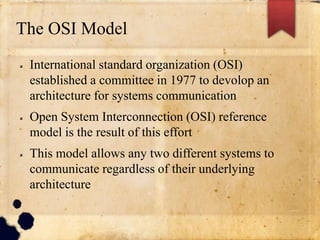
The OSI Model
 International standard organization (OSI)
established a committee in 1977 to devolop an
architecture for systems communication
 Open System Interconnection (OSI) reference
model is the result of this effort
 This model allows any two different systems to
communicate regardless of their underlying
architecture
Contradiction
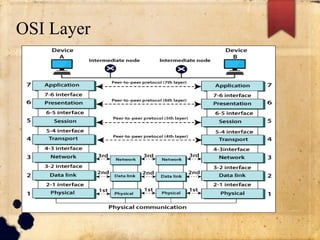
 The OSI model describes how data flows one
computer, through a network to another computer
 The OSI model is not a protocol it’s a model for
understanding and designing a network
architecture.
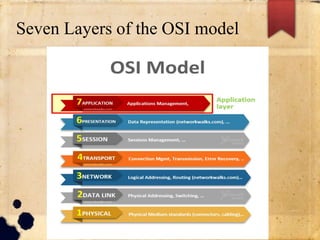
 The OSI model consists of seven separate but
related layers, each of which defins a part of the
process of moving information across a network.
Seven Layers of the OSI model
Why so many layers?
 To reduce the complexity, network are organized as
a stack of layers, one below the other
 Each layer perform a specific task, It provides
services to an adjacent layer
OSI Layer
Physical Layer
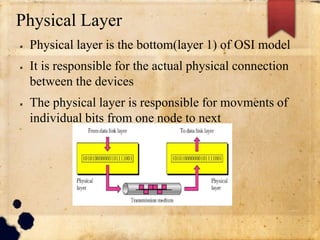
 Physical layer is the bottom(layer 1) of OSI model
 It is responsible for the actual physical connection
between the devices
 The physical layer is responsible for movments of
individual bits from one node to next
Functions of physical layer
 Convert bits to signal
 Bit synchronization
 Manage physical connection
 Bit rate control
 Line configuration
 Physical topology
 Transmission mode
 Switching
Data Link Layer
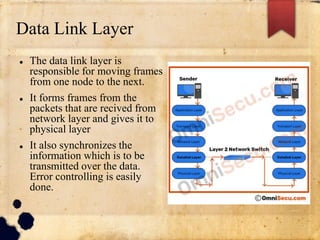
 The data link layer is
responsible for moving frames
from one node to the next.
 It forms frames from the
packets that are recived from
network layer and gives it to
physical layer
 It also synchronizes the
information which is to be
transmitted over the data.
Error controlling is easily
done.
Assingment 3-cse-313

Assingment 3-cse-313

  • 1.
    OSI & TCPModel Submitted By: Md. Sohanur Rahman ID: 1834902135 Batch: 49 (B) Program: CSE(Day)
  • 2.
    OBJECTIVES  To discussthe OSI model and it’s layer architecture and to show the interface between the layers  To briefly discuss the function of each layers in the OSI model  To introduce the TCP/IP protocol  To show the functionality of each layer in the TCP/IP Model
  • 3.
    Network Model  Amethod of describing and analyzing data communication networks by breaking the entire set of communication process into a number of layers  Each layer has a specific function
  • 4.
    The OSI Model International standard organization (OSI) established a committee in 1977 to devolop an architecture for systems communication  Open System Interconnection (OSI) reference model is the result of this effort  This model allows any two different systems to communicate regardless of their underlying architecture
  • 5.
    Contradiction  The OSImodel describes how data flows one computer, through a network to another computer  The OSI model is not a protocol it’s a model for understanding and designing a network architecture.  The OSI model consists of seven separate but related layers, each of which defins a part of the process of moving information across a network.
  • 6.
    Seven Layers ofthe OSI model
  • 7.
    Why so manylayers?  To reduce the complexity, network are organized as a stack of layers, one below the other  Each layer perform a specific task, It provides services to an adjacent layer
  • 8.
  • 9.
    Physical Layer  Physicallayer is the bottom(layer 1) of OSI model  It is responsible for the actual physical connection between the devices  The physical layer is responsible for movments of individual bits from one node to next
  • 10.
    Functions of physicallayer  Convert bits to signal  Bit synchronization  Manage physical connection  Bit rate control  Line configuration  Physical topology  Transmission mode  Switching
  • 11.
    Data Link Layer The data link layer is responsible for moving frames from one node to the next.  It forms frames from the packets that are recived from network layer and gives it to physical layer  It also synchronizes the information which is to be transmitted over the data. Error controlling is easily done.