
OSI Model
OSI MODEL
Presented by
Duryodhan Mahapatra
System Administrator
Strategy for connecting host computers and other
communicating equipment.
Defines necessary elements for data communication
between devices.
A communication architecture, therefore, defines a
standard for the communicating hosts.
A programmer formats data in a manner defined by
the communication architecture and passes it on to
the communication software.
Separating communication functions adds flexibility,
for example, we do not need to modify the entire host
software to include more communication devices.
OSI Model
Layer architecture simplifies the network design.
It is easy to debug network applications in a layered
architecture network.
The network management is easier due to the layered
architecture.
Network layers follow a set of rules, called protocol.
The protocol defines the format of the data being
exchanged, and the control and timing for the
handshake between layers.
OSI Model
International standard organization (ISO)
established a committee in 1977 to develop an
architecture for computer communication.
Open Systems Interconnection (OSI) reference
model is the result of this effort.
In 1984, the Open Systems Interconnection (OSI)
reference model was approved as an international
standard for communications architecture.
Term “open” denotes the ability to connect any two
systems which conform to the reference model and
associated standards.
OSI Model
The OSI model is now considered the primary
Architectural model for inter-computer
communications.
The OSI model describes how information or data
makes its way from application programmes (such as
spreadsheets) through a network medium (such as
wire) to another application programme located on
another network.
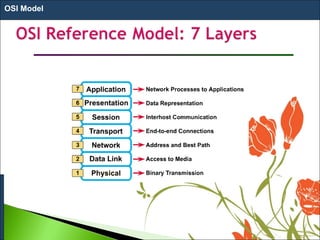
The OSI reference model divides the problem of
moving information between computers over a
network medium into SEVEN smaller and more
manageable problems .
This separation into smaller more manageable
functions is known as layering.
OSI Model
OSI Model
The process of breaking up the functions or tasks of
networking into layers reduces complexity.
Each layer provides a service to the layer above it in
the protocol specification.
Each layer communicates with the same layer’s
software or hardware on other computers.
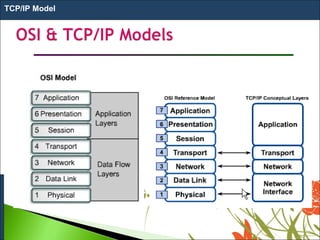
The lower 4 layers (transport, network, data link and
physical —Layers 4, 3, 2, and 1) are concerned with
the flow of data from end to end through the network.
The upper four layers of the OSI model (application,
presentation and session—Layers 7, 6 and 5) are
orientated more toward services to the applications.
Data is Encapsulated with the necessary protocol
information as it moves down the layers before
network transit.
OSI Model
Provides physical interface for transmission of
information.
Defines rules by which bits are passed from one
system to another on a physical communication
medium.
Covers all - mechanical, electrical, functional and
procedural - aspects for physical communication.
Such characteristics as voltage levels, timing of
voltage changes, physical data rates, maximum
transmission distances, physical connectors, and
other similar attributes are defined by physical layer
specifications.
OSI Model
Data link layer attempts to provide reliable
communication over the physical layer interface.
Breaks the outgoing data into frames and reassemble
the received frames.
Create and detect frame boundaries.
Handle errors by implementing an acknowledgement
and retransmission scheme.
Implement flow control.
Supports points-to-point as well as broadcast
communication.
Supports simplex, half-duplex or full-duplex
communication.
OSI Model
Implements routing of frames (packets) through the
network.
Defines the most optimum path the packet should
take from the source to the destination
Defines logical addressing so that any endpoint can
be identified.
Handles congestion in the network.
Facilitates interconnection between heterogeneous
networks (Internetworking).
The network layer also defines how to fragment a
packet into smaller packets to accommodate
different media.
OSI Model
Purpose of this layer is to provide a reliable
mechanism for the exchange of data between two
processes in different computers.
Ensures that the data units are delivered error free.
Ensures that data units are delivered in sequence.
Ensures that there is no loss or duplication of data
units.
Provides connectionless or connection oriented
service.
Provides for the connection management.
Multiplex multiple connection over a single channel.
OSI Model
Session layer provides mechanism for controlling the
dialogue between the two end systems. It defines how to
start, control and end conversations (called sessions)
between applications.
This layer requests for a logical connection to be
established on an end-user’s request.
Any necessary log-on or password validation is also
handled by this layer.
Session layer is also responsible for terminating the
connection.
This layer provides services like dialogue discipline which
can be full duplex or half duplex.
Session layer can also provide check-pointing mechanism
such that if a failure of some sort occurs between
checkpoints, all data can be retransmitted from the last
checkpoint.
OSI Model
Presentation layer defines the format in which the
data is to be exchanged between the two
communicating entities.
Also handles data compression and data encryption
(cryptography).
OSI Model
1. Application layer interacts with application
programs and is the highest level of OSI model.
2. Application layer contains management functions
to support distributed applications.
3. Examples of application layer are applications such
as file transfer, electronic mail, remote login etc.
OSI Model
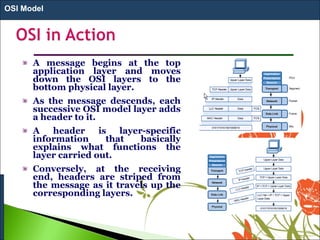
A message begins at the top
application layer and moves
down the OSI layers to the
bottom physical layer.
As the message descends, each
successive OSI model layer adds
a header to it.
A header is layer-specific
information that basically
explains what functions the
layer carried out.
Conversely, at the receiving
end, headers are striped from
the message as it travels up the
corresponding layers.
OSI Model
TCP/IP Model
TCP/IP MODEL
TCP/IP Model
TCP/IP Model
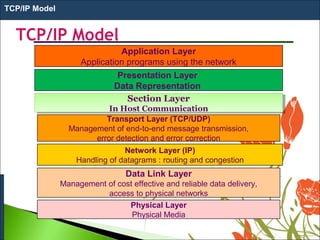
Application Layer
Application programs using the network
Transport Layer (TCP/UDP)
Management of end-to-end message transmission,
error detection and error correction
Network Layer (IP)
Handling of datagrams : routing and congestion
Data Link Layer
Management of cost effective and reliable data delivery,
access to physical networks
Physical Layer
Physical Media
Section Layer
In Host Communication
Section Layer
In Host Communication
Presentation Layer
Data Representation
OSI MODEL

OSI MODEL

  • 1.
    OSI Model OSI MODEL Presentedby Duryodhan Mahapatra System Administrator
  • 2.
    Strategy for connectinghost computers and other communicating equipment. Defines necessary elements for data communication between devices. A communication architecture, therefore, defines a standard for the communicating hosts. A programmer formats data in a manner defined by the communication architecture and passes it on to the communication software. Separating communication functions adds flexibility, for example, we do not need to modify the entire host software to include more communication devices. OSI Model
  • 3.
    Layer architecture simplifiesthe network design. It is easy to debug network applications in a layered architecture network. The network management is easier due to the layered architecture. Network layers follow a set of rules, called protocol. The protocol defines the format of the data being exchanged, and the control and timing for the handshake between layers. OSI Model
  • 4.
    International standard organization(ISO) established a committee in 1977 to develop an architecture for computer communication. Open Systems Interconnection (OSI) reference model is the result of this effort. In 1984, the Open Systems Interconnection (OSI) reference model was approved as an international standard for communications architecture. Term “open” denotes the ability to connect any two systems which conform to the reference model and associated standards. OSI Model
  • 5.
    The OSI modelis now considered the primary Architectural model for inter-computer communications. The OSI model describes how information or data makes its way from application programmes (such as spreadsheets) through a network medium (such as wire) to another application programme located on another network. The OSI reference model divides the problem of moving information between computers over a network medium into SEVEN smaller and more manageable problems . This separation into smaller more manageable functions is known as layering. OSI Model
  • 6.
  • 7.
    The process ofbreaking up the functions or tasks of networking into layers reduces complexity. Each layer provides a service to the layer above it in the protocol specification. Each layer communicates with the same layer’s software or hardware on other computers. The lower 4 layers (transport, network, data link and physical —Layers 4, 3, 2, and 1) are concerned with the flow of data from end to end through the network. The upper four layers of the OSI model (application, presentation and session—Layers 7, 6 and 5) are orientated more toward services to the applications. Data is Encapsulated with the necessary protocol information as it moves down the layers before network transit. OSI Model
  • 8.
    Provides physical interfacefor transmission of information. Defines rules by which bits are passed from one system to another on a physical communication medium. Covers all - mechanical, electrical, functional and procedural - aspects for physical communication. Such characteristics as voltage levels, timing of voltage changes, physical data rates, maximum transmission distances, physical connectors, and other similar attributes are defined by physical layer specifications. OSI Model
  • 9.
    Data link layerattempts to provide reliable communication over the physical layer interface. Breaks the outgoing data into frames and reassemble the received frames. Create and detect frame boundaries. Handle errors by implementing an acknowledgement and retransmission scheme. Implement flow control. Supports points-to-point as well as broadcast communication. Supports simplex, half-duplex or full-duplex communication. OSI Model
  • 10.
    Implements routing offrames (packets) through the network. Defines the most optimum path the packet should take from the source to the destination Defines logical addressing so that any endpoint can be identified. Handles congestion in the network. Facilitates interconnection between heterogeneous networks (Internetworking). The network layer also defines how to fragment a packet into smaller packets to accommodate different media. OSI Model
  • 11.
    Purpose of thislayer is to provide a reliable mechanism for the exchange of data between two processes in different computers. Ensures that the data units are delivered error free. Ensures that data units are delivered in sequence. Ensures that there is no loss or duplication of data units. Provides connectionless or connection oriented service. Provides for the connection management. Multiplex multiple connection over a single channel. OSI Model
  • 12.
    Session layer providesmechanism for controlling the dialogue between the two end systems. It defines how to start, control and end conversations (called sessions) between applications. This layer requests for a logical connection to be established on an end-user’s request. Any necessary log-on or password validation is also handled by this layer. Session layer is also responsible for terminating the connection. This layer provides services like dialogue discipline which can be full duplex or half duplex. Session layer can also provide check-pointing mechanism such that if a failure of some sort occurs between checkpoints, all data can be retransmitted from the last checkpoint. OSI Model
  • 13.
    Presentation layer definesthe format in which the data is to be exchanged between the two communicating entities. Also handles data compression and data encryption (cryptography). OSI Model
  • 14.
    1. Application layerinteracts with application programs and is the highest level of OSI model. 2. Application layer contains management functions to support distributed applications. 3. Examples of application layer are applications such as file transfer, electronic mail, remote login etc. OSI Model
  • 15.
    A message beginsat the top application layer and moves down the OSI layers to the bottom physical layer. As the message descends, each successive OSI model layer adds a header to it. A header is layer-specific information that basically explains what functions the layer carried out. Conversely, at the receiving end, headers are striped from the message as it travels up the corresponding layers. OSI Model
  • 16.
  • 17.
  • 18.
    TCP/IP Model Application Layer Applicationprograms using the network Transport Layer (TCP/UDP) Management of end-to-end message transmission, error detection and error correction Network Layer (IP) Handling of datagrams : routing and congestion Data Link Layer Management of cost effective and reliable data delivery, access to physical networks Physical Layer Physical Media Section Layer In Host Communication Section Layer In Host Communication Presentation Layer Data Representation