Eddie Hasty, MD
Daniel Carpenter, MD
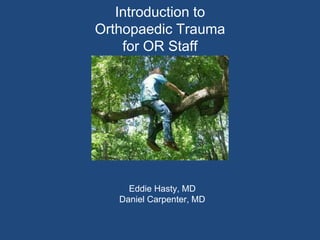
Introduction to
Orthopaedic Trauma
for OR Staff
Eddie Hasty, MD
Daniel Carpenter, MD
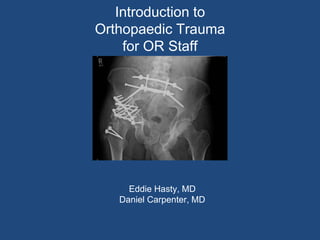
Introduction to
Orthopaedic Trauma
for OR Staff
Outline
●History/ statistics regarding orthopedic trauma
●Non-operative vs. operative fixation
●Principles of operative fixation
●Common traumatic injuries and associated
treatments
History
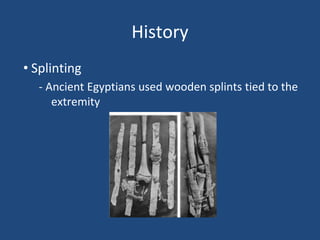
• Splinting
- Ancient Egyptians used wooden splints tied to the
extremity
History
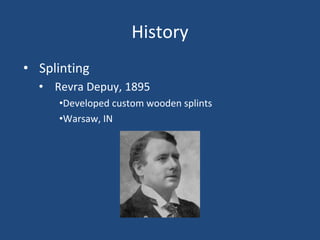
• Splinting
• Revra Depuy, 1895
•Developed custom wooden splints
•Warsaw, IN
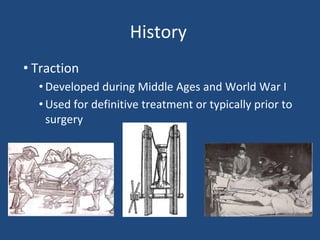
History
• Traction
• Developed during Middle Ages and World War I
• Used for definitive treatment or typically prior to
surgery
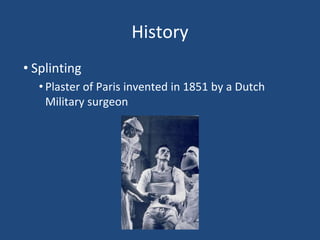
History
• Splinting
• Plaster of Paris invented in 1851 by a Dutch
Military surgeon
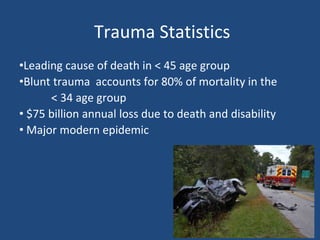
Trauma Statistics
•Leading cause of death in < 45 age group
•Blunt trauma accounts for 80% of mortality in the
< 34 age group
• $75 billion annual loss due to death and disability
• Major modern epidemic
Level 1 Trauma Activation Criteria
• Traumatic cardiac arrest during transport
• Systolic blood pressure less than 90
• Respiratory compromise/intubation
• Glasgow Coma Scale less than 8
• Traumatic limb paralysis
• Amputation proximal to wrist or ankle
• Vascular compromise of extremity
• Burns with traumatic component
• Penetrating injuries to head, neck chest, abdomen, extremities proximal to the
elbow or knee
PLEASE NOTE: Criteria may vary at centers
depending on State vs. ACS accreditation and
institution policy
Level 2 Trauma Activation Criteria
• Glasgow Coma Scale <14, >8
• Vital Sign instability (do not meet RED criteria)
• Flail chest or multiple rib fractures
• Pneumothorax/hemothorax
• Open/depressed skull fractures
• 2 or more long bone fractures
• Crush injury to chest or pelvis
• High level of suspicion related to mechanism
• Burns
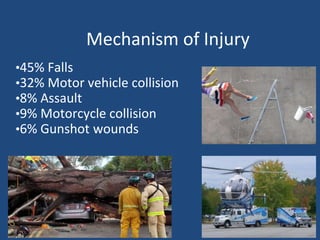
Mechanism of Injury
•45% Falls
•32% Motor vehicle collision
•8% Assault
•9% Motorcycle collision
•6% Gunshot wounds
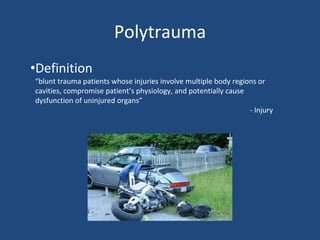
Polytrauma
•Definition
“blunt trauma patients whose injuries involve multiple body regions or
cavities, compromise patient’s physiology, and potentially cause
dysfunction of uninjured organs”
- Injury
Polytrauma
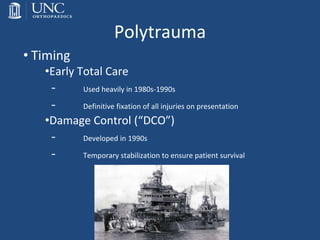
• Timing
•Early Total Care
- Used heavily in 1980s-1990s
- Definitive fixation of all injuries on presentation
•Damage Control (“DCO”)
- Developed in 1990s
- Temporary stabilization to ensure patient survival
Principles of Treatment
Non-operative treatment
vs.
Operative fixation
Non-Operative Treatment
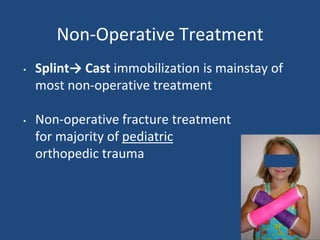
• Splint→ Cast immobilization is mainstay of
most non-operative treatment
• Non-operative fracture treatment
for majority of pediatric
orthopedic trauma
Common “non-op” fractures
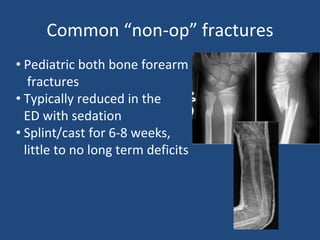
• Pediatric both bone forearm
fractures
• Typically reduced in the
ED with sedation
• Splint/cast for 6-8 weeks,
little to no long term deficits
Common “non-op” fractures
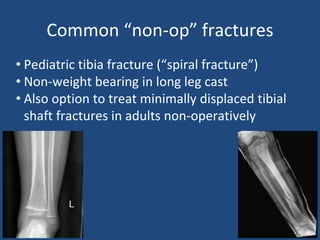
• Pediatric tibia fracture (“spiral fracture”)
• Non-weight bearing in long leg cast
• Also option to treat minimally displaced tibial
shaft fractures in adults non-operatively
Common “non-op” fractures
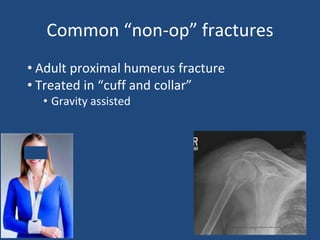
• Adult proximal humerus fracture
• Treated in “cuff and collar”
• Gravity assisted
Principles of Treatment
Non-operative treatment
vs.
Operative fixation
Operative Indications
• Open Fractures & Compartment Syndrome
• External Fixation
• Internal Fixation
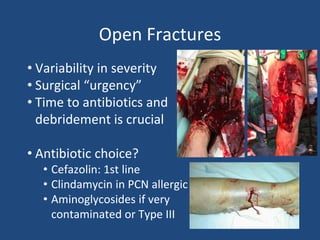
Open Fractures
• Variability in severity
• Surgical “urgency”
• Time to antibiotics and
debridement is crucial
• Antibiotic choice?
• Cefazolin: 1st line
• Clindamycin in PCN allergic
• Aminoglycosides if very
contaminated or Type III
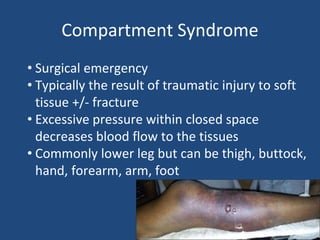
Compartment Syndrome
• Surgical emergency
• Typically the result of traumatic injury to soft
tissue +/- fracture
• Excessive pressure within closed space
decreases blood flow to the tissues
• Commonly lower leg but can be thigh, buttock,
hand, forearm, arm, foot
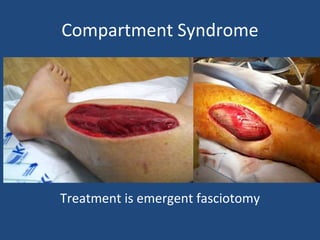
Compartment Syndrome
Treatment is emergent fasciotomy
Operative Indications
• Open Fractures & Compartment Syndrome
• External Fixation
• Internal Fixation
External Fixation
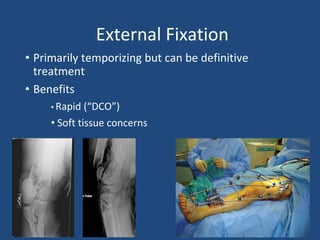
• Primarily temporizing but can be definitive
treatment
• Benefits
• Rapid (“DCO”)
• Soft tissue concerns
External Fixation
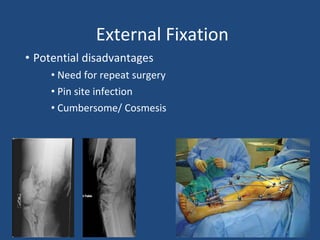
• Potential disadvantages
• Need for repeat surgery
• Pin site infection
• Cumbersome/ Cosmesis
Operative Indications
• Open Fractures & Compartment Syndrome
• External Fixation
• Internal Fixation
Internal Fixation
• Closed reduction percutaneous pinning
• Intramedullary nails
• Plate and screw constructs
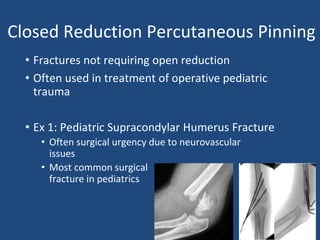
Closed Reduction Percutaneous Pinning
• Fractures not requiring open reduction
• Often used in treatment of operative pediatric
trauma
• Ex 1: Pediatric Supracondylar Humerus Fracture
• Often surgical urgency due to neurovascular
issues
• Most common surgical
fracture in pediatrics
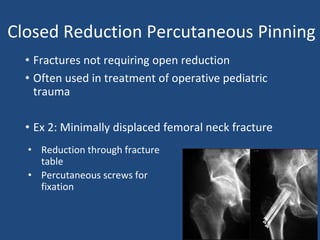
Closed Reduction Percutaneous Pinning
• Fractures not requiring open reduction
• Often used in treatment of operative pediatric
trauma
• Ex 2: Minimally displaced femoral neck fracture
• Reduction through fracture
table
• Percutaneous screws for
fixation
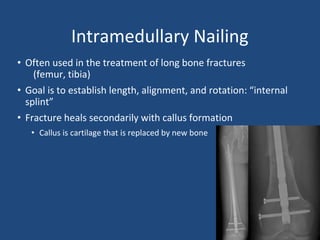
Intramedullary Nailing
• Often used in the treatment of long bone fractures
(femur, tibia)
• Goal is to establish length, alignment, and rotation: “internal
splint”
• Fracture heals secondarily with callus formation
• Callus is cartilage that is replaced by new bone
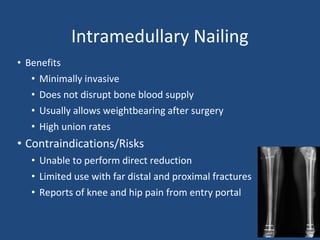
Intramedullary Nailing
• Benefits
• Minimally invasive
• Does not disrupt bone blood supply
• Usually allows weightbearing after surgery
• High union rates
• Contraindications/Risks
• Unable to perform direct reduction
• Limited use with far distal and proximal fractures
• Reports of knee and hip pain from entry portal
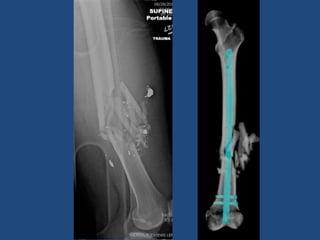
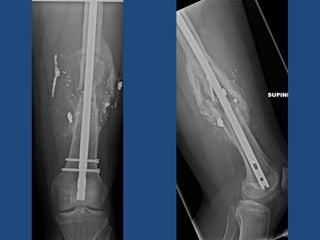
Femoral shaft and tibia fractures
• High energy mechanism
• Commonly treated with intramedullary
nailing
• Typically patients may “WBAT” following
surgery
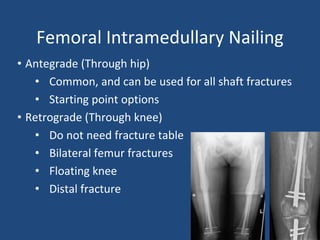
Femoral Intramedullary Nailing
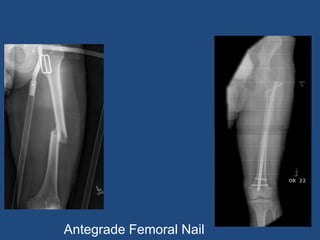
• Antegrade (Through hip)
• Common, and can be used for all shaft fractures
• Starting point options
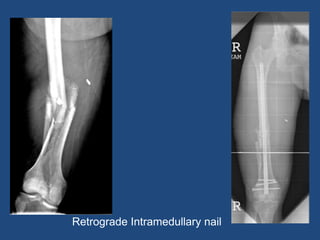
• Retrograde (Through knee)
• Do not need fracture table
• Bilateral femur fractures
• Floating knee
• Distal fracture
Antegrade Femoral Nail
Retrograde Intramedullary nail
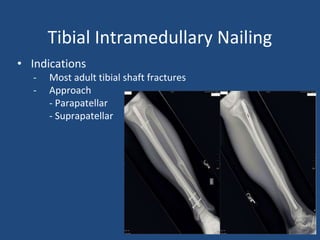
Tibial Intramedullary Nailing
• Indications
- Most adult tibial shaft fractures
- Approach
- Parapatellar
- Suprapatellar
Tibial Intramedullary Nailing
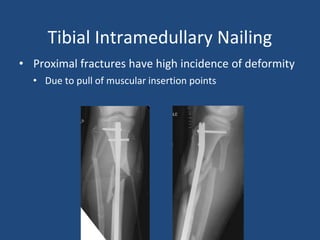
• Proximal fractures have high incidence of deformity
• Due to pull of muscular insertion points
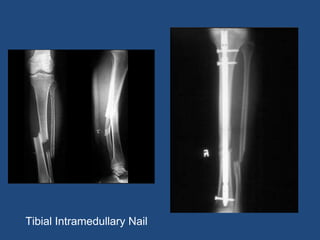
Tibial Intramedullary Nail
Plate and screw constructs
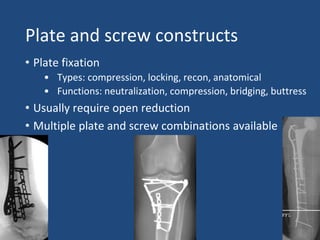
• Plate fixation
• Types: compression, locking, recon, anatomical
• Functions: neutralization, compression, bridging, buttress
• Usually require open reduction
• Multiple plate and screw combinations available
Common traumatic injuries and
associated treatments
• Pelvic ring injuries
• Acetabular fractures
• Femur and tibia fractures
• Hip fractures
• Both bone forearm fracture
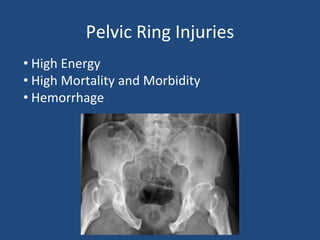
Pelvic Ring Injuries
• High Energy
• High Mortality and Morbidity
• Hemorrhage
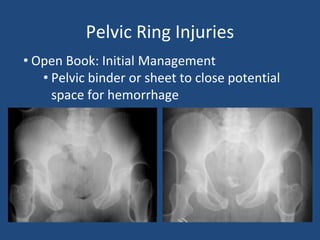
Pelvic Ring Injuries
• Open Book: Initial Management
• Pelvic binder or sheet to close potential
space for hemorrhage
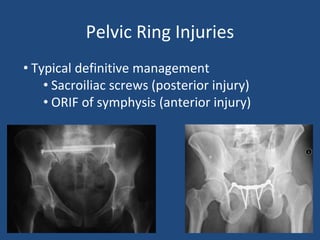
Pelvic Ring Injuries
• Typical definitive management
• Sacroiliac screws (posterior injury)
• ORIF of symphysis (anterior injury)
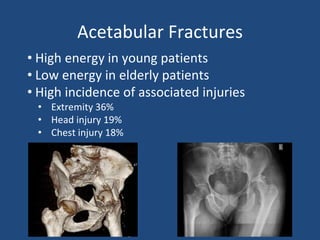
Acetabular Fractures
• High energy in young patients
• Low energy in elderly patients
• High incidence of associated injuries
• Extremity 36%
• Head injury 19%
• Chest injury 18%
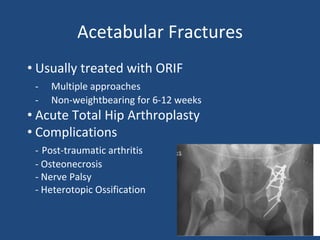
Acetabular Fractures
• Usually treated with ORIF
- Multiple approaches
- Non-weightbearing for 6-12 weeks
• Acute Total Hip Arthroplasty
• Complications
- Post-traumatic arthritis
- Osteonecrosis
- Nerve Palsy
- Heterotopic Ossification
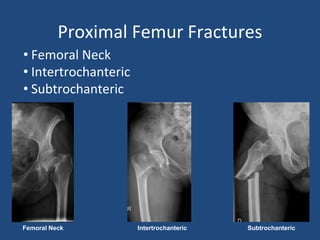
Proximal Femur Fractures
• Femoral Neck
• Intertrochanteric
• Subtrochanteric
Femoral Neck Intertrochanteric Subtrochanteric
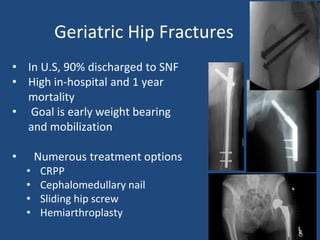
Geriatric Hip Fractures
• In U.S, 90% discharged to SNF
• High in-hospital and 1 year
mortality
• Goal is early weight bearing
and mobilization
• Numerous treatment options
• CRPP
• Cephalomedullary nail
• Sliding hip screw
• Hemiarthroplasty
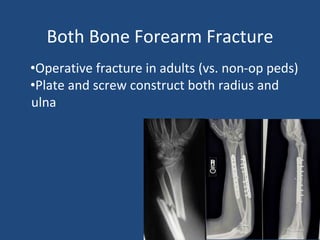
Both Bone Forearm Fracture
•Operative fracture in adults (vs. non-op peds)
•Plate and screw construct both radius and
ulna
A brief discussion about OR tables
• Regular table
• Fracture table
• OSI Flat top table
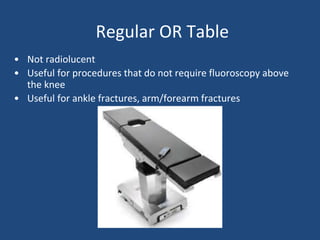
Regular OR Table
• Not radiolucent
• Useful for procedures that do not require fluoroscopy above
the knee
• Useful for ankle fractures, arm/forearm fractures
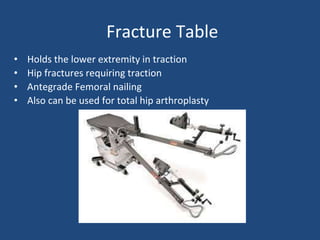
Fracture Table
• Holds the lower extremity in traction
• Hip fractures requiring traction
• Antegrade Femoral nailing
• Also can be used for total hip arthroplasty
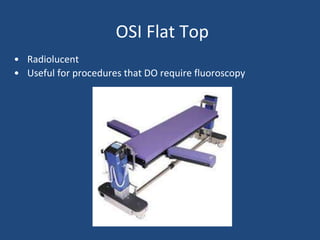
OSI Flat Top
• Radiolucent
• Useful for procedures that DO require fluoroscopy
Summary
• Orthopaedic traumatic injuries are common and often occur in
setting of high energy trauma with multi-organ involvement
• Mainstay of treatment involves stabilization/fixation
• Goal is early mobilization and function
• Generally acceptable outcomes but occasional severe long
term sequelae
Questions?
References
•Neria Butcher, Zsolt J Balogh. The definition of polytrauma:the need for international consensus. Injury, Int. J. Care Injured (2009)
40S4, S12–S22
•Holstein JH1, Culemann U, Pohlemann T; Working Group Mortality in Pelvic Fracture Patients. What are predictors of mortality in
patients with pelvic fractures? Clin Orthop Relat Res. 2012 Aug;470(8):2090-7. doi: 0.1007/s11999-012-2276-9.
•Taeger G, Ruchholtz S, Waydhas C, Lewan U, Schmidt B, Nast-Kolb D. Damage control orthopedics in patients with multiple injuries is
effective, time saving, and safe. J Trauma. 2005 Aug;59(2):409-16; discussion 417.
• Goodman DC, Fisher ES, Chang CH. After hospitalization: a Dartmouth Atlas report on post-acute care for Medicare beneficiaries. A
report of the Dartmouth Atlas project. 2011.
• Nikkel LE, Kates SL, Schreck M, Maceroli M, Mahmood B, Elfar JC. Length of hospital stay after hip fracture and risk of early mortality
after discharge in New York state: retrospective cohort study. BMJ 2015;351:h6246
•Scott Schnell, MD, Susan M. Friedman, MD, MPH, Daniel A. Mendelson, MS, MD, Karilee W. Bingham, MS, RN, FNP, Stephen L. Kates,
MD. The 1-Year Mortality of Patients Treated in a Hip Fracture Program for Elders. Geriatr Orthop Surg Rehabil. 2010 Sep; 1(1): 6–14.
•Koval KJ1, Friend KD, Aharonoff GB, Zukerman JD. Weight bearing after hip fracture: a prospective series of 596 geriatric hip fracture
patients. J Orthop Trauma. 1996;10(8):526-30.
•Haidukewych GJ. Acetabular fractures: the role of arthroplasty. Orthopedics. United States; 2010;33(9):645.
•Daurka JS, Pastides PS, Lewis A, Rickman M, and Bircher MD. Acetabular fractures in patients aged > 55 years: a systematic review of
the literature. Bone Joint J. England; 2014;96- B(2):157-63.
• Gary JL, Lefaivre KA, Gerold F, Hay MT, Reinert CM, and Starr AJ. Survivorship of the native hip joint after percutaneous repair of
acetabular fractures in the elderly. Injury. Netherlands; 2011;42(10):1144-51. 6.
•Tannast M, Najibi S, and Matta JM. Two to twenty-year survivorship of the hip in 810 patients with operatively treated acetabular
fractures. J Bone Joint Surg Am. United States; 2012;94(17):1559-67.
•O'Toole RV, Hui E, Chandra A, and Nascone JW. How often does open reduction and internal fixation of geriatric acetabular fractures
lead to hip arthroplasty? J Orthop Trauma. United States; 2014;28(3):148-53

ortho-trauma-presentation

  • 1.
    Eddie Hasty, MD DanielCarpenter, MD Introduction to Orthopaedic Trauma for OR Staff
  • 2.
    Eddie Hasty, MD DanielCarpenter, MD Introduction to Orthopaedic Trauma for OR Staff
  • 3.
    Outline ●History/ statistics regardingorthopedic trauma ●Non-operative vs. operative fixation ●Principles of operative fixation ●Common traumatic injuries and associated treatments
  • 4.
    History • Splinting - AncientEgyptians used wooden splints tied to the extremity
  • 5.
    History • Splinting • RevraDepuy, 1895 •Developed custom wooden splints •Warsaw, IN
  • 6.
    History • Traction • Developedduring Middle Ages and World War I • Used for definitive treatment or typically prior to surgery
  • 7.
    History • Splinting • Plasterof Paris invented in 1851 by a Dutch Military surgeon
  • 8.
    Trauma Statistics •Leading causeof death in < 45 age group •Blunt trauma accounts for 80% of mortality in the < 34 age group • $75 billion annual loss due to death and disability • Major modern epidemic
  • 9.
    Level 1 TraumaActivation Criteria • Traumatic cardiac arrest during transport • Systolic blood pressure less than 90 • Respiratory compromise/intubation • Glasgow Coma Scale less than 8 • Traumatic limb paralysis • Amputation proximal to wrist or ankle • Vascular compromise of extremity • Burns with traumatic component • Penetrating injuries to head, neck chest, abdomen, extremities proximal to the elbow or knee PLEASE NOTE: Criteria may vary at centers depending on State vs. ACS accreditation and institution policy
  • 10.
    Level 2 TraumaActivation Criteria • Glasgow Coma Scale <14, >8 • Vital Sign instability (do not meet RED criteria) • Flail chest or multiple rib fractures • Pneumothorax/hemothorax • Open/depressed skull fractures • 2 or more long bone fractures • Crush injury to chest or pelvis • High level of suspicion related to mechanism • Burns
  • 11.
    Mechanism of Injury •45%Falls •32% Motor vehicle collision •8% Assault •9% Motorcycle collision •6% Gunshot wounds
  • 12.
    Polytrauma •Definition “blunt trauma patientswhose injuries involve multiple body regions or cavities, compromise patient’s physiology, and potentially cause dysfunction of uninjured organs” - Injury
  • 13.
    Polytrauma • Timing •Early TotalCare - Used heavily in 1980s-1990s - Definitive fixation of all injuries on presentation •Damage Control (“DCO”) - Developed in 1990s - Temporary stabilization to ensure patient survival
  • 14.
    Principles of Treatment Non-operativetreatment vs. Operative fixation
  • 15.
    Non-Operative Treatment • Splint→Cast immobilization is mainstay of most non-operative treatment • Non-operative fracture treatment for majority of pediatric orthopedic trauma
  • 16.
    Common “non-op” fractures •Pediatric both bone forearm fractures • Typically reduced in the ED with sedation • Splint/cast for 6-8 weeks, little to no long term deficits
  • 17.
    Common “non-op” fractures •Pediatric tibia fracture (“spiral fracture”) • Non-weight bearing in long leg cast • Also option to treat minimally displaced tibial shaft fractures in adults non-operatively
  • 18.
    Common “non-op” fractures •Adult proximal humerus fracture • Treated in “cuff and collar” • Gravity assisted
  • 19.
    Principles of Treatment Non-operativetreatment vs. Operative fixation
  • 20.
    Operative Indications • OpenFractures & Compartment Syndrome • External Fixation • Internal Fixation
  • 21.
    Open Fractures • Variabilityin severity • Surgical “urgency” • Time to antibiotics and debridement is crucial • Antibiotic choice? • Cefazolin: 1st line • Clindamycin in PCN allergic • Aminoglycosides if very contaminated or Type III
  • 22.
    Compartment Syndrome • Surgicalemergency • Typically the result of traumatic injury to soft tissue +/- fracture • Excessive pressure within closed space decreases blood flow to the tissues • Commonly lower leg but can be thigh, buttock, hand, forearm, arm, foot
  • 23.
  • 24.
    Operative Indications • OpenFractures & Compartment Syndrome • External Fixation • Internal Fixation
  • 25.
    External Fixation • Primarilytemporizing but can be definitive treatment • Benefits • Rapid (“DCO”) • Soft tissue concerns
  • 26.
    External Fixation • Potentialdisadvantages • Need for repeat surgery • Pin site infection • Cumbersome/ Cosmesis
  • 27.
    Operative Indications • OpenFractures & Compartment Syndrome • External Fixation • Internal Fixation
  • 28.
    Internal Fixation • Closedreduction percutaneous pinning • Intramedullary nails • Plate and screw constructs
  • 29.
    Closed Reduction PercutaneousPinning • Fractures not requiring open reduction • Often used in treatment of operative pediatric trauma • Ex 1: Pediatric Supracondylar Humerus Fracture • Often surgical urgency due to neurovascular issues • Most common surgical fracture in pediatrics
  • 30.
    Closed Reduction PercutaneousPinning • Fractures not requiring open reduction • Often used in treatment of operative pediatric trauma • Ex 2: Minimally displaced femoral neck fracture • Reduction through fracture table • Percutaneous screws for fixation
  • 31.
    Intramedullary Nailing • Oftenused in the treatment of long bone fractures (femur, tibia) • Goal is to establish length, alignment, and rotation: “internal splint” • Fracture heals secondarily with callus formation • Callus is cartilage that is replaced by new bone
  • 32.
    Intramedullary Nailing • Benefits •Minimally invasive • Does not disrupt bone blood supply • Usually allows weightbearing after surgery • High union rates • Contraindications/Risks • Unable to perform direct reduction • Limited use with far distal and proximal fractures • Reports of knee and hip pain from entry portal
  • 35.
    Femoral shaft andtibia fractures • High energy mechanism • Commonly treated with intramedullary nailing • Typically patients may “WBAT” following surgery
  • 36.
    Femoral Intramedullary Nailing •Antegrade (Through hip) • Common, and can be used for all shaft fractures • Starting point options • Retrograde (Through knee) • Do not need fracture table • Bilateral femur fractures • Floating knee • Distal fracture
  • 37.
  • 38.
  • 39.
    Tibial Intramedullary Nailing •Indications - Most adult tibial shaft fractures - Approach - Parapatellar - Suprapatellar
  • 40.
    Tibial Intramedullary Nailing •Proximal fractures have high incidence of deformity • Due to pull of muscular insertion points
  • 41.
  • 42.
    Plate and screwconstructs • Plate fixation • Types: compression, locking, recon, anatomical • Functions: neutralization, compression, bridging, buttress • Usually require open reduction • Multiple plate and screw combinations available
  • 43.
    Common traumatic injuriesand associated treatments • Pelvic ring injuries • Acetabular fractures • Femur and tibia fractures • Hip fractures • Both bone forearm fracture
  • 44.
    Pelvic Ring Injuries •High Energy • High Mortality and Morbidity • Hemorrhage
  • 45.
    Pelvic Ring Injuries •Open Book: Initial Management • Pelvic binder or sheet to close potential space for hemorrhage
  • 46.
    Pelvic Ring Injuries •Typical definitive management • Sacroiliac screws (posterior injury) • ORIF of symphysis (anterior injury)
  • 47.
    Acetabular Fractures • Highenergy in young patients • Low energy in elderly patients • High incidence of associated injuries • Extremity 36% • Head injury 19% • Chest injury 18%
  • 48.
    Acetabular Fractures • Usuallytreated with ORIF - Multiple approaches - Non-weightbearing for 6-12 weeks • Acute Total Hip Arthroplasty • Complications - Post-traumatic arthritis - Osteonecrosis - Nerve Palsy - Heterotopic Ossification
  • 49.
    Proximal Femur Fractures •Femoral Neck • Intertrochanteric • Subtrochanteric Femoral Neck Intertrochanteric Subtrochanteric
  • 50.
    Geriatric Hip Fractures •In U.S, 90% discharged to SNF • High in-hospital and 1 year mortality • Goal is early weight bearing and mobilization • Numerous treatment options • CRPP • Cephalomedullary nail • Sliding hip screw • Hemiarthroplasty
  • 51.
    Both Bone ForearmFracture •Operative fracture in adults (vs. non-op peds) •Plate and screw construct both radius and ulna
  • 52.
    A brief discussionabout OR tables • Regular table • Fracture table • OSI Flat top table
  • 53.
    Regular OR Table •Not radiolucent • Useful for procedures that do not require fluoroscopy above the knee • Useful for ankle fractures, arm/forearm fractures
  • 54.
    Fracture Table • Holdsthe lower extremity in traction • Hip fractures requiring traction • Antegrade Femoral nailing • Also can be used for total hip arthroplasty
  • 55.
    OSI Flat Top •Radiolucent • Useful for procedures that DO require fluoroscopy
  • 56.
    Summary • Orthopaedic traumaticinjuries are common and often occur in setting of high energy trauma with multi-organ involvement • Mainstay of treatment involves stabilization/fixation • Goal is early mobilization and function • Generally acceptable outcomes but occasional severe long term sequelae
  • 57.
  • 58.
    References •Neria Butcher, ZsoltJ Balogh. The definition of polytrauma:the need for international consensus. Injury, Int. J. Care Injured (2009) 40S4, S12–S22 •Holstein JH1, Culemann U, Pohlemann T; Working Group Mortality in Pelvic Fracture Patients. What are predictors of mortality in patients with pelvic fractures? Clin Orthop Relat Res. 2012 Aug;470(8):2090-7. doi: 0.1007/s11999-012-2276-9. •Taeger G, Ruchholtz S, Waydhas C, Lewan U, Schmidt B, Nast-Kolb D. Damage control orthopedics in patients with multiple injuries is effective, time saving, and safe. J Trauma. 2005 Aug;59(2):409-16; discussion 417. • Goodman DC, Fisher ES, Chang CH. After hospitalization: a Dartmouth Atlas report on post-acute care for Medicare beneficiaries. A report of the Dartmouth Atlas project. 2011. • Nikkel LE, Kates SL, Schreck M, Maceroli M, Mahmood B, Elfar JC. Length of hospital stay after hip fracture and risk of early mortality after discharge in New York state: retrospective cohort study. BMJ 2015;351:h6246 •Scott Schnell, MD, Susan M. Friedman, MD, MPH, Daniel A. Mendelson, MS, MD, Karilee W. Bingham, MS, RN, FNP, Stephen L. Kates, MD. The 1-Year Mortality of Patients Treated in a Hip Fracture Program for Elders. Geriatr Orthop Surg Rehabil. 2010 Sep; 1(1): 6–14. •Koval KJ1, Friend KD, Aharonoff GB, Zukerman JD. Weight bearing after hip fracture: a prospective series of 596 geriatric hip fracture patients. J Orthop Trauma. 1996;10(8):526-30. •Haidukewych GJ. Acetabular fractures: the role of arthroplasty. Orthopedics. United States; 2010;33(9):645. •Daurka JS, Pastides PS, Lewis A, Rickman M, and Bircher MD. Acetabular fractures in patients aged > 55 years: a systematic review of the literature. Bone Joint J. England; 2014;96- B(2):157-63. • Gary JL, Lefaivre KA, Gerold F, Hay MT, Reinert CM, and Starr AJ. Survivorship of the native hip joint after percutaneous repair of acetabular fractures in the elderly. Injury. Netherlands; 2011;42(10):1144-51. 6. •Tannast M, Najibi S, and Matta JM. Two to twenty-year survivorship of the hip in 810 patients with operatively treated acetabular fractures. J Bone Joint Surg Am. United States; 2012;94(17):1559-67. •O'Toole RV, Hui E, Chandra A, and Nascone JW. How often does open reduction and internal fixation of geriatric acetabular fractures lead to hip arthroplasty? J Orthop Trauma. United States; 2014;28(3):148-53