Meeting the Needs of Children with
Special Needs
By: Stella Osorio
Case Study : Jose
Visual Impairment
Inclusion of Children with Special Needs
ECEP 233-061
Professor: Lisa McCaie
By: Stella Osorio
300686728
Date: April 4-2014
Needs of the Child
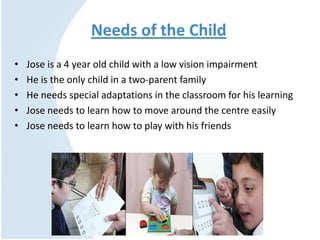
• Jose is a 4 year old child with a low vision impairment
• He is the only child in a two-parent family
• He needs special adaptations in the classroom for his learning
• Jose needs to learn how to move around the centre easily
• Jose needs to learn how to play with his friends
What is Visual Impairment?
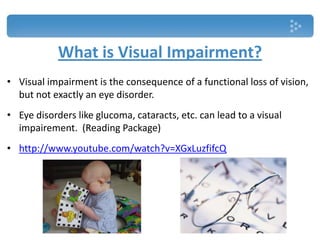
• Visual impairment is the consequence of a functional loss of vision,
but not exactly an eye disorder.
• Eye disorders like glucoma, cataracts, etc. can lead to a visual
impairement. (Reading Package)
• http://www.youtube.com/watch?v=XGxLuzfifcQ
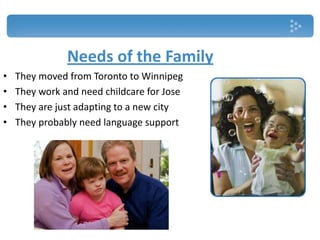
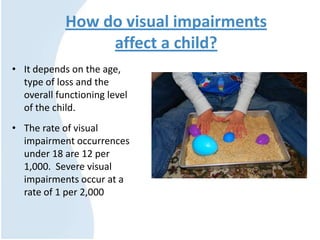
Needs of the Family
• They moved from Toronto to Winnipeg
• They work and need childcare for Jose
• They are just adapting to a new city
• They probably need language support
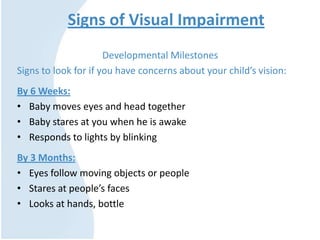
How do visual impairments
affect a child?
• It depends on the age,
type of loss and the
overall functioning level
of the child.
• The rate of visual
impairment occurrences
under 18 are 12 per
1,000. Severe visual
impairments occur at a
rate of 1 per 2,000
Signs of Visual Impairment
Developmental Milestones
Signs to look for if you have concerns about your child’s vision:
By 6 Weeks:
• Baby moves eyes and head together
• Baby stares at you when he is awake
• Responds to lights by blinking
By 3 Months:
• Eyes follow moving objects or people
• Stares at people’s faces
• Looks at hands, bottle
By 6 Months:
• Eyes look for sounds
• Looks for distant objects
• Responds by smiling when you smile to him/her
By 12 Months:
• Eyes move when objects move close to his/her nose
• Watches for long periods of time
By 2 Years:
• Points to people
• Looks where going when walking
http://www.children.govd.on.ca/htdocs/English/topics/earlychildhood/blindne
sslowvision/brochure.aspx
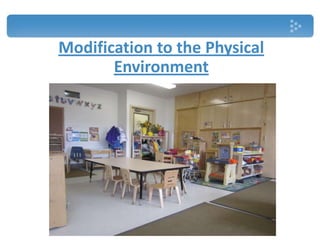
Modification to the Physical
Environment
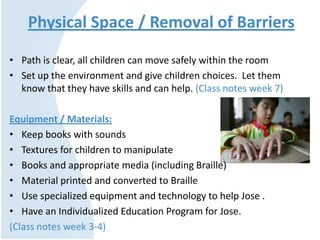
Physical Space / Removal of Barriers
• Path is clear, all children can move safely within the room
• Set up the environment and give children choices. Let them
know that they have skills and can help. (Class notes week 7)
Equipment / Materials:
• Keep books with sounds
• Textures for children to manipulate
• Books and appropriate media (including Braille)
• Material printed and converted to Braille
• Use specialized equipment and technology to help Jose .
• Have an Individualized Education Program for Jose.
(Class notes week 3-4)
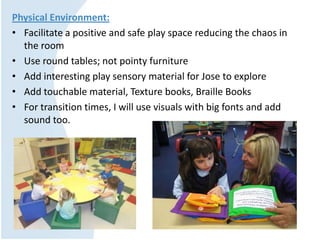
Physical Environment:
• Facilitate a positive and safe play space reducing the chaos in
the room
• Use round tables; not pointy furniture
• Add interesting play sensory material for Jose to explore
• Add touchable material, Texture books, Braille Books
• For transition times, I will use visuals with big fonts and add
sound too.
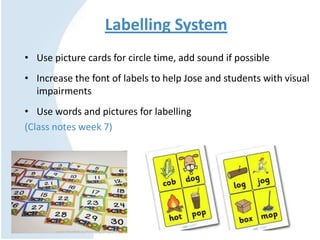
Labelling System
• Use picture cards for circle time, add sound if possible
• Increase the font of labels to help Jose and students with visual
impairments
• Use words and pictures for labelling
(Class notes week 7)
Strategies for Inclusion
• Modeling, questioning and encouraging: I will use the same
strategies as for the rest of the children with some variations
for Jose. For example: say ā€œno eatingā€ instead of saying ā€œusing
gentle handsā€ which is confusing for children with especial
needs.
• Choices: Giving a child the opportunity to be in control of the
environment.
• Praise and Encouragement: Use it too but something different
with Jose for example would be an individualize plan.
• Active Listening: Using open ended questions, and listening to
Jose.
• Peer modeling: Jose can learn from others. For children with
special needs do not use too much information.
(Class notes Week 7)
Teaching Strategies
• Prompting and fading: I have to define the skill that I want to
teach Jose
• Physical, visual pointing
• Reinforcement: Can help the child to stay on task. Should
include social praise and attention. With Jose it is better to
use words than hands to patt his shoulder because he won’t
see it.
• I will start from where Jose's cognitive development is at, and
from there I can plan and set up goals for him.
• Teaching through sensory experimentation is a powerful tool
for children like Jose. His hands are the primary source of
information for himself
• Families and friends can help Jose to develop sensory learning
by providing him with the experiences of smell, touch, taste
and hearing
• Active engagement in playing with the child is helpful as well;
i.e. putting toys on his leg, not his hands
• Letting the child do activities by himself
• Providing real fruits and vegetable can help more than using
plastic ones.
http://kidshealth.org/teen/diseases_conditions/sight/visual_im
pairment.html#
Another teaching strategy would be Adapting play materials:
• To help Jose to develop independence and to be able to
manipulate material in class I will use three strategies
Stabilizing, Enhancing, and Simplifying.
• Stabilizing: Use a tray for example to keep the toys together,
or Velcro to secure them.
• Enhancing: To help Jose or a child with visual impairments to
make parts of toys more accessible, For example add texture
to the toys pushing buttons. Enhance sensory materials by
building up handles to the toys.
• Simplifying: Reduce steps, remove some number of pieces
and replace large toys pieces for small ones.
• Delay in reaching motor milestones
• Can struggle with symbolic social play communication and self
esteem
Task Analysis
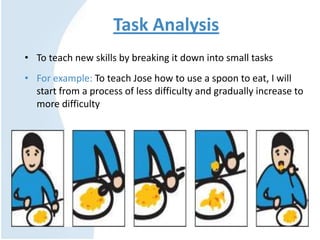
• To teach new skills by breaking it down into small tasks
• For example: To teach Jose how to use a spoon to eat, I will
start from a process of less difficulty and gradually increase to
more difficulty
Adaptive Devices
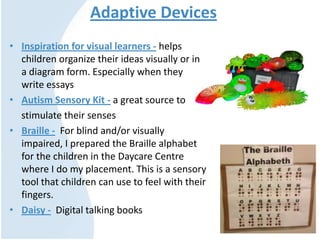
• Inspiration for visual learners - helps
children organize their ideas visually or in
a diagram form. Especially when they
write essays
• Autism Sensory Kit - a great source to
stimulate their senses
• Braille - For blind and/or visually
impaired, I prepared the Braille alphabet
for the children in the Daycare Centre
where I do my placement. This is a sensory
tool that children can use to feel with their
fingers.
• Daisy - Digital talking books
• Kurzweil 1000 - Allows great independence to visually
impaired or blind. It is a software that delivers online books,
magazines, or scanned material using natural sounding
voices to users.
• Zoom Text - For visual impairments it is a device that
enlarges everything in the computer screen.
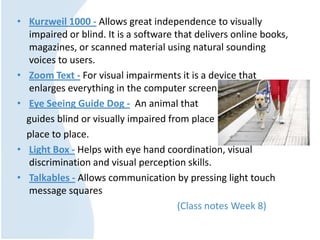
• Eye Seeing Guide Dog - An animal that
guides blind or visually impaired from place
place to place.
• Light Box - Helps with eye hand coordination, visual
discrimination and visual perception skills.
• Talkables - Allows communication by pressing light touch
message squares
(Class notes Week 8)
Professionals that can support Jose, his
family and myself an ECE
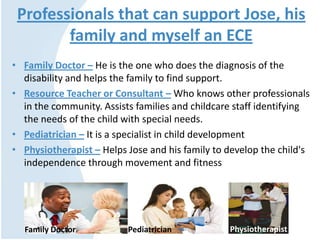
• Family Doctor – He is the one who does the diagnosis of the
disability and helps the family to find support.
• Resource Teacher or Consultant – Who knows other professionals
in the community. Assists families and childcare staff identifying
the needs of the child with special needs.
• Pediatrician – It is a specialist in child development
• Physiotherapist – Helps Jose and his family to develop the child's
independence through movement and fitness
Family Doctor Pediatrician Physiotherapist
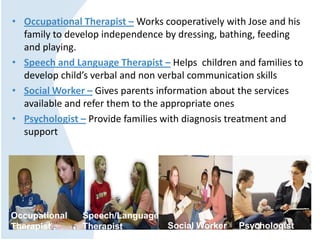
• Occupational Therapist – Works cooperatively with Jose and his
family to develop independence by dressing, bathing, feeding
and playing.
• Speech and Language Therapist – Helps children and families to
develop child’s verbal and non verbal communication skills
• Social Worker – Gives parents information about the services
available and refer them to the appropriate ones
• Psychologist – Provide families with diagnosis treatment and
support
Occupational
Therapist
Speech/Language
Therapist Social Worker Psychologist
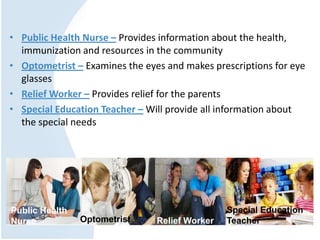
• Public Health Nurse – Provides information about the health,
immunization and resources in the community
• Optometrist – Examines the eyes and makes prescriptions for eye
glasses
• Relief Worker – Provides relief for the parents
• Special Education Teacher – Will provide all information about
the special needs
Public Health
Nurse Optometrist Relief Worker
Special Education
Teacher
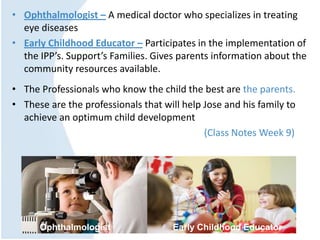
• Ophthalmologist – A medical doctor who specializes in treating
eye diseases
• Early Childhood Educator – Participates in the implementation of
the IPP’s. Support’s Families. Gives parents information about the
community resources available.
• The Professionals who know the child the best are the parents.
• These are the professionals that will help Jose and his family to
achieve an optimum child development
(Class Notes Week 9)
Ophthalmologist Early Childhood Educator
Agencies in the local area where I can
refer this family
Who? Toronto Preschool Speech and Language Services
What? This organization provides three basic services to the
community 1. Preschool Speech and Language
2. Infant – Hearing
3. Blind – Low vision Early
Intervention Program
Where? Tel. (416)338-8255.
When? Monday-Friday. 8:30am-4:30pm
www.tpsis.on.ca
Family Connect for families of children with visual
impairments. It is an online multimedia created for the
blind. It supports parents and refers them to local
resources.(http://afb.org/default.aspx)
---------------------------------------
• Toronto Public Health
• Phone 311
• Phone 416338 7600
• They provide information to families and refer them to
appropriate services
Some other resources: Books and Literature
Essential elements in Early Intervention: Visual Impairment
and Multiple Disabilities
By Deborah Chen
Chidren with Visual Impairments: A Parents’ Guide
By M. Clay Holbrook
(Taken from the Reading Package)
Canadian National Institute for the Blind (CNIB)
www.cnib.ca
This institute provide especialized services within the country.
Vision Institute of Canada
www.vision institute.optometry.net
It is a non –profit clinic that provide services for all especial
needs.
Persons With Disabilities Online
www.pwd-online.ca
Provides services for all persons with disabilities and their
families . (Reading Package)
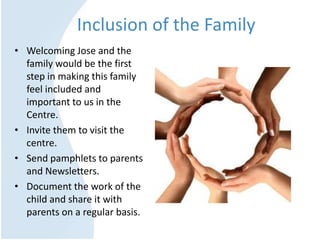
Inclusion of the Family
• Welcoming Jose and the
family would be the first
step in making this family
feel included and
important to us in the
Centre.
• Invite them to visit the
centre.
• Send pamphlets to parents
and Newsletters.
• Document the work of the
child and share it with
parents on a regular basis.
Inclusion of the Family
(Continuation)
• If the parents had English Languages difficulties, I can get
translation services for them.
• I will provide information about the services within the
Centre and the community.
• It is good to inform parents about the modifications done in
the classroom in order to meet their child’s needs.
• Advice parents about some changes needed at home to
better support their child.
• Help parents to integrate to the new life in the city by
refering them to the appropriate services.
Voki
http://www.voki.com/pickup.php?scid=9650238&height=
267&width=200
Animoto
http://animoto.com/play/QhITpRvoYUHc8uPSOmZkvg
Picture References
• https://public.rgfl.org/VisualImpairment/Pages/Referrals.aspx
• http://www.pathstoliteracy.org/sites/pathstoliteracy.perkinsdev1.org/files/styles/full_post_view/public/uploaded-
images/emergent_cropped_0.jpg?itok=OaPMC3iO
• http://drleahyvarinen.com/2011/01/12/development-of-vision-impaired-children-without-other-impairments/
• http://www.ncoes.net/images/Infant%20book.jpg
• http://www.beltina.org/pics/vision_impairment.jpg
• http://www.juniorblind.org/site/infant-early-childhood-program
• http://www.mdschblind.org/statewide_family_support.asp
• http://media-cache-ak0.pinimg.com/736x/d6/e2/d1/d6e2d10d2c81c8b136ff8e99302409a9.jpg
• https://lh5.googleusercontent.com/-RmRiOlKphLo/TYjVqRx3atI/AAAAAAAAAAY/vs2ywrVxiaY/s320/blind+child.jpg
• http://www.laduechapel.org/wp-content/uploads/148.jpg
• http://www.tactilegraphics.co.za/
• http://media-cache-ak0.pinimg.com/736x/58/b7/b4/58b7b4b0fbe0fdf54dbba69d946950ed.jpg
• http://www.twinkl.co.uk/image/resource_preview_large/T-S-202-CVC-Word-Cards-O-for-Visually-Impaired.jpg
• http://connectability.ca/2010/09/23/chaining-and-shaping-behaviour-mastering-and-motivating-the-child-to-learn-the-steps/
• http://www.cheapdisabilityaids.co.uk/ekmps/shops/podcmedia/images/sensory-hamper-medium-479-p.jpg
• http://2.bp.blogspot.com/-twubIuMhDJA/T4aTXM9zbqI/AAAAAAAAAUc/A4Qa3AijNKE/s1600/Assistance-dogs--Blind-wo-010.jpg
• http://www.cbc.ca/news2/pointofview/iStock_doctor%20with%20kid.jpg
• http://www.mamashealth.com/preemie/images/questions.jpg
• http://www.therapiesforkids.com.au/wp-content/uploads/2013/09/Vision-3.jpg
• http://www.eastersealscrossroads.org/files/image/ESC-Occupational-Therapy-Handwriting--1-1-3.jpg
• http://www.thechildrenstherapycenter.com/images/Section-B-Speech-language-T.jpg
• http://savf.co.za/wordpress/wp-content/uploads/2011/04/Social-Worker-Day-1.jpg
• http://0.tqn.com/d/careerplanning/1/0/Q/C/clinical-psychologist.jpg
• http://nursingschoolsdirect.com/wp-content/uploads/Depositphotos_10538720_xs-300x256.jpg
• http://northcoasteyecare.com/wordpress/wp-content/uploads/2012/06/optometrist.jpg
• http://www.thestar.com/content/dam/thestar/static_images/sponsoredsections/giftofgiving/2013/canadianreliefworkersonthefrontline.jpg
• http://www.p12.nysed.gov/specialed/publications/images/teacher.gif
• http://agarwaleyecare.com/images/squint.jpg
• http://3.bp.blogspot.com/-nyNod_azo6Y/UJiTa7D_ebI/AAAAAAAAAiQ/jefknXWfKow/s1600/Early+childhood+education+survey.jpg
• http://www.aislingdiscoveries.on.ca/files/images/tpsls_logo.gif
• http://hr.anu.edu.au/__images/staff-equity/diversity.jpg
References
• http://www.google.ca/url?sa=i&rct=j&q=&esrc=s&source=images&cd=&cad=rja&uact=8&doci
d=snVn4cW4qE65YM&tbnid=ZFCfW5RAjg_gRM:&ved=0CAQQjB0&url=http%3A%2F%2Fwww.s
pecialeducationguide.com%2Fdisability-profiles%2Fvisual-
impairment%2F&ei=hVY3U5OUFI7KsQTwpoGoCg&bvm=bv.63808443,d.aWM&psig=AFQjCNGa
lFrU__2K1Iw3nKtDKQy0XCQuVQ&ust=1396221927341571
• http://www.educationscotland.gov.uk/supportinglearners/additionalsupportneeds/visualimpai
rment/index.asp
• http://www.aph.org/advisory/2007adv12.html
• http://www.ehow.com/about_5439731_types-visual-impairment-children.html
• http://www.speechbuddy.com/blog/legal-issues/navigating-the-early-intervention-process/
• http://www.cleftsmile.org/hearing-vision-resources-and-helpful-information/
• http://www.youtube.com/watch?v=XGxLuzfifcQ
• http://www.children.govd.on.ca/htdocs/English/topics/earlychildhood/blindnesslowvision/bro
chure.aspx
• http://commons.wikimedia.org/wiki/File:FVES_Classroom.jpg
• http://www.tpsls.on.ca/

Jose final copy

  • 1.
    Meeting the Needsof Children with Special Needs By: Stella Osorio
  • 2.
    Case Study :Jose Visual Impairment Inclusion of Children with Special Needs ECEP 233-061 Professor: Lisa McCaie By: Stella Osorio 300686728 Date: April 4-2014
  • 3.
    Needs of theChild • Jose is a 4 year old child with a low vision impairment • He is the only child in a two-parent family • He needs special adaptations in the classroom for his learning • Jose needs to learn how to move around the centre easily • Jose needs to learn how to play with his friends
  • 4.
    What is VisualImpairment? • Visual impairment is the consequence of a functional loss of vision, but not exactly an eye disorder. • Eye disorders like glucoma, cataracts, etc. can lead to a visual impairement. (Reading Package) • http://www.youtube.com/watch?v=XGxLuzfifcQ
  • 5.
    Needs of theFamily • They moved from Toronto to Winnipeg • They work and need childcare for Jose • They are just adapting to a new city • They probably need language support
  • 6.
    How do visualimpairments affect a child? • It depends on the age, type of loss and the overall functioning level of the child. • The rate of visual impairment occurrences under 18 are 12 per 1,000. Severe visual impairments occur at a rate of 1 per 2,000
  • 7.
    Signs of VisualImpairment Developmental Milestones Signs to look for if you have concerns about your child’s vision: By 6 Weeks: • Baby moves eyes and head together • Baby stares at you when he is awake • Responds to lights by blinking By 3 Months: • Eyes follow moving objects or people • Stares at people’s faces • Looks at hands, bottle
  • 8.
    By 6 Months: •Eyes look for sounds • Looks for distant objects • Responds by smiling when you smile to him/her By 12 Months: • Eyes move when objects move close to his/her nose • Watches for long periods of time By 2 Years: • Points to people • Looks where going when walking http://www.children.govd.on.ca/htdocs/English/topics/earlychildhood/blindne sslowvision/brochure.aspx
  • 9.
    Modification to thePhysical Environment
  • 10.
    Physical Space /Removal of Barriers • Path is clear, all children can move safely within the room • Set up the environment and give children choices. Let them know that they have skills and can help. (Class notes week 7) Equipment / Materials: • Keep books with sounds • Textures for children to manipulate • Books and appropriate media (including Braille) • Material printed and converted to Braille • Use specialized equipment and technology to help Jose . • Have an Individualized Education Program for Jose. (Class notes week 3-4)
  • 11.
    Physical Environment: • Facilitatea positive and safe play space reducing the chaos in the room • Use round tables; not pointy furniture • Add interesting play sensory material for Jose to explore • Add touchable material, Texture books, Braille Books • For transition times, I will use visuals with big fonts and add sound too.
  • 12.
    Labelling System • Usepicture cards for circle time, add sound if possible • Increase the font of labels to help Jose and students with visual impairments • Use words and pictures for labelling (Class notes week 7)
  • 13.
    Strategies for Inclusion •Modeling, questioning and encouraging: I will use the same strategies as for the rest of the children with some variations for Jose. For example: say ā€œno eatingā€ instead of saying ā€œusing gentle handsā€ which is confusing for children with especial needs. • Choices: Giving a child the opportunity to be in control of the environment. • Praise and Encouragement: Use it too but something different with Jose for example would be an individualize plan. • Active Listening: Using open ended questions, and listening to Jose. • Peer modeling: Jose can learn from others. For children with special needs do not use too much information. (Class notes Week 7)
  • 14.
    Teaching Strategies • Promptingand fading: I have to define the skill that I want to teach Jose • Physical, visual pointing • Reinforcement: Can help the child to stay on task. Should include social praise and attention. With Jose it is better to use words than hands to patt his shoulder because he won’t see it. • I will start from where Jose's cognitive development is at, and from there I can plan and set up goals for him. • Teaching through sensory experimentation is a powerful tool for children like Jose. His hands are the primary source of information for himself
  • 15.
    • Families andfriends can help Jose to develop sensory learning by providing him with the experiences of smell, touch, taste and hearing • Active engagement in playing with the child is helpful as well; i.e. putting toys on his leg, not his hands • Letting the child do activities by himself • Providing real fruits and vegetable can help more than using plastic ones. http://kidshealth.org/teen/diseases_conditions/sight/visual_im pairment.html#
  • 16.
    Another teaching strategywould be Adapting play materials: • To help Jose to develop independence and to be able to manipulate material in class I will use three strategies Stabilizing, Enhancing, and Simplifying. • Stabilizing: Use a tray for example to keep the toys together, or Velcro to secure them. • Enhancing: To help Jose or a child with visual impairments to make parts of toys more accessible, For example add texture to the toys pushing buttons. Enhance sensory materials by building up handles to the toys. • Simplifying: Reduce steps, remove some number of pieces and replace large toys pieces for small ones. • Delay in reaching motor milestones • Can struggle with symbolic social play communication and self esteem
  • 17.
    Task Analysis • Toteach new skills by breaking it down into small tasks • For example: To teach Jose how to use a spoon to eat, I will start from a process of less difficulty and gradually increase to more difficulty
  • 18.
    Adaptive Devices • Inspirationfor visual learners - helps children organize their ideas visually or in a diagram form. Especially when they write essays • Autism Sensory Kit - a great source to stimulate their senses • Braille - For blind and/or visually impaired, I prepared the Braille alphabet for the children in the Daycare Centre where I do my placement. This is a sensory tool that children can use to feel with their fingers. • Daisy - Digital talking books
  • 19.
    • Kurzweil 1000- Allows great independence to visually impaired or blind. It is a software that delivers online books, magazines, or scanned material using natural sounding voices to users. • Zoom Text - For visual impairments it is a device that enlarges everything in the computer screen. • Eye Seeing Guide Dog - An animal that guides blind or visually impaired from place place to place. • Light Box - Helps with eye hand coordination, visual discrimination and visual perception skills. • Talkables - Allows communication by pressing light touch message squares (Class notes Week 8)
  • 20.
    Professionals that cansupport Jose, his family and myself an ECE • Family Doctor – He is the one who does the diagnosis of the disability and helps the family to find support. • Resource Teacher or Consultant – Who knows other professionals in the community. Assists families and childcare staff identifying the needs of the child with special needs. • Pediatrician – It is a specialist in child development • Physiotherapist – Helps Jose and his family to develop the child's independence through movement and fitness Family Doctor Pediatrician Physiotherapist
  • 21.
    • Occupational Therapist– Works cooperatively with Jose and his family to develop independence by dressing, bathing, feeding and playing. • Speech and Language Therapist – Helps children and families to develop child’s verbal and non verbal communication skills • Social Worker – Gives parents information about the services available and refer them to the appropriate ones • Psychologist – Provide families with diagnosis treatment and support Occupational Therapist Speech/Language Therapist Social Worker Psychologist
  • 22.
    • Public HealthNurse – Provides information about the health, immunization and resources in the community • Optometrist – Examines the eyes and makes prescriptions for eye glasses • Relief Worker – Provides relief for the parents • Special Education Teacher – Will provide all information about the special needs Public Health Nurse Optometrist Relief Worker Special Education Teacher
  • 23.
    • Ophthalmologist –A medical doctor who specializes in treating eye diseases • Early Childhood Educator – Participates in the implementation of the IPP’s. Support’s Families. Gives parents information about the community resources available. • The Professionals who know the child the best are the parents. • These are the professionals that will help Jose and his family to achieve an optimum child development (Class Notes Week 9) Ophthalmologist Early Childhood Educator
  • 24.
    Agencies in thelocal area where I can refer this family Who? Toronto Preschool Speech and Language Services What? This organization provides three basic services to the community 1. Preschool Speech and Language 2. Infant – Hearing 3. Blind – Low vision Early Intervention Program Where? Tel. (416)338-8255. When? Monday-Friday. 8:30am-4:30pm www.tpsis.on.ca
  • 25.
    Family Connect forfamilies of children with visual impairments. It is an online multimedia created for the blind. It supports parents and refers them to local resources.(http://afb.org/default.aspx) --------------------------------------- • Toronto Public Health • Phone 311 • Phone 416338 7600 • They provide information to families and refer them to appropriate services
  • 26.
    Some other resources:Books and Literature Essential elements in Early Intervention: Visual Impairment and Multiple Disabilities By Deborah Chen Chidren with Visual Impairments: A Parents’ Guide By M. Clay Holbrook (Taken from the Reading Package)
  • 27.
    Canadian National Institutefor the Blind (CNIB) www.cnib.ca This institute provide especialized services within the country. Vision Institute of Canada www.vision institute.optometry.net It is a non –profit clinic that provide services for all especial needs. Persons With Disabilities Online www.pwd-online.ca Provides services for all persons with disabilities and their families . (Reading Package)
  • 28.
    Inclusion of theFamily • Welcoming Jose and the family would be the first step in making this family feel included and important to us in the Centre. • Invite them to visit the centre. • Send pamphlets to parents and Newsletters. • Document the work of the child and share it with parents on a regular basis.
  • 29.
    Inclusion of theFamily (Continuation) • If the parents had English Languages difficulties, I can get translation services for them. • I will provide information about the services within the Centre and the community. • It is good to inform parents about the modifications done in the classroom in order to meet their child’s needs. • Advice parents about some changes needed at home to better support their child. • Help parents to integrate to the new life in the city by refering them to the appropriate services.
  • 30.
  • 31.
    Picture References • https://public.rgfl.org/VisualImpairment/Pages/Referrals.aspx •http://www.pathstoliteracy.org/sites/pathstoliteracy.perkinsdev1.org/files/styles/full_post_view/public/uploaded- images/emergent_cropped_0.jpg?itok=OaPMC3iO • http://drleahyvarinen.com/2011/01/12/development-of-vision-impaired-children-without-other-impairments/ • http://www.ncoes.net/images/Infant%20book.jpg • http://www.beltina.org/pics/vision_impairment.jpg • http://www.juniorblind.org/site/infant-early-childhood-program • http://www.mdschblind.org/statewide_family_support.asp • http://media-cache-ak0.pinimg.com/736x/d6/e2/d1/d6e2d10d2c81c8b136ff8e99302409a9.jpg • https://lh5.googleusercontent.com/-RmRiOlKphLo/TYjVqRx3atI/AAAAAAAAAAY/vs2ywrVxiaY/s320/blind+child.jpg • http://www.laduechapel.org/wp-content/uploads/148.jpg • http://www.tactilegraphics.co.za/ • http://media-cache-ak0.pinimg.com/736x/58/b7/b4/58b7b4b0fbe0fdf54dbba69d946950ed.jpg • http://www.twinkl.co.uk/image/resource_preview_large/T-S-202-CVC-Word-Cards-O-for-Visually-Impaired.jpg • http://connectability.ca/2010/09/23/chaining-and-shaping-behaviour-mastering-and-motivating-the-child-to-learn-the-steps/ • http://www.cheapdisabilityaids.co.uk/ekmps/shops/podcmedia/images/sensory-hamper-medium-479-p.jpg • http://2.bp.blogspot.com/-twubIuMhDJA/T4aTXM9zbqI/AAAAAAAAAUc/A4Qa3AijNKE/s1600/Assistance-dogs--Blind-wo-010.jpg • http://www.cbc.ca/news2/pointofview/iStock_doctor%20with%20kid.jpg • http://www.mamashealth.com/preemie/images/questions.jpg • http://www.therapiesforkids.com.au/wp-content/uploads/2013/09/Vision-3.jpg • http://www.eastersealscrossroads.org/files/image/ESC-Occupational-Therapy-Handwriting--1-1-3.jpg • http://www.thechildrenstherapycenter.com/images/Section-B-Speech-language-T.jpg • http://savf.co.za/wordpress/wp-content/uploads/2011/04/Social-Worker-Day-1.jpg • http://0.tqn.com/d/careerplanning/1/0/Q/C/clinical-psychologist.jpg • http://nursingschoolsdirect.com/wp-content/uploads/Depositphotos_10538720_xs-300x256.jpg • http://northcoasteyecare.com/wordpress/wp-content/uploads/2012/06/optometrist.jpg • http://www.thestar.com/content/dam/thestar/static_images/sponsoredsections/giftofgiving/2013/canadianreliefworkersonthefrontline.jpg • http://www.p12.nysed.gov/specialed/publications/images/teacher.gif • http://agarwaleyecare.com/images/squint.jpg • http://3.bp.blogspot.com/-nyNod_azo6Y/UJiTa7D_ebI/AAAAAAAAAiQ/jefknXWfKow/s1600/Early+childhood+education+survey.jpg • http://www.aislingdiscoveries.on.ca/files/images/tpsls_logo.gif • http://hr.anu.edu.au/__images/staff-equity/diversity.jpg
  • 32.
    References • http://www.google.ca/url?sa=i&rct=j&q=&esrc=s&source=images&cd=&cad=rja&uact=8&doci d=snVn4cW4qE65YM&tbnid=ZFCfW5RAjg_gRM:&ved=0CAQQjB0&url=http%3A%2F%2Fwww.s pecialeducationguide.com%2Fdisability-profiles%2Fvisual- impairment%2F&ei=hVY3U5OUFI7KsQTwpoGoCg&bvm=bv.63808443,d.aWM&psig=AFQjCNGa lFrU__2K1Iw3nKtDKQy0XCQuVQ&ust=1396221927341571 • http://www.educationscotland.gov.uk/supportinglearners/additionalsupportneeds/visualimpai rment/index.asp •http://www.aph.org/advisory/2007adv12.html • http://www.ehow.com/about_5439731_types-visual-impairment-children.html • http://www.speechbuddy.com/blog/legal-issues/navigating-the-early-intervention-process/ • http://www.cleftsmile.org/hearing-vision-resources-and-helpful-information/ • http://www.youtube.com/watch?v=XGxLuzfifcQ • http://www.children.govd.on.ca/htdocs/English/topics/earlychildhood/blindnesslowvision/bro chure.aspx • http://commons.wikimedia.org/wiki/File:FVES_Classroom.jpg • http://www.tpsls.on.ca/