© 2020 LNS Research
OPERATIONAL
EXCELLENCE 4.0
AND THE AUTONOMOUS
PLANT10-11NOV2020
© 2020 LNS Research
AGENDA
• Industry Trends and Challenges
• Re-Defining OE
• Operationalizing OE
• OE and Autonomy
• Recommendations and Summary
© 2020 LNS Research
INDUSTRY TRENDS AND CHALLENGES
3
© 2020 LNS Research
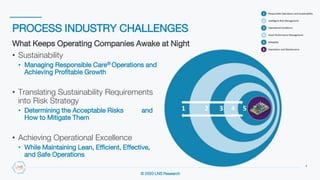
PROCESS INDUSTRY CHALLENGES
4
• Sustainability
• Managing Responsible Care® Operations and
Achieving Profitable Growth
• Translating Sustainability Requirements
into Risk Strategy
• Determining the Acceptable Risks and
How to Mitigate Them
• Achieving Operational Excellence
• While Maintaining Lean, Efficient, Effective,
and Safe Operations
What Keeps Operating Companies Awake at Night
© 2020 LNS Research
MAJOR INDUSTRY TRENDS
5
COVID-19 Only Accelerating the Changes in the Way the Work is Done
1. Industry 4.0 / Smart Manufacturing
• Enabled by Disruptive Digital Technologies
2. Workforce Challenges
• Turnover, Retirements, Millennials … Knowledge Loss Increasing
• Connected Worker ► Safer, More Efficient, Highly Skilled Workforce
3. IT Coming to OT in a Big Way
• Virtualization, Containerization, Scaling, DevOps, DataOps, Open Systems, Software > Hardware
• IT/OT Convergence … New Organizational and Collaborative Models
4. New Operational Architecture and OT Ecosystem
• Compression of ISA 95 Layers
• Data Democracy ► Data Ops, Shared Access, Openness, Transparency, Context, Relevance
© 2020 LNS Research
RESULT …. INDUSTRY IS DEFINING NEW GOALS
6
Can We Achieve Remote and Autonomous Operations?
• To answer those questions, LNS decided to revisit what it means to
be operationally excellent … and how it relates to risk management,
performance maximization and the autonomous plant
Thus We Will Address
• What is OE 4.0? New Definition, Drivers and Challenges
• Need for an Integrated OE Execution system
• Autonomous Plant Maturity Model and Characteristics
• What Will It Take To Get There
© 2020 LNS Research
DEFINING OPERATIONAL EXCELLENCE
7
© 2020 LNS Research
LNS FOCUSED ON OE NOT LONG AFTER INCEPTION
8
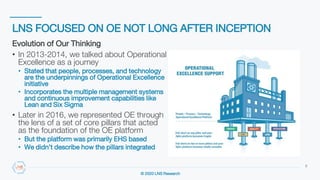
• In 2013-2014, we talked about Operational
Excellence as a journey
• Stated that people, processes, and technology
are the underpinnings of Operational Excellence
initiative
• Incorporates the multiple management systems
and continuous improvement capabilities like
Lean and Six Sigma
• Later in 2016, we represented OE through
the lens of a set of core pillars that acted
as the foundation of the OE platform
• But the platform was primarily EHS based
• We didn’t describe how the pillars integrated
Evolution of Our Thinking
© 2020 LNS Research
SO WHAT IS OPERATIONAL EXCELLENCE?
9
Many Definitions … Lots of What It Is … But Little on “How to Do It”
• Industrie 3.0 definition mainly echoes Continuous Improvement initiatives
• Arising from the discrete industries …. Lean, Six Sigma, Kaizen
• McKinsey
• “The execution of the business strategy more consistently and reliably than the competition.”
• Business Dictionary
• “A philosophy of the workplace where problem-solving, teamwork, and
leadership results in the ongoing improvement in an organization.”
• DuPont
• “OE is the application of principles, systems, and tools to engage and focus everyone’s efforts on
meeting customer needs and continuously improving process performance. It focuses on minimizing and
managing downside risks while maximizing an operation’s performance and shareholder value.”
© 2020 LNS Research
WHY DUPONT’S DEFINITION IS IMPORTANT
10
• The Critical Role of Leadership
• Leading by doing; setting the example; getting
your hands dirty too
• Focus on Operational Discipline (OD)
• By OD, we mean the “deeply rooted dedication
and commitment by every member of the
organization to carry out each task the
right way every time.”
• Speaks to culture and workforce capabilities
• Focus on Positive Outcomes
• Lower Risk
• Maximized Operational Performance
• More Satisfied Customers
• Increased Shareholder Value
Three Overlooked Concepts Critical to OE
© 2020 LNS Research
OPERATIONAL DISCIPLINE ISN’T A NEW CONCEPT
11
• “Conduct of Operations (CoO) is the execution
of operational and management tasks in a
deliberate and structured manner.
• It is also sometimes called “Operational
Discipline” or “Formality of Operations.”
• Calls for an Operational Excellence Management
System (OEMS)
• Requires a culture of OD that drives:
• the understanding of,
• the adherence to,
• the questioning of,
• and the enforcement of the OEMS
Originated in 2011 from the Center for Chemical Process Safety (CCPS)
© 2020 LNS Research
OE 3.0 VS. OE 4.0
12
Roots of OE 4.0
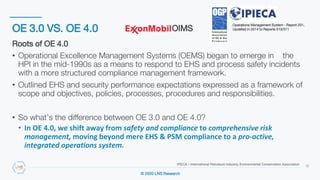
• Operational Excellence Management Systems (OEMS) began to emerge in the
HPI in the mid-1990s as a means to respond to EHS and process safety incidents
with a more structured compliance management framework.
• Outlined EHS and security performance expectations expressed as a framework of
scope and objectives, policies, processes, procedures and responsibilities.
• So what’s the difference between OE 3.0 and OE 4.0?
• In OE 4.0, we shift away from safety and compliance to comprehensive risk
management, moving beyond mere EHS & PSM compliance to a pro-active,
integrated operations system.
OIMS
Operations Management System - Report 201,
Updated in 2014 to Reports 510/511
IPIECA = International Petroleum Industry, Environmental Conservation Association
© 2020 LNS Research
INSTITUTE FOR OPERATIONAL EXCELLENCE
13
Describes OE as a Journey of Continuous Improvement
• Where “each and every employee can see the flow of value
to the customer and fix that flow before it breaks down.”
• By defining Operational Excellence in this way, it applies to every level and
every person in the organization, from executives all the way down to the
employees producing the product or service.
• It’s clear, concise, practical, and, most importantly, actionable and teachable.
Everyone in the organization “gets it.” They know that, in their respective areas,
there should be a visible flow of product or information.
• They should be able to recognize if that flow is normal or abnormal and what to
do if it is abnormal, all without requiring the assistance of management.”
© 2020 LNS Research
SO WHAT DEFINITION CAN WE LAND ON?
14
Key Characteristics
• Means to deliver on the company’s strategy
• Journey toward value creation for the company and its customers
• Holistic flow of production and information
• Cross-functional … integrates the pillars and silos
• Inclusive of Continuous Improvement and Innovation processes and tools
• Proactive not just reactive … help to score results, not just be a scorekeeper
• Leverages new digital technologies
• Clear, concise, practical, actionable, measurable, and teachable = SMART*
• Lower operational risk, lower operating costs, profitable growth, and higher customer satisfaction
• Human performance, skills, culture and discipline are critical components
*SMART = Specific, Measurable, Achievable, Relevant, and Time-bound
© 2020 LNS Research
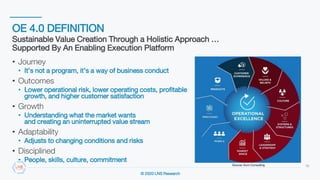
OE 4.0 DEFINITION
15
• Journey
• It’s not a program, it’s a way of business conduct
• Outcomes
• Lower operational risk, lower operating costs, profitable
growth, and higher customer satisfaction
• Growth
• Understanding what the market wants
and creating an uninterrupted value stream
• Adaptability
• Adjusts to changing conditions and risks
• Disciplined
• People, skills, culture, commitment
Sustainable Value Creation Through a Holistic Approach …
Supported By An Enabling Execution Platform
Source: Korn Consulting
© 2020 LNS Research
OPERATIONALIZING OE
16
© 2020 LNS Research
BARRIERS TO OE 4.0
17
Organizational, Process and Technical
• Organizational
• How to organize around OE, not just by departments and functions
• IT/OT and Other Support Convergence
• Empowering teams closest to the operations with decision-making authority i.e. holacracy
• Process
• Understanding the integrated workflows and dynamic management of change
• Identifying the opportunities for improvement, innovation and automation
• Technical
• Getting the Ecosystem data architecture right …
• Defining and implementing the execution platform … EHS + Quality + EAM + APM + HCM …
• Defining the right performance metrics, amongst the plethora of existing ones
• Rip & Replace vs. Phase-in
• On-premise vs. Cloud vs. mobile
© 2020 LNS Research
WORKFLOWS TOUCH MULTIPLE SYSTEMS
18
Integration and Interoperability Are Necessary to Drive Efficient and
Effective Execution and Provide Visibility to Current Operations
APM 4.0
Digital Twins
EAM System
ERPHistorian
Asset Strategy
PSI / Document
Task / Compliance
Procedure
Asset Health
Operator Logs /
Shift Handover
Work Request /
Work Order
Management of
Change (MoC)
Corrective Action
(CAPA)
Incident
Work Permits
Tag / Event / IOW
Operator
Rounds
Asset
Condition
Findings
Need
Change
Need Non-
Work Order
Corrective
Action
Monitoring
Reference Document
Execution of Task
/ Monitoring
Mobile Procedure
Over the Limit
Data Collection
Mobility
Platform
APM 4.0
Failure Modes Library
3D Engineering /
Content Management
Best Practice
Processes & Procedures
Content Management
Process Historian
EHS System
Parts Inventory
Purchase Order
P.O.
Request
Real-Time Data
Events
Need
Repair
© 2020 LNS Research
OE INTEGRATED EXECUTION SYSTEM
19
Winning Characteristics
• Integrated Workflows and Visualization
• Single system for OE
• Outcome-based Metrics
• Not just OEE, but e.g. production losses
• Comprehensive Risk Management
• As-Is and AI/ML predictive capabilities
• Content, Best Practices and Templates
• Enables rapid implementation
• Modular and Interoperable
• Permits co-existence with other applications
• Allows for phased implementation
• Customizable for innovation
• Easy integration with other mfg. systems
© 2020 LNS Research
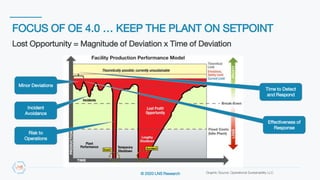
FOCUS OF OE 4.0 … KEEP THE PLANT ON SETPOINT
20
Lost Opportunity = Magnitude of Deviation x Time of Deviation
Minor Deviations
Risk to
Operations
Incident
Avoidance
Graphic Source: Operational Sustainability LLC
Time to Detect
and Respond
Effectiveness of
Response
© 2020 LNS Research
GETTING THERE
21
Various Approaches
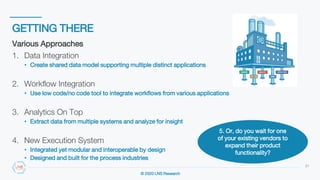
1. Data Integration
• Create shared data model supporting multiple distinct applications
2. Workflow Integration
• Use low code/no code tool to integrate workflows from various applications
3. Analytics On Top
• Extract data from multiple systems and analyze for insight
4. New Execution System
• Integrated yet modular and interoperable by design
• Designed and built for the process industries
5. Or, do you wait for one
of your existing vendors to
expand their product
functionality?
© 2020 LNS Research
SO WHY CHANGE YOUR OE APPROACH?
22
Drivers for Change
• Reduced Operating Risk and
Safer Operations
• Industry incidents on the rise
• Don’t just see where you are, see
where you are going
• Reduced Downtime and
Performance Maximization
• Faster problem identification
• Faster response
• Operational Discipline
• Silo’ed systems don’t support
collaboration and teamwork
• With fewer people on site, workforce
efficiency and effectiveness is critical
The past two years (2018-2019) has been another turbulent period for
the energy industry, with an unusually high number of large losses.”
“The very best sites, with the most mature process safety cultures, have
consistently shown it is possible to run a facility without losses across the
duration of their lifespan, and across a range of external regulatory
standards and oil prices.” Marsh 100LL 1974-2019
The best operators save 10+% on insurance bills
Even with the right maintenance strategies and inspection program, inefficient
response produces production losses and quality issues, as reflected in the
usual performance metrics: throughput, yield, conversion, capacity, utilization,
energy, quality, emissions, inventory carrying cost, promised delivery, etc.
Look for 2%-5% improvement, in some measures potentially more.
Productivity suffers when efforts are wasted and often redundant. Systems
must facilitate doing the right task the right way every time.
Anticipate a 10%-30% improvement.
© 2020 LNS Research
OE, PERFORMANCE OPTIMIZATION AND AUTONOMY
23
© 2020 LNS Research
WHAT IS AUTONOMY?
24
Definitions Vary
• Watson & Scheidt (2005) “Systems that – without manual (human) intervention –
can change their behavior in response to unanticipated events during operation.”
• Don’t confuse autonomy with an automation system which “performs defined instructions
within a limited scope of operation.”
• Key Characteristics:
• Self-controlling … more than automation, both controls and adapts
• Self-managing … automates decisions, maintains and optimizes itself …
• Self-learning … improves over time
• But remember … autonomous systems are not sentient
• One still has to give the system goals and objectives, and specify constraints and boundaries
© 2020 LNS Research
DOES PERFORMANCE OPTIMIZATION = AUTONOMY?
25
Not Quite …. But It Is the Plant’s Gas Pedal and It’s Well On Its Way to AO
Challenges
• Integration
• Workflows
• Visualization
• Move to Cloud
• Infusion of AI/ML
• Support Model
• Remote Operations
• Company vs. Vendor
Data
Reconciliation
Production
Accounting
Model
Rigorous/Hybrid
Planning
Scheduling Optimization
APC APC APC
Process Historian
Control Systems
ERP
Raw Material Selection
Production Targets
Operating Targets & Timing
Logistics Plan & Timing
Corrected Model
Corrected
Data
Raw
Data
Trading &
Hedging
Demand Forecasting
Contractualization
Markets
© 2020 LNS Research
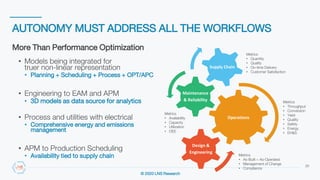
AUTONOMY MUST ADDRESS ALL THE WORKFLOWS
26
• Models being integrated for
truer non-linear representation
• Planning + Scheduling + Process + OPT/APC
• Engineering to EAM and APM
• 3D models as data source for analytics
• Process and utilities with electrical
• Comprehensive energy and emissions
management
• APM to Production Scheduling
• Availability tied to supply chain
More Than Performance Optimization
Operations
Maintenance
& Reliability
Supply Chain
Metrics
• Quantity
• Quality
• On-time Delivery
• Customer Satisfaction
Metrics
• Availability
• Capacity
• Utilization
• OEE
Metrics
• Throughput
• Conversion
• Yield
• Quality
• Safety
• Energy
• EH&S
Design &
Engineering
Metrics
• As-Built = As-Operated
• Management of Change
• Compliance
© 2020 LNS Research
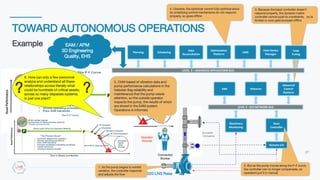
Basic
Controller
3. Because the basic controller doesn't
respond properly, the dynamic matrix
controller cannot push to constraints, so is
limited or even gets bumped offline
2. But as the pump moves along the P-F curve,
the controller can no longer compensate, so
operators put it in manual
TOWARD AUTONOMOUS OPERATIONS
27
Example
LEVEL 2 - DCS NETWORK BUS
Advanced
Control
Platform
LEVEL 3 – ADVANCED APPLICATIONS BUS
Remote I/O
Smart Instruments
Drives, and Actuators
Historian
Machinery
Monitoring
Connected
Worker
FT
CV
Operator
Rounds
HMI
1. As the pump begins to exhibit
variation, the controller responds
and adjusts the flow
4. Likewise, the optimizer cannot fully optimize since
its underlying control mechanisms do not respond
properly, so goes offline
5. CbM-based of vibration data and
pump performance calculations in the
historian flag reliability and
maintenance that the pump needs
attention, so the outside operator
inspects the pump, the results of which
are stored in the EAM system.
Operations is informed.
6. How can only a few personnel
analyze and understand all these
relationships across literally what
could be hundreds of critical assets,
across so many disparate systems,
in just one plant?
? ?
EAM / APM
3D Engineering
Quality, EHS
LIMS
Optimization
Platform
Field Device
Manager
Planning Scheduling
Data
Reconciliation
Loop
Tuning
© 2020 LNS Research
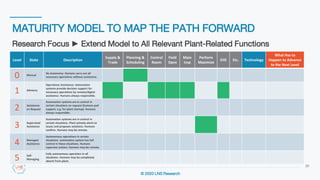
MATURITY MODEL TO MAP THE PATH FORWARD
28
Research Focus ► Extend Model to All Relevant Plant-Related Functions
Level State Description
Supply &
Trade
Planning &
Scheduling
Control
Room
Field
Opns
Main
Insp
Perform
Maximize
EHS Etc. Technology
What Has to
Happen to Advance
to the Next Level
0 Manual
No Autonomy: Humans carry out all
necessary operations without assistance.
1 Advisory
Operations Assistance: Automation
systems provide decision support for
necessary operations by remote/digital
assistance. Humans always responsible.
2 Assistance
on Request
Automation systems are in control in
certain situations on request (humans pull
support, e.g. for plant startup). Humans
always responsible.
3 Supervised
Assistance
Automation systems are in control in
certain situations. Plant actively alerts to
issues and proposes solutions. Humans

confirm. Humans may be remote.
4 Managed
Assistance
Autonomous operations in certain
situations: automation system has full
control in these situations. Humans
supervise actions. Humans may be remote.
5 Self-
Managing
Fully autonomous operation in all
situations. Humans may be completely
absent from plant.
© 2020 LNS Research
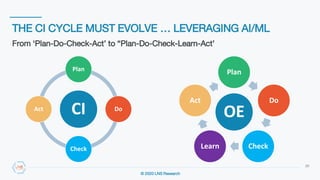
THE CI CYCLE MUST EVOLVE … LEVERAGING AI/ML
29
CI
Plan
Do
Check
Act
Plan
Do
CheckLearn
Act
From ‘Plan-Do-Check-Act’ to “Plan-Do-Check-Learn-Act’
OE
© 2020 LNS Research
SUMMARY AND RECOMMENDATIONS
30
© 2020 LNS Research
THE PATH TO AUTONOMY FLOWS THROUGH OE 4.0
31
You Must Have An OE Strategy Enabled By An Integrated Execution System
• Workflows must reflect how the work is actually done … not just by silos
• Identify opportunities for cross-functional innovation and automation
• Software and system must be evenb-driven
• The right foundational architecture and infrastructure elements must be in place
• IT’s challenge, along with OT, is to build the value chain highway upon which supply chain, operations and
their supporting functions can navigate
• We’ll see robotics, drones, video, blockchain and robotic process automation in the mix too
• Prediction … autonomy will drive IT and OT to merge into simply “T”
• Remember software can be made to support collaboration in ways
that hierarchical organizational reporting structures cannot do
• Solutions must be organized around problem identification and solving
• Technology ultimately will not be the limiting factor … change management will be … and always is
© 2020 LNS Research
AUTONOMY WILL NOT OCCUR IN A GIANT LEAP
32
Instead Autonomy Will Occur in Phases Over Time
• Knowledge management and learning systems are keys to autonomy
• Yes this means AI/ML, but also collaborative/learning systems directed at the frontline workforce
• Autonomy should support holacratic* organizations
• Invest in and build trust in your frontline people, and the systems
which support them
• When your team members are asked who does one report to, the
answer should be “it depends on what problem we are solving.”
• Not all companies or industries will autonomize to the same degree or at the same rate
• Companies need to set their own targets commensurate with their trust levels and risk management
• Both vendors and owner/operators must work together to build out the maturity model to shine the light on the
path forward
*Holacracy is a new way of structuring
and running your organization that
replaces the conventional management
hierarchy. Instead of operating top-
down, power is distributed throughout
the organization – giving individuals and
teams freedom to solve problems while
staying aligned to the organization's
purpose.
© 2020 LNS Research
STAY TUNED FOR MORE FROM LNS
THANK YOU
33

OE 4.0 and the Autonomous Plant

  • 1.
    © 2020 LNSResearch OPERATIONAL EXCELLENCE 4.0 AND THE AUTONOMOUS PLANT10-11NOV2020
  • 2.
    © 2020 LNSResearch AGENDA • Industry Trends and Challenges • Re-Defining OE • Operationalizing OE • OE and Autonomy • Recommendations and Summary
  • 3.
    © 2020 LNSResearch INDUSTRY TRENDS AND CHALLENGES 3
  • 4.
    © 2020 LNSResearch PROCESS INDUSTRY CHALLENGES 4 • Sustainability • Managing Responsible Care® Operations and Achieving Profitable Growth • Translating Sustainability Requirements into Risk Strategy • Determining the Acceptable Risks and How to Mitigate Them • Achieving Operational Excellence • While Maintaining Lean, Efficient, Effective, and Safe Operations What Keeps Operating Companies Awake at Night
  • 5.
    © 2020 LNSResearch MAJOR INDUSTRY TRENDS 5 COVID-19 Only Accelerating the Changes in the Way the Work is Done 1. Industry 4.0 / Smart Manufacturing • Enabled by Disruptive Digital Technologies 2. Workforce Challenges • Turnover, Retirements, Millennials … Knowledge Loss Increasing • Connected Worker ► Safer, More Efficient, Highly Skilled Workforce 3. IT Coming to OT in a Big Way • Virtualization, Containerization, Scaling, DevOps, DataOps, Open Systems, Software > Hardware • IT/OT Convergence … New Organizational and Collaborative Models 4. New Operational Architecture and OT Ecosystem • Compression of ISA 95 Layers • Data Democracy ► Data Ops, Shared Access, Openness, Transparency, Context, Relevance
  • 6.
    © 2020 LNSResearch RESULT …. INDUSTRY IS DEFINING NEW GOALS 6 Can We Achieve Remote and Autonomous Operations? • To answer those questions, LNS decided to revisit what it means to be operationally excellent … and how it relates to risk management, performance maximization and the autonomous plant Thus We Will Address • What is OE 4.0? New Definition, Drivers and Challenges • Need for an Integrated OE Execution system • Autonomous Plant Maturity Model and Characteristics • What Will It Take To Get There
  • 7.
    © 2020 LNSResearch DEFINING OPERATIONAL EXCELLENCE 7
  • 8.
    © 2020 LNSResearch LNS FOCUSED ON OE NOT LONG AFTER INCEPTION 8 • In 2013-2014, we talked about Operational Excellence as a journey • Stated that people, processes, and technology are the underpinnings of Operational Excellence initiative • Incorporates the multiple management systems and continuous improvement capabilities like Lean and Six Sigma • Later in 2016, we represented OE through the lens of a set of core pillars that acted as the foundation of the OE platform • But the platform was primarily EHS based • We didn’t describe how the pillars integrated Evolution of Our Thinking
  • 9.
    © 2020 LNSResearch SO WHAT IS OPERATIONAL EXCELLENCE? 9 Many Definitions … Lots of What It Is … But Little on “How to Do It” • Industrie 3.0 definition mainly echoes Continuous Improvement initiatives • Arising from the discrete industries …. Lean, Six Sigma, Kaizen • McKinsey • “The execution of the business strategy more consistently and reliably than the competition.” • Business Dictionary • “A philosophy of the workplace where problem-solving, teamwork, and leadership results in the ongoing improvement in an organization.” • DuPont • “OE is the application of principles, systems, and tools to engage and focus everyone’s efforts on meeting customer needs and continuously improving process performance. It focuses on minimizing and managing downside risks while maximizing an operation’s performance and shareholder value.”
  • 10.
    © 2020 LNSResearch WHY DUPONT’S DEFINITION IS IMPORTANT 10 • The Critical Role of Leadership • Leading by doing; setting the example; getting your hands dirty too • Focus on Operational Discipline (OD) • By OD, we mean the “deeply rooted dedication and commitment by every member of the organization to carry out each task the right way every time.” • Speaks to culture and workforce capabilities • Focus on Positive Outcomes • Lower Risk • Maximized Operational Performance • More Satisfied Customers • Increased Shareholder Value Three Overlooked Concepts Critical to OE
  • 11.
    © 2020 LNSResearch OPERATIONAL DISCIPLINE ISN’T A NEW CONCEPT 11 • “Conduct of Operations (CoO) is the execution of operational and management tasks in a deliberate and structured manner. • It is also sometimes called “Operational Discipline” or “Formality of Operations.” • Calls for an Operational Excellence Management System (OEMS) • Requires a culture of OD that drives: • the understanding of, • the adherence to, • the questioning of, • and the enforcement of the OEMS Originated in 2011 from the Center for Chemical Process Safety (CCPS)
  • 12.
    © 2020 LNSResearch OE 3.0 VS. OE 4.0 12 Roots of OE 4.0 • Operational Excellence Management Systems (OEMS) began to emerge in the HPI in the mid-1990s as a means to respond to EHS and process safety incidents with a more structured compliance management framework. • Outlined EHS and security performance expectations expressed as a framework of scope and objectives, policies, processes, procedures and responsibilities. • So what’s the difference between OE 3.0 and OE 4.0? • In OE 4.0, we shift away from safety and compliance to comprehensive risk management, moving beyond mere EHS & PSM compliance to a pro-active, integrated operations system. OIMS Operations Management System - Report 201, Updated in 2014 to Reports 510/511 IPIECA = International Petroleum Industry, Environmental Conservation Association
  • 13.
    © 2020 LNSResearch INSTITUTE FOR OPERATIONAL EXCELLENCE 13 Describes OE as a Journey of Continuous Improvement • Where “each and every employee can see the flow of value to the customer and fix that flow before it breaks down.” • By defining Operational Excellence in this way, it applies to every level and every person in the organization, from executives all the way down to the employees producing the product or service. • It’s clear, concise, practical, and, most importantly, actionable and teachable. Everyone in the organization “gets it.” They know that, in their respective areas, there should be a visible flow of product or information. • They should be able to recognize if that flow is normal or abnormal and what to do if it is abnormal, all without requiring the assistance of management.”
  • 14.
    © 2020 LNSResearch SO WHAT DEFINITION CAN WE LAND ON? 14 Key Characteristics • Means to deliver on the company’s strategy • Journey toward value creation for the company and its customers • Holistic flow of production and information • Cross-functional … integrates the pillars and silos • Inclusive of Continuous Improvement and Innovation processes and tools • Proactive not just reactive … help to score results, not just be a scorekeeper • Leverages new digital technologies • Clear, concise, practical, actionable, measurable, and teachable = SMART* • Lower operational risk, lower operating costs, profitable growth, and higher customer satisfaction • Human performance, skills, culture and discipline are critical components *SMART = Specific, Measurable, Achievable, Relevant, and Time-bound
  • 15.
    © 2020 LNSResearch OE 4.0 DEFINITION 15 • Journey • It’s not a program, it’s a way of business conduct • Outcomes • Lower operational risk, lower operating costs, profitable growth, and higher customer satisfaction • Growth • Understanding what the market wants and creating an uninterrupted value stream • Adaptability • Adjusts to changing conditions and risks • Disciplined • People, skills, culture, commitment Sustainable Value Creation Through a Holistic Approach … Supported By An Enabling Execution Platform Source: Korn Consulting
  • 16.
    © 2020 LNSResearch OPERATIONALIZING OE 16
  • 17.
    © 2020 LNSResearch BARRIERS TO OE 4.0 17 Organizational, Process and Technical • Organizational • How to organize around OE, not just by departments and functions • IT/OT and Other Support Convergence • Empowering teams closest to the operations with decision-making authority i.e. holacracy • Process • Understanding the integrated workflows and dynamic management of change • Identifying the opportunities for improvement, innovation and automation • Technical • Getting the Ecosystem data architecture right … • Defining and implementing the execution platform … EHS + Quality + EAM + APM + HCM … • Defining the right performance metrics, amongst the plethora of existing ones • Rip & Replace vs. Phase-in • On-premise vs. Cloud vs. mobile
  • 18.
    © 2020 LNSResearch WORKFLOWS TOUCH MULTIPLE SYSTEMS 18 Integration and Interoperability Are Necessary to Drive Efficient and Effective Execution and Provide Visibility to Current Operations APM 4.0 Digital Twins EAM System ERPHistorian Asset Strategy PSI / Document Task / Compliance Procedure Asset Health Operator Logs / Shift Handover Work Request / Work Order Management of Change (MoC) Corrective Action (CAPA) Incident Work Permits Tag / Event / IOW Operator Rounds Asset Condition Findings Need Change Need Non- Work Order Corrective Action Monitoring Reference Document Execution of Task / Monitoring Mobile Procedure Over the Limit Data Collection Mobility Platform APM 4.0 Failure Modes Library 3D Engineering / Content Management Best Practice Processes & Procedures Content Management Process Historian EHS System Parts Inventory Purchase Order P.O. Request Real-Time Data Events Need Repair
  • 19.
    © 2020 LNSResearch OE INTEGRATED EXECUTION SYSTEM 19 Winning Characteristics • Integrated Workflows and Visualization • Single system for OE • Outcome-based Metrics • Not just OEE, but e.g. production losses • Comprehensive Risk Management • As-Is and AI/ML predictive capabilities • Content, Best Practices and Templates • Enables rapid implementation • Modular and Interoperable • Permits co-existence with other applications • Allows for phased implementation • Customizable for innovation • Easy integration with other mfg. systems
  • 20.
    © 2020 LNSResearch FOCUS OF OE 4.0 … KEEP THE PLANT ON SETPOINT 20 Lost Opportunity = Magnitude of Deviation x Time of Deviation Minor Deviations Risk to Operations Incident Avoidance Graphic Source: Operational Sustainability LLC Time to Detect and Respond Effectiveness of Response
  • 21.
    © 2020 LNSResearch GETTING THERE 21 Various Approaches 1. Data Integration • Create shared data model supporting multiple distinct applications 2. Workflow Integration • Use low code/no code tool to integrate workflows from various applications 3. Analytics On Top • Extract data from multiple systems and analyze for insight 4. New Execution System • Integrated yet modular and interoperable by design • Designed and built for the process industries 5. Or, do you wait for one of your existing vendors to expand their product functionality?
  • 22.
    © 2020 LNSResearch SO WHY CHANGE YOUR OE APPROACH? 22 Drivers for Change • Reduced Operating Risk and Safer Operations • Industry incidents on the rise • Don’t just see where you are, see where you are going • Reduced Downtime and Performance Maximization • Faster problem identification • Faster response • Operational Discipline • Silo’ed systems don’t support collaboration and teamwork • With fewer people on site, workforce efficiency and effectiveness is critical The past two years (2018-2019) has been another turbulent period for the energy industry, with an unusually high number of large losses.” “The very best sites, with the most mature process safety cultures, have consistently shown it is possible to run a facility without losses across the duration of their lifespan, and across a range of external regulatory standards and oil prices.” Marsh 100LL 1974-2019 The best operators save 10+% on insurance bills Even with the right maintenance strategies and inspection program, inefficient response produces production losses and quality issues, as reflected in the usual performance metrics: throughput, yield, conversion, capacity, utilization, energy, quality, emissions, inventory carrying cost, promised delivery, etc. Look for 2%-5% improvement, in some measures potentially more. Productivity suffers when efforts are wasted and often redundant. Systems must facilitate doing the right task the right way every time. Anticipate a 10%-30% improvement.
  • 23.
    © 2020 LNSResearch OE, PERFORMANCE OPTIMIZATION AND AUTONOMY 23
  • 24.
    © 2020 LNSResearch WHAT IS AUTONOMY? 24 Definitions Vary • Watson & Scheidt (2005) “Systems that – without manual (human) intervention – can change their behavior in response to unanticipated events during operation.” • Don’t confuse autonomy with an automation system which “performs defined instructions within a limited scope of operation.” • Key Characteristics: • Self-controlling … more than automation, both controls and adapts • Self-managing … automates decisions, maintains and optimizes itself … • Self-learning … improves over time • But remember … autonomous systems are not sentient • One still has to give the system goals and objectives, and specify constraints and boundaries
  • 25.
    © 2020 LNSResearch DOES PERFORMANCE OPTIMIZATION = AUTONOMY? 25 Not Quite …. But It Is the Plant’s Gas Pedal and It’s Well On Its Way to AO Challenges • Integration • Workflows • Visualization • Move to Cloud • Infusion of AI/ML • Support Model • Remote Operations • Company vs. Vendor Data Reconciliation Production Accounting Model Rigorous/Hybrid Planning Scheduling Optimization APC APC APC Process Historian Control Systems ERP Raw Material Selection Production Targets Operating Targets & Timing Logistics Plan & Timing Corrected Model Corrected Data Raw Data Trading & Hedging Demand Forecasting Contractualization Markets
  • 26.
    © 2020 LNSResearch AUTONOMY MUST ADDRESS ALL THE WORKFLOWS 26 • Models being integrated for truer non-linear representation • Planning + Scheduling + Process + OPT/APC • Engineering to EAM and APM • 3D models as data source for analytics • Process and utilities with electrical • Comprehensive energy and emissions management • APM to Production Scheduling • Availability tied to supply chain More Than Performance Optimization Operations Maintenance & Reliability Supply Chain Metrics • Quantity • Quality • On-time Delivery • Customer Satisfaction Metrics • Availability • Capacity • Utilization • OEE Metrics • Throughput • Conversion • Yield • Quality • Safety • Energy • EH&S Design & Engineering Metrics • As-Built = As-Operated • Management of Change • Compliance
  • 27.
    © 2020 LNSResearch Basic Controller 3. Because the basic controller doesn't respond properly, the dynamic matrix controller cannot push to constraints, so is limited or even gets bumped offline 2. But as the pump moves along the P-F curve, the controller can no longer compensate, so operators put it in manual TOWARD AUTONOMOUS OPERATIONS 27 Example LEVEL 2 - DCS NETWORK BUS Advanced Control Platform LEVEL 3 – ADVANCED APPLICATIONS BUS Remote I/O Smart Instruments Drives, and Actuators Historian Machinery Monitoring Connected Worker FT CV Operator Rounds HMI 1. As the pump begins to exhibit variation, the controller responds and adjusts the flow 4. Likewise, the optimizer cannot fully optimize since its underlying control mechanisms do not respond properly, so goes offline 5. CbM-based of vibration data and pump performance calculations in the historian flag reliability and maintenance that the pump needs attention, so the outside operator inspects the pump, the results of which are stored in the EAM system. Operations is informed. 6. How can only a few personnel analyze and understand all these relationships across literally what could be hundreds of critical assets, across so many disparate systems, in just one plant? ? ? EAM / APM 3D Engineering Quality, EHS LIMS Optimization Platform Field Device Manager Planning Scheduling Data Reconciliation Loop Tuning
  • 28.
    © 2020 LNSResearch MATURITY MODEL TO MAP THE PATH FORWARD 28 Research Focus ► Extend Model to All Relevant Plant-Related Functions Level State Description Supply & Trade Planning & Scheduling Control Room Field Opns Main Insp Perform Maximize EHS Etc. Technology What Has to Happen to Advance to the Next Level 0 Manual No Autonomy: Humans carry out all necessary operations without assistance. 1 Advisory Operations Assistance: Automation systems provide decision support for necessary operations by remote/digital assistance. Humans always responsible. 2 Assistance on Request Automation systems are in control in certain situations on request (humans pull support, e.g. for plant startup). Humans always responsible. 3 Supervised Assistance Automation systems are in control in certain situations. Plant actively alerts to issues and proposes solutions. Humans confirm. Humans may be remote. 4 Managed Assistance Autonomous operations in certain situations: automation system has full control in these situations. Humans supervise actions. Humans may be remote. 5 Self- Managing Fully autonomous operation in all situations. Humans may be completely absent from plant.
  • 29.
    © 2020 LNSResearch THE CI CYCLE MUST EVOLVE … LEVERAGING AI/ML 29 CI Plan Do Check Act Plan Do CheckLearn Act From ‘Plan-Do-Check-Act’ to “Plan-Do-Check-Learn-Act’ OE
  • 30.
    © 2020 LNSResearch SUMMARY AND RECOMMENDATIONS 30
  • 31.
    © 2020 LNSResearch THE PATH TO AUTONOMY FLOWS THROUGH OE 4.0 31 You Must Have An OE Strategy Enabled By An Integrated Execution System • Workflows must reflect how the work is actually done … not just by silos • Identify opportunities for cross-functional innovation and automation • Software and system must be evenb-driven • The right foundational architecture and infrastructure elements must be in place • IT’s challenge, along with OT, is to build the value chain highway upon which supply chain, operations and their supporting functions can navigate • We’ll see robotics, drones, video, blockchain and robotic process automation in the mix too • Prediction … autonomy will drive IT and OT to merge into simply “T” • Remember software can be made to support collaboration in ways that hierarchical organizational reporting structures cannot do • Solutions must be organized around problem identification and solving • Technology ultimately will not be the limiting factor … change management will be … and always is
  • 32.
    © 2020 LNSResearch AUTONOMY WILL NOT OCCUR IN A GIANT LEAP 32 Instead Autonomy Will Occur in Phases Over Time • Knowledge management and learning systems are keys to autonomy • Yes this means AI/ML, but also collaborative/learning systems directed at the frontline workforce • Autonomy should support holacratic* organizations • Invest in and build trust in your frontline people, and the systems which support them • When your team members are asked who does one report to, the answer should be “it depends on what problem we are solving.” • Not all companies or industries will autonomize to the same degree or at the same rate • Companies need to set their own targets commensurate with their trust levels and risk management • Both vendors and owner/operators must work together to build out the maturity model to shine the light on the path forward *Holacracy is a new way of structuring and running your organization that replaces the conventional management hierarchy. Instead of operating top- down, power is distributed throughout the organization – giving individuals and teams freedom to solve problems while staying aligned to the organization's purpose.
  • 33.
    © 2020 LNSResearch STAY TUNED FOR MORE FROM LNS THANK YOU 33