Presentation on topic:-
Organisation
Development
PRESENTED BY:- SAMRITI GOYAL
681
M.COM.(FINAL)
Historical
Developm
ent Of
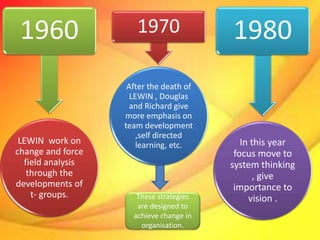
LEWIN work on
change and force
field analysis
through the
developments of
t- groups.
1960
After the death of
LEWIN , Douglas
and Richard give
more emphasis on
team development
,self directed
learning, etc.
1970
In this year
focus move to
system thinking
, give
importance to
vision .
1980
These strategies
are designed to
achieve change in
organisation.
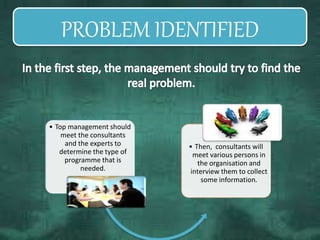
PROBLEM IDENTIFIED
• Top management should
meet the consultants
and the experts to
determine the type of
programme that is
needed.
• Then, consultants will
meet various persons in
the organisation and
interview them to collect
some information.
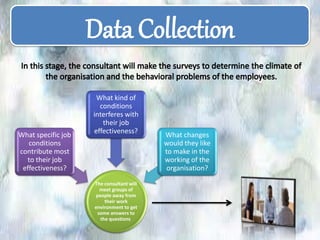
Data Collection
The consultant will
meet groups of
people away from
their work
environment to get
some answers to
the questions
What specific job
conditions
contribute most
to their job
effectiveness?
What kind of
conditions
interferes with
their job
effectiveness?
What changes
would they like
to make in the
working of the
organisation?
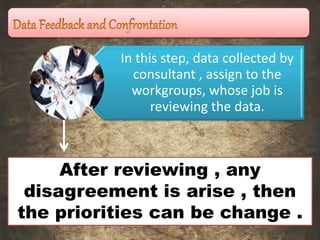
In this step, data collected by
consultant , assign to the
workgroups, whose job is
reviewing the data.
After reviewing , any
disagreement is arise , then
the priorities can be change .
Planning Strategy for Change
In this stage, the consultant will
suggest the strategy for change. He
transform diagnosis of the problem
into a proper action plan involving the
overall goals for change,
determination of basic approach for
attaining these goals and the
sequence of detailed scheme for
implementing the approach.
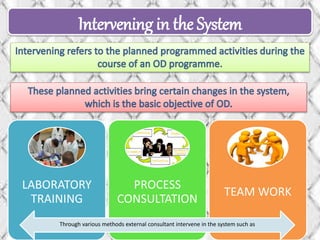
Intervening in the System
LABORATORY
TRAINING
PROCESS
CONSULTATION
TEAM WORK
Through various methods external consultant intervene in the system such as
EVALUATIONThis steps in OD are last
and main part of a whole
process, so all of them need
to be applied if a firm
expects to get the full
benefits of OD. An
organisation which applies
only a few steps and leaves
the others will be
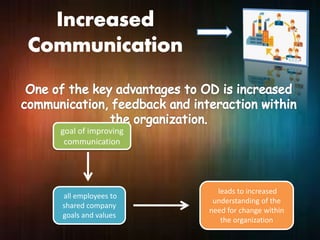
goal of improving
communication
leads to increased
understanding of the
need for change within
the organization
all employees to
shared company
goals and values
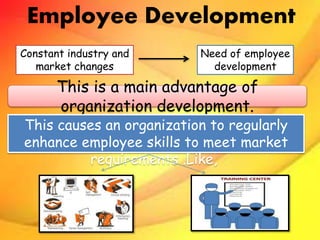
Employee Development
Need of employee
development
Constant industry and
market changes
This is a main advantage of
organization development.
This causes an organization to regularly
enhance employee skills to meet market
requirements .Like,
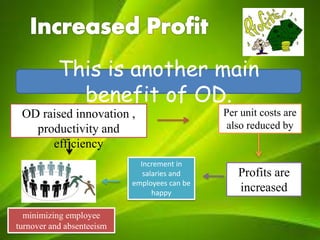
This is another main
benefit of OD.
OD raised innovation ,
productivity and
efficiency
Profits are
increased
minimizing employee
turnover and absenteeism
Per unit costs are
also reduced by
Increment in
salaries and
employees can be
happy
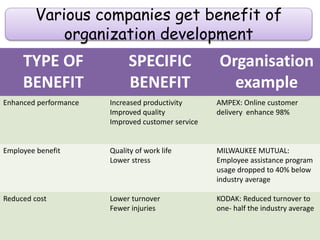
TYPE OF
BENEFIT
SPECIFIC
BENEFIT
Organisation
example
Enhanced performance Increased productivity
Improved quality
Improved customer service
AMPEX: Online customer
delivery enhance 98%
Employee benefit Quality of work life
Lower stress
MILWAUKEE MUTUAL:
Employee assistance program
usage dropped to 40% below
industry average
Reduced cost Lower turnover
Fewer injuries
KODAK: Reduced turnover to
one- half the industry average
Various companies get benefit of
organization development
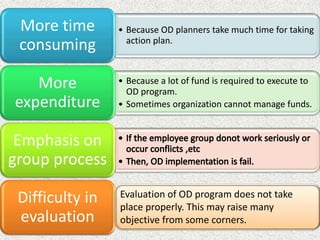
• Because OD planners take much time for taking
action plan.
More time
consuming
• Because a lot of fund is required to execute to
OD program.
• Sometimes organization cannot manage funds.
More
expenditure
Emphasis on
group process
Difficulty in
evaluation
Evaluation of OD program does not take
place properly. This may raise many
objective from some corners.
CONCLUSION
It can be concluded that through organizational
development many changes can be occur in various
organization . Some developments can be give benefit
to organization and some not.

Organisation change and development

  • 1.
  • 3.
  • 5.
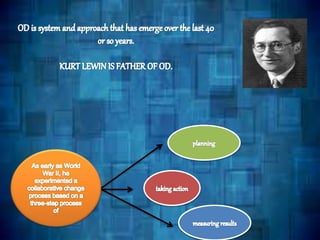
    LEWIN work on changeand force field analysis through the developments of t- groups. 1960 After the death of LEWIN , Douglas and Richard give more emphasis on team development ,self directed learning, etc. 1970 In this year focus move to system thinking , give importance to vision . 1980 These strategies are designed to achieve change in organisation.
  • 7.
    PROBLEM IDENTIFIED • Topmanagement should meet the consultants and the experts to determine the type of programme that is needed. • Then, consultants will meet various persons in the organisation and interview them to collect some information.
  • 8.
    Data Collection The consultantwill meet groups of people away from their work environment to get some answers to the questions What specific job conditions contribute most to their job effectiveness? What kind of conditions interferes with their job effectiveness? What changes would they like to make in the working of the organisation?
  • 9.
    In this step,data collected by consultant , assign to the workgroups, whose job is reviewing the data. After reviewing , any disagreement is arise , then the priorities can be change .
  • 10.
    Planning Strategy forChange In this stage, the consultant will suggest the strategy for change. He transform diagnosis of the problem into a proper action plan involving the overall goals for change, determination of basic approach for attaining these goals and the sequence of detailed scheme for implementing the approach.
  • 11.
    Intervening in theSystem LABORATORY TRAINING PROCESS CONSULTATION TEAM WORK Through various methods external consultant intervene in the system such as
  • 13.
    EVALUATIONThis steps inOD are last and main part of a whole process, so all of them need to be applied if a firm expects to get the full benefits of OD. An organisation which applies only a few steps and leaves the others will be
  • 15.
    goal of improving communication leadsto increased understanding of the need for change within the organization all employees to shared company goals and values
  • 16.
    Employee Development Need ofemployee development Constant industry and market changes This is a main advantage of organization development. This causes an organization to regularly enhance employee skills to meet market requirements .Like,
  • 17.
    This is anothermain benefit of OD. OD raised innovation , productivity and efficiency Profits are increased minimizing employee turnover and absenteeism Per unit costs are also reduced by Increment in salaries and employees can be happy
  • 18.
    TYPE OF BENEFIT SPECIFIC BENEFIT Organisation example Enhanced performanceIncreased productivity Improved quality Improved customer service AMPEX: Online customer delivery enhance 98% Employee benefit Quality of work life Lower stress MILWAUKEE MUTUAL: Employee assistance program usage dropped to 40% below industry average Reduced cost Lower turnover Fewer injuries KODAK: Reduced turnover to one- half the industry average Various companies get benefit of organization development
  • 20.
    • Because ODplanners take much time for taking action plan. More time consuming • Because a lot of fund is required to execute to OD program. • Sometimes organization cannot manage funds. More expenditure Emphasis on group process Difficulty in evaluation Evaluation of OD program does not take place properly. This may raise many objective from some corners.
  • 21.
    CONCLUSION It can beconcluded that through organizational development many changes can be occur in various organization . Some developments can be give benefit to organization and some not.