OD Interventions
• Arethe planned activities that client
organization and consultant participate in
during the course of an organization
development program.
• These are sets of structured activities in
which selected organizational units (target
groups or individuals) engage in a task or
sequence of tasks where the goals are
related directly or indirectly to
organizational improvement.
3.
Develop the overallgame plan with
the client
• Integrate the problem or opportunity to be
addressed,
• the goals and desired outcomes and the
sequencing and
• timing of the various interventions needed.
4.
Structuring OD activities
•Structure the activity so that the relevant people are
involved, those who are affected by the problem or
the opportunity being addressed by the intervention.
• Structure the activity so that it is a) problem or
opportunity oriented and b) oriented to the problems
or opportunities generated by the clients themselves.
This assures maximum support and commitment.
• Structure the activity so that the goal is clear and the
way to reach the goal is clear to all involved.
• Structure the activity so that there is high probability
of goal attainment. Goals should be realistic.
• Structure the activity so that it contains both
experience-based learning and
conceptual/cognitive/theoretical learning.
• Structure the climate of the activity so that
individuals are “freed up” rather than anxious or
defensive.
5.
Structuring …
• Structurethe activity so that the participants
learn both how to solve a particular problem and
“learn how to learn” at the same time.
• Structure the activity so that individuals can
learn about both task and process.
• Structure the activity so that individuals are
engaged as whole persons, not segmented
persons. This means that role demands,
thoughts, beliefs, feelings and strivings should
all be called into play, not just one or two of
these.
6.
choosing and sequencingactivities
• Maximize diagnostic data
• Maximize effectiveness – Early interventions
should enhance the effectiveness of subsequent
interventions.
• Maximize efficiency – Conserve organization
resources.
• Maximize speed
• Maximize relevance - priority to organizational
performance over impact on individuals or
culture.
• Minimize psychological and organizational strain
7.
Results of ODInterventions
• Feedback
• Awareness of changing sociocultural norms or
dysfunctional present norms
• Increased interaction and communication
• Confrontation ( of issues, not people)
• Education
• Participation
• Increased accountability
• Increased energy and optimism
8.
Major types ofOD interventions
by type of engagement
• Diagnostic activities
• Team-building activities
• Intergroup activities
• Survey feedback activities
• Education and training
• Technostructural or structural activities
• Process consultation
• 3rd
party peacemaking
• Coaching and counseling
• Life and Career Planning
• Planning and goal setting
9.
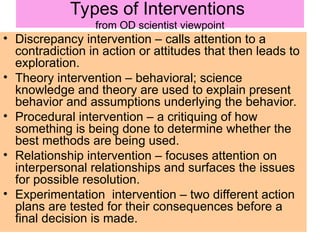
Types of Interventions
fromOD scientist viewpoint
• Discrepancy intervention – calls attention to a
contradiction in action or attitudes that then leads to
exploration.
• Theory intervention – behavioral; science
knowledge and theory are used to explain present
behavior and assumptions underlying the behavior.
• Procedural intervention – a critiquing of how
something is being done to determine whether the
best methods are being used.
• Relationship intervention – focuses attention on
interpersonal relationships and surfaces the issues
for possible resolution.
• Experimentation intervention – two different action
plans are tested for their consequences before a
final decision is made.
10.
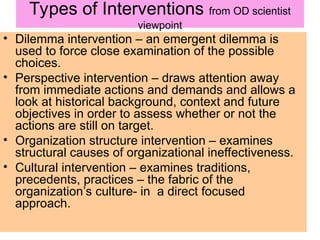
Types of Interventionsfrom OD scientist
viewpoint
• Dilemma intervention – an emergent dilemma is
used to force close examination of the possible
choices.
• Perspective intervention – draws attention away
from immediate actions and demands and allows a
look at historical background, context and future
objectives in order to assess whether or not the
actions are still on target.
• Organization structure intervention – examines
structural causes of organizational ineffectiveness.
• Cultural intervention – examines traditions,
precedents, practices – the fabric of the
organization’s culture- in a direct focused
approach.
11.
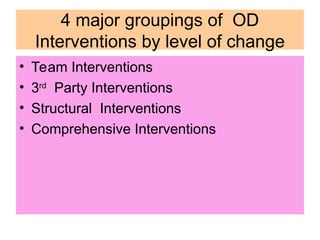
4 major groupingsof OD
Interventions by level of change
• Team Interventions
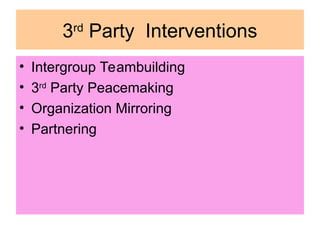
• 3rd
Party Interventions
• Structural Interventions
• Comprehensive Interventions
12.
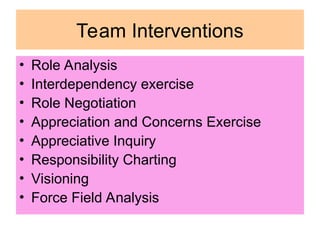
Team Interventions
• RoleAnalysis
• Interdependency exercise
• Role Negotiation
• Appreciation and Concerns Exercise
• Appreciative Inquiry
• Responsibility Charting
• Visioning
• Force Field Analysis
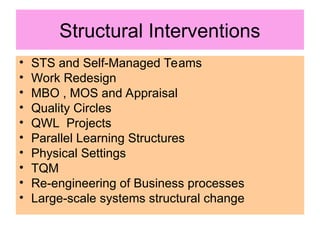
Structural Interventions
• STSand Self-Managed Teams
• Work Redesign
• MBO , MOS and Appraisal
• Quality Circles
• QWL Projects
• Parallel Learning Structures
• Physical Settings
• TQM
• Re-engineering of Business processes
• Large-scale systems structural change
15.
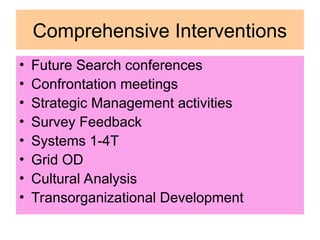
Comprehensive Interventions
• FutureSearch conferences
• Confrontation meetings
• Strategic Management activities
• Survey Feedback
• Systems 1-4T
• Grid OD
• Cultural Analysis
• Transorganizational Development
16.
For descriptive detailsof each
intervention
• Read : Organization Development:
Behavioral Science Interventions for
Organization Improvement, Prentice Hall,
6th Edition, Wendell L. French, Cecil H.
Bell