KOLB’S LEARNING
MODEL
A REVIEW
EXPERIENTIAL LEARNING THEORY
(ELT): DAVID KOLB 1984
 “Learning is a process whereby knowledge is created through the
transformation of experience”, Kolb 1984, p 38
 4 Distinct Learning Styles based on four-stage learning cycle
 Cycle of learning – central principal in experiential learning theory
 Immediate or concrete experiences lead to observations and reflections
 Observations and reflections assimilated into abstract concepts
 Abstract concepts produce implications for actions that can be actively
tested
 Actions taken create new experiences
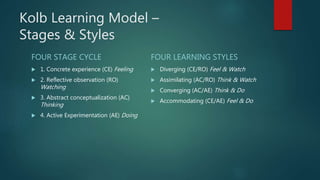
Kolb Learning Model –
Stages & Styles
FOUR STAGE CYCLE
 1. Concrete experience (CE) Feeling
 2. Reflective observation (RO)
Watching
 3. Abstract conceptualization (AC)
Thinking
 4. Active Experimentation (AE) Doing
FOUR LEARNING STYLES
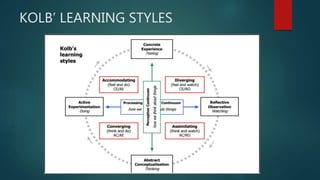
 Diverging (CE/RO) Feel & Watch
 Assimilating (AC/RO) Think & Watch
 Converging (AC/AE) Think & Do
 Accommodating (CE/AE) Feel & Do
KOLB’ LEARNING STYLES
Preferred learning style
 We choose a way of grasping experience and a way to transform the
experience
 Grasping experience – how to approach it a) watch or b) do
 Transform experience – our emotional response to experience a) think or
b) feel
3 Stages of Development
 Various factors influence a person’s preferred style.
 Age improves propensity to reconcile and integrate
 Development stages:
 Acquisition – birth to adolescence, development of basic abilities & cognitive
structures
 Specialization – schooling, early work and personal experiences of adulthood,
development of specialized learning style shaped by social educational and
organizational socialization
 Integration – mid career through to later lifer, expression of non dominant
learning style at work and personal life
General Application of Theory
 Organizational Application:
 Based on Kolb theory, adult learning and development function has been improved
 Training and Development has incorporated experiential learning
 Learning Organization concept focusses on how groups and organizations learn
 Education Application:
 Improved classroom learning through more appropriate learning opportunities
 Classroom activities designed to offer learners chances to engage in suitable manner – shift
from teacher dominated to participative learning environment
 Educators can identify preferred learning style and application of experiential learning cycle
 Use of better techniques like case study methods for real life learning scenarios
Application of Kolb Theory for Young
Adults (18-25 year olds)
 Kolb’s model is a generalized model and its applicability to young adults is
dependent on individual situations and environmental factors
 Whereas the stages and styles may be loosely relevant, its practical impact
varies based on development stage and individual difference
 Kolb’s model lacks universal applicability even for Young Adults
 Education experiences can be enhanced on the basis of experiential
learning model of Kolb. However, all kinds of content cannot be learned
through experience based learning e.g. mathematics
Unique Considerations
 Development takes place in “good enough” environment coupled with
biological timetable
 Young Adults have:
 More complex thinking
 Appreciation for diverse views
 Mutuality in relationship
 Emotional regulation
 Risk taking and decision making
 caveats
Individual Differences
 Age, education, gender
 Abuse, neglect. Trauma
 Race. Ethnicity, sexual identity
 Temperament
 Parenting style
 Illness
 Disabilities
 Substance abuse
 Culture
 Getting stuck
MIT Young Adults Development
Project
 In order to provide Young Adults with challenge to improve learning:
 Interactions with teachers and other adults
 Diversity of peers
 Interdisciplinary & integrative approaches to education
 Instruction in cognitive skills
MIT Young Adult Development Project
 Kolb’s model is applicable in education for young adults in the light of the
support from external environment
 Matching level of challenge with ability
 Balance of structure and flexibility
 Monitoring
 Safety net
 Tincture of time
Reflections
 Kolb’s model does not include the impact of human interactions (family,
peers, teachers); interdisciplinary approaches to education, and instruction
to cognitive skills like leadership and critical thinking
 Kolb’s focus is on one aspect: behavioral processes of learner. It fails to
include the psychological, emotional and social factors in the external
environment and interactions with environment
 Kolb’s model discusses the abstract conceptualization of learners. Young
adults (18-25 year olds) are in an age group where it has only somewhat
developed. Abstract conceptualization improves in late adulthood given
the right environment. It doesn’t become part of learning on its own unless
given the right environment to develop. It is established in research finding
that human brain does not reach full maturity until at least mid 20s (J.
Giedd)
Reflections
 Kolb’s model is more relevant to organizational learning for later
adulthood than for young adults.
 The developmental stage of specialization where Kolb’s model really is
applicable is shaped by social , educational and organizational socialization
 Although teachers and educational institutions can design curriculum with
focus on experimental learning, the development stage of learners
themselves may need more time.
 A supportive environment inclusive of family, peers, teachers helps to
maintain positive learning experiences and foster learning development
Reflections
 Kolb’s model doesn’t include age related development. Brain and cognitive
development may develop over time and hence learners in later adulthood
should be the focus for Kolb model and not the young adults
 Kolb’s model does not incorporate environment and other effects on
behavior and learning. In reality no learning is in vaccum and environment
and individual factors have a bigger influence than internal factors or
individual himself.
 Types (positive or negative) and duration of experience is also an
important contributor towards learning which is not included in Kolb
model. In addition, the source of experience is critical for learners. If a
teacher or educator is not deemed positively by a learner, the learning
experience may turn out to be different than expected.
Concluding Remarks
 According to Kolb’s model, learning is based on experience. Experiences
may vary and depend on individual development, learner’s immediate
environment and individual differences
 For young adults (18-25 year olds), both stages of learning cycle and types
of learning styles are dependant on environment and individual
differences. Changes may be take place with different development stages
 Diversity of experiences can enhance experiential learning
 Experiences supported by a well developed safety net can enhance
learning and create positive reinforcement
References
 http://www.businessballs.com/kolblearningstyles.htm
 McLeod, S. A. (2013). Kolb - Learning Styles. Retrieved from www.simplypsychology.org/learning-kolb.html
 http://hrweb.mit/worklife/youngadults/index.html

KOLB LEARNING MODEL final

  • 1.
  • 2.
    EXPERIENTIAL LEARNING THEORY (ELT):DAVID KOLB 1984  “Learning is a process whereby knowledge is created through the transformation of experience”, Kolb 1984, p 38  4 Distinct Learning Styles based on four-stage learning cycle  Cycle of learning – central principal in experiential learning theory  Immediate or concrete experiences lead to observations and reflections  Observations and reflections assimilated into abstract concepts  Abstract concepts produce implications for actions that can be actively tested  Actions taken create new experiences
  • 3.
    Kolb Learning Model– Stages & Styles FOUR STAGE CYCLE  1. Concrete experience (CE) Feeling  2. Reflective observation (RO) Watching  3. Abstract conceptualization (AC) Thinking  4. Active Experimentation (AE) Doing FOUR LEARNING STYLES  Diverging (CE/RO) Feel & Watch  Assimilating (AC/RO) Think & Watch  Converging (AC/AE) Think & Do  Accommodating (CE/AE) Feel & Do
  • 4.
  • 5.
    Preferred learning style We choose a way of grasping experience and a way to transform the experience  Grasping experience – how to approach it a) watch or b) do  Transform experience – our emotional response to experience a) think or b) feel
  • 6.
    3 Stages ofDevelopment  Various factors influence a person’s preferred style.  Age improves propensity to reconcile and integrate  Development stages:  Acquisition – birth to adolescence, development of basic abilities & cognitive structures  Specialization – schooling, early work and personal experiences of adulthood, development of specialized learning style shaped by social educational and organizational socialization  Integration – mid career through to later lifer, expression of non dominant learning style at work and personal life
  • 7.
    General Application ofTheory  Organizational Application:  Based on Kolb theory, adult learning and development function has been improved  Training and Development has incorporated experiential learning  Learning Organization concept focusses on how groups and organizations learn  Education Application:  Improved classroom learning through more appropriate learning opportunities  Classroom activities designed to offer learners chances to engage in suitable manner – shift from teacher dominated to participative learning environment  Educators can identify preferred learning style and application of experiential learning cycle  Use of better techniques like case study methods for real life learning scenarios
  • 8.
    Application of KolbTheory for Young Adults (18-25 year olds)  Kolb’s model is a generalized model and its applicability to young adults is dependent on individual situations and environmental factors  Whereas the stages and styles may be loosely relevant, its practical impact varies based on development stage and individual difference  Kolb’s model lacks universal applicability even for Young Adults  Education experiences can be enhanced on the basis of experiential learning model of Kolb. However, all kinds of content cannot be learned through experience based learning e.g. mathematics
  • 9.
    Unique Considerations  Developmenttakes place in “good enough” environment coupled with biological timetable  Young Adults have:  More complex thinking  Appreciation for diverse views  Mutuality in relationship  Emotional regulation  Risk taking and decision making  caveats
  • 10.
    Individual Differences  Age,education, gender  Abuse, neglect. Trauma  Race. Ethnicity, sexual identity  Temperament  Parenting style  Illness  Disabilities  Substance abuse  Culture  Getting stuck
  • 11.
    MIT Young AdultsDevelopment Project  In order to provide Young Adults with challenge to improve learning:  Interactions with teachers and other adults  Diversity of peers  Interdisciplinary & integrative approaches to education  Instruction in cognitive skills
  • 12.
    MIT Young AdultDevelopment Project  Kolb’s model is applicable in education for young adults in the light of the support from external environment  Matching level of challenge with ability  Balance of structure and flexibility  Monitoring  Safety net  Tincture of time
  • 13.
    Reflections  Kolb’s modeldoes not include the impact of human interactions (family, peers, teachers); interdisciplinary approaches to education, and instruction to cognitive skills like leadership and critical thinking  Kolb’s focus is on one aspect: behavioral processes of learner. It fails to include the psychological, emotional and social factors in the external environment and interactions with environment  Kolb’s model discusses the abstract conceptualization of learners. Young adults (18-25 year olds) are in an age group where it has only somewhat developed. Abstract conceptualization improves in late adulthood given the right environment. It doesn’t become part of learning on its own unless given the right environment to develop. It is established in research finding that human brain does not reach full maturity until at least mid 20s (J. Giedd)
  • 14.
    Reflections  Kolb’s modelis more relevant to organizational learning for later adulthood than for young adults.  The developmental stage of specialization where Kolb’s model really is applicable is shaped by social , educational and organizational socialization  Although teachers and educational institutions can design curriculum with focus on experimental learning, the development stage of learners themselves may need more time.  A supportive environment inclusive of family, peers, teachers helps to maintain positive learning experiences and foster learning development
  • 15.
    Reflections  Kolb’s modeldoesn’t include age related development. Brain and cognitive development may develop over time and hence learners in later adulthood should be the focus for Kolb model and not the young adults  Kolb’s model does not incorporate environment and other effects on behavior and learning. In reality no learning is in vaccum and environment and individual factors have a bigger influence than internal factors or individual himself.  Types (positive or negative) and duration of experience is also an important contributor towards learning which is not included in Kolb model. In addition, the source of experience is critical for learners. If a teacher or educator is not deemed positively by a learner, the learning experience may turn out to be different than expected.
  • 16.
    Concluding Remarks  Accordingto Kolb’s model, learning is based on experience. Experiences may vary and depend on individual development, learner’s immediate environment and individual differences  For young adults (18-25 year olds), both stages of learning cycle and types of learning styles are dependant on environment and individual differences. Changes may be take place with different development stages  Diversity of experiences can enhance experiential learning  Experiences supported by a well developed safety net can enhance learning and create positive reinforcement
  • 17.
    References  http://www.businessballs.com/kolblearningstyles.htm  McLeod,S. A. (2013). Kolb - Learning Styles. Retrieved from www.simplypsychology.org/learning-kolb.html  http://hrweb.mit/worklife/youngadults/index.html