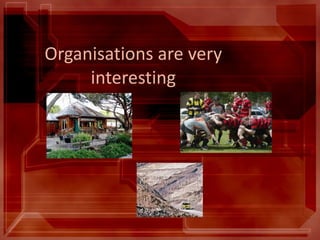
Organisations are very interesting
An organisation is a group of people  intentionally organized to accomplish  an overall, common goal or set of goals. Coffee shops to small businesses. July 2008, there were 1.93 million small businesses in Australia, representing 96% of all businesses.
Technology Internal/External Environment Strategy People Structure Elements of an  Organisation
People How  people work together is the essence of the organisation. Culture  explicit deliberate careful cultivation of image and mode of operation implicit operating unrecognised behind the scenes Roles of management Management styles Employee responsibilities
Corporate culture Is a term used to describe the shared values and beliefs of the people in an organisation. Staff uniforms are an example of culture Staff training days Use of internet  Policies on bullying in the workplace Policies on advancement
The organisational “iceburg” Mission, vision Goals and objectives Business plan   Formal organisation  specific tasks span of control   operating    policies Lines of communication  controls channels of authority Relationships between  needs of individuals Managers and workers  group feelings  friendships and networks Individual hopes and  informal organisation   Aspiration Perceptions of trust  interpersonal relationships Honesty and ethics influential employees  power plays and politics and managers
Management Roles Henri Fayol outlined FOUR main functions of management. 1  Planning    setting objectives and how to    achieve them 2  Organising  arranging resources of the    business to achieve its goals 3  Leading  influencing people to work   towards  achieving set      objectives 4  Controlling  evaluating and modifying tasks   to ensure set objectives are being    achieved
Leadership styles There is no questioning this function, just how managers operate is interesting. Leadership styles range on a continuum Management style Autocratic Democratic / participative Laissez-  faire
Structure an organisation’s structure refers to the way divisions, departments, functions, and people link together and interact.  Reveals vertical operational responsibilities horizontal linkages may be represented by an organisation chart Visual representation of the formal structure complexity of an organisation's structure is often proportional to its size and its geographic dispersal.
Vertical specialisation Top Management Middle management Lower or frontline management Long term or strategic planning Operational and supervision of  lower management Daily management and rosters
Vertical Specialisation chain of command from top to front line management Chain of command is a system that determines responsibility, supervision and accountability of members of the organisation. delegation of responsibilities and duties to others within the same line of authority management hierarchy – provides increasing authority at higher levels  Senior managers have greater  Accountability Responsibility and Power compared to those at lower levels organisation requires coordinated effort of all levels of management to achieve goals
More Less Accountability Responsibility Authority Board of Directors Chief Executive Officer (CEO Managing Director Department Head Divisional Head Plant Manager Store Manager Team Manager Supervisor Team Leader Frontline Manager Top/ Senior/ Executive Management Team Middle Management  Team Frontline/Supervisory Management Team
Horizontal Specialisation Division of tasks required to be performed into separate departments. Functional Model Divisional Model Matrix Model
Functional   Model Division occurs based on organisational functions eg HR, Finance, Marketing Functions General Manager Finance Manager Marketing Manager Finance Manager Operations Manager
Divisional   Model Model organised based on division by: Product Service Geography Divisions General Manager Produce Manager Meat Manager Deli Manager Grocery Manager
Matrix   Model Combines function and division Permits specialisation by project while each person remains part of a department based on function Production Manager General Manager Dinnerware Jewellery Marketing Manager
Strategy Organisations require strategies to formulate appropriate decisions Decision making & problem solving SWOT analysis
Decision Making:  making choices among possible courses of action Problem Solving:  consists of making a series of decision to resolve an issue.
6 Step Approach to DECISION MAKING & PROBLEM SOLVING 1.  Define the  O bjective 2.  Outline the  F acts Decide on the  C auses 4.  Develop Several  S olutions 5.  I mplement Preferred Solution 6.  E valuate Effectiveness of Solution If solution unsuccessful restart process
Overly Fat Children See Ice cream Everywhere
Decision-making conditions Certainty Outcome of alternative known in advance Rarely the case Minimal Risk High Risk Risky Outcome of alternatives not completely known Probabilities exist Statistical models can be used Common condition Uncertainty Difficult condition Probabilities do not exist Condition exists more at top management level Decisions of a long term nature affected by externalities 3 conditions under which decisions can occur:
Minor problems – management not needed Many matters may already be covered by established policy – decisions already in place Avoid crisis conditions and therefore rush decisions Provide leadership – avoid situation of indecision Errors can be made – decisions should not be considered permanent.
SWOT Strategic planning strategy Strengths Weaknesses Opportunities Threats Internal  – People, organisation, systems, communications, products, production, finance, credentials, knowledge External  – market, technology, finance, economic climate, society, legislation, ecology
Environment – Internal / External Major impact on how organisations operate Organisations lack of response to environmental challenges can be a determinant to success - flexibility
Technology To remain competitive organisations must: Make creative use of modern technology Technology, generally, aims to: Improve efficiencies Increase productivity Inevitable that workplaces will continue to change as a result of our reliance on technology

Organisations and management

  • 1.
  • 2.
    An organisation isa group of people intentionally organized to accomplish an overall, common goal or set of goals. Coffee shops to small businesses. July 2008, there were 1.93 million small businesses in Australia, representing 96% of all businesses.
  • 3.
    Technology Internal/External EnvironmentStrategy People Structure Elements of an Organisation
  • 4.
    People How people work together is the essence of the organisation. Culture explicit deliberate careful cultivation of image and mode of operation implicit operating unrecognised behind the scenes Roles of management Management styles Employee responsibilities
  • 5.
    Corporate culture Isa term used to describe the shared values and beliefs of the people in an organisation. Staff uniforms are an example of culture Staff training days Use of internet Policies on bullying in the workplace Policies on advancement
  • 6.
    The organisational “iceburg”Mission, vision Goals and objectives Business plan Formal organisation specific tasks span of control operating policies Lines of communication controls channels of authority Relationships between needs of individuals Managers and workers group feelings friendships and networks Individual hopes and informal organisation Aspiration Perceptions of trust interpersonal relationships Honesty and ethics influential employees power plays and politics and managers
  • 7.
    Management Roles HenriFayol outlined FOUR main functions of management. 1 Planning setting objectives and how to achieve them 2 Organising arranging resources of the business to achieve its goals 3 Leading influencing people to work towards achieving set objectives 4 Controlling evaluating and modifying tasks to ensure set objectives are being achieved
  • 8.
    Leadership styles Thereis no questioning this function, just how managers operate is interesting. Leadership styles range on a continuum Management style Autocratic Democratic / participative Laissez- faire
  • 9.
    Structure an organisation’sstructure refers to the way divisions, departments, functions, and people link together and interact. Reveals vertical operational responsibilities horizontal linkages may be represented by an organisation chart Visual representation of the formal structure complexity of an organisation's structure is often proportional to its size and its geographic dispersal.
  • 10.
    Vertical specialisation TopManagement Middle management Lower or frontline management Long term or strategic planning Operational and supervision of lower management Daily management and rosters
  • 11.
    Vertical Specialisation chainof command from top to front line management Chain of command is a system that determines responsibility, supervision and accountability of members of the organisation. delegation of responsibilities and duties to others within the same line of authority management hierarchy – provides increasing authority at higher levels Senior managers have greater Accountability Responsibility and Power compared to those at lower levels organisation requires coordinated effort of all levels of management to achieve goals
  • 12.
    More Less AccountabilityResponsibility Authority Board of Directors Chief Executive Officer (CEO Managing Director Department Head Divisional Head Plant Manager Store Manager Team Manager Supervisor Team Leader Frontline Manager Top/ Senior/ Executive Management Team Middle Management Team Frontline/Supervisory Management Team
  • 13.
    Horizontal Specialisation Divisionof tasks required to be performed into separate departments. Functional Model Divisional Model Matrix Model
  • 14.
    Functional Model Division occurs based on organisational functions eg HR, Finance, Marketing Functions General Manager Finance Manager Marketing Manager Finance Manager Operations Manager
  • 15.
    Divisional Model Model organised based on division by: Product Service Geography Divisions General Manager Produce Manager Meat Manager Deli Manager Grocery Manager
  • 16.
    Matrix Model Combines function and division Permits specialisation by project while each person remains part of a department based on function Production Manager General Manager Dinnerware Jewellery Marketing Manager
  • 17.
    Strategy Organisations requirestrategies to formulate appropriate decisions Decision making & problem solving SWOT analysis
  • 18.
    Decision Making: making choices among possible courses of action Problem Solving: consists of making a series of decision to resolve an issue.
  • 19.
    6 Step Approachto DECISION MAKING & PROBLEM SOLVING 1. Define the O bjective 2. Outline the F acts Decide on the C auses 4. Develop Several S olutions 5. I mplement Preferred Solution 6. E valuate Effectiveness of Solution If solution unsuccessful restart process
  • 20.
    Overly Fat ChildrenSee Ice cream Everywhere
  • 21.
    Decision-making conditions CertaintyOutcome of alternative known in advance Rarely the case Minimal Risk High Risk Risky Outcome of alternatives not completely known Probabilities exist Statistical models can be used Common condition Uncertainty Difficult condition Probabilities do not exist Condition exists more at top management level Decisions of a long term nature affected by externalities 3 conditions under which decisions can occur:
  • 22.
    Minor problems –management not needed Many matters may already be covered by established policy – decisions already in place Avoid crisis conditions and therefore rush decisions Provide leadership – avoid situation of indecision Errors can be made – decisions should not be considered permanent.
  • 23.
    SWOT Strategic planningstrategy Strengths Weaknesses Opportunities Threats Internal – People, organisation, systems, communications, products, production, finance, credentials, knowledge External – market, technology, finance, economic climate, society, legislation, ecology
  • 24.
    Environment – Internal/ External Major impact on how organisations operate Organisations lack of response to environmental challenges can be a determinant to success - flexibility
  • 25.
    Technology To remaincompetitive organisations must: Make creative use of modern technology Technology, generally, aims to: Improve efficiencies Increase productivity Inevitable that workplaces will continue to change as a result of our reliance on technology