WHY STRUCTURES DIFFER
 Organizational structures differ because of the nature of the work that the organizations do and their
different methods of dealing with dilemmas
 Organizational structure divides organization into distinct parts and defines the relationships among
them (Verle, Markic, and Kodric, 2014)
 Organizational structures:
• Define authority
• Emphasize employee behavior
• Determine how work accomplished
• Impact performance, motivation, corporate culture (CSU, 2018)
 Factors that affect structure – strategy, size, technology, and environment
STRATEGY
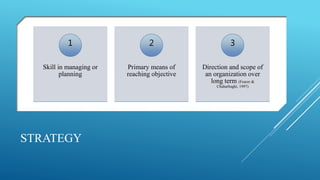
Skill in managing or
planning
1
Primary means of
reaching objective
2
Direction and scope of
an organization over
long term (Feurer &
Chaharbaghi, 1997)
3
STRATEGY (CONT.)
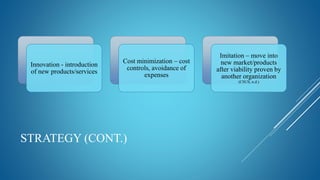
Innovation - introduction
of new products/services
Cost minimization – cost
controls, avoidance of
expenses
Imitation – move into
new market/products
after viability proven by
another organization
(CSUS, n.d.)
ORGANIZATIONAL SIZE
 Organizational size can affect structure:
1. As organization grows it needs more managers for
controlling - adds layers of hierarchy
2. Employee/job satisfaction can decrease
3. Growth can deplete employee empowerment (Gupta, 2010)
ORGANIZATIONAL
SIZE (CONT.)
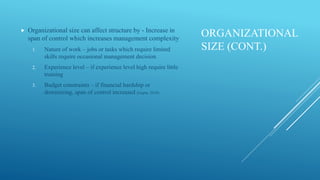
 Organizational size can affect structure by - Increase in
span of control which increases management complexity
1. Nature of work – jobs or tasks which require limited
skills require occasional management decision
2. Experience level – if experience level high require little
training
3. Budget constraints – if financial hardship or
downsizing, span of control increased (Gupta, 2010)
TECHNOLOGY
 Technology can create or eliminate positions within your
company. As technology continues to change the function of jobs,
the organizational structure changes with it (Root, n.d.)
 Technology can influence –
 Horizontal communication – among peers
 Vertical communication – upward and downward
 Work flow – semi-automated form of manual labor
 Automation – human is a supervisor, machine des the work (Gustafsson,
Franke, Johnson, & Lillieskold, n.d.)
TECHNOLOGY (CONT.)
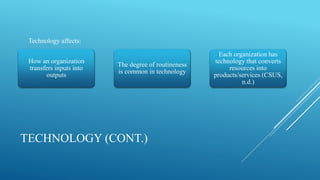
How an organization
transfers inputs into
outputs
The degree of routineness
is common in technology
Each organization has
technology that converts
resources into
products/services (CSUS,
n.d.)
Technology affects:
ENVIRONMENT
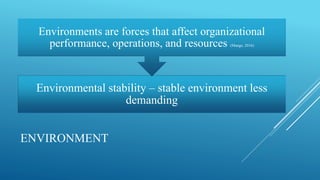
Environmental stability – stable environment less
demanding
Environments are forces that affect organizational
performance, operations, and resources (Mange, 2016)
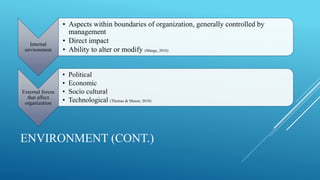
ENVIRONMENT (CONT.)
Internal
environment
• Aspects within boundaries of organization, generally controlled by
management
• Direct impact
• Ability to alter or modify (Mange, 2016)
External forces
that affect
organization
• Political
• Economic
• Socio cultural
• Technological (Thomas & Mason, 2018)
REFERENCES
CSU. (2018). Unit VI: Organizational design models and organizational structures. Retrieved from
https://online.columbiasouthern.edu/CSU_Content/Courses/Business/MBA/MBA6001/15L/UnitVI_Presentation.ppsx
CSUS. (n.d.). Chapter 15: Foundations of organization structure. Retrieved from https://www.csus.edu/indiv/s/sablynskic/ch15.htm
Feurer, R., & Chaharbaghi, K. (1997). Strategy development: Past, present and future. Training for Quality, 5(2), 58-70. Retrieved from
https://libraryresources.columbiasouthern.edu/login?url=http://search.proquest.com.libraryresources.columbiasouthern.edu/docview/2121117
83?accountid=33337
Gupta, A. (2010). Organization’s size and span of control. Retrieved from http://practical-management.com/Organization-
Development/Organization-s-size-and-span-of-control.html
Gustafsson, P., Franke, U., Johnson, P., & Lillieskold, J. (n.d.). Identifying IT impacts on organizational structure and business value. Retrieved
from http://ceur-ws.org/Vol-336/paper4.pdf
REFERENCES (CONT.)
Mange, S. (2016). The impact of environment on organizational structure. Retrieved from
https://www.slideshare.net/Sunilkumarmange/the-impact-of-environment-on-organisational-structure
Root III, G. N. (n.d.). What impacts organizational structure? Retrieved from http://smallbusiness.chron.com/impacts-organizational-
structure-75.html
Thomas, J. G., Mason, W. H. (2018). Macroenvironmental forces. Retrieved from
http://www.referenceforbusiness.com/management/Log-Mar/Macroenvironmental-Forces.html
Verle, K., Markic, M., Kodric, B., & Gorenc Zoran, A. (2014). Managerial competencies and organizational structures. Industrial
Management & Data Systems, 114(6), 922-935. Retrieved from
https://libraryresources.columbiasouthern.edu/login?url=http://search.proquest.com.libraryresources.columbiasouthern.edu/docvie
w/1650583955?accountid=33337

Why structures differ

  • 1.
    WHY STRUCTURES DIFFER Organizational structures differ because of the nature of the work that the organizations do and their different methods of dealing with dilemmas  Organizational structure divides organization into distinct parts and defines the relationships among them (Verle, Markic, and Kodric, 2014)  Organizational structures: • Define authority • Emphasize employee behavior • Determine how work accomplished • Impact performance, motivation, corporate culture (CSU, 2018)  Factors that affect structure – strategy, size, technology, and environment
  • 2.
    STRATEGY Skill in managingor planning 1 Primary means of reaching objective 2 Direction and scope of an organization over long term (Feurer & Chaharbaghi, 1997) 3
  • 3.
    STRATEGY (CONT.) Innovation -introduction of new products/services Cost minimization – cost controls, avoidance of expenses Imitation – move into new market/products after viability proven by another organization (CSUS, n.d.)
  • 4.
    ORGANIZATIONAL SIZE  Organizationalsize can affect structure: 1. As organization grows it needs more managers for controlling - adds layers of hierarchy 2. Employee/job satisfaction can decrease 3. Growth can deplete employee empowerment (Gupta, 2010)
  • 5.
    ORGANIZATIONAL SIZE (CONT.)  Organizationalsize can affect structure by - Increase in span of control which increases management complexity 1. Nature of work – jobs or tasks which require limited skills require occasional management decision 2. Experience level – if experience level high require little training 3. Budget constraints – if financial hardship or downsizing, span of control increased (Gupta, 2010)
  • 6.
    TECHNOLOGY  Technology cancreate or eliminate positions within your company. As technology continues to change the function of jobs, the organizational structure changes with it (Root, n.d.)  Technology can influence –  Horizontal communication – among peers  Vertical communication – upward and downward  Work flow – semi-automated form of manual labor  Automation – human is a supervisor, machine des the work (Gustafsson, Franke, Johnson, & Lillieskold, n.d.)
  • 7.
    TECHNOLOGY (CONT.) How anorganization transfers inputs into outputs The degree of routineness is common in technology Each organization has technology that converts resources into products/services (CSUS, n.d.) Technology affects:
  • 8.
    ENVIRONMENT Environmental stability –stable environment less demanding Environments are forces that affect organizational performance, operations, and resources (Mange, 2016)
  • 9.
    ENVIRONMENT (CONT.) Internal environment • Aspectswithin boundaries of organization, generally controlled by management • Direct impact • Ability to alter or modify (Mange, 2016) External forces that affect organization • Political • Economic • Socio cultural • Technological (Thomas & Mason, 2018)
  • 10.
    REFERENCES CSU. (2018). UnitVI: Organizational design models and organizational structures. Retrieved from https://online.columbiasouthern.edu/CSU_Content/Courses/Business/MBA/MBA6001/15L/UnitVI_Presentation.ppsx CSUS. (n.d.). Chapter 15: Foundations of organization structure. Retrieved from https://www.csus.edu/indiv/s/sablynskic/ch15.htm Feurer, R., & Chaharbaghi, K. (1997). Strategy development: Past, present and future. Training for Quality, 5(2), 58-70. Retrieved from https://libraryresources.columbiasouthern.edu/login?url=http://search.proquest.com.libraryresources.columbiasouthern.edu/docview/2121117 83?accountid=33337 Gupta, A. (2010). Organization’s size and span of control. Retrieved from http://practical-management.com/Organization- Development/Organization-s-size-and-span-of-control.html Gustafsson, P., Franke, U., Johnson, P., & Lillieskold, J. (n.d.). Identifying IT impacts on organizational structure and business value. Retrieved from http://ceur-ws.org/Vol-336/paper4.pdf
  • 11.
    REFERENCES (CONT.) Mange, S.(2016). The impact of environment on organizational structure. Retrieved from https://www.slideshare.net/Sunilkumarmange/the-impact-of-environment-on-organisational-structure Root III, G. N. (n.d.). What impacts organizational structure? Retrieved from http://smallbusiness.chron.com/impacts-organizational- structure-75.html Thomas, J. G., Mason, W. H. (2018). Macroenvironmental forces. Retrieved from http://www.referenceforbusiness.com/management/Log-Mar/Macroenvironmental-Forces.html Verle, K., Markic, M., Kodric, B., & Gorenc Zoran, A. (2014). Managerial competencies and organizational structures. Industrial Management & Data Systems, 114(6), 922-935. Retrieved from https://libraryresources.columbiasouthern.edu/login?url=http://search.proquest.com.libraryresources.columbiasouthern.edu/docvie w/1650583955?accountid=33337