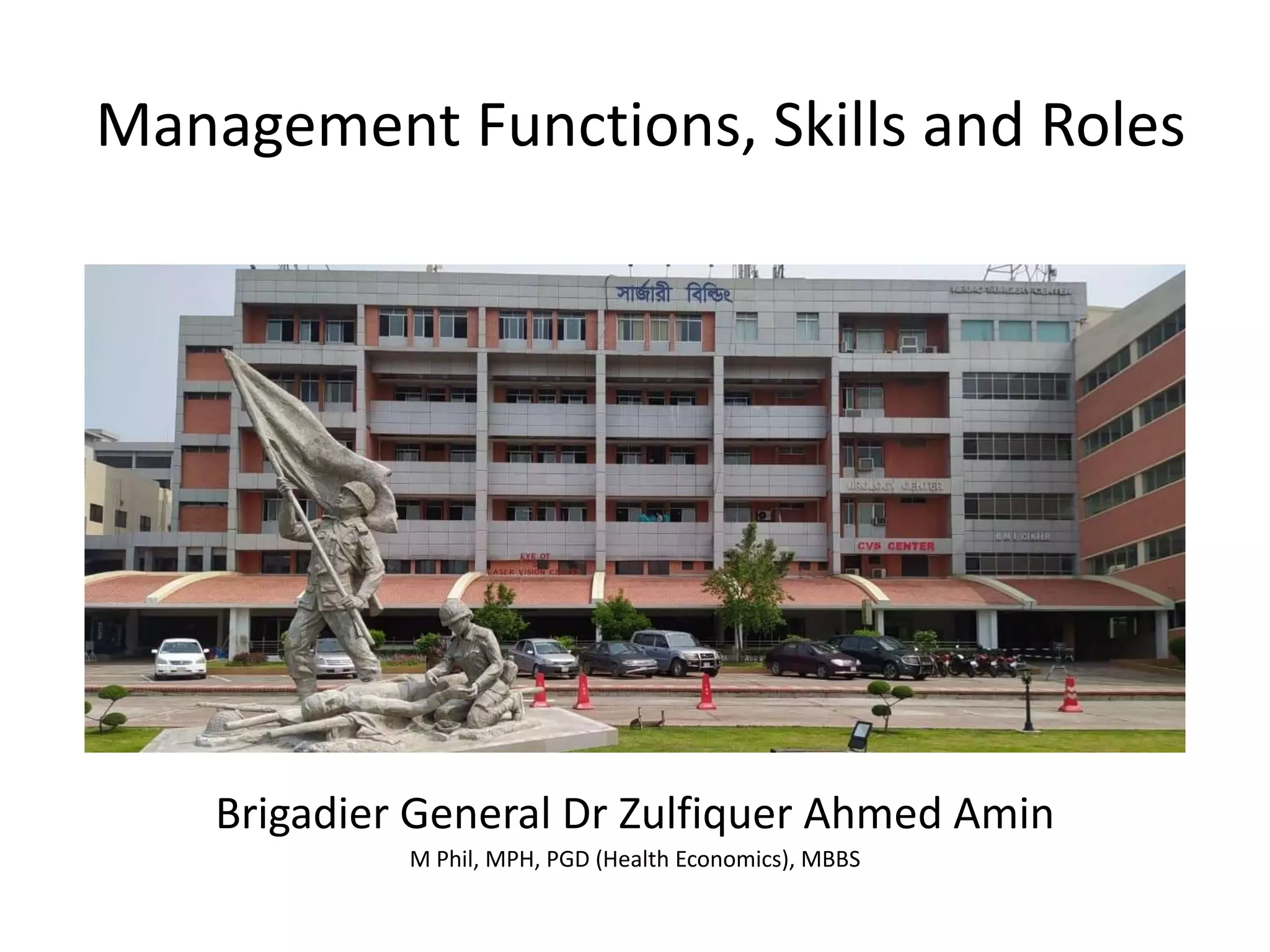
Management Functions, Skills and Roles
Brigadier General Dr Zulfiquer Ahmed Amin
M Phil, MPH, PGD (Health Economics), MBBS
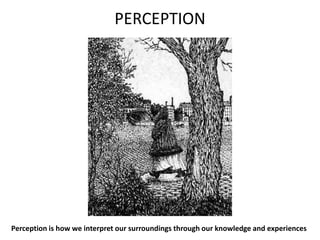
PERCEPTION
Perception is how we interpret our surroundings through our knowledge and experiences
What is Management?
Management is the art and science of getting things done with and
through people, in a formally organized group.
Management is the process of designing and maintaining an
environment in which individuals, working together in groups,
efficiently accomplish selected aims.
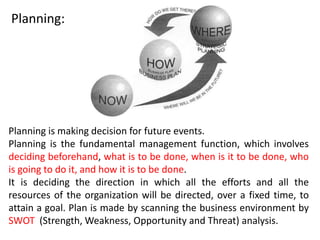
Planning is making decision for future events.
Planning is the fundamental management function, which involves
deciding beforehand, what is to be done, when is it to be done, who
is going to do it, and how it is to be done.
It is deciding the direction in which all the efforts and all the
resources of the organization will be directed, over a fixed time, to
attain a goal. Plan is made by scanning the business environment by
SWOT (Strength, Weakness, Opportunity and Threat) analysis.
Planning:
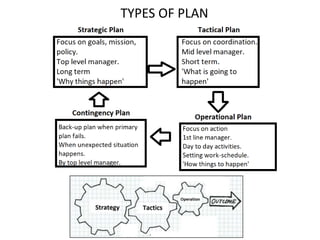
TYPES OF PLAN
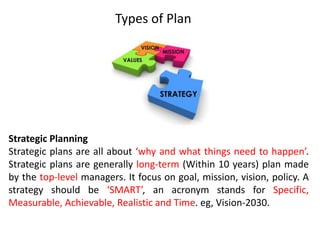
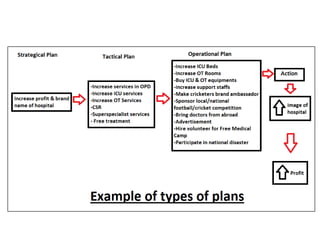
Types of Plan
Strategic Planning
Strategic plans are all about ‘why and what things need to happen’.
Strategic plans are generally long-term (Within 10 years) plan made
by the top-level managers. It focus on goal, mission, vision, policy. A
strategy should be ‘SMART’, an acronym stands for Specific,
Measurable, Achievable, Realistic and Time. eg, Vision-2030.
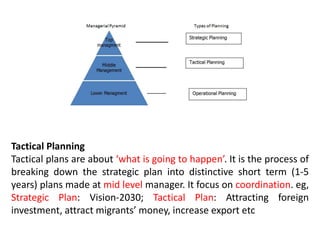
Tactical Planning
Tactical plans are about ‘what is going to happen’. It is the process of
breaking down the strategic plan into distinctive short term (1-5
years) plans made at mid level manager. It focus on coordination. eg,
Strategic Plan: Vision-2030; Tactical Plan: Attracting foreign
investment, attract migrants’ money, increase export etc
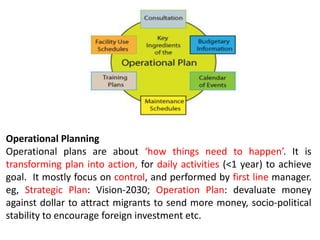
Operational Planning
Operational plans are about ‘how things need to happen’. It is
transforming plan into action, for daily activities (<1 year) to achieve
goal. It mostly focus on control, and performed by first line manager.
eg, Strategic Plan: Vision-2030; Operation Plan: devaluate money
against dollar to attract migrants to send more money, socio-political
stability to encourage foreign investment etc.
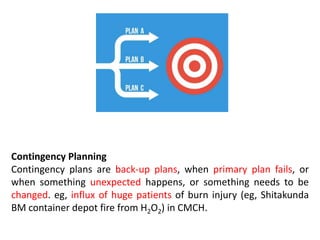
Contingency Planning
Contingency plans are back-up plans, when primary plan fails, or
when something unexpected happens, or something needs to be
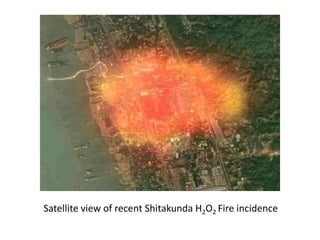
changed. eg, influx of huge patients of burn injury (eg, Shitakunda
BM container depot fire from H2O2) in CMCH.
Satellite view of recent Shitakunda H2O2 Fire incidence
Organizing
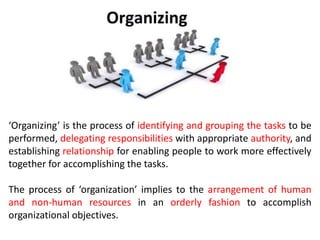
‘Organizing’ is the process of identifying and grouping the tasks to be
performed, delegating responsibilities with appropriate authority, and
establishing relationship for enabling people to work more effectively
together for accomplishing the tasks.
The process of ‘organization’ implies to the arrangement of human
and non-human resources in an orderly fashion to accomplish
organizational objectives.
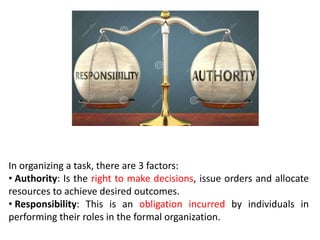
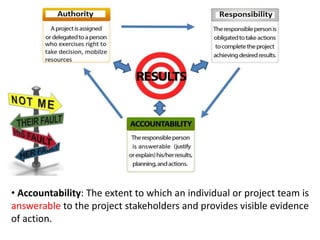
In organizing a task, there are 3 factors:
• Authority: Is the right to make decisions, issue orders and allocate
resources to achieve desired outcomes.
• Responsibility: This is an obligation incurred by individuals in
performing their roles in the formal organization.
• Accountability: The extent to which an individual or project team is
answerable to the project stakeholders and provides visible evidence
of action.
Types of Organization
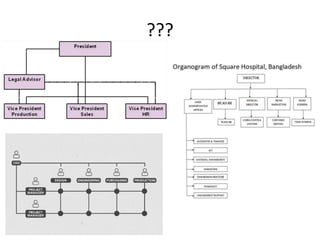
 Line Organization
 Line and Staff Organization
 Functional Organization
 Matrix Organization
 Project Structure Organization
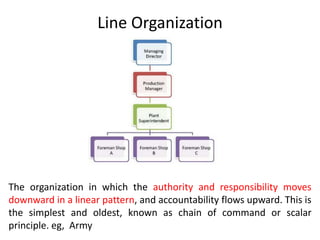
Line Organization
The organization in which the authority and responsibility moves
downward in a linear pattern, and accountability flows upward. This is
the simplest and oldest, known as chain of command or scalar
principle. eg, Army
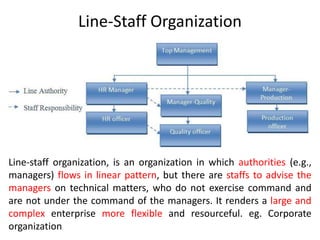
Line-Staff Organization
Line-staff organization, is an organization in which authorities (e.g.,
managers) flows in linear pattern, but there are staffs to advise the
managers on technical matters, who do not exercise command and
are not under the command of the managers. It renders a large and
complex enterprise more flexible and resourceful. eg. Corporate
organization
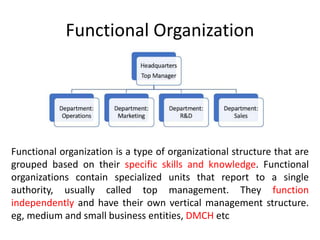
Functional Organization
Functional organization is a type of organizational structure that are
grouped based on their specific skills and knowledge. Functional
organizations contain specialized units that report to a single
authority, usually called top management. They function
independently and have their own vertical management structure.
eg, medium and small business entities, DMCH etc
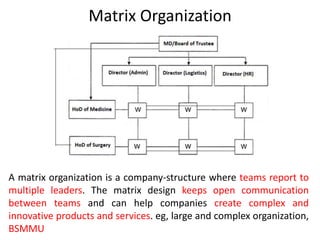
Matrix Organization
A matrix organization is a company-structure where teams report to
multiple leaders. The matrix design keeps open communication
between teams and can help companies create complex and
innovative products and services. eg, large and complex organization,
BSMMU
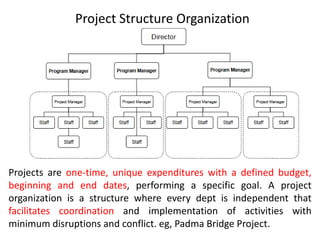
Project Structure Organization
Projects are one-time, unique expenditures with a defined budget,
beginning and end dates, performing a specific goal. A project
organization is a structure where every dept is independent that
facilitates coordination and implementation of activities with
minimum disruptions and conflict. eg, Padma Bridge Project.
???
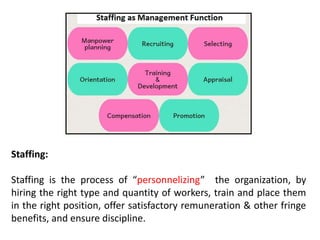
Staffing:
Staffing is the process of “personnelizing” the organization, by
hiring the right type and quantity of workers, train and place them
in the right position, offer satisfactory remuneration & other fringe
benefits, and ensure discipline.
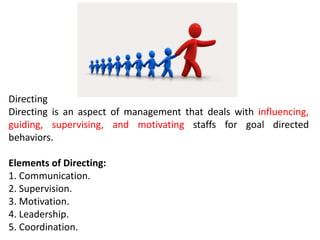
Directing
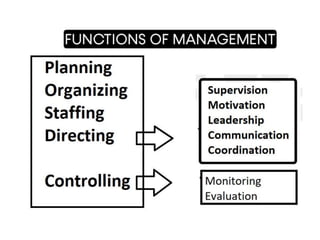
Directing is an aspect of management that deals with influencing,
guiding, supervising, and motivating staffs for goal directed
behaviors.
Elements of Directing:
1. Communication.
2. Supervision.
3. Motivation.
4. Leadership.
5. Coordination.
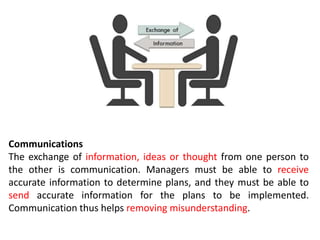
Communications
The exchange of information, ideas or thought from one person to
the other is communication. Managers must be able to receive
accurate information to determine plans, and they must be able to
send accurate information for the plans to be implemented.
Communication thus helps removing misunderstanding.
Supervision:
Supervision means “Overseeing the subordinates at work, with an
aim to guide them.
Leadership:
Leadership is the ability to influence people and inspire trust and
confidence in them for a purpose. These people tend to have great
motivation, a clear and positive vision and are very good at
communicating.
Coordination:
Coordination is the integration and synchronization of people and
group, so that they can work together properly to achieve an
organizational goal.
Motivation:
Motivation is the process of stimulating people to actions to
accomplish the goals. Motivation is the process that initiates, guides,
and maintains goal-oriented behaviors. Managers follow ‘Maslow’s
Need of Hierarchy’ principles to satisfy the ‘needs’ of people as the
strongest motivator.
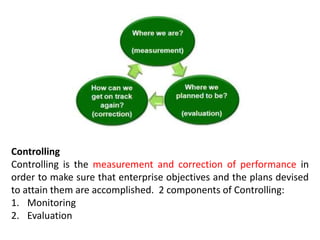
Controlling
Controlling is the measurement and correction of performance in
order to make sure that enterprise objectives and the plans devised
to attain them are accomplished. 2 components of Controlling:
1. Monitoring
2. Evaluation
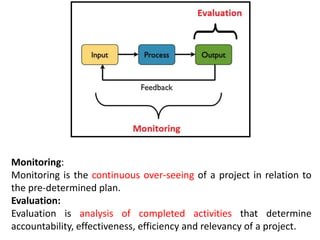
Monitoring:
Monitoring is the continuous over-seeing of a project in relation to
the pre-determined plan.
Evaluation:
Evaluation is analysis of completed activities that determine
accountability, effectiveness, efficiency and relevancy of a project.
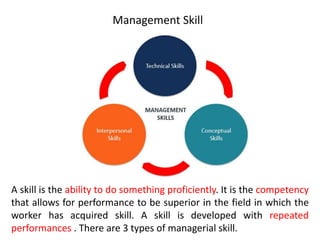
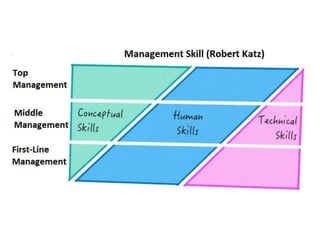
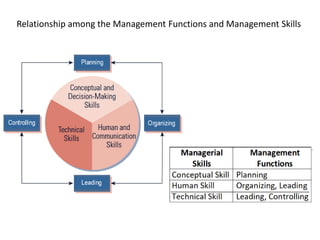
A skill is the ability to do something proficiently. It is the competency
that allows for performance to be superior in the field in which the
worker has acquired skill. A skill is developed with repeated
performances . There are 3 types of managerial skill.
Management Skill
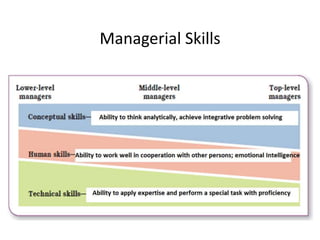
Managerial Skills
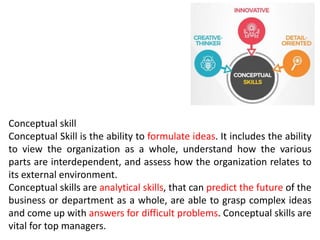
Conceptual skill
Conceptual Skill is the ability to formulate ideas. It includes the ability
to view the organization as a whole, understand how the various
parts are interdependent, and assess how the organization relates to
its external environment.
Conceptual skills are analytical skills, that can predict the future of the
business or department as a whole, are able to grasp complex ideas
and come up with answers for difficult problems. Conceptual skills are
vital for top managers.
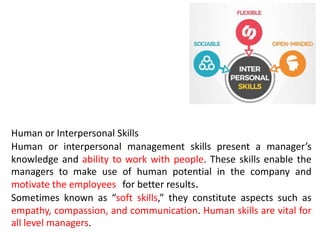
Human or Interpersonal Skills
Human or interpersonal management skills present a manager’s
knowledge and ability to work with people. These skills enable the
managers to make use of human potential in the company and
motivate the employees for better results.
Sometimes known as “soft skills,” they constitute aspects such as
empathy, compassion, and communication. Human skills are vital for
all level managers.
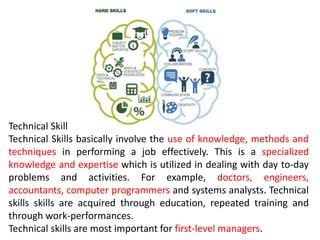
Technical Skill
Technical Skills basically involve the use of knowledge, methods and
techniques in performing a job effectively. This is a specialized
knowledge and expertise which is utilized in dealing with day to-day
problems and activities. For example, doctors, engineers,
accountants, computer programmers and systems analysts. Technical
skills skills are acquired through education, repeated training and
through work-performances.
Technical skills are most important for first-level managers.
Relationship among the Management Functions and Management Skills
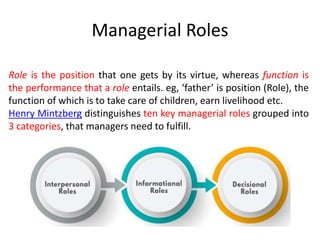
Managerial Roles
Role is the position that one gets by its virtue, whereas function is
the performance that a role entails. eg, ‘father’ is position (Role), the
function of which is to take care of children, earn livelihood etc.
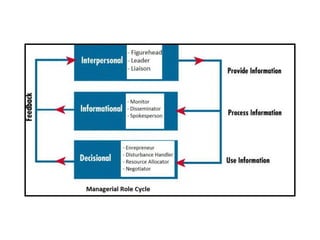
Henry Mintzberg distinguishes ten key managerial roles grouped into
3 categories, that managers need to fulfill.
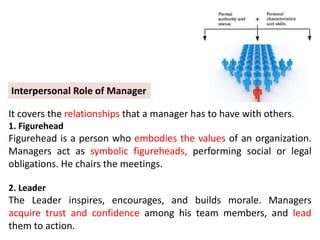
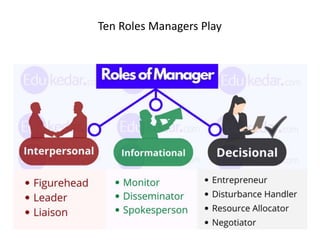
Ten Roles Managers Play
It covers the relationships that a manager has to have with others.
1. Figurehead
Figurehead is a person who embodies the values of an organization.
Managers act as symbolic figureheads, performing social or legal
obligations. He chairs the meetings.
2. Leader
The Leader inspires, encourages, and builds morale. Managers
acquire trust and confidence among his team members, and lead
them to action.
Interpersonal Role of Manager
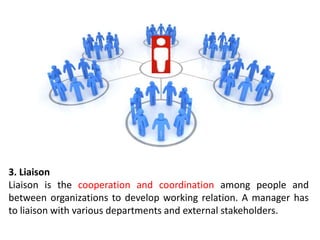
3. Liaison
Liaison is the cooperation and coordination among people and
between organizations to develop working relation. A manager has
to liaison with various departments and external stakeholders.
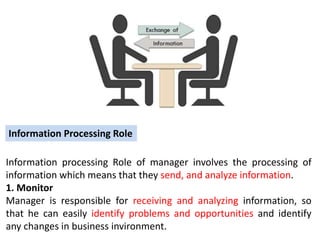
Information processing Role of manager involves the processing of
information which means that they send, and analyze information.
1. Monitor
Manager is responsible for receiving and analyzing information, so
that he can easily identify problems and opportunities and identify
any changes in business invironment.
Information Processing Role
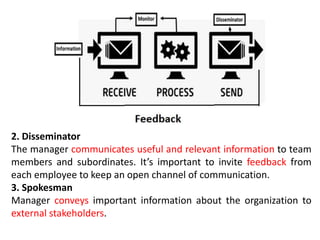
2. Disseminator
The manager communicates useful and relevant information to team
members and subordinates. It’s important to invite feedback from
each employee to keep an open channel of communication.
3. Spokesman
Manager conveys important information about the organization to
external stakeholders.
Managers are responsible for decision-making.
1. Entrepreneur
Entrepreneur is one who organizes, manages, and assumes the risks
of a business or enterprise. As entrepreneurs, managers are
constantly on the lookout for new ideas for improvement of product
or service.
2. Disturbance handler
Manager will always immediately respond to unexpected events and
operational breakdowns.
Decision-making
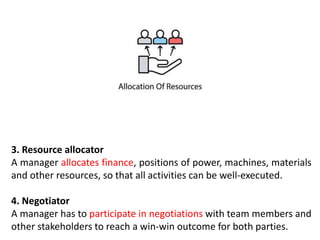
3. Resource allocator
A manager allocates finance, positions of power, machines, materials
and other resources, so that all activities can be well-executed.
4. Negotiator
A manager has to participate in negotiations with team members and
other stakeholders to reach a win-win outcome for both parties.
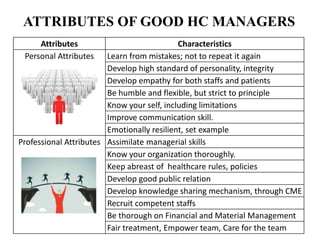
Attributes Characteristics
Personal Attributes Learn from mistakes; not to repeat it again
Develop high standard of personality, integrity
Develop empathy for both staffs and patients
Be humble and flexible, but strict to principle
Know your self, including limitations
Improve communication skill.
Emotionally resilient, set example
Professional Attributes Assimilate managerial skills
Know your organization thoroughly.
Keep abreast of healthcare rules, policies
Develop good public relation
Develop knowledge sharing mechanism, through CME
Recruit competent staffs
Be thorough on Financial and Material Management
Fair treatment, Empower team, Care for the team
ATTRIBUTES OF GOOD HC MANAGERS
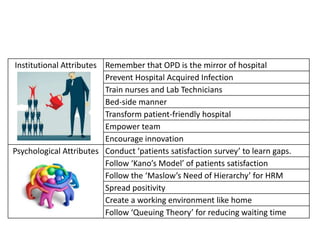
Institutional Attributes Remember that OPD is the mirror of hospital
Prevent Hospital Acquired Infection
Train nurses and Lab Technicians
Bed-side manner
Transform patient-friendly hospital
Empower team
Encourage innovation
Psychological Attributes Conduct ‘patients satisfaction survey’ to learn gaps.
Follow ‘Kano’s Model’ of patients satisfaction
Follow the ‘Maslow’s Need of Hierarchy’ for HRM
Spread positivity
Create a working environment like home
Follow ‘Queuing Theory’ for reducing waiting time
CONCLUSION
Assignment-2 (10/6/22)
Dr Iqbal Ahmed, the Director of DMCH from his source found that
there are dissatisfaction among the nurses on their social status in
work place. Which dept of hospital is to deal with this issue?
Illustrate the skills required by a Hospital Manager to be
successful.
Pl submit in Hard Copy on Next Class.
zulfiquer.amin@northsouth.edu/ zulfiquer732@yahoo.com

Management Functions, Skills and Roles.pptx

  • 1.
    Management Functions, Skillsand Roles Brigadier General Dr Zulfiquer Ahmed Amin M Phil, MPH, PGD (Health Economics), MBBS
  • 2.
    PERCEPTION Perception is howwe interpret our surroundings through our knowledge and experiences
  • 3.
    What is Management? Managementis the art and science of getting things done with and through people, in a formally organized group. Management is the process of designing and maintaining an environment in which individuals, working together in groups, efficiently accomplish selected aims.
  • 5.
    Planning is makingdecision for future events. Planning is the fundamental management function, which involves deciding beforehand, what is to be done, when is it to be done, who is going to do it, and how it is to be done. It is deciding the direction in which all the efforts and all the resources of the organization will be directed, over a fixed time, to attain a goal. Plan is made by scanning the business environment by SWOT (Strength, Weakness, Opportunity and Threat) analysis. Planning:
  • 6.
  • 7.
    Types of Plan StrategicPlanning Strategic plans are all about ‘why and what things need to happen’. Strategic plans are generally long-term (Within 10 years) plan made by the top-level managers. It focus on goal, mission, vision, policy. A strategy should be ‘SMART’, an acronym stands for Specific, Measurable, Achievable, Realistic and Time. eg, Vision-2030.
  • 8.
    Tactical Planning Tactical plansare about ‘what is going to happen’. It is the process of breaking down the strategic plan into distinctive short term (1-5 years) plans made at mid level manager. It focus on coordination. eg, Strategic Plan: Vision-2030; Tactical Plan: Attracting foreign investment, attract migrants’ money, increase export etc
  • 9.
    Operational Planning Operational plansare about ‘how things need to happen’. It is transforming plan into action, for daily activities (<1 year) to achieve goal. It mostly focus on control, and performed by first line manager. eg, Strategic Plan: Vision-2030; Operation Plan: devaluate money against dollar to attract migrants to send more money, socio-political stability to encourage foreign investment etc.
  • 10.
    Contingency Planning Contingency plansare back-up plans, when primary plan fails, or when something unexpected happens, or something needs to be changed. eg, influx of huge patients of burn injury (eg, Shitakunda BM container depot fire from H2O2) in CMCH.
  • 11.
    Satellite view ofrecent Shitakunda H2O2 Fire incidence
  • 13.
    Organizing ‘Organizing’ is theprocess of identifying and grouping the tasks to be performed, delegating responsibilities with appropriate authority, and establishing relationship for enabling people to work more effectively together for accomplishing the tasks. The process of ‘organization’ implies to the arrangement of human and non-human resources in an orderly fashion to accomplish organizational objectives.
  • 14.
    In organizing atask, there are 3 factors: • Authority: Is the right to make decisions, issue orders and allocate resources to achieve desired outcomes. • Responsibility: This is an obligation incurred by individuals in performing their roles in the formal organization.
  • 15.
    • Accountability: Theextent to which an individual or project team is answerable to the project stakeholders and provides visible evidence of action.
  • 16.
    Types of Organization Line Organization  Line and Staff Organization  Functional Organization  Matrix Organization  Project Structure Organization
  • 17.
    Line Organization The organizationin which the authority and responsibility moves downward in a linear pattern, and accountability flows upward. This is the simplest and oldest, known as chain of command or scalar principle. eg, Army
  • 18.
    Line-Staff Organization Line-staff organization,is an organization in which authorities (e.g., managers) flows in linear pattern, but there are staffs to advise the managers on technical matters, who do not exercise command and are not under the command of the managers. It renders a large and complex enterprise more flexible and resourceful. eg. Corporate organization
  • 19.
    Functional Organization Functional organizationis a type of organizational structure that are grouped based on their specific skills and knowledge. Functional organizations contain specialized units that report to a single authority, usually called top management. They function independently and have their own vertical management structure. eg, medium and small business entities, DMCH etc
  • 20.
    Matrix Organization A matrixorganization is a company-structure where teams report to multiple leaders. The matrix design keeps open communication between teams and can help companies create complex and innovative products and services. eg, large and complex organization, BSMMU
  • 21.
    Project Structure Organization Projectsare one-time, unique expenditures with a defined budget, beginning and end dates, performing a specific goal. A project organization is a structure where every dept is independent that facilitates coordination and implementation of activities with minimum disruptions and conflict. eg, Padma Bridge Project.
  • 22.
  • 23.
    Staffing: Staffing is theprocess of “personnelizing” the organization, by hiring the right type and quantity of workers, train and place them in the right position, offer satisfactory remuneration & other fringe benefits, and ensure discipline.
  • 24.
    Directing Directing is anaspect of management that deals with influencing, guiding, supervising, and motivating staffs for goal directed behaviors. Elements of Directing: 1. Communication. 2. Supervision. 3. Motivation. 4. Leadership. 5. Coordination.
  • 25.
    Communications The exchange ofinformation, ideas or thought from one person to the other is communication. Managers must be able to receive accurate information to determine plans, and they must be able to send accurate information for the plans to be implemented. Communication thus helps removing misunderstanding.
  • 26.
    Supervision: Supervision means “Overseeingthe subordinates at work, with an aim to guide them. Leadership: Leadership is the ability to influence people and inspire trust and confidence in them for a purpose. These people tend to have great motivation, a clear and positive vision and are very good at communicating.
  • 27.
    Coordination: Coordination is theintegration and synchronization of people and group, so that they can work together properly to achieve an organizational goal. Motivation: Motivation is the process of stimulating people to actions to accomplish the goals. Motivation is the process that initiates, guides, and maintains goal-oriented behaviors. Managers follow ‘Maslow’s Need of Hierarchy’ principles to satisfy the ‘needs’ of people as the strongest motivator.
  • 28.
    Controlling Controlling is themeasurement and correction of performance in order to make sure that enterprise objectives and the plans devised to attain them are accomplished. 2 components of Controlling: 1. Monitoring 2. Evaluation
  • 29.
    Monitoring: Monitoring is thecontinuous over-seeing of a project in relation to the pre-determined plan. Evaluation: Evaluation is analysis of completed activities that determine accountability, effectiveness, efficiency and relevancy of a project.
  • 30.
    A skill isthe ability to do something proficiently. It is the competency that allows for performance to be superior in the field in which the worker has acquired skill. A skill is developed with repeated performances . There are 3 types of managerial skill. Management Skill
  • 31.
  • 32.
    Conceptual skill Conceptual Skillis the ability to formulate ideas. It includes the ability to view the organization as a whole, understand how the various parts are interdependent, and assess how the organization relates to its external environment. Conceptual skills are analytical skills, that can predict the future of the business or department as a whole, are able to grasp complex ideas and come up with answers for difficult problems. Conceptual skills are vital for top managers.
  • 33.
    Human or InterpersonalSkills Human or interpersonal management skills present a manager’s knowledge and ability to work with people. These skills enable the managers to make use of human potential in the company and motivate the employees for better results. Sometimes known as “soft skills,” they constitute aspects such as empathy, compassion, and communication. Human skills are vital for all level managers.
  • 34.
    Technical Skill Technical Skillsbasically involve the use of knowledge, methods and techniques in performing a job effectively. This is a specialized knowledge and expertise which is utilized in dealing with day to-day problems and activities. For example, doctors, engineers, accountants, computer programmers and systems analysts. Technical skills skills are acquired through education, repeated training and through work-performances. Technical skills are most important for first-level managers.
  • 36.
    Relationship among theManagement Functions and Management Skills
  • 37.
    Managerial Roles Role isthe position that one gets by its virtue, whereas function is the performance that a role entails. eg, ‘father’ is position (Role), the function of which is to take care of children, earn livelihood etc. Henry Mintzberg distinguishes ten key managerial roles grouped into 3 categories, that managers need to fulfill.
  • 38.
  • 39.
    It covers therelationships that a manager has to have with others. 1. Figurehead Figurehead is a person who embodies the values of an organization. Managers act as symbolic figureheads, performing social or legal obligations. He chairs the meetings. 2. Leader The Leader inspires, encourages, and builds morale. Managers acquire trust and confidence among his team members, and lead them to action. Interpersonal Role of Manager
  • 40.
    3. Liaison Liaison isthe cooperation and coordination among people and between organizations to develop working relation. A manager has to liaison with various departments and external stakeholders.
  • 41.
    Information processing Roleof manager involves the processing of information which means that they send, and analyze information. 1. Monitor Manager is responsible for receiving and analyzing information, so that he can easily identify problems and opportunities and identify any changes in business invironment. Information Processing Role
  • 42.
    2. Disseminator The managercommunicates useful and relevant information to team members and subordinates. It’s important to invite feedback from each employee to keep an open channel of communication. 3. Spokesman Manager conveys important information about the organization to external stakeholders.
  • 43.
    Managers are responsiblefor decision-making. 1. Entrepreneur Entrepreneur is one who organizes, manages, and assumes the risks of a business or enterprise. As entrepreneurs, managers are constantly on the lookout for new ideas for improvement of product or service. 2. Disturbance handler Manager will always immediately respond to unexpected events and operational breakdowns. Decision-making
  • 44.
    3. Resource allocator Amanager allocates finance, positions of power, machines, materials and other resources, so that all activities can be well-executed. 4. Negotiator A manager has to participate in negotiations with team members and other stakeholders to reach a win-win outcome for both parties.
  • 46.
    Attributes Characteristics Personal AttributesLearn from mistakes; not to repeat it again Develop high standard of personality, integrity Develop empathy for both staffs and patients Be humble and flexible, but strict to principle Know your self, including limitations Improve communication skill. Emotionally resilient, set example Professional Attributes Assimilate managerial skills Know your organization thoroughly. Keep abreast of healthcare rules, policies Develop good public relation Develop knowledge sharing mechanism, through CME Recruit competent staffs Be thorough on Financial and Material Management Fair treatment, Empower team, Care for the team ATTRIBUTES OF GOOD HC MANAGERS
  • 47.
    Institutional Attributes Rememberthat OPD is the mirror of hospital Prevent Hospital Acquired Infection Train nurses and Lab Technicians Bed-side manner Transform patient-friendly hospital Empower team Encourage innovation Psychological Attributes Conduct ‘patients satisfaction survey’ to learn gaps. Follow ‘Kano’s Model’ of patients satisfaction Follow the ‘Maslow’s Need of Hierarchy’ for HRM Spread positivity Create a working environment like home Follow ‘Queuing Theory’ for reducing waiting time
  • 49.
  • 51.
    Assignment-2 (10/6/22) Dr IqbalAhmed, the Director of DMCH from his source found that there are dissatisfaction among the nurses on their social status in work place. Which dept of hospital is to deal with this issue? Illustrate the skills required by a Hospital Manager to be successful. Pl submit in Hard Copy on Next Class. zulfiquer.amin@northsouth.edu/ zulfiquer732@yahoo.com