Chapter 1  The Nature of Strategic Management Strategic Management:  Concepts & Cases 10 th  Edition Fred David Stolen from: 4AAC (Batch 2008) Yahoogroups
Themes in the Text Global Considerations   –  impact virtually all strategic decisions E-commerce  –  vital strategic management tool. Natural environment   –  important strategic issue.
Art & science of  formulating ,  implementing , and  evaluating , cross-functional decisions that enable an organization to achieve its objectives. Strategic Management – Defined
In essence, the  strategic plan  is a company’s  game plan . Strategic Management
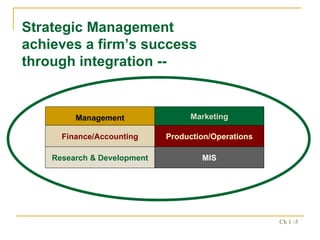
Strategic Management achieves a firm’s success through integration -- Management MIS Production/Operations Finance/Accounting Marketing Research & Development
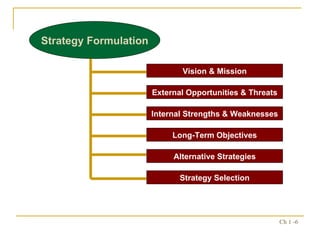
Vision & Mission Strategy Formulation External Opportunities & Threats Internal Strengths & Weaknesses Long-Term Objectives Alternative Strategies Strategy Selection
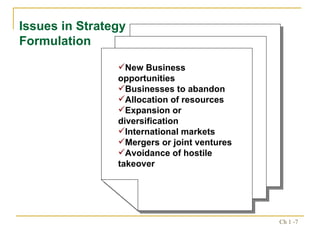
Issues in Strategy Formulation New Business opportunities Businesses to abandon Allocation of resources Expansion or diversification International markets Mergers or joint ventures Avoidance of hostile takeover
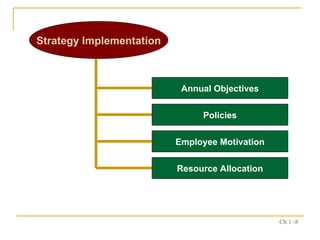
Strategy Implementation Annual Objectives Policies Employee Motivation Resource Allocation
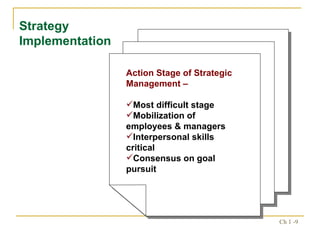
Strategy Implementation Action Stage of Strategic Management – Most difficult stage Mobilization of employees & managers Interpersonal skills critical Consensus on goal pursuit
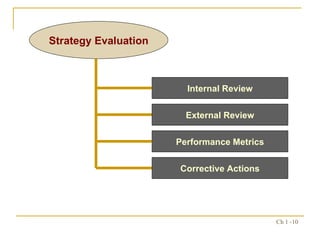
Strategy Evaluation Internal Review External Review Performance Metrics Corrective Actions
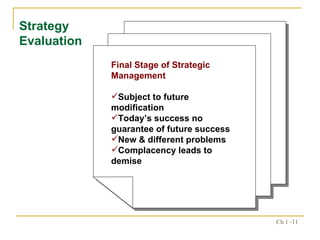
Strategy Evaluation Final Stage of Strategic Management Subject to future modification Today’s success no guarantee of future success New & different problems Complacency leads to demise
Peter Drucker : --  think through the overall mission of a business.  Ask the key question :  “ What is our Business?” Prime Task of  Strategic Management
The strategic management process attempts to organize quantitative and qualitative information under conditions of uncertainty. Integrating  Intuition  and  Analysis
Intuition is based on: Past experiences Judgment Feelings Integrating  Intuition  and  Analysis Intuition is   Useful for decision making Conditions of great uncertainty Conditions with little precedent
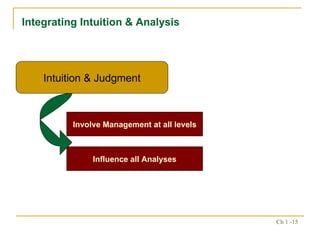
Involve Management at all levels Intuition & Judgment Influence all Analyses Integrating Intuition & Analysis
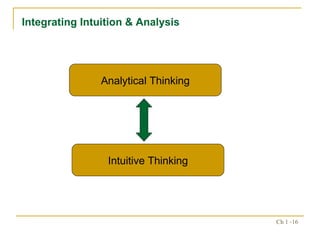
Analytical Thinking Integrating Intuition & Analysis Intuitive Thinking
Organizations must monitor events On-going process Internal and external events Timely changes Adapting to Change
“ Anything that a firm does especially well compared to rival firms” Strategic Management is Gaining and Maintaining  Competitive Advantage
1.  Adapting to change in external trends, internal capabilities and resources Achieving  Sustained Competitive Advantage 2.  Effectively formulating, implementing & evaluating strategies
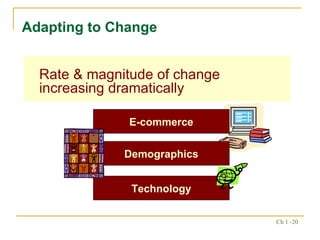
Rate & magnitude of change increasing dramatically Adapting to Change E-commerce Demographics Technology
Effective Adaptation Adapting to Change Requires long-term focus
What kind of business should we become? Are we in the right fields Are there new competitors What strategies should we pursue? How are our customers changing? Adapting to Change – Key Strategic Management Questions
Key Terms Various Job Titles: Chief Executive Officer (CEO) Chief Strategy Officer (CSO) President Owner Board Chair Executive Director Strategists  – Firm’s success/failure
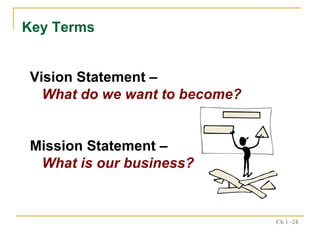
Vision Statement – What do we want to become? Mission Statement – What is our business? Key Terms
Largely beyond the control of a single organization Key Terms  Opportunities and Threats (External)
Opportunities & Threats  (External)  Key Terms Analysis of Trends: Economic Social Cultural Demographic/Environmental Political, Legal, Governmental Technological Competitors
Process of conducting research and gathering and assimilating external information Key Terms  Opportunities & Threats Environmental Scanning (Industry Analysis)
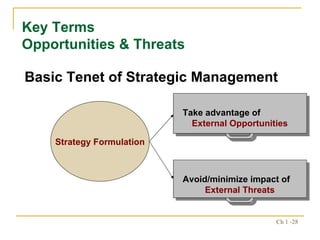
Basic Tenet of Strategic Management Key Terms  Opportunities & Threats Strategy Formulation Take advantage of  External Opportunities Avoid/minimize impact of External Threats
Controllable activities performed especially well or poorly Key Terms  Strengths & Weaknesses (Internal)
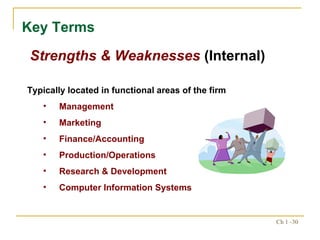
Strengths & Weaknesses  (Internal)  Key Terms Typically located in functional areas of the firm Management Marketing Finance/Accounting Production/Operations Research & Development Computer Information Systems
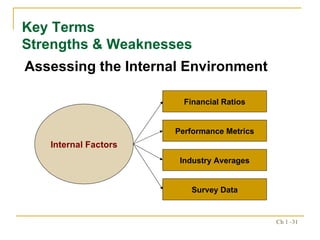
Assessing the Internal Environment Key Terms  Strengths & Weaknesses Internal Factors Performance Metrics Financial Ratios Industry Averages Survey Data
Mission-driven pursuit of specified results more than one year out Key Terms  Long-term Objectives
Long-term Objectives Key Terms Essential for ensuring the firm’s success Provide direction Aid in evaluation Create synergy Focus coordination Basis for planning, motivating, and  controlling
Means by which long-term objectives are achieved Key Terms  Strategies
Strategies Key Terms Some Examples Geographic expansion Diversification Acquisition Market penetration Retrenchment Liquidation Joint venture
Short-term milestones that firms must achieve to attain long-term objectives Key Terms  Annual Objectives
Means by which annual objectives will be achieved Key Terms  Policies
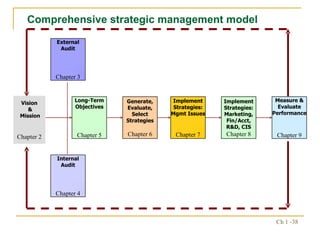
Comprehensive strategic management model External Audit Chapter 3 Internal Audit Chapter 4 Long-Term Objectives Chapter 5 Generate, Evaluate, Select Strategies Chapter 6 Implement Strategies: Mgmt Issues Chapter 7 Implement Strategies: Marketing, Fin/Acct, R&D, CIS Chapter 8 Measure & Evaluate Performance Chapter 9 Vision & Mission Chapter 2
Dynamic & Continuous More formal in larger organizations Strategic Management Model Strategic Management Process
1.  Identify Existing -- Strategic Management Model Vision Mission Objectives Strategies
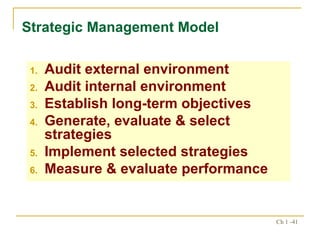
Audit external environment Audit internal environment Establish long-term objectives Generate, evaluate & select strategies Implement selected strategies Measure & evaluate performance Strategic Management Model
Benefits of Strategic Management Proactive in shaping firm’s future Initiate and influence firm’s activities Formulate better strategies Systematic, logical, rational
Benefits of Strategic Management Financial Benefits Improvement in sales Improvement in profitability Productivity improvement
Benefits of Strategic Management Non- Financial Benefits Improved understanding of competitors strategies Enhanced awareness of threats Reduced resistance to change Enhanced problem-prevention capabilities
Benefits of Strategic Management (Greenley) Identification of Opportunities Objective view of management problems Improved coordination & control Minimizes adverse conditions & changes Decisions that better support objectives
Benefits of Strategic Management (Greenley –  cont’d ) Effective allocation of time & resources Internal communication among personnel Integration of individual behaviors Clarify individual responsibilities Encourage forward thinking
Benefits of Strategic Management (Greenley  – cont’d  ) Encourages favorable attitude toward change Provides discipline and formality to the management of the business
Why Some Firms Do  No  Strategic Planning Poor reward structures Fire-fighting Waste of time Too expensive Laziness Content with success
Why Some Firms Do  No  Strategic Planning Fear of failure Overconfidence Prior bad experience Self-interest Fear of the unknown Suspicion
Principles of conduct within organizations that guide decision making and behavior. Business Ethics & Strategic Management Business Ethics defined --
Prerequisite for good strategic management Business Ethics & Strategic Management Good business ethics –
Provides basis on which policies can be devised to guide daily behavior and decisions in the workplace Business Ethics & Strategic Management Code of business ethics –
Misleading advertising Misleading labeling Harm to the environment Insider trading Dumping flawed products on foreign markets Poor product or service safety Padding expense accounts Business Ethics & Strategic Management Business practices always considered unethical –
ISO 9000 focuses on quality control > 1.5 million companies incorporate ISO Natural Environment Perspective ISO used to gain strategic advantage
Voluntary standards  ISO 14001 standard for Environmental Management System Firms minimize harmful effects on environment Natural Environment Perspective ISO 14000 standards
Parent company Host country The Nature of Global Competition International/multinational corporations
Cultural differences Norms Values Work ethic The Nature of Global Competition Strategy implementation may be difficult
Advantages of International Operations Absorb excess capacity Reduce unit costs Spread risk over wider markets Low-cost production facilities
Advantages of International Operations ( cont’d ) Less intense competition Lower taxes Economies of scale
Disadvantages of International Operations Difficult communications Underestimate foreign competition Cultural barriers to effective management Complications arising from currency differences

Chapter01

  • 1.
    Chapter 1 The Nature of Strategic Management Strategic Management: Concepts & Cases 10 th Edition Fred David Stolen from: 4AAC (Batch 2008) Yahoogroups
  • 2.
    Themes in theText Global Considerations – impact virtually all strategic decisions E-commerce – vital strategic management tool. Natural environment – important strategic issue.
  • 3.
    Art & scienceof formulating , implementing , and evaluating , cross-functional decisions that enable an organization to achieve its objectives. Strategic Management – Defined
  • 4.
    In essence, the strategic plan is a company’s game plan . Strategic Management
  • 5.
    Strategic Management achievesa firm’s success through integration -- Management MIS Production/Operations Finance/Accounting Marketing Research & Development
  • 6.
    Vision & MissionStrategy Formulation External Opportunities & Threats Internal Strengths & Weaknesses Long-Term Objectives Alternative Strategies Strategy Selection
  • 7.
    Issues in StrategyFormulation New Business opportunities Businesses to abandon Allocation of resources Expansion or diversification International markets Mergers or joint ventures Avoidance of hostile takeover
  • 8.
    Strategy Implementation AnnualObjectives Policies Employee Motivation Resource Allocation
  • 9.
    Strategy Implementation ActionStage of Strategic Management – Most difficult stage Mobilization of employees & managers Interpersonal skills critical Consensus on goal pursuit
  • 10.
    Strategy Evaluation InternalReview External Review Performance Metrics Corrective Actions
  • 11.
    Strategy Evaluation FinalStage of Strategic Management Subject to future modification Today’s success no guarantee of future success New & different problems Complacency leads to demise
  • 12.
    Peter Drucker :-- think through the overall mission of a business. Ask the key question : “ What is our Business?” Prime Task of Strategic Management
  • 13.
    The strategic managementprocess attempts to organize quantitative and qualitative information under conditions of uncertainty. Integrating Intuition and Analysis
  • 14.
    Intuition is basedon: Past experiences Judgment Feelings Integrating Intuition and Analysis Intuition is Useful for decision making Conditions of great uncertainty Conditions with little precedent
  • 15.
    Involve Management atall levels Intuition & Judgment Influence all Analyses Integrating Intuition & Analysis
  • 16.
    Analytical Thinking IntegratingIntuition & Analysis Intuitive Thinking
  • 17.
    Organizations must monitorevents On-going process Internal and external events Timely changes Adapting to Change
  • 18.
    “ Anything thata firm does especially well compared to rival firms” Strategic Management is Gaining and Maintaining Competitive Advantage
  • 19.
    1. Adaptingto change in external trends, internal capabilities and resources Achieving Sustained Competitive Advantage 2. Effectively formulating, implementing & evaluating strategies
  • 20.
    Rate & magnitudeof change increasing dramatically Adapting to Change E-commerce Demographics Technology
  • 21.
    Effective Adaptation Adaptingto Change Requires long-term focus
  • 22.
    What kind ofbusiness should we become? Are we in the right fields Are there new competitors What strategies should we pursue? How are our customers changing? Adapting to Change – Key Strategic Management Questions
  • 23.
    Key Terms VariousJob Titles: Chief Executive Officer (CEO) Chief Strategy Officer (CSO) President Owner Board Chair Executive Director Strategists – Firm’s success/failure
  • 24.
    Vision Statement –What do we want to become? Mission Statement – What is our business? Key Terms
  • 25.
    Largely beyond thecontrol of a single organization Key Terms Opportunities and Threats (External)
  • 26.
    Opportunities & Threats (External) Key Terms Analysis of Trends: Economic Social Cultural Demographic/Environmental Political, Legal, Governmental Technological Competitors
  • 27.
    Process of conductingresearch and gathering and assimilating external information Key Terms Opportunities & Threats Environmental Scanning (Industry Analysis)
  • 28.
    Basic Tenet ofStrategic Management Key Terms Opportunities & Threats Strategy Formulation Take advantage of External Opportunities Avoid/minimize impact of External Threats
  • 29.
    Controllable activities performedespecially well or poorly Key Terms Strengths & Weaknesses (Internal)
  • 30.
    Strengths & Weaknesses (Internal) Key Terms Typically located in functional areas of the firm Management Marketing Finance/Accounting Production/Operations Research & Development Computer Information Systems
  • 31.
    Assessing the InternalEnvironment Key Terms Strengths & Weaknesses Internal Factors Performance Metrics Financial Ratios Industry Averages Survey Data
  • 32.
    Mission-driven pursuit ofspecified results more than one year out Key Terms Long-term Objectives
  • 33.
    Long-term Objectives KeyTerms Essential for ensuring the firm’s success Provide direction Aid in evaluation Create synergy Focus coordination Basis for planning, motivating, and controlling
  • 34.
    Means by whichlong-term objectives are achieved Key Terms Strategies
  • 35.
    Strategies Key TermsSome Examples Geographic expansion Diversification Acquisition Market penetration Retrenchment Liquidation Joint venture
  • 36.
    Short-term milestones thatfirms must achieve to attain long-term objectives Key Terms Annual Objectives
  • 37.
    Means by whichannual objectives will be achieved Key Terms Policies
  • 38.
    Comprehensive strategic managementmodel External Audit Chapter 3 Internal Audit Chapter 4 Long-Term Objectives Chapter 5 Generate, Evaluate, Select Strategies Chapter 6 Implement Strategies: Mgmt Issues Chapter 7 Implement Strategies: Marketing, Fin/Acct, R&D, CIS Chapter 8 Measure & Evaluate Performance Chapter 9 Vision & Mission Chapter 2
  • 39.
    Dynamic & ContinuousMore formal in larger organizations Strategic Management Model Strategic Management Process
  • 40.
    1. IdentifyExisting -- Strategic Management Model Vision Mission Objectives Strategies
  • 41.
    Audit external environmentAudit internal environment Establish long-term objectives Generate, evaluate & select strategies Implement selected strategies Measure & evaluate performance Strategic Management Model
  • 42.
    Benefits of StrategicManagement Proactive in shaping firm’s future Initiate and influence firm’s activities Formulate better strategies Systematic, logical, rational
  • 43.
    Benefits of StrategicManagement Financial Benefits Improvement in sales Improvement in profitability Productivity improvement
  • 44.
    Benefits of StrategicManagement Non- Financial Benefits Improved understanding of competitors strategies Enhanced awareness of threats Reduced resistance to change Enhanced problem-prevention capabilities
  • 45.
    Benefits of StrategicManagement (Greenley) Identification of Opportunities Objective view of management problems Improved coordination & control Minimizes adverse conditions & changes Decisions that better support objectives
  • 46.
    Benefits of StrategicManagement (Greenley – cont’d ) Effective allocation of time & resources Internal communication among personnel Integration of individual behaviors Clarify individual responsibilities Encourage forward thinking
  • 47.
    Benefits of StrategicManagement (Greenley – cont’d ) Encourages favorable attitude toward change Provides discipline and formality to the management of the business
  • 48.
    Why Some FirmsDo No Strategic Planning Poor reward structures Fire-fighting Waste of time Too expensive Laziness Content with success
  • 49.
    Why Some FirmsDo No Strategic Planning Fear of failure Overconfidence Prior bad experience Self-interest Fear of the unknown Suspicion
  • 50.
    Principles of conductwithin organizations that guide decision making and behavior. Business Ethics & Strategic Management Business Ethics defined --
  • 51.
    Prerequisite for goodstrategic management Business Ethics & Strategic Management Good business ethics –
  • 52.
    Provides basis onwhich policies can be devised to guide daily behavior and decisions in the workplace Business Ethics & Strategic Management Code of business ethics –
  • 53.
    Misleading advertising Misleadinglabeling Harm to the environment Insider trading Dumping flawed products on foreign markets Poor product or service safety Padding expense accounts Business Ethics & Strategic Management Business practices always considered unethical –
  • 54.
    ISO 9000 focuseson quality control > 1.5 million companies incorporate ISO Natural Environment Perspective ISO used to gain strategic advantage
  • 55.
    Voluntary standards ISO 14001 standard for Environmental Management System Firms minimize harmful effects on environment Natural Environment Perspective ISO 14000 standards
  • 56.
    Parent company Hostcountry The Nature of Global Competition International/multinational corporations
  • 57.
    Cultural differences NormsValues Work ethic The Nature of Global Competition Strategy implementation may be difficult
  • 58.
    Advantages of InternationalOperations Absorb excess capacity Reduce unit costs Spread risk over wider markets Low-cost production facilities
  • 59.
    Advantages of InternationalOperations ( cont’d ) Less intense competition Lower taxes Economies of scale
  • 60.
    Disadvantages of InternationalOperations Difficult communications Underestimate foreign competition Cultural barriers to effective management Complications arising from currency differences