Innovation
Management
Dr. Govind Kr.
Assistant Professor, SOCMS,
Sandip University, Nashik
govind.kumar@sandipuniversity.edu.in
 Innovation is anything that proposes an alternative to something that is done in
a certain way, brings economic and behavioral benefits, solves problems, or
makes people's daily lives more practical.
 It can be related to a product, service, process, market, means of production,
technology, or anything else that brings about a change that becomes
sustained and indispensable.
 For innovation to take place, people and companies use the countless
possibilities technology offers. Technology is the basis that supports and
enables all types of innovation, since without good tools innovation can come
at the wrong time and lose the potential to scale your business.
 Remember that to innovate is to go beyond and exceed the expectations of
stakeholders and the market. For this to happen, you need speed, quality, and
precision.
What is Innovation ?
 Keeping processes organized: By being innovative in how
you perform processes, especially if you use technology, you
create standards and systematize the best work method for
your brand. And this is crucial for strategies to be successful,
results to be achieved, and goals to be reached.
 Developing creativity: With innovation, a company shows
that it's open to changes and that employees can contribute
with new ideas and see in practice the benefits new things can
bring to the day to day.
 Increasing the business’s competitiveness: By adopting
strategic resources, a company becomes more attractive to
customers, partners, and talents and gains a competitive
advantage in the market.
Advantages of Innovation
 Increasing productivity: Innovation proposes more
effective processes, more production control, effective
strategy, and more engaged employees.
 Adding value to a product or service: When you
innovate, you boost the marketing of products and
services, because you bring something different and
unique for your target audience.
 Increasing profits: With more productivity, a more
attractive business, and more effective management,
your business will consequently see greater profits.
Continue…
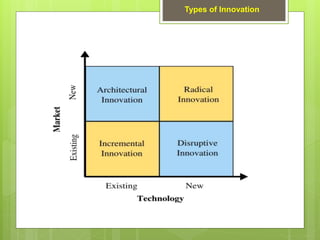
Types of Innovation
Incremental Innovation
Incremental Innovation is the most common form of
innovation. It utilizes your existing technology and
increases value to the customer (features, design
changes, etc.) within your existing market.
Almost all companies engage in incremental innovation in
one form or another.
Examples include adding new features to existing products
or services or even removing features (value through
simplification). Even small updates to user experience
can add value.
As the name suggests, a radical innovation really
changes the circumstances of a brand, whether in terms
of market or of business dynamics.
It can occur due to a complete change in a company's
positioning, work method, processes, services, and
products offered, or how it relates to customers.
An example of radical innovation would be Apple's iPhone.
When it was released, smartphones already existed, but
Apple included features that changed the market and made
it more popular.
Radical Innovation
Another type of innovation is incremental innovation. It adds new
features to a product, brand, or production methods without
promoting a very drastic change.
It's usually an evolution of an innovation already implemented
by the brand that complements and offers improvements, be it to
employees, customers, or features of a business.
An example of incremental innovation is Gmail, which was created
with the purpose of sending emails quickly – but over time,
different features were added to improve the customer experience
and make it more useful and competitive.
Incremental Innovation
Technological and behavioral changes have favored the emergence
of disruptive innovation in recent decades.
This type of innovation follows the market more than a specific
brand, product, or service. It can be leveraged by something a
company has offered and, as a result, made their name, but, in
general, it's a scalable change that reaches many people at the
same time.
Examples of disruptive innovation include Netflix, as the market used
to rely on companies like Blockbuster for movies and TV series.
Netflix started offering DVD-by-mail rental services but decided to
innovate. It started offering video streaming services through a
monthly subscription and, in doing so, drove Blockbuster out of the
market. In addition to being innovative, this also gave Netflix a
predictable monthly revenue.
Disruptive Innovation
 Product innovation
 Service innovation
 Innovation in production processes
 Innovation in business model
 Technological innovation
 Logistical innovation
 Marketing innovation
 Organizational innovation
Examples of Innovation
The stages of the innovation process are simple, and to innovate you must have
a system and repetition. Learn about them here:
Generation of new ideas: What are the opportunities in the field? What hasn't
been done yet and would actually change a product, service, or company?
Evaluation: What's necessary to put this into practice, is it possible, and how do
you make it viable?
Experimentation: It's vital to test your ideas and identify what really works and
what needs to be improved.
Marketing: Has it reached the sweet spot? It's time to offer to customers what
before was just an internal project.
Follow-up: Keeping track of what has been implemented is important to
understand public acceptance, audience, and strategy. To do that, feedback is
essential.
Stages of Innovation

Innovation Management.pptx

  • 1.
    Innovation Management Dr. Govind Kr. AssistantProfessor, SOCMS, Sandip University, Nashik govind.kumar@sandipuniversity.edu.in
  • 2.
     Innovation isanything that proposes an alternative to something that is done in a certain way, brings economic and behavioral benefits, solves problems, or makes people's daily lives more practical.  It can be related to a product, service, process, market, means of production, technology, or anything else that brings about a change that becomes sustained and indispensable.  For innovation to take place, people and companies use the countless possibilities technology offers. Technology is the basis that supports and enables all types of innovation, since without good tools innovation can come at the wrong time and lose the potential to scale your business.  Remember that to innovate is to go beyond and exceed the expectations of stakeholders and the market. For this to happen, you need speed, quality, and precision. What is Innovation ?
  • 3.
     Keeping processesorganized: By being innovative in how you perform processes, especially if you use technology, you create standards and systematize the best work method for your brand. And this is crucial for strategies to be successful, results to be achieved, and goals to be reached.  Developing creativity: With innovation, a company shows that it's open to changes and that employees can contribute with new ideas and see in practice the benefits new things can bring to the day to day.  Increasing the business’s competitiveness: By adopting strategic resources, a company becomes more attractive to customers, partners, and talents and gains a competitive advantage in the market. Advantages of Innovation
  • 4.
     Increasing productivity:Innovation proposes more effective processes, more production control, effective strategy, and more engaged employees.  Adding value to a product or service: When you innovate, you boost the marketing of products and services, because you bring something different and unique for your target audience.  Increasing profits: With more productivity, a more attractive business, and more effective management, your business will consequently see greater profits. Continue…
  • 5.
  • 6.
    Incremental Innovation Incremental Innovationis the most common form of innovation. It utilizes your existing technology and increases value to the customer (features, design changes, etc.) within your existing market. Almost all companies engage in incremental innovation in one form or another. Examples include adding new features to existing products or services or even removing features (value through simplification). Even small updates to user experience can add value.
  • 7.
    As the namesuggests, a radical innovation really changes the circumstances of a brand, whether in terms of market or of business dynamics. It can occur due to a complete change in a company's positioning, work method, processes, services, and products offered, or how it relates to customers. An example of radical innovation would be Apple's iPhone. When it was released, smartphones already existed, but Apple included features that changed the market and made it more popular. Radical Innovation
  • 8.
    Another type ofinnovation is incremental innovation. It adds new features to a product, brand, or production methods without promoting a very drastic change. It's usually an evolution of an innovation already implemented by the brand that complements and offers improvements, be it to employees, customers, or features of a business. An example of incremental innovation is Gmail, which was created with the purpose of sending emails quickly – but over time, different features were added to improve the customer experience and make it more useful and competitive. Incremental Innovation
  • 9.
    Technological and behavioralchanges have favored the emergence of disruptive innovation in recent decades. This type of innovation follows the market more than a specific brand, product, or service. It can be leveraged by something a company has offered and, as a result, made their name, but, in general, it's a scalable change that reaches many people at the same time. Examples of disruptive innovation include Netflix, as the market used to rely on companies like Blockbuster for movies and TV series. Netflix started offering DVD-by-mail rental services but decided to innovate. It started offering video streaming services through a monthly subscription and, in doing so, drove Blockbuster out of the market. In addition to being innovative, this also gave Netflix a predictable monthly revenue. Disruptive Innovation
  • 10.
     Product innovation Service innovation  Innovation in production processes  Innovation in business model  Technological innovation  Logistical innovation  Marketing innovation  Organizational innovation Examples of Innovation
  • 11.
    The stages ofthe innovation process are simple, and to innovate you must have a system and repetition. Learn about them here: Generation of new ideas: What are the opportunities in the field? What hasn't been done yet and would actually change a product, service, or company? Evaluation: What's necessary to put this into practice, is it possible, and how do you make it viable? Experimentation: It's vital to test your ideas and identify what really works and what needs to be improved. Marketing: Has it reached the sweet spot? It's time to offer to customers what before was just an internal project. Follow-up: Keeping track of what has been implemented is important to understand public acceptance, audience, and strategy. To do that, feedback is essential. Stages of Innovation