Entrepreneurs facing the unknown
1
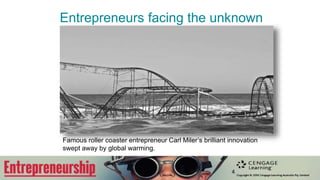
Famous roller coaster entrepreneur Carl Miler’s brilliant innovation
swept away by global warming.
Chapter 1
Entrepreneurship:
evolution and revolution
Objectives
1. To begin our exploration of entrepreneurship and the
environment
2. To distinguish between business and social entrepreneurs
3. To distinguish between entrepreneurs and small-business
owners
4. To explain the importance of entrepreneurs for economic growth
5. To examine the historical development of entrepreneurs and of
entrepreneurship
6. To define entrepreneurship and explore the major schools of
entrepreneurial thought
7. To realise that entrepreneurship is a pathway to freedom
Entrepreneurs facing the unknown
5
Famous roller coaster entrepreneur Carl Miler’s brilliant innovation
swept away by global warming.
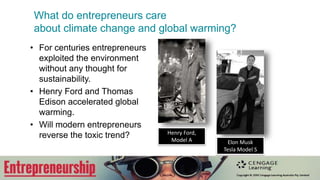
What do entrepreneurs care
about climate change and global warming?
• For centuries entrepreneurs
exploited the environment
without any thought for
sustainability.
• Henry Ford and Thomas
Edison accelerated global
warming.
• Will modern entrepreneurs
reverse the toxic trend? Henry Ford,
Model A Elon Musk
Tesla Model S
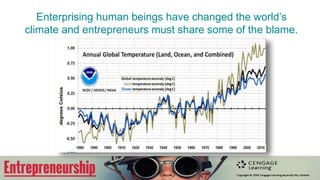
Enterprising human beings have changed the world’s
climate and entrepreneurs must share some of the blame.
Why we are hopeful
• How can we as entrepreneurs
stop this global environmental
catastrophe?
• Who is best positioned to
commercialise existing
innovations and create new
technologies?
• Entrepreneurs never waste a
good crisis
• Entrepreneurs recognise
opportunities where others see
chaos or confusion.
• Entrepreneurs could well be the
saviours of our planet.
• ‘Entrepreneurs who respond to
the challenge will reap
commercial success’
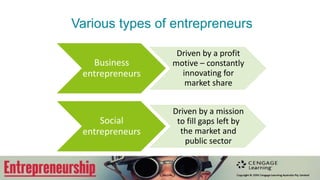
Various types of entrepreneurs
Business
entrepreneurs
Driven by a profit
motive – constantly
innovating for
market share
Social
entrepreneurs
Driven by a mission
to fill gaps left by
the market and
public sector
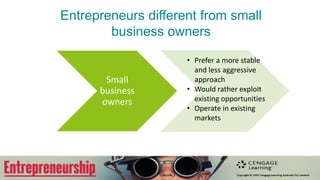
Entrepreneurs different from small
business owners
Small
business
owners
• Prefer a more stable
and less aggressive
approach
• Would rather exploit
existing opportunities
• Operate in existing
markets
Enterprising mind set
• Entrepreneurs have an enterprising mindset.
• Enterprising:
– ‘marked by imagination, initiative and readiness to
undertake new projects’.
• Entrepreneurial:
– ‘willing to take risks in order to create value’.
• Anyone can be enterprising.
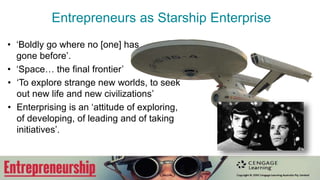
Entrepreneurs as Starship Enterprise
• ‘Boldly go where no [one] has
gone before’.
• ‘Space… the final frontier’
• ‘To explore strange new worlds, to seek
out new life and new civilizations’
• Enterprising is an ‘attitude of exploring,
of developing, of leading and of taking
initiatives’.
• What does the word
‘entrepreneur’ mean to you?
• In your language or culture, what
is the word for entrepreneur?
• What is its “root meaning” in your
language?
• Write it down on a sheet of paper
for use later.
?
Derivation & Definition
• The word ‘entrepreneur’ is a French verb entreprendre,
meaning ‘to take in between’, or ‘to undertake’ (someone
who undertakes)
• Today it means a social or business innovator
– who recognises and seizes opportunities;
– converts those opportunities into workable/marketable ideas;
– adds value through time, effort, money or skills;
– assumes the risks of the competitive marketplace to implement these ideas; and
– realises the rewards from these efforts.
In other languages and cultures
• usahawan (Malay) − someone who does a commercial
activity at some financial risk.
• pupagongan (Thai) − ‘someone who assembles other
people together’.
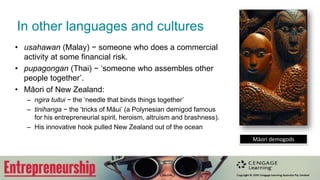
• Māori of New Zealand:
– ngira tuitui − the ‘needle that binds things together’
– tinihanga − the ‘tricks of Māui’ (a Polynesian demigod famous
for his entrepreneurial spirit, heroism, altruism and brashness).
– His innovative hook pulled New Zealand out of the ocean
Māori demogods
Entrepreneurship
through the ages
• Primitive hunter gatherers sought
niche advantage in the wild market
place.
• Ancient Assyrian had innovation and
a corps of knowledge workers.
• Phoenician traders peacefully
connected cultures through trade.
• Roman nobles let slave run their
enterprises.
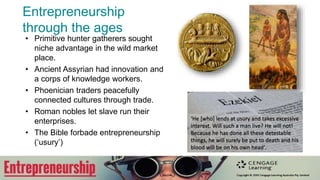
• The Bible forbade entrepreneurship
(‘usury’)
‘He [who] lends at usury and takes excessive
interest. Will such a man live? He will not!
Because he has done all these detestable
things, he will surely be put to death and his
blood will be on his own head’.
Entrepreneurship
through the ages
• Islam promoted entrepreneurship.
The Prophet Mohammed was a trade agent.
• During the Dark Ages, wealth creation came
through conquest; innovation was separate to
wealth creation.
• With the industrial revolution came a strong link
between entrepreneurial activity and wealth.
• Mark Twain’s Connecticut Yankee entrepreneur
transported magically back to King Arthur’s court.
Contemporary definitions
• Rugged individualists cherish
individual liberty and self-reliance
• Closely linked with free enterprise
and capitalism.
• Definition has broadened beyond
financial or business value to
creating social value.
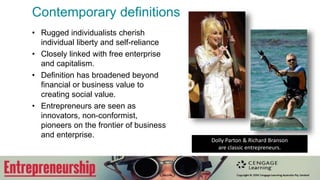
• Entrepreneurs are seen as
innovators, non-conformist,
pioneers on the frontier of business
and enterprise.
Dolly Parton & Richard Branson
are classic entrepreneurs.
Contemporary definitions
• Essential ingredients:
– Willingness to take calculated risks (time, equity, career)
– Ability to formulate an effective venture team
– Creative skill to marshal resources
– Skill of building a solid business plan
– Vision to recognise opportunity among chaos, contradiction and
confusion
– Entrepreneurs considered heroes of free enterprise and
social venturing.
– Many people now regard entrepreneurship as pioneership
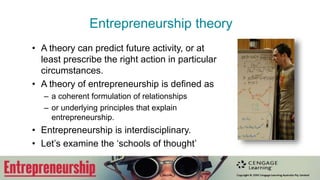
Entrepreneurship theory
• A theory can predict future activity, or at
least prescribe the right action in particular
circumstances.
• A theory of entrepreneurship is defined as
– a coherent formulation of relationships
– or underlying principles that explain
entrepreneurship.
• Entrepreneurship is interdisciplinary.
• Let’s examine the ‘schools of thought’
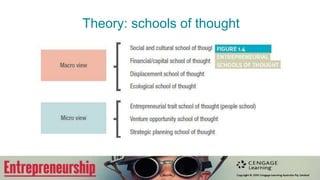
Theory: schools of thought
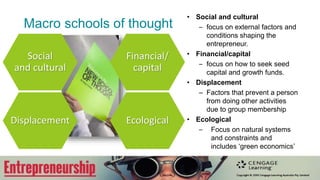
Macro schools of thought
• Social and cultural
– focus on external factors and
conditions shaping the
entrepreneur.
• Financial/capital
– focus on how to seek seed
capital and growth funds.
• Displacement
– Factors that prevent a person
from doing other activities
due to group membership
• Ecological
– Focus on natural systems
and constraints and
includes ‘green economics’
Social
and cultural
Financial/
capital
Displacement Ecological
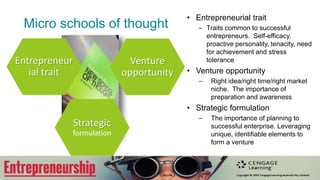
Micro schools of thought
• Entrepreneurial trait
– Traits common to successful
entrepreneurs. Self-efficacy,
proactive personality, tenacity, need
for achievement and stress
tolerance
• Venture opportunity
– Right idea/right time/right market
niche. The importance of
preparation and awareness
• Strategic formulation
– The importance of planning to
successful enterprise. Leveraging
unique, identifiable elements to
form a venture
Entrepreneur
ial trait
Venture
opportunity
Strategic
formulation
‘Your’ school of thought
• Earlier you were asked to write down
‘What does the word
“entrepreneurship” mean to you?’
• Go back to what you wrote and
identify which school(s) of thought is
demonstrated in your response.
?
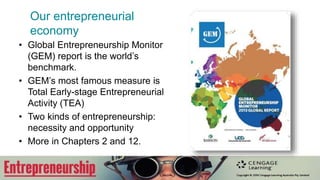
Our entrepreneurial
economy
• Global Entrepreneurship Monitor
(GEM) report is the world’s
benchmark.
• GEM’s most famous measure is
Total Early-stage Entrepreneurial
Activity (TEA)
• Two kinds of entrepreneurship:
necessity and opportunity
• More in Chapters 2 and 12.
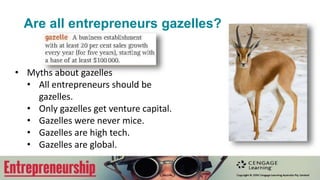
Are all entrepreneurs gazelles?
• Myths about gazelles
• All entrepreneurs should be
gazelles.
• Only gazelles get venture capital.
• Gazelles were never mice.
• Gazelles are high tech.
• Gazelles are global.
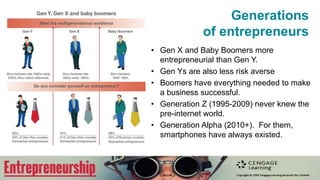
Generations
of entrepreneurs
• Gen X and Baby Boomers more
entrepreneurial than Gen Y.
• Gen Ys are also less risk averse
• Boomers have everything needed to make
a business successful.
• Generation Z (1995-2009) never knew the
pre-internet world.
• Generation Alpha (2010+). For them,
smartphones have always existed.
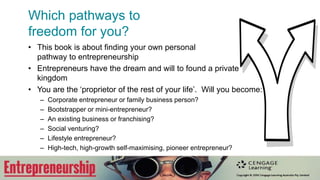
Which pathways to
freedom for you?
• This book is about finding your own personal
pathway to entrepreneurship
• Entrepreneurs have the dream and will to found a private
kingdom
• You are the ‘proprietor of the rest of your life’. Will you become:
– Corporate entrepreneur or family business person?
– Bootstrapper or mini-entrepreneur?
– An existing business or franchising?
– Social venturing?
– Lifestyle entrepreneur?
– High-tech, high-growth self-maximising, pioneer entrepreneur?
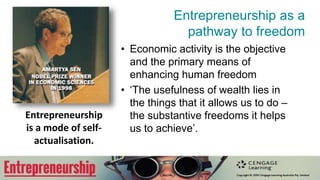
Entrepreneurship as a
pathway to freedom
• Economic activity is the objective
and the primary means of
enhancing human freedom
• ‘The usefulness of wealth lies in
the things that it allows us to do –
the substantive freedoms it helps
us to achieve’.
Entrepreneurship
is a mode of self-
actualisation.
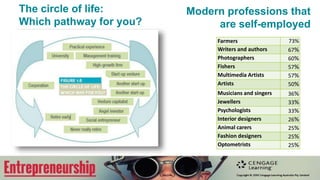
The circle of life:
Which pathway for you?
Farmers 73%
Writers and authors 67%
Photographers 60%
Fishers 57%
Multimedia Artists 57%
Artists 50%
Musicians and singers 36%
Jewellers 33%
Psychologists 33%
Interior designers 26%
Animal carers 25%
Fashion designers 25%
Optometrists 25%
Modern professions that
are self-employed
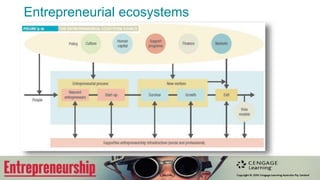
Entrepreneurial ecosystems
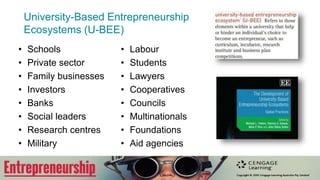
University-Based Entrepreneurship
Ecosystems (U-BEE)
• Labour
• Students
• Lawyers
• Cooperatives
• Councils
• Multinationals
• Foundations
• Aid agencies
• Schools
• Private sector
• Family businesses
• Investors
• Banks
• Social leaders
• Research centres
• Military
‘University-Based Entrepreneurship Ecosystem’
Does your university have . . . ?
• Links to angel and venture funds
• Business plan competitions
• Entrepreneurship student club(s)
• Business incubator
• Networking events for entrepreneurs
• Entrepreneurship activities centre
• Entrepreneurship research activities
• Student venture investment fund
Key concepts
(close your books)
1. Provide a short definition of the
word ‘entrepreneur’.
2. What will influence your
likelihood of becoming an
entrepreneur?
?
Key concepts
• An entrepreneur:
– recognises and seizes opportunities and converts
them into marketable ideas
– adds value through time, effort, money and skills
– assumes risks in a competitive marketplace.
• A range of perspectives (schools of thought)
• Choice to be an entrepreneur is influenced by
culture, education and situation

Entrepreneurship: evolution and revolution

  • 1.
    Entrepreneurs facing theunknown 1 Famous roller coaster entrepreneur Carl Miler’s brilliant innovation swept away by global warming.
  • 3.
  • 4.
    Objectives 1. To beginour exploration of entrepreneurship and the environment 2. To distinguish between business and social entrepreneurs 3. To distinguish between entrepreneurs and small-business owners 4. To explain the importance of entrepreneurs for economic growth 5. To examine the historical development of entrepreneurs and of entrepreneurship 6. To define entrepreneurship and explore the major schools of entrepreneurial thought 7. To realise that entrepreneurship is a pathway to freedom
  • 5.
    Entrepreneurs facing theunknown 5 Famous roller coaster entrepreneur Carl Miler’s brilliant innovation swept away by global warming.
  • 6.
    What do entrepreneurscare about climate change and global warming? • For centuries entrepreneurs exploited the environment without any thought for sustainability. • Henry Ford and Thomas Edison accelerated global warming. • Will modern entrepreneurs reverse the toxic trend? Henry Ford, Model A Elon Musk Tesla Model S
  • 7.
    Enterprising human beingshave changed the world’s climate and entrepreneurs must share some of the blame.
  • 8.
    Why we arehopeful • How can we as entrepreneurs stop this global environmental catastrophe? • Who is best positioned to commercialise existing innovations and create new technologies? • Entrepreneurs never waste a good crisis • Entrepreneurs recognise opportunities where others see chaos or confusion. • Entrepreneurs could well be the saviours of our planet. • ‘Entrepreneurs who respond to the challenge will reap commercial success’
  • 9.
    Various types ofentrepreneurs Business entrepreneurs Driven by a profit motive – constantly innovating for market share Social entrepreneurs Driven by a mission to fill gaps left by the market and public sector
  • 10.
    Entrepreneurs different fromsmall business owners Small business owners • Prefer a more stable and less aggressive approach • Would rather exploit existing opportunities • Operate in existing markets
  • 11.
    Enterprising mind set •Entrepreneurs have an enterprising mindset. • Enterprising: – ‘marked by imagination, initiative and readiness to undertake new projects’. • Entrepreneurial: – ‘willing to take risks in order to create value’. • Anyone can be enterprising.
  • 12.
    Entrepreneurs as StarshipEnterprise • ‘Boldly go where no [one] has gone before’. • ‘Space… the final frontier’ • ‘To explore strange new worlds, to seek out new life and new civilizations’ • Enterprising is an ‘attitude of exploring, of developing, of leading and of taking initiatives’.
  • 13.
    • What doesthe word ‘entrepreneur’ mean to you? • In your language or culture, what is the word for entrepreneur? • What is its “root meaning” in your language? • Write it down on a sheet of paper for use later. ?
  • 14.
    Derivation & Definition •The word ‘entrepreneur’ is a French verb entreprendre, meaning ‘to take in between’, or ‘to undertake’ (someone who undertakes) • Today it means a social or business innovator – who recognises and seizes opportunities; – converts those opportunities into workable/marketable ideas; – adds value through time, effort, money or skills; – assumes the risks of the competitive marketplace to implement these ideas; and – realises the rewards from these efforts.
  • 15.
    In other languagesand cultures • usahawan (Malay) − someone who does a commercial activity at some financial risk. • pupagongan (Thai) − ‘someone who assembles other people together’. • Māori of New Zealand: – ngira tuitui − the ‘needle that binds things together’ – tinihanga − the ‘tricks of Māui’ (a Polynesian demigod famous for his entrepreneurial spirit, heroism, altruism and brashness). – His innovative hook pulled New Zealand out of the ocean Māori demogods
  • 16.
    Entrepreneurship through the ages •Primitive hunter gatherers sought niche advantage in the wild market place. • Ancient Assyrian had innovation and a corps of knowledge workers. • Phoenician traders peacefully connected cultures through trade. • Roman nobles let slave run their enterprises. • The Bible forbade entrepreneurship (‘usury’) ‘He [who] lends at usury and takes excessive interest. Will such a man live? He will not! Because he has done all these detestable things, he will surely be put to death and his blood will be on his own head’.
  • 17.
    Entrepreneurship through the ages •Islam promoted entrepreneurship. The Prophet Mohammed was a trade agent. • During the Dark Ages, wealth creation came through conquest; innovation was separate to wealth creation. • With the industrial revolution came a strong link between entrepreneurial activity and wealth. • Mark Twain’s Connecticut Yankee entrepreneur transported magically back to King Arthur’s court.
  • 18.
    Contemporary definitions • Ruggedindividualists cherish individual liberty and self-reliance • Closely linked with free enterprise and capitalism. • Definition has broadened beyond financial or business value to creating social value. • Entrepreneurs are seen as innovators, non-conformist, pioneers on the frontier of business and enterprise. Dolly Parton & Richard Branson are classic entrepreneurs.
  • 19.
    Contemporary definitions • Essentialingredients: – Willingness to take calculated risks (time, equity, career) – Ability to formulate an effective venture team – Creative skill to marshal resources – Skill of building a solid business plan – Vision to recognise opportunity among chaos, contradiction and confusion – Entrepreneurs considered heroes of free enterprise and social venturing. – Many people now regard entrepreneurship as pioneership
  • 20.
    Entrepreneurship theory • Atheory can predict future activity, or at least prescribe the right action in particular circumstances. • A theory of entrepreneurship is defined as – a coherent formulation of relationships – or underlying principles that explain entrepreneurship. • Entrepreneurship is interdisciplinary. • Let’s examine the ‘schools of thought’
  • 21.
  • 22.
    Macro schools ofthought • Social and cultural – focus on external factors and conditions shaping the entrepreneur. • Financial/capital – focus on how to seek seed capital and growth funds. • Displacement – Factors that prevent a person from doing other activities due to group membership • Ecological – Focus on natural systems and constraints and includes ‘green economics’ Social and cultural Financial/ capital Displacement Ecological
  • 23.
    Micro schools ofthought • Entrepreneurial trait – Traits common to successful entrepreneurs. Self-efficacy, proactive personality, tenacity, need for achievement and stress tolerance • Venture opportunity – Right idea/right time/right market niche. The importance of preparation and awareness • Strategic formulation – The importance of planning to successful enterprise. Leveraging unique, identifiable elements to form a venture Entrepreneur ial trait Venture opportunity Strategic formulation
  • 24.
    ‘Your’ school ofthought • Earlier you were asked to write down ‘What does the word “entrepreneurship” mean to you?’ • Go back to what you wrote and identify which school(s) of thought is demonstrated in your response. ?
  • 25.
    Our entrepreneurial economy • GlobalEntrepreneurship Monitor (GEM) report is the world’s benchmark. • GEM’s most famous measure is Total Early-stage Entrepreneurial Activity (TEA) • Two kinds of entrepreneurship: necessity and opportunity • More in Chapters 2 and 12.
  • 26.
    Are all entrepreneursgazelles? • Myths about gazelles • All entrepreneurs should be gazelles. • Only gazelles get venture capital. • Gazelles were never mice. • Gazelles are high tech. • Gazelles are global.
  • 27.
    Generations of entrepreneurs • GenX and Baby Boomers more entrepreneurial than Gen Y. • Gen Ys are also less risk averse • Boomers have everything needed to make a business successful. • Generation Z (1995-2009) never knew the pre-internet world. • Generation Alpha (2010+). For them, smartphones have always existed.
  • 28.
    Which pathways to freedomfor you? • This book is about finding your own personal pathway to entrepreneurship • Entrepreneurs have the dream and will to found a private kingdom • You are the ‘proprietor of the rest of your life’. Will you become: – Corporate entrepreneur or family business person? – Bootstrapper or mini-entrepreneur? – An existing business or franchising? – Social venturing? – Lifestyle entrepreneur? – High-tech, high-growth self-maximising, pioneer entrepreneur?
  • 29.
    Entrepreneurship as a pathwayto freedom • Economic activity is the objective and the primary means of enhancing human freedom • ‘The usefulness of wealth lies in the things that it allows us to do – the substantive freedoms it helps us to achieve’. Entrepreneurship is a mode of self- actualisation.
  • 30.
    The circle oflife: Which pathway for you? Farmers 73% Writers and authors 67% Photographers 60% Fishers 57% Multimedia Artists 57% Artists 50% Musicians and singers 36% Jewellers 33% Psychologists 33% Interior designers 26% Animal carers 25% Fashion designers 25% Optometrists 25% Modern professions that are self-employed
  • 31.
  • 32.
    University-Based Entrepreneurship Ecosystems (U-BEE) •Labour • Students • Lawyers • Cooperatives • Councils • Multinationals • Foundations • Aid agencies • Schools • Private sector • Family businesses • Investors • Banks • Social leaders • Research centres • Military
  • 33.
    ‘University-Based Entrepreneurship Ecosystem’ Doesyour university have . . . ? • Links to angel and venture funds • Business plan competitions • Entrepreneurship student club(s) • Business incubator • Networking events for entrepreneurs • Entrepreneurship activities centre • Entrepreneurship research activities • Student venture investment fund
  • 34.
    Key concepts (close yourbooks) 1. Provide a short definition of the word ‘entrepreneur’. 2. What will influence your likelihood of becoming an entrepreneur? ?
  • 35.
    Key concepts • Anentrepreneur: – recognises and seizes opportunities and converts them into marketable ideas – adds value through time, effort, money and skills – assumes risks in a competitive marketplace. • A range of perspectives (schools of thought) • Choice to be an entrepreneur is influenced by culture, education and situation

Editor's Notes

  • #2 1
  • #5 To begin our exploration of entrepreneurship and the environment To distinguish between business and social entrepreneurs To distinguish between entrepreneurs and small-business owners To explain the importance of entrepreneurs for economic growth To examine the historical development of entrepreneurs and of entrepreneurship To define entrepreneurship and explore the major schools of entrepreneurial thought To realise that entrepreneurship is a pathway to freedom Bullseye. Work found at http://pixabay.com/p-155726 CC0 Public Domain
  • #6 5
  • #7 6
  • #8 7
  • #9 8
  • #10 9
  • #11 10
  • #12 11
  • #13 12
  • #14 PowerPoints to accompany Frederick, HH. et al. Entrepreneurship: Theory Process Practice (4th Asia-Pacific ed.), Melbourne: Cengage Learning Australia 2016.
  • #15 14
  • #16 15
  • #17 16
  • #18 17
  • #19 Today we recognise that the agent of change in human history has been and most likely will continue to be the entrepreneur. Rugged individualists, those who cherish individual liberty and self-reliance, frequently found themselves opposed to authority and to controls over the individual. At the core of it was the mantra that entrepreneurs ‘mind their own business’ (as in take charge of or look after themselves). Dolly Parton: Work found at http://commons.wikimedia.org/wiki/File:Dolly_parton_grand_ole_opry_crop.jpg Country star Dolly Parton sings on stage during a Grand Ole Opry live broadcast in Nashville, Tenn This is a retouched picture, which means that it has been digitally altered from its Original version. Modifications: cropped. Modifications made by Clcx. // Richard Branson: Work found at http://commons.wikimedia.org/wiki/File:Sir_Richard_Branson_photo_by_Priory_Studios.jpg . Cropped. CC Attribution-Share Alike 3.0
  • #20 Essential ingredients include the willingness to take calculated risks in terms of time, equity or career; the ability to formulate an effective venture team; the creative skill to marshal needed resources; and, finally, the vision to recognise opportunity where others see chaos, contradiction and confusion. Whatever the specific activity they engage in, entrepreneurs in the twenty-first century are today considered heroes of free enterprise and social venturing. Many of them use innovation and creativity to build highly valued social and business enterprises from fledgling ventures. Many people now regard entrepreneurship as pioneership on the frontier of business. Entrepreneurship is a dynamic process of vision, change and creation. It requires an application of energy and passion towards the creation and implementation of new value-adding ideas and creative solutions.
  • #21 Research on entrepreneurship has grown dramatically A theory of entrepreneurship is defined as a verifiable and logically coherent formulation of relationships, or underlying principles that explain entrepreneurship. These principles predict entrepreneurial activity (for example, by characterising conditions that are likely to lead to new profit opportunities and the formation of new enterprises) In the study of contemporary entrepreneurship, one concept recurs: Entrepreneurship is interdisciplinary. As such, it contains various approaches that can increase one’s understanding of the field. Thus we need to recognise the diversity of theories as an emergence of entrepreneurial understanding. One way to examine these theories is with a ‘schools of thought’ approach that divides entrepreneurship into specific activities. These activities may be within a ‘macro’ view or a ‘micro’ view, yet all address the conceptual nature of entrepreneurship. Bing Bang Theory: Work found at https://www.flickr.com/photos/pimkie_fotos/3439170184/in/album-72157616628184467/ . Cropped. Attribution-ShareAlike 2.0 Generic (CC BY-SA 2.0)
  • #22 21
  • #23 22
  • #24 23
  • #25 24
  • #26 25
  • #27 26
  • #28 27
  • #29 28
  • #30 29
  • #31 30
  • #32 Entrepreneurs are most successful when they have access to the human, financial and professional resources they need, and operate in an environment in which policies encourage and safeguard entrepreneurs. It is worthwhile taking the elements of the entrepreneurial ecosystem shown in Figure 9.10 into account as you consider your start-up and its future trajectory. This network is described as the ‘entrepreneurship ecosystem’. This systems view of entrepreneurship acknowledges that entrepreneurship does not start and stop with the actions of an entrepreneur or the organisations they build but instead it includes the multiple elements that work together to create a supportive environment for entrepreneurship. Startup Ecosystem: Work found at https://en.wikipedia.org/wiki/Startup_ecosystem#/media/File:StartupEcosystem.png / Creator: Startup Ecosystem Whitepaper (//en.wikipedia.org/wiki/Wikipedia:Text_of_Creative_Commons_Attribution-ShareAlike_3.0_Unported_License)
  • #33 Refer to Chapter 1, Slide 35. U-BEE refers to the elements of a particular university that facilitate or block a person from developing his or her enterprising personality and launching a successful social or business venture. These may include government, schools, private sector, family businesses, investors, banks, entrepreneurs, social leaders, research centres, military, labour representatives, students, lawyers, cooperatives, councils, multinationals, private foundations, aid agencies and the like. The entrepreneurial ecosystem is comprised of the physical spaces where entrepreneurs interact; the alignment of institutional objectives; access to university resources like laboratories, researchers and knowledge transfer; market-driven orientation for research; participation of the business community; participation of venture capital firms; and active participation of state and federal government in creating the necessary legal framework and assigning economic resources to job and new venture creation. Cover: Own image
  • #34 33
  • #35 PowerPoints to accompany Frederick, HH. et al. Entrepreneurship: Theory Process Practice (4th Asia-Pacific ed.), Melbourne: Cengage Learning Australia 2016.
  • #36 PowerPoints to accompany Frederick, HH. et al. Entrepreneurship: Theory Process Practice (4th Asia-Pacific ed.), Melbourne: Cengage Learning Australia 2016.