Planning is one of the most important project management and time management 
techniques. Planning is preparing a sequence of action steps to achieve some specific 
goal. If one can do it effectively, can reduce much the necessary time and effort of 
achieving the goal. 
There are three main types of plans that a manager will use in his or her pursuit of company 
goals, which include operational, tactical and strategic. 
Operational Plans 
Operational plans sit at the bottom of the totem pole; they are the plans that are made by 
frontline, or low-level, managers. All operational plans are focused on the specific procedures 
and processes that occur within the lowest levels of the organization. Managers must plan the 
routine tasks of the department using a high level of detail. 
Operational plans can be either single-use or ongoing plans. Single-use plans are those plans 
that are intended to be used only once. They include activities that would not be repeated and 
often have an expiration. Creating a monthly budget and developing a promotional advertisement 
for the quarter to increase the sales of a certain product are examples of how Frank would utilize 
single-use planning. 
Tactical Plans 
Tactical plans support strategic plans by translating them into specific plans relevant to a distinct 
area of the organization. Tactical plans are concerned with the responsibility and functionality of 
lower-level departments to fulfill their parts of the strategic plan. 
Strategic Plans 
To best understand the relationship between the different types of plans, let's start at the 
top. Strategic plans are designed with the entire organization in mind and begin with an 
organization's mission. Top-level managers, such as CEOs or presidents, will design and 
execute strategic plans to paint a picture of the desired future and long-term goals of the 
organization. Essentially, strategic plans look ahead to where the organization wants to be in 
three, five, even ten years. Strategic plans, provided by top-level managers, serve as the 
framework for lower-level planning. 
1
Goal 
A goal is a desired result a person or a system envisions plans and commits to achieve a 
personal or organizational desired end-point in some sort of assumed development. Many 
people endeavor to reach goals within a finite time by setting deadlines. 
Purpose of goal setting in an organization 
If a company is to be successful, the first step towards success will include setting goals. These 
goals will be the objectives that the business plans and hopes to achieve. 
The goals are set as performance targets used by management to measure success or failure 
within each area of the business. An organization will commit its resources at each level in order 
to meet these goals. An organization functions systematically because it sets goals and plans 
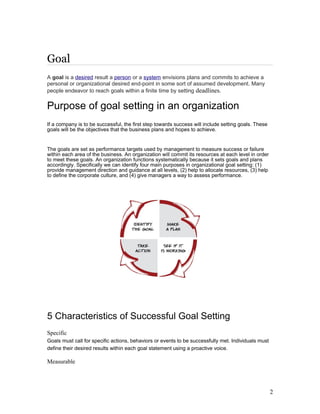
accordingly. Specifically we can identify four main purposes in organizational goal setting: (1) 
provide management direction and guidance at all levels, (2) help to allocate resources, (3) help 
to define the corporate culture, and (4) give managers a way to assess performance. 
5 Characteristics of Successful Goal Setting 
Specific 
Goals must call for specific actions, behaviors or events to be successfully met. Individuals must 
define their desired results within each goal statement using a proactive voice. 
Measurable 
2
Goals must be measurable to assure success. When setting goals, it is important to describe how 
each result will be measured. In our example we set clear steps and timelines. 
Achievable 
Goals must be achievable. A person cannot become a doctor if he has not been graduated from 
medical school, nor can a business increase its sales if it does not have an advertising budget. In 
a savings-related goal like our example, a person must ask himself whether the goal is 
achievable with his current resources. 
Realistic 
Taking a realistic approach is perhaps one of the most important characteristics of successful 
goal setting. Goals challenge us to achieve or attain what is important to us. 
Timely 
Successful goal setting must set forth measurable points for starting, ending, review and 
assessment. A successful goal has deadlines and endings. In our example, we set a weekly 
period goal and an end goal of summer. Open-ended goals often fail because individuals have 
not have set dates to review, measure and revise. 
Barriers of goal setting in an organization 
here are many barriers to goal setting and we are going to list some of the common ones 
together with some tips on how to overcome them. 
Lack of Vision - It's tough for some people to have a vision of the future. Setting goals 
can certainly help accomplish what people truly want, but they must be very clear as to 
what that is before the goal-setting process can work. 
3
Fear of the Unknown - Some people are terrified of goal-setting. The goal-setting process 
usually demands people to beat their biggest fears-the fear of the unfamiliar and of 
disappointment. They are afraid because challenges and risk might take them into 
unknown, risky realms. 
Lack of Understanding - People don’t set goals because they don’t fully grasp how 
powerful goals can be. They can turn them from good employees to excellent ones-determined, 
productive, and high achieving. Some employees don’t understand the nature 
of goal-setting. They think they have goals but really just have wishes. 
History - A bad goal setting process in the past may have caused a lot of 
disappointments. In this case people are hesitant to try again and find it hard to believe 
that goal setting is a tool to help them achieve what they want, step by step. 
Lack of Focus - Some people are really disorganized and busy and they see the goal 
setting process as a way to add more work into their already overpacked schedule. They 
don’t feel they are ready to take on new challenges. They don’t understand that having 
goals will make their lives easier, not more difficult, and will save them time in the long 
run. 
Steps for Successful Goal Setting 
4
Goal Setting is an extremely powerful technique for accomplishment, but for Goal Setting to really be 
effective requires more than just writing down what we want to achieve. This article will present important 
steps that will help to define and achieve goals with more success.. 
1. Well formed Goal Statements 
2. Breaking goals down into manageable Steps 
3. Motivation and Commitment 
4. Reminders and Keeping on track 
5. Frequent Review and Re-assessment 
5
Goal Setting is an extremely powerful technique for accomplishment, but for Goal Setting to really be 
effective requires more than just writing down what we want to achieve. This article will present important 
steps that will help to define and achieve goals with more success.. 
1. Well formed Goal Statements 
2. Breaking goals down into manageable Steps 
3. Motivation and Commitment 
4. Reminders and Keeping on track 
5. Frequent Review and Re-assessment 
5

Saidul

  • 1.
    Planning is oneof the most important project management and time management techniques. Planning is preparing a sequence of action steps to achieve some specific goal. If one can do it effectively, can reduce much the necessary time and effort of achieving the goal. There are three main types of plans that a manager will use in his or her pursuit of company goals, which include operational, tactical and strategic. Operational Plans Operational plans sit at the bottom of the totem pole; they are the plans that are made by frontline, or low-level, managers. All operational plans are focused on the specific procedures and processes that occur within the lowest levels of the organization. Managers must plan the routine tasks of the department using a high level of detail. Operational plans can be either single-use or ongoing plans. Single-use plans are those plans that are intended to be used only once. They include activities that would not be repeated and often have an expiration. Creating a monthly budget and developing a promotional advertisement for the quarter to increase the sales of a certain product are examples of how Frank would utilize single-use planning. Tactical Plans Tactical plans support strategic plans by translating them into specific plans relevant to a distinct area of the organization. Tactical plans are concerned with the responsibility and functionality of lower-level departments to fulfill their parts of the strategic plan. Strategic Plans To best understand the relationship between the different types of plans, let's start at the top. Strategic plans are designed with the entire organization in mind and begin with an organization's mission. Top-level managers, such as CEOs or presidents, will design and execute strategic plans to paint a picture of the desired future and long-term goals of the organization. Essentially, strategic plans look ahead to where the organization wants to be in three, five, even ten years. Strategic plans, provided by top-level managers, serve as the framework for lower-level planning. 1
  • 2.
    Goal A goalis a desired result a person or a system envisions plans and commits to achieve a personal or organizational desired end-point in some sort of assumed development. Many people endeavor to reach goals within a finite time by setting deadlines. Purpose of goal setting in an organization If a company is to be successful, the first step towards success will include setting goals. These goals will be the objectives that the business plans and hopes to achieve. The goals are set as performance targets used by management to measure success or failure within each area of the business. An organization will commit its resources at each level in order to meet these goals. An organization functions systematically because it sets goals and plans accordingly. Specifically we can identify four main purposes in organizational goal setting: (1) provide management direction and guidance at all levels, (2) help to allocate resources, (3) help to define the corporate culture, and (4) give managers a way to assess performance. 5 Characteristics of Successful Goal Setting Specific Goals must call for specific actions, behaviors or events to be successfully met. Individuals must define their desired results within each goal statement using a proactive voice. Measurable 2
  • 3.
    Goals must bemeasurable to assure success. When setting goals, it is important to describe how each result will be measured. In our example we set clear steps and timelines. Achievable Goals must be achievable. A person cannot become a doctor if he has not been graduated from medical school, nor can a business increase its sales if it does not have an advertising budget. In a savings-related goal like our example, a person must ask himself whether the goal is achievable with his current resources. Realistic Taking a realistic approach is perhaps one of the most important characteristics of successful goal setting. Goals challenge us to achieve or attain what is important to us. Timely Successful goal setting must set forth measurable points for starting, ending, review and assessment. A successful goal has deadlines and endings. In our example, we set a weekly period goal and an end goal of summer. Open-ended goals often fail because individuals have not have set dates to review, measure and revise. Barriers of goal setting in an organization here are many barriers to goal setting and we are going to list some of the common ones together with some tips on how to overcome them. Lack of Vision - It's tough for some people to have a vision of the future. Setting goals can certainly help accomplish what people truly want, but they must be very clear as to what that is before the goal-setting process can work. 3
  • 4.
    Fear of theUnknown - Some people are terrified of goal-setting. The goal-setting process usually demands people to beat their biggest fears-the fear of the unfamiliar and of disappointment. They are afraid because challenges and risk might take them into unknown, risky realms. Lack of Understanding - People don’t set goals because they don’t fully grasp how powerful goals can be. They can turn them from good employees to excellent ones-determined, productive, and high achieving. Some employees don’t understand the nature of goal-setting. They think they have goals but really just have wishes. History - A bad goal setting process in the past may have caused a lot of disappointments. In this case people are hesitant to try again and find it hard to believe that goal setting is a tool to help them achieve what they want, step by step. Lack of Focus - Some people are really disorganized and busy and they see the goal setting process as a way to add more work into their already overpacked schedule. They don’t feel they are ready to take on new challenges. They don’t understand that having goals will make their lives easier, not more difficult, and will save them time in the long run. Steps for Successful Goal Setting 4
  • 5.
    Goal Setting isan extremely powerful technique for accomplishment, but for Goal Setting to really be effective requires more than just writing down what we want to achieve. This article will present important steps that will help to define and achieve goals with more success.. 1. Well formed Goal Statements 2. Breaking goals down into manageable Steps 3. Motivation and Commitment 4. Reminders and Keeping on track 5. Frequent Review and Re-assessment 5
  • 6.
    Goal Setting isan extremely powerful technique for accomplishment, but for Goal Setting to really be effective requires more than just writing down what we want to achieve. This article will present important steps that will help to define and achieve goals with more success.. 1. Well formed Goal Statements 2. Breaking goals down into manageable Steps 3. Motivation and Commitment 4. Reminders and Keeping on track 5. Frequent Review and Re-assessment 5