ORGANISATIONAL BEHAVIOUR
Siemens simple structure-not
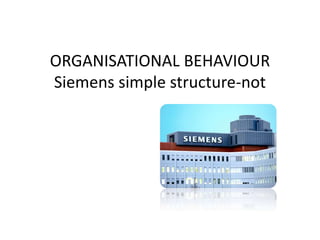
Siemens
• Siemens AG is a German Conglomerate (the
combination of two or more corporations for
example in Pakistan Fauji Foundation)
Company Headquartered jn Berlin and Munich
and the largest manufacturing and Electronics
Company in Europe with branch offices abroad.
• Siemens and Halske was founded by Werner von
Siemens and Johann Georg Halske on 12 October
1847.
Aim
• After the end of this presentation , colleague
should be able to:
Know the Change in the organizational
structure of MNC
Organizational Structure
• Defines how job tasks are formally divided,
grouped, and coordinated.
1. Work specialization,
2. Departmentalization,
3. Chain of Command,
4. Span of Control,
5. Centralization and Decentralization, and
6. Formalization
are components which determine organizational
structure.
Common Organizational Design
There are
1. The Simple Structure,
2. The Bureaucracy, and
3. The Matrix Structure.
NEW DESIGN OPTIONS
• The Virtual Organization
• The Boundary less Organization
Case Study
• There is perhaps no tougher (strong) task for an executive
than to restructure a European organization. Ask former
Siemens CEO Klaus Kleinfeld.
• Siemens, with $114 billion in revenues in 2006 and
branches in 190 countries, is one of the largest electronics
companies in the world. Although the company has long
been respected for its engineering prowess (Skill), it’s also
derided (fun of) for its sluggishness (dull) and mechanistic
structure. So when Kleinfeld took over as CEO, he sought to
restructure the company along the lines of what Jack Welch
did at General Electric. He has tried to make the structure
less bureaucratic so that decisions are made faster. He spun
off (creation of an independent company) underperforming
businesses. And he simplified the company’s structure.
Cont.
Kleinfeld’s efforts drew angry protests from
employee groups, with constant picket lines
outside his corporate offices. One of the
challenges of transforming European
organizations is the active participation of
employees in executive decisions. Half the seats
on the Seimens board of directors are allocated
to labor representatives. Not surprisingly, the
labor groups did not react positively to Kleinfeld’s
GE-like restructuring efforts. In his efforts to
speed those efforts, labor groups alleged,
Kleinfeld secretly bankrolled a business-friendly
workers' group to try to undermine Germany’s
main industrial union.
Cont.
• Due to this and other allegations, Kleinfeld was forced out
in June 2007 and replaced by Peter Löscher. Löscher has
found the same tensions between inertia and the need for
restructuring. Only a month after becoming CEO, Löscher
was faced with a decision whether to spin off its
underperforming $14 billion auto parts unit,
VDO(odometer ). Löscher has to weigh the forces for
stability, who wish to protect worker interests, with U.S.-
style pressures for financial performance. One of VDO’s
possible buyers is a U.S. company, TRW, (automotive
original equipment manufacturers )the controlling interest
of which is held by U.S. private equity firm Blackstone
(investments co). Private equity firms have been called
“locusts” by German labor representatives, so, more than
most CEOs, Löscher has to balance worker interests with
pressure for financial performance.
Questions
 Q 1 What do Kleinfeld’s efforts at Siemens tell
you about the difficulties of restructuring
organization?
Restructuring the Organization
 Kleinfeld tried to do the
following
o Low degree of
• departmentalization
o Wide span of control
o Make quicker decisions
o Develop the under
performing
• businesses
o Less formalization
 50% board of members are
• labor representatives
 Labor representative did
not
• positively react to
• restructuring
 Conflict between labor
• representatives and bank
• rolled business friendly
• work force
 Kleinfeld was forced out and
• replaced by Peter Loscher.
Comparison
Q 2 Why do you think Loscher’s
restructuring decisions generated less
controversy than Kleinfeld’s?
 Loscher faced the same tension as Kleinfeld, in
terms of restructuring the company.
 Loscher had to take a decision to spin off an
underperforming 10 billion-euro auto parts unit,
VDO.
 He had to weigh the forces for stability, which
wanted to protect worker interest, against U.S.
style pressures for financial performance
Action
 One of VDO’s possible buyers was a U.S.
company, TRW, a U.S. private equity firm.
 But German labor representatives derided such
private equity firms as “locusts”.
 Loscher decided to sell VDO to German tire
giant, Continental Corporation thereby acquiring
the support of workers.
The decision of the company’s supervisory
board was unanimous, with trade union
representatives supporting the decision.
In mid-2008,although he announced elimination
of nearly 17,000 jobs, yet he managed to
downsize the organization efficiently.
Assume a colleague read this case and
concluded “This case proves restructuring
efforts do not improve a company’s financial
performance.”
How would you respond to this statement?.
• A business organization makes changes in
personnel and departments and can change
how workers and departments report to one
another to meet market conditions.
Cont.
o Some companies shift organizational structure
to expand and create new departments to
serve growing markets
o Other companies reorganize corporate
structure to downsize or eliminate
departments to conserve overhead. Often
new owners or managers rearrange business
structure to create a familiar business model.
Q 3 Do you think a CEO who decides to
restructure or downsize a company
takes the well being of employees in
to account? should he or she do so?
Why or why not?
• Downsizing refers to a process where a
company or a firm simply reduces its work
force in order to cut the operating costs and
improve efficiency.
Cont.
 The following are the reasons for downsizing a
company:
a) Merging of two or more firms
b) Acquisition
c) Economic crisis
d) Strategy changes
e) Excessive workforce.
Organizational Culture
Assignment Questions
Q 3 What factors create and sustain an
organization’s culture?
Q 4 How is culture transmitted to employees?
Q 5 How can an ethical culture be created?
Q 6 What is a positive organizational culture?
Q 3 What factors create and sustain
an organization’s culture?
• Factors that sustain an organizational culture or
keep it alive are:
• Selection - Concerned with how well the
candidates will fit into the organization and
provides information to candidates about the
organization.
• Top Management - Senior executives help
establish behavioral norms that are adopted by
the organization.
• Socialization - The process that helps new
employees adapt to the organization’s Culture.
Creating and Sustain Organizational
Culture
Q 4 How is culture transmitted to
employees?
Answer: Employees learn the culture through the socialization
process. The culture is transmitted in a number of forms.
1) Stories - Anchor the present into the past and provide
explanations and legitimacy for current practices
2) Rituals - Repetitive sequences of activities that express and
reinforce the key values of the organization
3) Material Symbols - Acceptable attire, office size, opulence
of the office furnishings, and executive perks that convey to
employees who is important in the organization
4) Language - Jargon and special ways of expressing one’s self
to indicate membership in the organization
culture transmitted to employees
Q5 How can an ethical culture be
created?
An organizational culture most likely to shape
high ethical standards is one that is high in
risk tolerance, low to moderate in
aggressiveness, and focuses on means as well
as outcomes. If the culture is strong and
supports high ethical standards, it should have
a very powerful and positive influence on
employee behavior. An organization can
create an ethical culture by doing the
following:
Cont.
• Be a visible role model. Employees will look to top-management
behavior as a benchmark for defining appropriate behavior.
• Communicate ethical expectations. Ethical ambiguities can be
minimized by creating and disseminating an organizational code of
ethics.
• Provide ethical training. Use training sessions to reinforce the
organization’s standards of conduct, to clarify what practices are
and are not permissible, and to address possible ethical dilemmas.
• Visibly reward ethical acts and punish unethical ones. Performance
appraisals of managers should include a point-by-point evaluation
of how his or her decisions measured against the organization’s
code of ethics.
• Provide protective mechanisms. The organization needs to provide
formal mechanisms so that employees can discuss ethical dilemmas
and report unethical behavior without fear of reprimand. This might
include creation of ethical counselors, ombudsmen, or ethical
officers.
Q6 What is a positive organizational
culture?
A positive organizational culture is one that b
1) Builds on employee strengths - Focus is on
discovering, sharing, and building on the
strengths of individual employees
2) Rewards more than it punishes - Articulating
praise and “catching employees doing something
right”
3) Emphasizes individual vitality and growth -
Helping employees learn and grow in their jobs
and careers
colleague

Organisational behaviour assignement (colour copy )

  • 1.
  • 2.
    Siemens • Siemens AGis a German Conglomerate (the combination of two or more corporations for example in Pakistan Fauji Foundation) Company Headquartered jn Berlin and Munich and the largest manufacturing and Electronics Company in Europe with branch offices abroad. • Siemens and Halske was founded by Werner von Siemens and Johann Georg Halske on 12 October 1847.
  • 4.
    Aim • After theend of this presentation , colleague should be able to: Know the Change in the organizational structure of MNC
  • 5.
    Organizational Structure • Defineshow job tasks are formally divided, grouped, and coordinated. 1. Work specialization, 2. Departmentalization, 3. Chain of Command, 4. Span of Control, 5. Centralization and Decentralization, and 6. Formalization are components which determine organizational structure.
  • 6.
    Common Organizational Design Thereare 1. The Simple Structure, 2. The Bureaucracy, and 3. The Matrix Structure.
  • 7.
    NEW DESIGN OPTIONS •The Virtual Organization • The Boundary less Organization
  • 8.
    Case Study • Thereis perhaps no tougher (strong) task for an executive than to restructure a European organization. Ask former Siemens CEO Klaus Kleinfeld. • Siemens, with $114 billion in revenues in 2006 and branches in 190 countries, is one of the largest electronics companies in the world. Although the company has long been respected for its engineering prowess (Skill), it’s also derided (fun of) for its sluggishness (dull) and mechanistic structure. So when Kleinfeld took over as CEO, he sought to restructure the company along the lines of what Jack Welch did at General Electric. He has tried to make the structure less bureaucratic so that decisions are made faster. He spun off (creation of an independent company) underperforming businesses. And he simplified the company’s structure.
  • 9.
    Cont. Kleinfeld’s efforts drewangry protests from employee groups, with constant picket lines outside his corporate offices. One of the challenges of transforming European organizations is the active participation of employees in executive decisions. Half the seats on the Seimens board of directors are allocated to labor representatives. Not surprisingly, the labor groups did not react positively to Kleinfeld’s GE-like restructuring efforts. In his efforts to speed those efforts, labor groups alleged, Kleinfeld secretly bankrolled a business-friendly workers' group to try to undermine Germany’s main industrial union.
  • 10.
    Cont. • Due tothis and other allegations, Kleinfeld was forced out in June 2007 and replaced by Peter Löscher. Löscher has found the same tensions between inertia and the need for restructuring. Only a month after becoming CEO, Löscher was faced with a decision whether to spin off its underperforming $14 billion auto parts unit, VDO(odometer ). Löscher has to weigh the forces for stability, who wish to protect worker interests, with U.S.- style pressures for financial performance. One of VDO’s possible buyers is a U.S. company, TRW, (automotive original equipment manufacturers )the controlling interest of which is held by U.S. private equity firm Blackstone (investments co). Private equity firms have been called “locusts” by German labor representatives, so, more than most CEOs, Löscher has to balance worker interests with pressure for financial performance.
  • 11.
    Questions  Q 1What do Kleinfeld’s efforts at Siemens tell you about the difficulties of restructuring organization?
  • 12.
    Restructuring the Organization Kleinfeld tried to do the following o Low degree of • departmentalization o Wide span of control o Make quicker decisions o Develop the under performing • businesses o Less formalization  50% board of members are • labor representatives  Labor representative did not • positively react to • restructuring  Conflict between labor • representatives and bank • rolled business friendly • work force  Kleinfeld was forced out and • replaced by Peter Loscher.
  • 13.
  • 14.
    Q 2 Whydo you think Loscher’s restructuring decisions generated less controversy than Kleinfeld’s?  Loscher faced the same tension as Kleinfeld, in terms of restructuring the company.  Loscher had to take a decision to spin off an underperforming 10 billion-euro auto parts unit, VDO.  He had to weigh the forces for stability, which wanted to protect worker interest, against U.S. style pressures for financial performance
  • 15.
    Action  One ofVDO’s possible buyers was a U.S. company, TRW, a U.S. private equity firm.  But German labor representatives derided such private equity firms as “locusts”.  Loscher decided to sell VDO to German tire giant, Continental Corporation thereby acquiring the support of workers.
  • 16.
    The decision ofthe company’s supervisory board was unanimous, with trade union representatives supporting the decision. In mid-2008,although he announced elimination of nearly 17,000 jobs, yet he managed to downsize the organization efficiently.
  • 17.
    Assume a colleagueread this case and concluded “This case proves restructuring efforts do not improve a company’s financial performance.” How would you respond to this statement?. • A business organization makes changes in personnel and departments and can change how workers and departments report to one another to meet market conditions.
  • 18.
    Cont. o Some companiesshift organizational structure to expand and create new departments to serve growing markets o Other companies reorganize corporate structure to downsize or eliminate departments to conserve overhead. Often new owners or managers rearrange business structure to create a familiar business model.
  • 19.
    Q 3 Doyou think a CEO who decides to restructure or downsize a company takes the well being of employees in to account? should he or she do so? Why or why not? • Downsizing refers to a process where a company or a firm simply reduces its work force in order to cut the operating costs and improve efficiency.
  • 20.
    Cont.  The followingare the reasons for downsizing a company: a) Merging of two or more firms b) Acquisition c) Economic crisis d) Strategy changes e) Excessive workforce.
  • 21.
  • 22.
    Assignment Questions Q 3What factors create and sustain an organization’s culture? Q 4 How is culture transmitted to employees? Q 5 How can an ethical culture be created? Q 6 What is a positive organizational culture?
  • 23.
    Q 3 Whatfactors create and sustain an organization’s culture? • Factors that sustain an organizational culture or keep it alive are: • Selection - Concerned with how well the candidates will fit into the organization and provides information to candidates about the organization. • Top Management - Senior executives help establish behavioral norms that are adopted by the organization. • Socialization - The process that helps new employees adapt to the organization’s Culture.
  • 24.
    Creating and SustainOrganizational Culture
  • 25.
    Q 4 Howis culture transmitted to employees? Answer: Employees learn the culture through the socialization process. The culture is transmitted in a number of forms. 1) Stories - Anchor the present into the past and provide explanations and legitimacy for current practices 2) Rituals - Repetitive sequences of activities that express and reinforce the key values of the organization 3) Material Symbols - Acceptable attire, office size, opulence of the office furnishings, and executive perks that convey to employees who is important in the organization 4) Language - Jargon and special ways of expressing one’s self to indicate membership in the organization
  • 26.
  • 27.
    Q5 How canan ethical culture be created? An organizational culture most likely to shape high ethical standards is one that is high in risk tolerance, low to moderate in aggressiveness, and focuses on means as well as outcomes. If the culture is strong and supports high ethical standards, it should have a very powerful and positive influence on employee behavior. An organization can create an ethical culture by doing the following:
  • 28.
    Cont. • Be avisible role model. Employees will look to top-management behavior as a benchmark for defining appropriate behavior. • Communicate ethical expectations. Ethical ambiguities can be minimized by creating and disseminating an organizational code of ethics. • Provide ethical training. Use training sessions to reinforce the organization’s standards of conduct, to clarify what practices are and are not permissible, and to address possible ethical dilemmas. • Visibly reward ethical acts and punish unethical ones. Performance appraisals of managers should include a point-by-point evaluation of how his or her decisions measured against the organization’s code of ethics. • Provide protective mechanisms. The organization needs to provide formal mechanisms so that employees can discuss ethical dilemmas and report unethical behavior without fear of reprimand. This might include creation of ethical counselors, ombudsmen, or ethical officers.
  • 29.
    Q6 What isa positive organizational culture? A positive organizational culture is one that b 1) Builds on employee strengths - Focus is on discovering, sharing, and building on the strengths of individual employees 2) Rewards more than it punishes - Articulating praise and “catching employees doing something right” 3) Emphasizes individual vitality and growth - Helping employees learn and grow in their jobs and careers
  • 30.