Organizational Restructuring:
The Case of Control vs
Commitment
MECInternational
© All Rights Reserved – www.MECinternational.us
Case Overview
 Client is a ~200 employee services firm in an industry
with excellent growth potential
 Industry trends in their service business lines are upwards
and expected to continue growing in the next 3 years
 Management perceived that high turnover, employee lack
of commitment and low motivation was preventing them
from capitalizing on the high
earnings potential and
current uptrends in their
business lines
MECInternational
Objective
 The objective of the engagement was to determine
typical industry turnover rates as a benchmark
 Determine specific drivers for employee turnover
 Suggest approaches to
increase employee
motivation and
commitment
 Minimize employee
turnover
MECInternational
Approach
MECInternational
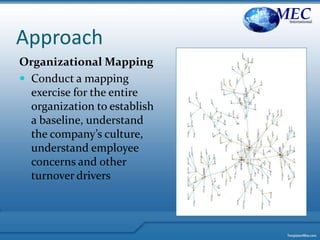
Organizational Mapping
 Conduct a mapping
exercise for the entire
organization to establish
a baseline, understand
the company’s culture,
understand employee
concerns and other
turnover drivers
Results:
 Industry turnover rates for the region were found to be
16.5%. Organization’s turnover rates were 34.6%
 Organizational mapping results pointed at 7 important
factors to conform the scorecard focus of the engagement:
1. Job Design
2. Performance Expectations
3. Management Organization
4. Reward Policies
5. Communications and Open Door Policies
6. Employee – Manager Relationship
7. Overall Company’s Philosophy
MECInternational
Baseline Scores
The baseline evaluation gave the following results:
 Job Design:
 Individual attention limited to performing individual
job
 Specific job description
 Fragmented work and fragmented thinking
 Specific tasks assigned
 Accountability focused on individual
MECInternational
Baseline Scores
 Performance Expectations
 Fixed job definition
 Measured standards to define minimum performance
 Desirable stability
 Management Organization
 Layered structure from top down
 Coordination and control rely on rules and procedures
 Emphasis on positional authority
MECInternational
Baseline Scores
 Reward Policies
 Status symbols distributed to reinforce hierarchy (VP’s)
 Individual pay geared to job evaluation
 Concentration in hourly payroll
 Communications & Open Door Policies
 Employee opinions allowed on relatively narrow agenda
 Employee sees risks associated with expressing
opinions openly
 Business data concealed
MECInternational
Baseline Scores
 Employee – Manager relationship
 Business information distributed on strictly “need to
know” basis
 Overall Company Philosophy
 Management philosophy emphasizes management
prerogatives and obligations to shareholders
MECInternational
Recommended KPIs
We recommended the following changes to address
senior management concerns for each KPI
 Job Design:
 Individual responsibility should be extended upstream
and downstream to improve team performance
 Job descriptions should emphasize each department
and division as a whole performance unit
 Individual accountability should emphasize combined
thinking and overlap individual responsibilities
MECInternational
Recommended KPIs
 Performance Expectations
 Flexible definition of duties, contingent on changing
conditions
 Emphasis placed on higher “stretch” objectives
 Dynamic & market oriented
 Management Organization
 Restructure into flat/semi-flat organization structure
with mutual influence systems
 Coordination and control based on shared goals, values
and traditions
 Emphasis on problem-solving, relevant information
and expertise
MECInternational
Recommended KPIs
 Reward Policies
 Minimize pay differences among similarly skilled
personnel
 Create performance related rewards to create equity
and reinforce department/division achievements
 Communications & Open Door Policies
 Encourage employee participation on all department
and division issues and concerns
 Institute transparency policies, share business and
financial performance information
 Encourage participation in company policy decision
making
MECInternational
Recommended KPIs
 Employee – Manager relationship
 Encourage managers to conduct joint planning and
problem solving meetings
 Institute at all possible shared and/or combined
definition of roles
 Overall Company Philosophy
 Recommended to Senior Management to include
importance of stakeholders, and not focus only on
shareholder interests
MECInternational
Implementation Results
 With our help, senior management implemented most
recommendations.
 KPIs were utilized to track and document progress
 KPIs were also utilized to adjust strategic and tactical
initiatives
 Employee turnover 6 months after rollout was reported at
20.0%
 Employee turnover 1 year after rollout was reported at
14.2%
 Financial KPIs also showed increases (Net Profit Margin
increased 4%; Avg Growth Rate increased 9% over TTMs)
MECInternational

Organizational Restructuring: Achieving Results by Reducing Turnover

  • 1.
    Organizational Restructuring: The Caseof Control vs Commitment MECInternational © All Rights Reserved – www.MECinternational.us
  • 2.
    Case Overview  Clientis a ~200 employee services firm in an industry with excellent growth potential  Industry trends in their service business lines are upwards and expected to continue growing in the next 3 years  Management perceived that high turnover, employee lack of commitment and low motivation was preventing them from capitalizing on the high earnings potential and current uptrends in their business lines MECInternational
  • 3.
    Objective  The objectiveof the engagement was to determine typical industry turnover rates as a benchmark  Determine specific drivers for employee turnover  Suggest approaches to increase employee motivation and commitment  Minimize employee turnover MECInternational
  • 4.
    Approach MECInternational Organizational Mapping  Conducta mapping exercise for the entire organization to establish a baseline, understand the company’s culture, understand employee concerns and other turnover drivers
  • 5.
    Results:  Industry turnoverrates for the region were found to be 16.5%. Organization’s turnover rates were 34.6%  Organizational mapping results pointed at 7 important factors to conform the scorecard focus of the engagement: 1. Job Design 2. Performance Expectations 3. Management Organization 4. Reward Policies 5. Communications and Open Door Policies 6. Employee – Manager Relationship 7. Overall Company’s Philosophy MECInternational
  • 6.
    Baseline Scores The baselineevaluation gave the following results:  Job Design:  Individual attention limited to performing individual job  Specific job description  Fragmented work and fragmented thinking  Specific tasks assigned  Accountability focused on individual MECInternational
  • 7.
    Baseline Scores  PerformanceExpectations  Fixed job definition  Measured standards to define minimum performance  Desirable stability  Management Organization  Layered structure from top down  Coordination and control rely on rules and procedures  Emphasis on positional authority MECInternational
  • 8.
    Baseline Scores  RewardPolicies  Status symbols distributed to reinforce hierarchy (VP’s)  Individual pay geared to job evaluation  Concentration in hourly payroll  Communications & Open Door Policies  Employee opinions allowed on relatively narrow agenda  Employee sees risks associated with expressing opinions openly  Business data concealed MECInternational
  • 9.
    Baseline Scores  Employee– Manager relationship  Business information distributed on strictly “need to know” basis  Overall Company Philosophy  Management philosophy emphasizes management prerogatives and obligations to shareholders MECInternational
  • 10.
    Recommended KPIs We recommendedthe following changes to address senior management concerns for each KPI  Job Design:  Individual responsibility should be extended upstream and downstream to improve team performance  Job descriptions should emphasize each department and division as a whole performance unit  Individual accountability should emphasize combined thinking and overlap individual responsibilities MECInternational
  • 11.
    Recommended KPIs  PerformanceExpectations  Flexible definition of duties, contingent on changing conditions  Emphasis placed on higher “stretch” objectives  Dynamic & market oriented  Management Organization  Restructure into flat/semi-flat organization structure with mutual influence systems  Coordination and control based on shared goals, values and traditions  Emphasis on problem-solving, relevant information and expertise MECInternational
  • 12.
    Recommended KPIs  RewardPolicies  Minimize pay differences among similarly skilled personnel  Create performance related rewards to create equity and reinforce department/division achievements  Communications & Open Door Policies  Encourage employee participation on all department and division issues and concerns  Institute transparency policies, share business and financial performance information  Encourage participation in company policy decision making MECInternational
  • 13.
    Recommended KPIs  Employee– Manager relationship  Encourage managers to conduct joint planning and problem solving meetings  Institute at all possible shared and/or combined definition of roles  Overall Company Philosophy  Recommended to Senior Management to include importance of stakeholders, and not focus only on shareholder interests MECInternational
  • 14.
    Implementation Results  Withour help, senior management implemented most recommendations.  KPIs were utilized to track and document progress  KPIs were also utilized to adjust strategic and tactical initiatives  Employee turnover 6 months after rollout was reported at 20.0%  Employee turnover 1 year after rollout was reported at 14.2%  Financial KPIs also showed increases (Net Profit Margin increased 4%; Avg Growth Rate increased 9% over TTMs) MECInternational