L-2
Decomposition of organic residues in soil
• Components of organic residues undergoing decomposition
(fresh plant &animal residues, microbial dead/living cell)
• Metabolic products of micro-organisms utilizing organic
residues a source of energy
• Products of secondary synthesis in the form of bacterial plasma
• Humic substances
Composition of Soil Organic Matter (percentaage )
The first three categories consist of various' non-specific substances (such
as proteins, decomposition products of proteins, carbohydrates organic
acids, fats, resins, "waxes, etc.) and constitute 10-15% of soil organic
matter.
Humic constitutes 85 - 90%.
Proximate Constituents of Organic Matter
A Carbohydrates and related compounds [mono-
and disaccharides, celluloses,
hemicelluloses, pectins, pentosans,
mannans, polyuronides, uronic acids,
organic acids, alcohols, hydrocarbons,
aromatics]
B Proteins and their derivatives [aminoacids,
amides, amino sugars, nucleoproteins,
purine and pyrimidine bases]
C Lignin and their derivatives –
d. Fats & related substances
e. Tannins & their derivatives
f Resins and terpenes
Plant residues contain 75% moisture and 25% dry matter
25% is made up of - C (10-12%), O (9-10%) , H (1.5-2.5%) , N(1-2%) and
mineral matter (1-3%).
Carbohydrates
Celluloses 20-50%
Hemicellulose 10-30%
Starch, Sugar 1-5%
Proteins 1-15%
Fats, waxes, tannins 1-8 %
Lignins 10-30%
General changes during decomposition
1.Compounds of plant tissues
a Those compounds that decompose with difficulty [Fats, oils, lignins,
resins, waxes, etc.]
b. Those that decompose easily [Celluloses, starch, sugars,
proteins, etc.]
2. Complex, intermediate compounds of decomposition
a. Those resistant to microbial action [Resins, waxes, fats, lignins, oils,
etc.]
b. Those that decompose readily [.Aminoacids, amides, alcohols,
carbohydrates, aldehydes, etc.]
3. Decomposition products
a. Resistant compounds [Humus]
b. Simple end products [C02, H20, No3." SO" P04, compounds, etc.]
Decomposition process
• Fresh residues consist of recently deceased micro-organisms, insects and
earthworms, old plant roots, crop residues, and recently added manures.
• Crop residues contain mainly complex carbon compounds originating from
cell walls (cellulose, hemicellulose, etc.).
• Chains of carbon, with each carbon atom linked to other carbons, form the
“backbone” of organic molecules. These carbon chains, with varying
amounts of attached oxygen, H, N, P and S, are the basis for both simple
sugars and amino acids and more complicated molecules of long carbon
chains or rings.
• Depending on their chemical structure, decomposition is rapid (sugars,
starches and proteins), slow (cellulose, fats, waxes and resins) or very slow
(lignin).
• During the decomposition process, microorganisms convert the carbon
structures of fresh residues into transformed carbon products in the soil.
• Simple molecules have been synthesized directly from plants or other
living organisms. These relatively simple chemicals, such as sugars, amino
acids, and cellulose are readily consumed by many organisms. For this
reason, they do not remain in the soil for a long time.
• Other chemicals such as resins and waxes also come directly from plants,
but are more difficult for soil organisms to break down.
• Humus is the result of successive steps in the decomposition of organic
matter.
• Because of the complex structure of humic substances, humus cannot be
used by many micro-organisms as an energy source and remains in the soil
for a relatively long time.
Under aerobic conditions the
products
Co2, NH4, NO3 , H2PO4, SO4, H2O and
essential plant nutrients like Ca, Mg,
Fe, Cu, Zn etc
Under anaerobic conditions CH4,
organic acids like lactic, propionic,
butyric,
NH4, various amine residues (R-NH2)
H2S,
ethylene (CH2=CH2) and
humic substances
Molecules very resistant to microbial action is formed either through
modification of compounds or by microbial synthesis
• Enzymatic oxidation of the bulk with the release of Co2 , water, energy and heat
• Essential elements are released (N, P, S etc) and immobilized by a series of
reactions.
• Formation of compounds which are resistant to microbial action.
The general reactions taking place during decomposition are
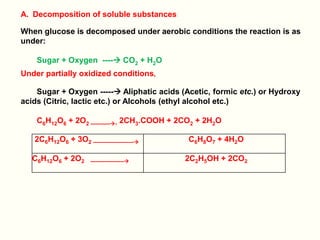
2C6H12O6 + 3O2 ----------------------- C6H8O7 + 4H2O
C6H12O6 + 2O2 ------------------- 2C2H5OH + 2CO2
A. Decomposition of soluble substances:
When glucose is decomposed under aerobic conditions the reaction is as
under:
Sugar + Oxygen ---- CO2 + H2O
Under partially oxidized conditions,
Sugar + Oxygen ----- Aliphatic acids (Acetic, formic etc.) or Hydroxy
acids (Citric, lactic etc.) or Alcohols (ethyl alcohol etc.)
C6H12O6 + 2O2 ------------ 2CH3.COOH + 2CO2 + 2H2O
B. Decomposition of Insoluble Substances
i) Breakdown of Protein: During the course of decomposition
of plant materials, the proteins are first hydrolyzed to a number
of intermediate products.
Aminization: The process of conversion of proteins to
aminoacids.
Ammonification:The process of conversion of aminoacids
and amides to ammonia.
i) Ammonification:
The transformation of organic nitrogenous compounds (amino acids,
amides, ammonium compounds, etc.) into ammonia is called
ammonification. This process occurs as a result of hydrolytic and
oxidative enzymatic reaction under aerobic conditions by heterotrophic
microbes.
ii) Nitrification:
The process of conversion of ammonia to nitrites (NO2) and then to
nitrate (NO3
-) is known as nitrification. It is an aerobic process by
autotrophic bacteria.
NH3 --------------nitrosomon-as--------------- NO2 -----Nitrobacte-r---------NO3-
Ammonia Nitrite Nitrate
The net reactions are as follows:
NH4 + O2 ----------- NO2 + 2H+ + H2O + energy
NO2 + O2 ------------ NO3
- + energy
iii) Denitrification:
The process, which involves conversion of soil nitrate into gaseous
nitrogen or nitrous oxide, is called Denitrification.
Water logging and high pH will increase N loss by Denitrification.
Nitrate ----Pseudom--/Bacillus--------- N2gas
organic N - Polypeptides – Peptides – aminoacids – NH3 or NH4
ii) Breakdown of cellulose:
The decomposition of the most abundant carbohydrates.
Hydrolysis hydrolysis oxidation
Cellulose ----- Cellobiose ----------Glucose------Organic acids --- CO2 + H2O
(cellulase) (cellobiase)
This reaction proceeds more slowly in acid soils than in neutral and
alkaline soils.
It is quite rapid in well aerated soils and comparatively slow in
poorly aerated soils.
iii) Breakdown of Hemicellulose:
• Decompose faster than cellulose and are first hydrolyzed to their
components sugars and uronic acids.
• Sugars are attacked by microbes and are converted to organic
acids, alcohols, carbon dioxide and water.
• The uronic acids are broken down to pentose and CO2.
Breakdown of Starch:
• It is chemically a glucose polymer and is first hydrolyzed to
maltose by the action of amylases.
• Maltose is next converted to glucose by maltase. The process is
represented as under:
(C6H10O5)n +nH2O ------------------------ n (C6H12O6)
C. Decomposition of ether soluble substances:
Fats ---------------------glycerol + fatty acids
Glycerol -----------------------------------CO2 + water
F. Sulphur containing organic compounds:
Converted to SO4
-2 + H+ + energy by sulphur oxidizing bacteria.
P containing organic compounds:
Various micro organisms mineralize phospholipids and
other organic P compounds in the presence of phosphates
enzymes to H2PO4 and HPO4
-2 depending on soil PH.
Mineralisation – > C, N,P S: < -Immobilization
D. Decomposition of lignin:
Lignin decomposes slowly, much slower than cellulose.
Complete oxidation gives rise to CO2 and H2O.
Factors affecting decomposition
Aeration:
• proper activity of the microorganisms involved in the decomposition
of organic matter.
• Under anaerobic conditions fungi and actinomycetes are almost
suppressed and only a few bacteria (Clostridium) take part in
anaerobic decomposition.
• It was found that under aerobic conditions 65 percent of the total
organic matter decomposes during six months, while under anaerobic
conditions only 47 percent organic matter can be decomposed during
the same period.
• Anaerobic decomposition of organic matter results into the
production of large quantity of organic acids and evolution of gases
like methane (CH 4) hydrogen (H2).
Temperature:
rapid in the temperature range of 30° to 40°' At temperatures below or
above this range, the rate of decomposition is markedly retarded.
Appreciable organic mater decomposition occurs at 25° C.
Moisture:
• Adequate soil moisture i.e. about 60 to 80 percent of the water-
holding capacity of the soil is must for the proper decomposition
of organic matter.
• Too much moisture leads to insufficient aeration -reduced activity
of microorganisms.
Soil PH/soil reaction:
• affects directly the kind, density and the activity of fungi, bacteria
& actinomycetes
• decomposition is more in neutral soils than that of acidic soils.
• Therefore, treatment of acid soils with lime can accelerate the
rate of organic matter decomposition.
C: N ratio:
• The optimum C: N ratio in the range of 20-25 is ideal for maximum
decomposition,
• Thus, a low nitrogen content or wide C'.N ratio results into the
slow decompotion.
Thanks

null.pptx

  • 1.
  • 6.
    • Components oforganic residues undergoing decomposition (fresh plant &animal residues, microbial dead/living cell) • Metabolic products of micro-organisms utilizing organic residues a source of energy • Products of secondary synthesis in the form of bacterial plasma • Humic substances Composition of Soil Organic Matter (percentaage ) The first three categories consist of various' non-specific substances (such as proteins, decomposition products of proteins, carbohydrates organic acids, fats, resins, "waxes, etc.) and constitute 10-15% of soil organic matter. Humic constitutes 85 - 90%.
  • 7.
    Proximate Constituents ofOrganic Matter A Carbohydrates and related compounds [mono- and disaccharides, celluloses, hemicelluloses, pectins, pentosans, mannans, polyuronides, uronic acids, organic acids, alcohols, hydrocarbons, aromatics] B Proteins and their derivatives [aminoacids, amides, amino sugars, nucleoproteins, purine and pyrimidine bases] C Lignin and their derivatives – d. Fats & related substances e. Tannins & their derivatives f Resins and terpenes Plant residues contain 75% moisture and 25% dry matter 25% is made up of - C (10-12%), O (9-10%) , H (1.5-2.5%) , N(1-2%) and mineral matter (1-3%). Carbohydrates Celluloses 20-50% Hemicellulose 10-30% Starch, Sugar 1-5% Proteins 1-15% Fats, waxes, tannins 1-8 % Lignins 10-30%
  • 8.
    General changes duringdecomposition 1.Compounds of plant tissues a Those compounds that decompose with difficulty [Fats, oils, lignins, resins, waxes, etc.] b. Those that decompose easily [Celluloses, starch, sugars, proteins, etc.] 2. Complex, intermediate compounds of decomposition a. Those resistant to microbial action [Resins, waxes, fats, lignins, oils, etc.] b. Those that decompose readily [.Aminoacids, amides, alcohols, carbohydrates, aldehydes, etc.] 3. Decomposition products a. Resistant compounds [Humus] b. Simple end products [C02, H20, No3." SO" P04, compounds, etc.]
  • 9.
    Decomposition process • Freshresidues consist of recently deceased micro-organisms, insects and earthworms, old plant roots, crop residues, and recently added manures. • Crop residues contain mainly complex carbon compounds originating from cell walls (cellulose, hemicellulose, etc.). • Chains of carbon, with each carbon atom linked to other carbons, form the “backbone” of organic molecules. These carbon chains, with varying amounts of attached oxygen, H, N, P and S, are the basis for both simple sugars and amino acids and more complicated molecules of long carbon chains or rings. • Depending on their chemical structure, decomposition is rapid (sugars, starches and proteins), slow (cellulose, fats, waxes and resins) or very slow (lignin). • During the decomposition process, microorganisms convert the carbon structures of fresh residues into transformed carbon products in the soil.
  • 10.
    • Simple moleculeshave been synthesized directly from plants or other living organisms. These relatively simple chemicals, such as sugars, amino acids, and cellulose are readily consumed by many organisms. For this reason, they do not remain in the soil for a long time. • Other chemicals such as resins and waxes also come directly from plants, but are more difficult for soil organisms to break down. • Humus is the result of successive steps in the decomposition of organic matter. • Because of the complex structure of humic substances, humus cannot be used by many micro-organisms as an energy source and remains in the soil for a relatively long time.
  • 11.
    Under aerobic conditionsthe products Co2, NH4, NO3 , H2PO4, SO4, H2O and essential plant nutrients like Ca, Mg, Fe, Cu, Zn etc Under anaerobic conditions CH4, organic acids like lactic, propionic, butyric, NH4, various amine residues (R-NH2) H2S, ethylene (CH2=CH2) and humic substances Molecules very resistant to microbial action is formed either through modification of compounds or by microbial synthesis • Enzymatic oxidation of the bulk with the release of Co2 , water, energy and heat • Essential elements are released (N, P, S etc) and immobilized by a series of reactions. • Formation of compounds which are resistant to microbial action. The general reactions taking place during decomposition are
  • 12.
    2C6H12O6 + 3O2----------------------- C6H8O7 + 4H2O C6H12O6 + 2O2 ------------------- 2C2H5OH + 2CO2 A. Decomposition of soluble substances: When glucose is decomposed under aerobic conditions the reaction is as under: Sugar + Oxygen ---- CO2 + H2O Under partially oxidized conditions, Sugar + Oxygen ----- Aliphatic acids (Acetic, formic etc.) or Hydroxy acids (Citric, lactic etc.) or Alcohols (ethyl alcohol etc.) C6H12O6 + 2O2 ------------ 2CH3.COOH + 2CO2 + 2H2O
  • 13.
    B. Decomposition ofInsoluble Substances i) Breakdown of Protein: During the course of decomposition of plant materials, the proteins are first hydrolyzed to a number of intermediate products. Aminization: The process of conversion of proteins to aminoacids. Ammonification:The process of conversion of aminoacids and amides to ammonia.
  • 14.
    i) Ammonification: The transformationof organic nitrogenous compounds (amino acids, amides, ammonium compounds, etc.) into ammonia is called ammonification. This process occurs as a result of hydrolytic and oxidative enzymatic reaction under aerobic conditions by heterotrophic microbes. ii) Nitrification: The process of conversion of ammonia to nitrites (NO2) and then to nitrate (NO3 -) is known as nitrification. It is an aerobic process by autotrophic bacteria. NH3 --------------nitrosomon-as--------------- NO2 -----Nitrobacte-r---------NO3- Ammonia Nitrite Nitrate The net reactions are as follows: NH4 + O2 ----------- NO2 + 2H+ + H2O + energy NO2 + O2 ------------ NO3 - + energy iii) Denitrification: The process, which involves conversion of soil nitrate into gaseous nitrogen or nitrous oxide, is called Denitrification. Water logging and high pH will increase N loss by Denitrification. Nitrate ----Pseudom--/Bacillus--------- N2gas organic N - Polypeptides – Peptides – aminoacids – NH3 or NH4
  • 16.
    ii) Breakdown ofcellulose: The decomposition of the most abundant carbohydrates. Hydrolysis hydrolysis oxidation Cellulose ----- Cellobiose ----------Glucose------Organic acids --- CO2 + H2O (cellulase) (cellobiase) This reaction proceeds more slowly in acid soils than in neutral and alkaline soils. It is quite rapid in well aerated soils and comparatively slow in poorly aerated soils.
  • 18.
    iii) Breakdown ofHemicellulose: • Decompose faster than cellulose and are first hydrolyzed to their components sugars and uronic acids. • Sugars are attacked by microbes and are converted to organic acids, alcohols, carbon dioxide and water. • The uronic acids are broken down to pentose and CO2.
  • 19.
    Breakdown of Starch: •It is chemically a glucose polymer and is first hydrolyzed to maltose by the action of amylases. • Maltose is next converted to glucose by maltase. The process is represented as under: (C6H10O5)n +nH2O ------------------------ n (C6H12O6) C. Decomposition of ether soluble substances: Fats ---------------------glycerol + fatty acids Glycerol -----------------------------------CO2 + water F. Sulphur containing organic compounds: Converted to SO4 -2 + H+ + energy by sulphur oxidizing bacteria. P containing organic compounds: Various micro organisms mineralize phospholipids and other organic P compounds in the presence of phosphates enzymes to H2PO4 and HPO4 -2 depending on soil PH. Mineralisation – > C, N,P S: < -Immobilization
  • 21.
    D. Decomposition oflignin: Lignin decomposes slowly, much slower than cellulose. Complete oxidation gives rise to CO2 and H2O.
  • 23.
    Factors affecting decomposition Aeration: •proper activity of the microorganisms involved in the decomposition of organic matter. • Under anaerobic conditions fungi and actinomycetes are almost suppressed and only a few bacteria (Clostridium) take part in anaerobic decomposition. • It was found that under aerobic conditions 65 percent of the total organic matter decomposes during six months, while under anaerobic conditions only 47 percent organic matter can be decomposed during the same period. • Anaerobic decomposition of organic matter results into the production of large quantity of organic acids and evolution of gases like methane (CH 4) hydrogen (H2). Temperature: rapid in the temperature range of 30° to 40°' At temperatures below or above this range, the rate of decomposition is markedly retarded. Appreciable organic mater decomposition occurs at 25° C.
  • 24.
    Moisture: • Adequate soilmoisture i.e. about 60 to 80 percent of the water- holding capacity of the soil is must for the proper decomposition of organic matter. • Too much moisture leads to insufficient aeration -reduced activity of microorganisms. Soil PH/soil reaction: • affects directly the kind, density and the activity of fungi, bacteria & actinomycetes • decomposition is more in neutral soils than that of acidic soils. • Therefore, treatment of acid soils with lime can accelerate the rate of organic matter decomposition. C: N ratio: • The optimum C: N ratio in the range of 20-25 is ideal for maximum decomposition, • Thus, a low nitrogen content or wide C'.N ratio results into the slow decompotion.
  • 25.