
- Dr.C.P. Arya
M.D.S. II
Contents
1.INTRODUCTION
2.FUNCTIONS
3.CLASSIFICATION
4.STRUCTURE
5.CHARACTERISTICS OF EPITHELIUM
6.ORAL EPITHELIUM
7.SUMMARY
8.BIBILIOGRAPHY
INTRODUCTION
TISSUES ARE GROUP OF CELLS OR AGGREGATES TO
PERFORM ONE OR MORE FUNCTIONS.
 EPITHELIUM (epi + thele + ium) is one of the four basic
types of animal tissue, along with
A-CONNECTIVE TISSUE
B-MUSCLE TISSUE
C-NEURAL TISSUE
 The term EPITHELIUM is applied to the layer of cells
covering the body surfaces.
 Epithelium is an avascular tissue comprised of cells that
line both the internal cavities and external surfaces.
DEFINITION
Epithelium is an avascular tissue composed of cells that
cover the exterior body surfaces and line internal closed
cavities (including the vascular system) and body tubes
that communicate with the exterior (the alimentary,
respiratory, and genitourinary tracts). Epithelium also
forms the secretory portion (parenchyma) of glands and
their ducts. In addition, specialized epithelial cells function
as receptors for the special senses (smell, taste, hearing,
and vision).
DEVELOPMENT
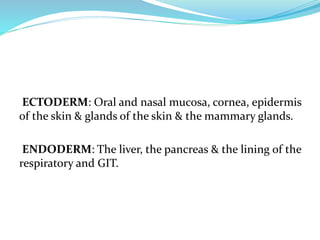
 EPITHELIUM IS DERIVED FROM THREE GERM
LAYERS
 ECTODERM
 MESODERM
 ENDODERM
 ALTHOUGH MOST OF THE EPITHELIA ARE
DERIVED FROM ECTODERM AND ENDODEREM
ECTODERM: Oral and nasal mucosa, cornea, epidermis
of the skin & glands of the skin & the mammary glands.
ENDODERM: The liver, the pancreas & the lining of the
respiratory and GIT.
MESODERM: Uriniferous tubules of the kidney, the lining
of the male and female reproductive systems,the endothelial
lining of the circulatory system and the mesothelium of the
body cavity.
FUNCTIONS OF EPITHELIUM
 Selective Barriers
 Protection
 Secretory function
 Sensory function
 Characteristic of Epithelia
 Predominantly Cellular
 The Basal surface of an epithelium is in contact with
Basal Lamina.
 Avascular
 Can regenerate when injured
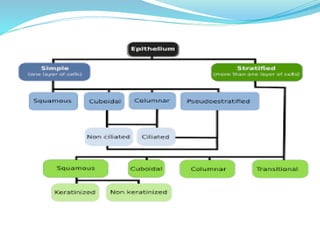
CLASSIFICATION
1) SIMPLE:
• Squamous
• cuboidal
• columnar
2) PSEUDOSTRATIFIED
3) STRATIFIED
• Squamous non keratinized
• Squamous keratinized
• Cuboidal
• Columnar
• transitional
Epithelium can be grouped mainly into
Lining Epithelium
Glandular Epithelium
The lining epithelium is further classified into
A-Simple epithelium (unilaminar)
B-Stratified epithelium (multilaminar)
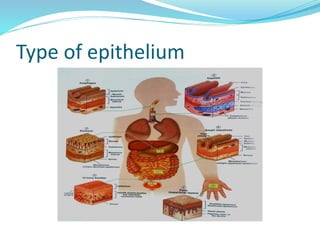
Type of epithelium
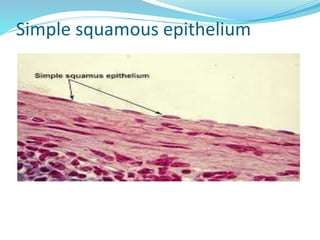
Simple squamous epithelium
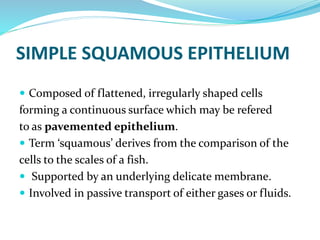
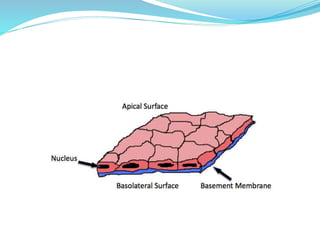
SIMPLE SQUAMOUS EPITHELIUM
 Composed of flattened, irregularly shaped cells
forming a continuous surface which may be refered
to as pavemented epithelium.
 Term ‘squamous’ derives from the comparison of the
cells to the scales of a fish.
 Supported by an underlying delicate membrane.
 Involved in passive transport of either gases or fluids.
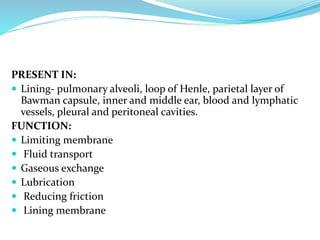
PRESENT IN:
 Lining- pulmonary alveoli, loop of Henle, parietal layer of
Bawman capsule, inner and middle ear, blood and lymphatic
vessels, pleural and peritoneal cavities.
FUNCTION:
 Limiting membrane
 Fluid transport
 Gaseous exchange
 Lubrication
 Reducing friction
 Lining membrane
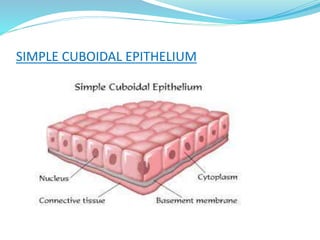
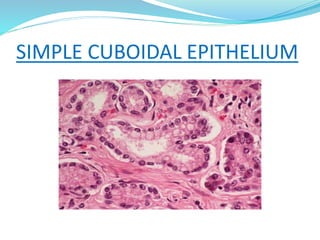
SIMPLE CUBOIDAL EPITHELIUM
 Single layer of cube like cells with large , spherical
central nuclei.
 Location- Kidney tubules , Ducts and secretory
portions of small glands , ovary surface , Intercalated
ducts of salivary glands.
 FUNCTIONS- Secretion and absorption.
SIMPLE COLUMNAR EPITHELIUM
• Cells are taller and appear columnar in sections at right
angles to the basement membrane.
• Nuclei are elongated and may be located towards the
base, the centre or occasionally the apex of the
cytoplasm, this is known as polarity.
PRESENT IN:
• Small intestine & colon
• Stomach lining and gastric glands
• Gall bladder
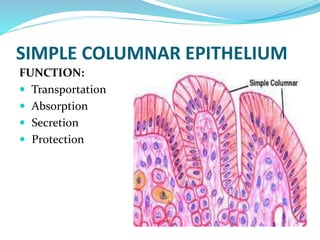
SIMPLE COLUMNAR EPITHELIUM
FUNCTION:
 Transportation
 Absorption
 Secretion
 Protection
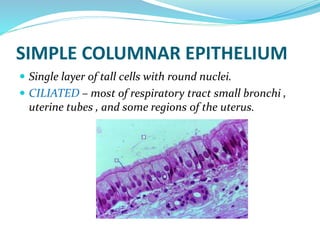
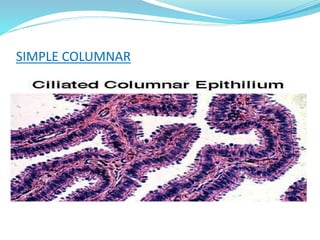
SIMPLE COLUMNAR EPITHELIUM
 Single layer of tall cells with round nuclei.
 CILIATED – most of respiratory tract small bronchi ,
uterine tubes , and some regions 0f the uterus.
SIMPLE COLUMNAR
 NON CILIATED – digestive tract ( stomach to anal
canal ) , excretory ducts of some glands
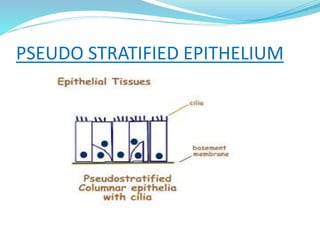
PSEUDO STRATIFIED EPITHELIUM
 Simple columnar epithelium , nuclei at different levels in
a vertical section.
 Migrating lymphocytes and mast cells give this
appearance.
 Seen in ciliated lining of the respiratory tract and
sensory epithelium of the olfactory areas.
 Excretory ducts of salivary glands.
 Multi-laminar epithelium.
STRATIFIED SQUAMOUS
 Stratified squamous epithelium
 Basal cells are cuboidal or columnar
 Surface cells squamous
 Occur in sites exposed to constant damage
 Two types keratinized and non- keratinized
 Location : Non-keratinized forms the moist linings of
the esophagus , mouth, and vagina;
 Keratinized variety forms the epidermis
STRATIFIED SQUAMOUS
STRATIFIED CUBOIDAL
STRATIFIED CUBOIDAL EPITHELIUM
 Thin, stratified epithelium which usually consists of
only two or three layers of cuboidal or low columnar
cells.
 Not involved in significant absorptive or secretory
activity
PRESENT IN:
 Ducts of sweat glands
 Large ducts of exocrine glands
 Anorectal junction
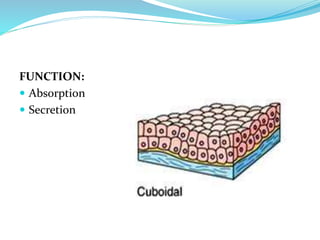
FUNCTION:
 Absorption
 Secretion
STRATIFIED COLUMNAR
PRESENT IN:
 Conjunctiva of eye
 Some large excretory ducts
 Portions of male urethra
FUNCTION:
 Secretion
 Absorption
 Protection
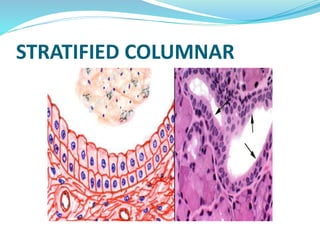
STRATIFIED COLUMNAR
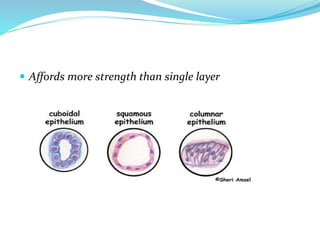
 Affords more strength than single layer
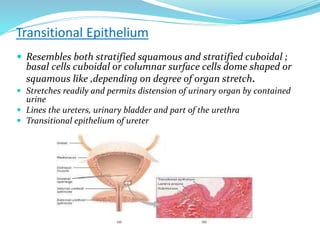
Transitional Epithelium
 Resembles both stratified squamous and stratified cuboidal ;
basal cells cuboidal or columnar surface cells dome shaped or
squamous like ,depending on degree of organ stretch.
 Stretches readily and permits distension of urinary organ by contained
urine
 Lines the ureters, urinary bladder and part of the urethra
 Transitional epithelium of ureter
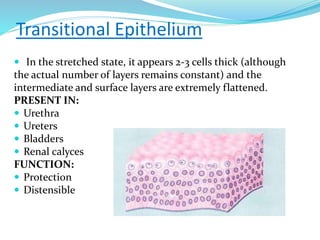
Transitional Epithelium
 In the stretched state, it appears 2-3 cells thick (although
the actual number of layers remains constant) and the
intermediate and surface layers are extremely flattened.
PRESENT IN:
 Urethra
 Ureters
 Bladders
 Renal calyces
FUNCTION:
 Protection
 Distensible
Oral mucosa
 Mucous membrane : moist lining of the gastrointestinal
tract, nasal passages ,Other body cavities that
communicate with the exterior.
 In the oral cavity the lining is called as oral mucous
membrane or oral mucosa.
Functions of oral mucosa
 Protection: Barrier for mechanical trauma and
microbiological insults
 Sensation: Temperature (heat and cold) , touch ,pain,
taste buds, thirst; reflexes such as swallowing , etching,
gagging and salivating .
 Secretion : Salivary secretion
Development and structure of oral epithelium
 The epithelium of the oral cavity derived from the
embryonic ectoderm.
 Most of the mucosal surface is lined by a non-
keratinized stratified squamous epithelium.
 Except for Gingiva , hard palate and dorsal surface of
the tongue where the epithelium is keratinized.
FUNCTIONAL CHARACTERISTICS
 As the cells migrate from the basal layer to the
surface layer, differentiation produces a surface layer
that is either
 Non-keratinized
 Ortho Keratinized
 Para keratinized
Non-Keratinized Epithelium
 The surface cells retain their nuclei and cytoplasm does not
contain keratin filaments.
 Stratum spinosum and granulosum is absent.
 Lining mucosa of the oral cavity.
 Clinical considerations:
 Prosthetic devices thin the epithelium
 Linea alba
 Angina pectoris- Nitroglycerine tablets are placed
sublingually and absorbed quickly through the thin non-
keratinized epithelium and into large veins of the ventral
surface of the tongue.
Ortho Keratinized epithelium
 Stratum basale- tall columnar or cuboidal.
 Stratum corneum elliptical / spherical.
 In contact only by Desmosomes.
 Stratum granulosum- flat cells with keratohyaline
granules.
 Stratum spinosum- squamous cells with no nuclei.
 Masticatory mucosa-Ortho keratinized.
ULTRA STRUCTURE OF THE EPITHELIAL CELL
 Cells of the basal layer are least differentiated.
 They contain organelles and typical filamentous strands
called tonofilaments.
 Tonofilaments aggregate- tonofibrills.
 Chemically they are cytokeratins.
 Epithelial cells are named as keratinocyte
 Keratins
 Epithelial cells produce proteins- carbohydrate complex
which provide cohesion.
 Desmosomes.
 Hemi desmosomes.
APICAL CELL SPECIALISATION
Microvilli
 Finger like cytoplasmic processes.
 Number and shape correlates with absorptive capacity.
 Contain actin filament.
Cilia:
Stereocilia
GLANDULAR EPITHELIUM
Classification of Glands
ENDOCRINE GLANDS:-
 Hormones are secreted directly into blood.
 No ducts.
 Under the microscope , they look like any stratified
epithelial tissue with one big difference: THEY DO NOT
HAVE A FREE SURFACE AND SURROUNDED DIRECTLY BY
OTHER TISSUES.
EXOCRINE GLANDS
 Release their products onto the free surface of the skin or of
the open cavities of the body such as the digestive ,
respiratory or reproductive tracts.
 Their products are NOT released into the blood.
 THESE ARE OF TWO TYPES:
UNICELLULAR:
 They are scattered amongst other non-secretory epithelial
cells.
 They have NO ducts, but they secrete their products directly
on the free surface.
 The most common unicellular exocrine glands are the
Goblet cells(mucous secreting)
MULTICELLULAR
Serous and mucous glands of oral cavity.
 Simple: (one branched duct) Sweat glands.
 Compound: (branched ducts) Parotid gland.
Major salivary glands:
1)-Parotid –entirely serous
2)-Sublingual-mixed (predominantly mucous)
3)-Submandibular- mixed (predominantly serous)
Minor salivary glands:
 Palatal – purely mucous
 Lingual –
Anterior ( Glands of Blandin and Nuhn )
 Anteriorly- cheifly mucous
 Posteriorly-mixed
Posteriorly (Von Ebner’s glands )-serous
 Gloss palatine – purely mucous
 Labial & Buccal- mixed
SECRETORY CELLS
SEROUS CELLS
 Pyramidal cells with basal nuclei Microvilli on the
luminal surface.
 Spherical nuclei basally.
 Lateral surface have folds interdigitating with same
from adjacent cells.
 Joined together by cell junctions.
MUCOUS CELLS
 Tubular configuration with mucous cells surroundings
a central lumen.
 Demi Lune- serous cells associated with them at the
end of the tubule.
 Apical cytoplasm has accumulated mucous
Ducts – Intercalated ducts
 Lined by simple cuboidal epithelium.
 Centrally placed nuclei.
 Small cytoplasm , few ER and a small Golgi complex.
 Apically few secretory granules.
 Few short microvilli
 Unidentified in routine histology.
Striated duct cells
 Cells are columnar , centrally placed nucleus and
acidophilic cytoplasm.
 Striation appear in the basal cytoplasm, mitochondria
in cytoplasmic partition separated by highly folded cell
membrane.
Excretory ducts
 Pseudo stratified epithelium with columnar cells.
 Larger than striated ducts.
 Scattered Goblet cells seen.
Clinical importance
 Cystic fibrosis (CF) is a genetic disorder of certain
exocrine glands including the salivary glands, the sweat
glands, the pancreas and the mucous glands of the
respiratory tract.
 A person with CF has clogged bronchial tubes, frequent
episodes of pneumonia and ultimately lungs that can
not carry out gas exchange.
 CF –mutations in the gene that encodes the CF
transmembrane conductance regular
SPECIAL EPITHELIA
 Epithelium of sense organs:olfactory, gustatory and
vestibulocochlear epithelium.
 Myoepithelial cells/basket cells.
 Seminiferous epithelium
Structure of basal lamina
 Light microscope- basement membrane.
 Electron microscope-basal lamina.
 Basal lamina divided into:
 Lamina Lucida
 Lamina lucid
 Lamina dens
 Lamina reticularis
STRUCTURE OF BASEMENT MEMBRANE
 Type IV collagen
 Proteoglycan (heparin and chondroitin sulfate)
 Glycoprotein
 Fibronectin
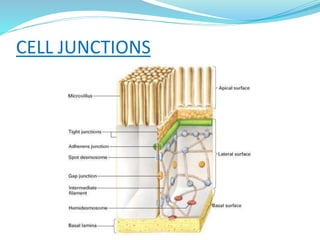
CELL JUNCTIONS
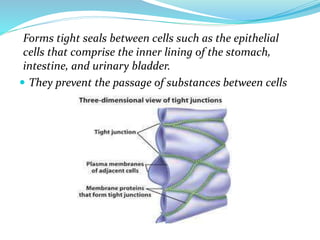
Forms tight seals between cells such as the epithelial
cells that comprise the inner lining of the stomach,
intestine, and urinary bladder.
 They prevent the passage of substances between cells
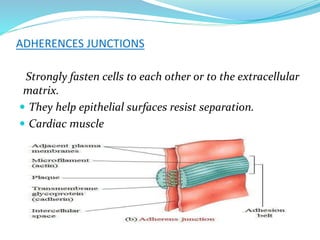
ADHERENCES JUNCTIONS
Strongly fasten cells to each other or to the extracellular
matrix.
 They help epithelial surfaces resist separation.
 Cardiac muscle
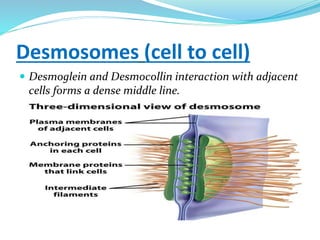
Desmosomes (cell to cell)
 Desmoglein and Desmocollin interaction with adjacent
cells forms a dense middle line.
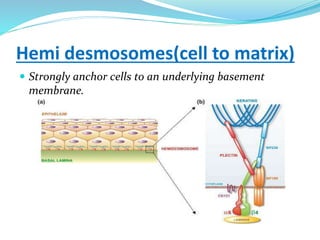
Hemi desmosomes(cell to matrix)
 Strongly anchor cells to an underlying basement
membrane.
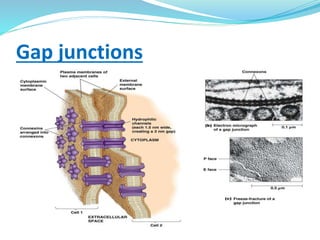
Gap junctions
 Formed by minute, fluid filled tunnels that permit
passage of electrical signals or chemicals (i.e. ions and
small molecules) from one cell to a neighbouring cell,
located in some parts of the nervous system, in heart
muscle and in the gastrointestinal tract.
Gap junctions
SUMMARY
 Epithelial is an avascular tissue derived from all the
three germ layers.
 They line the external surface of the body , occur as
membranes and as glands.
 All epithelia lie upon a basal lamina.
 Cells are connected to each other by cell junctions.
 May possess cilia or microvilli.
 They are protective , secretory , absorptive , sensory
depending on the location
BIBILOGRAPHY
 Freshney, R.I. (2002). “Introduction “. In Freshney,
R .Ian; Freshney, Mary. Culture of epithelial
cells.ISBN 978-0-471-6.
 Orban’s Oral Histology and Embryology-10th
Edition
 Essential of Oral Histology and Embryology-
James K Avery, 2nd Edition
 Oral Histology Development, Structures &
Fundamental – Ten Cate’s, 7th Edition

 Histology Text and Atlas- Michael H Ross,Lynn J
Romrell, Gorden I Kaye, 3rd Edition
 Gray’s Anatomy- The Anatomical Basis of Clinical
Practice ,40th Edition Susan Standing
 Bloom & Fawcett’s Concise Histology- Don W
 Essentials of Anatomy and Physiology ,5th Edition,
Valerie Scalon ,PhD.
THANK YOU

Oral-Epithelium by DR. C.P. ARYA ( B.Sc. ;B.D.S. ;M.D.S. ;P.M.S. ;R.N.T.C.P.)

  • 1.
  • 2.
  • 3.
    INTRODUCTION TISSUES ARE GROUPOF CELLS OR AGGREGATES TO PERFORM ONE OR MORE FUNCTIONS.  EPITHELIUM (epi + thele + ium) is one of the four basic types of animal tissue, along with A-CONNECTIVE TISSUE B-MUSCLE TISSUE C-NEURAL TISSUE
  • 4.
     The termEPITHELIUM is applied to the layer of cells covering the body surfaces.  Epithelium is an avascular tissue comprised of cells that line both the internal cavities and external surfaces.
  • 5.
    DEFINITION Epithelium is anavascular tissue composed of cells that cover the exterior body surfaces and line internal closed cavities (including the vascular system) and body tubes that communicate with the exterior (the alimentary, respiratory, and genitourinary tracts). Epithelium also forms the secretory portion (parenchyma) of glands and their ducts. In addition, specialized epithelial cells function as receptors for the special senses (smell, taste, hearing, and vision).
  • 6.
    DEVELOPMENT  EPITHELIUM ISDERIVED FROM THREE GERM LAYERS  ECTODERM  MESODERM  ENDODERM  ALTHOUGH MOST OF THE EPITHELIA ARE DERIVED FROM ECTODERM AND ENDODEREM
  • 8.
    ECTODERM: Oral andnasal mucosa, cornea, epidermis of the skin & glands of the skin & the mammary glands. ENDODERM: The liver, the pancreas & the lining of the respiratory and GIT.
  • 9.
    MESODERM: Uriniferous tubulesof the kidney, the lining of the male and female reproductive systems,the endothelial lining of the circulatory system and the mesothelium of the body cavity.
  • 10.
    FUNCTIONS OF EPITHELIUM Selective Barriers  Protection  Secretory function  Sensory function  Characteristic of Epithelia
  • 11.
     Predominantly Cellular The Basal surface of an epithelium is in contact with Basal Lamina.  Avascular  Can regenerate when injured
  • 12.
    CLASSIFICATION 1) SIMPLE: • Squamous •cuboidal • columnar 2) PSEUDOSTRATIFIED 3) STRATIFIED • Squamous non keratinized • Squamous keratinized • Cuboidal • Columnar • transitional
  • 14.
    Epithelium can begrouped mainly into Lining Epithelium Glandular Epithelium The lining epithelium is further classified into A-Simple epithelium (unilaminar) B-Stratified epithelium (multilaminar)
  • 15.
  • 16.
  • 17.
    SIMPLE SQUAMOUS EPITHELIUM Composed of flattened, irregularly shaped cells forming a continuous surface which may be refered to as pavemented epithelium.  Term ‘squamous’ derives from the comparison of the cells to the scales of a fish.  Supported by an underlying delicate membrane.  Involved in passive transport of either gases or fluids.
  • 18.
    PRESENT IN:  Lining-pulmonary alveoli, loop of Henle, parietal layer of Bawman capsule, inner and middle ear, blood and lymphatic vessels, pleural and peritoneal cavities. FUNCTION:  Limiting membrane  Fluid transport  Gaseous exchange  Lubrication  Reducing friction  Lining membrane
  • 20.
  • 21.
  • 22.
     Single layerof cube like cells with large , spherical central nuclei.  Location- Kidney tubules , Ducts and secretory portions of small glands , ovary surface , Intercalated ducts of salivary glands.  FUNCTIONS- Secretion and absorption.
  • 23.
    SIMPLE COLUMNAR EPITHELIUM •Cells are taller and appear columnar in sections at right angles to the basement membrane. • Nuclei are elongated and may be located towards the base, the centre or occasionally the apex of the cytoplasm, this is known as polarity. PRESENT IN: • Small intestine & colon • Stomach lining and gastric glands • Gall bladder
  • 24.
    SIMPLE COLUMNAR EPITHELIUM FUNCTION: Transportation  Absorption  Secretion  Protection
  • 25.
    SIMPLE COLUMNAR EPITHELIUM Single layer of tall cells with round nuclei.  CILIATED – most of respiratory tract small bronchi , uterine tubes , and some regions 0f the uterus.
  • 26.
  • 27.
     NON CILIATED– digestive tract ( stomach to anal canal ) , excretory ducts of some glands
  • 28.
  • 29.
    PSEUDO STRATIFIED EPITHELIUM Simple columnar epithelium , nuclei at different levels in a vertical section.  Migrating lymphocytes and mast cells give this appearance.  Seen in ciliated lining of the respiratory tract and sensory epithelium of the olfactory areas.  Excretory ducts of salivary glands.  Multi-laminar epithelium.
  • 30.
    STRATIFIED SQUAMOUS  Stratifiedsquamous epithelium  Basal cells are cuboidal or columnar  Surface cells squamous  Occur in sites exposed to constant damage  Two types keratinized and non- keratinized  Location : Non-keratinized forms the moist linings of the esophagus , mouth, and vagina;  Keratinized variety forms the epidermis
  • 31.
  • 32.
    STRATIFIED CUBOIDAL STRATIFIED CUBOIDALEPITHELIUM  Thin, stratified epithelium which usually consists of only two or three layers of cuboidal or low columnar cells.  Not involved in significant absorptive or secretory activity PRESENT IN:  Ducts of sweat glands  Large ducts of exocrine glands  Anorectal junction
  • 33.
  • 34.
    STRATIFIED COLUMNAR PRESENT IN: Conjunctiva of eye  Some large excretory ducts  Portions of male urethra FUNCTION:  Secretion  Absorption  Protection
  • 35.
  • 36.
     Affords morestrength than single layer
  • 37.
    Transitional Epithelium  Resemblesboth stratified squamous and stratified cuboidal ; basal cells cuboidal or columnar surface cells dome shaped or squamous like ,depending on degree of organ stretch.  Stretches readily and permits distension of urinary organ by contained urine  Lines the ureters, urinary bladder and part of the urethra  Transitional epithelium of ureter
  • 38.
    Transitional Epithelium  Inthe stretched state, it appears 2-3 cells thick (although the actual number of layers remains constant) and the intermediate and surface layers are extremely flattened. PRESENT IN:  Urethra  Ureters  Bladders  Renal calyces FUNCTION:  Protection  Distensible
  • 39.
    Oral mucosa  Mucousmembrane : moist lining of the gastrointestinal tract, nasal passages ,Other body cavities that communicate with the exterior.  In the oral cavity the lining is called as oral mucous membrane or oral mucosa.
  • 40.
    Functions of oralmucosa  Protection: Barrier for mechanical trauma and microbiological insults  Sensation: Temperature (heat and cold) , touch ,pain, taste buds, thirst; reflexes such as swallowing , etching, gagging and salivating .  Secretion : Salivary secretion
  • 41.
    Development and structureof oral epithelium  The epithelium of the oral cavity derived from the embryonic ectoderm.  Most of the mucosal surface is lined by a non- keratinized stratified squamous epithelium.  Except for Gingiva , hard palate and dorsal surface of the tongue where the epithelium is keratinized.
  • 42.
    FUNCTIONAL CHARACTERISTICS  Asthe cells migrate from the basal layer to the surface layer, differentiation produces a surface layer that is either  Non-keratinized  Ortho Keratinized  Para keratinized
  • 43.
    Non-Keratinized Epithelium  Thesurface cells retain their nuclei and cytoplasm does not contain keratin filaments.  Stratum spinosum and granulosum is absent.  Lining mucosa of the oral cavity.  Clinical considerations:  Prosthetic devices thin the epithelium  Linea alba  Angina pectoris- Nitroglycerine tablets are placed sublingually and absorbed quickly through the thin non- keratinized epithelium and into large veins of the ventral surface of the tongue.
  • 44.
    Ortho Keratinized epithelium Stratum basale- tall columnar or cuboidal.  Stratum corneum elliptical / spherical.  In contact only by Desmosomes.  Stratum granulosum- flat cells with keratohyaline granules.  Stratum spinosum- squamous cells with no nuclei.  Masticatory mucosa-Ortho keratinized.
  • 45.
    ULTRA STRUCTURE OFTHE EPITHELIAL CELL  Cells of the basal layer are least differentiated.  They contain organelles and typical filamentous strands called tonofilaments.  Tonofilaments aggregate- tonofibrills.  Chemically they are cytokeratins.  Epithelial cells are named as keratinocyte  Keratins  Epithelial cells produce proteins- carbohydrate complex which provide cohesion.  Desmosomes.  Hemi desmosomes.
  • 46.
    APICAL CELL SPECIALISATION Microvilli Finger like cytoplasmic processes.  Number and shape correlates with absorptive capacity.  Contain actin filament. Cilia: Stereocilia
  • 47.
    GLANDULAR EPITHELIUM Classification ofGlands ENDOCRINE GLANDS:-  Hormones are secreted directly into blood.  No ducts.  Under the microscope , they look like any stratified epithelial tissue with one big difference: THEY DO NOT HAVE A FREE SURFACE AND SURROUNDED DIRECTLY BY OTHER TISSUES.
  • 48.
    EXOCRINE GLANDS  Releasetheir products onto the free surface of the skin or of the open cavities of the body such as the digestive , respiratory or reproductive tracts.  Their products are NOT released into the blood.  THESE ARE OF TWO TYPES: UNICELLULAR:  They are scattered amongst other non-secretory epithelial cells.  They have NO ducts, but they secrete their products directly on the free surface.  The most common unicellular exocrine glands are the Goblet cells(mucous secreting)
  • 49.
    MULTICELLULAR Serous and mucousglands of oral cavity.  Simple: (one branched duct) Sweat glands.  Compound: (branched ducts) Parotid gland. Major salivary glands: 1)-Parotid –entirely serous 2)-Sublingual-mixed (predominantly mucous) 3)-Submandibular- mixed (predominantly serous)
  • 50.
    Minor salivary glands: Palatal – purely mucous  Lingual – Anterior ( Glands of Blandin and Nuhn )  Anteriorly- cheifly mucous  Posteriorly-mixed Posteriorly (Von Ebner’s glands )-serous  Gloss palatine – purely mucous  Labial & Buccal- mixed
  • 51.
    SECRETORY CELLS SEROUS CELLS Pyramidal cells with basal nuclei Microvilli on the luminal surface.  Spherical nuclei basally.  Lateral surface have folds interdigitating with same from adjacent cells.  Joined together by cell junctions.
  • 52.
    MUCOUS CELLS  Tubularconfiguration with mucous cells surroundings a central lumen.  Demi Lune- serous cells associated with them at the end of the tubule.  Apical cytoplasm has accumulated mucous
  • 53.
    Ducts – Intercalatedducts  Lined by simple cuboidal epithelium.  Centrally placed nuclei.  Small cytoplasm , few ER and a small Golgi complex.  Apically few secretory granules.  Few short microvilli  Unidentified in routine histology.
  • 54.
    Striated duct cells Cells are columnar , centrally placed nucleus and acidophilic cytoplasm.  Striation appear in the basal cytoplasm, mitochondria in cytoplasmic partition separated by highly folded cell membrane.
  • 55.
    Excretory ducts  Pseudostratified epithelium with columnar cells.  Larger than striated ducts.  Scattered Goblet cells seen.
  • 56.
    Clinical importance  Cysticfibrosis (CF) is a genetic disorder of certain exocrine glands including the salivary glands, the sweat glands, the pancreas and the mucous glands of the respiratory tract.  A person with CF has clogged bronchial tubes, frequent episodes of pneumonia and ultimately lungs that can not carry out gas exchange.  CF –mutations in the gene that encodes the CF transmembrane conductance regular
  • 57.
    SPECIAL EPITHELIA  Epitheliumof sense organs:olfactory, gustatory and vestibulocochlear epithelium.  Myoepithelial cells/basket cells.  Seminiferous epithelium
  • 58.
    Structure of basallamina  Light microscope- basement membrane.  Electron microscope-basal lamina.  Basal lamina divided into:  Lamina Lucida  Lamina lucid  Lamina dens  Lamina reticularis
  • 59.
    STRUCTURE OF BASEMENTMEMBRANE  Type IV collagen  Proteoglycan (heparin and chondroitin sulfate)  Glycoprotein  Fibronectin
  • 60.
  • 61.
    Forms tight sealsbetween cells such as the epithelial cells that comprise the inner lining of the stomach, intestine, and urinary bladder.  They prevent the passage of substances between cells
  • 62.
    ADHERENCES JUNCTIONS Strongly fastencells to each other or to the extracellular matrix.  They help epithelial surfaces resist separation.  Cardiac muscle
  • 63.
    Desmosomes (cell tocell)  Desmoglein and Desmocollin interaction with adjacent cells forms a dense middle line.
  • 64.
    Hemi desmosomes(cell tomatrix)  Strongly anchor cells to an underlying basement membrane.
  • 65.
    Gap junctions  Formedby minute, fluid filled tunnels that permit passage of electrical signals or chemicals (i.e. ions and small molecules) from one cell to a neighbouring cell, located in some parts of the nervous system, in heart muscle and in the gastrointestinal tract.
  • 66.
  • 67.
    SUMMARY  Epithelial isan avascular tissue derived from all the three germ layers.  They line the external surface of the body , occur as membranes and as glands.  All epithelia lie upon a basal lamina.
  • 68.
     Cells areconnected to each other by cell junctions.  May possess cilia or microvilli.  They are protective , secretory , absorptive , sensory depending on the location
  • 69.
    BIBILOGRAPHY  Freshney, R.I.(2002). “Introduction “. In Freshney, R .Ian; Freshney, Mary. Culture of epithelial cells.ISBN 978-0-471-6.  Orban’s Oral Histology and Embryology-10th Edition  Essential of Oral Histology and Embryology- James K Avery, 2nd Edition  Oral Histology Development, Structures & Fundamental – Ten Cate’s, 7th Edition 
  • 70.
     Histology Textand Atlas- Michael H Ross,Lynn J Romrell, Gorden I Kaye, 3rd Edition  Gray’s Anatomy- The Anatomical Basis of Clinical Practice ,40th Edition Susan Standing  Bloom & Fawcett’s Concise Histology- Don W  Essentials of Anatomy and Physiology ,5th Edition, Valerie Scalon ,PhD.
  • 71.