THE DIAGNOSTIC PROCESS 
Intra-oral Examination 
Periodontium: 
Gingiva is examined for signs of inflammation by 
studying the following features: 
color, contour, consistency, surface texture, size, 
position, pus, bleeding on probing & pocket formation. 
If pocket formation is noted, William’s graduated probe 
is used to measure pocket depth on all the four aspects of 
the tooth. 
Various indices (‘Gingival Index’, ‘Periodontal Index’) can 
also be used to assess the health of the periodontium in a 
more objective manner.
THE DIAGNOSTIC PROCESS
THE DIAGNOSTIC PROCESS 
Intra-oral Examination 
Oral Mucous Membrane: examined region wise 
~ Labial mucosa & vermilion border (upper & lower) 
~ Buccal Examination mucosa of (right an ulcer: 
& left; opening of parotid duct 
& assessment of salivary flow, viscosity) 
Inspection 
# Site, size, shape, number 
# Borders 
# Edges 
# Floor 
# Surrounding mucosa 
~ Vestibular mucosa (upper & lower; right & left) 
~ Palatal mucosa (hard & soft palate) 
~ Lingual mucosa (examination of tongue: dorsal, 
Palpation 
# Tenderness 
# Base 
# Fixity to 
underlying tissue 
# Bleeding 
ventral & lateral surfaces; size; papillae; movement; 
frenal attachment; and palpation & taste acuity ) 
~ Floor of the mouth mucosa (including openings of 
the submandibular ducts & assessment of salivary 
flow, viscosity)
THE DIAGNOSTIC PROCESS 
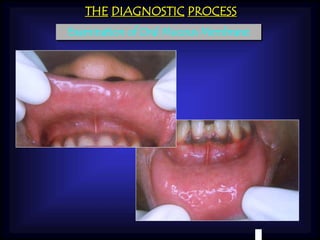
Examination of Oral Mucous Membrane
THE DIAGNOSTIC PROCESS 
Examination of Oral Mucous Membrane
THE DIAGNOSTIC PROCESS 
Examination of Oral Mucous Membrane
THE DIAGNOSTIC PROCESS 
Intra-oral Examination 
Detailed examination of the area of chief complaint: 
All the observations regarding this area, made 
during the examination so far, are first compiled. 
Any further observations - not made earlier - are 
then noted down. 
All the observations regarding the area of chief 
complaint - thus compiled under this heading - are 
coupled with the history of the chief complaint to 
lead the clinician to provisional diagnosis of the 
chief complaint.
THE DIAGNOSTIC PROCESS 
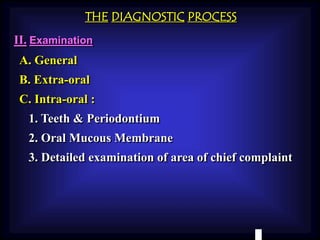
II. Examination 
A. General 
B. Extra-oral 
C. Intra-oral : 
1. Teeth & Periodontium 
2. Oral Mucous Membrane 
3. Detailed examination of area of chief complaint

Oral diagnostic process (part-4)

  • 1.
    THE DIAGNOSTIC PROCESS Intra-oral Examination Periodontium: Gingiva is examined for signs of inflammation by studying the following features: color, contour, consistency, surface texture, size, position, pus, bleeding on probing & pocket formation. If pocket formation is noted, William’s graduated probe is used to measure pocket depth on all the four aspects of the tooth. Various indices (‘Gingival Index’, ‘Periodontal Index’) can also be used to assess the health of the periodontium in a more objective manner.
  • 2.
  • 3.
    THE DIAGNOSTIC PROCESS Intra-oral Examination Oral Mucous Membrane: examined region wise ~ Labial mucosa & vermilion border (upper & lower) ~ Buccal Examination mucosa of (right an ulcer: & left; opening of parotid duct & assessment of salivary flow, viscosity) Inspection # Site, size, shape, number # Borders # Edges # Floor # Surrounding mucosa ~ Vestibular mucosa (upper & lower; right & left) ~ Palatal mucosa (hard & soft palate) ~ Lingual mucosa (examination of tongue: dorsal, Palpation # Tenderness # Base # Fixity to underlying tissue # Bleeding ventral & lateral surfaces; size; papillae; movement; frenal attachment; and palpation & taste acuity ) ~ Floor of the mouth mucosa (including openings of the submandibular ducts & assessment of salivary flow, viscosity)
  • 4.
    THE DIAGNOSTIC PROCESS Examination of Oral Mucous Membrane
  • 5.
    THE DIAGNOSTIC PROCESS Examination of Oral Mucous Membrane
  • 6.
    THE DIAGNOSTIC PROCESS Examination of Oral Mucous Membrane
  • 7.
    THE DIAGNOSTIC PROCESS Intra-oral Examination Detailed examination of the area of chief complaint: All the observations regarding this area, made during the examination so far, are first compiled. Any further observations - not made earlier - are then noted down. All the observations regarding the area of chief complaint - thus compiled under this heading - are coupled with the history of the chief complaint to lead the clinician to provisional diagnosis of the chief complaint.
  • 8.
    THE DIAGNOSTIC PROCESS II. Examination A. General B. Extra-oral C. Intra-oral : 1. Teeth & Periodontium 2. Oral Mucous Membrane 3. Detailed examination of area of chief complaint