Meeting institutional
needs for digital curation
through shared endeavor
The application of Hydra/Fedora at Hull
Chris Awre
Head of Information Management, Library and Learning Innovation
IDCC, 10th February 2015
To cover
• Background/context
• Digital repository development at Hull
• Open source and community
• Applying Fedora at Hull
• Hydra development
• Hydra and Fedora
• Hydra and Hull
• Reflections and looking ahead
Digital curation through shared endeavour | 10 February 2015 | 2
Background/context
• 2005
– The Jisc FAIR (Focus on Access to Institutional
Resources) programme was finishing
• Lots of emphasis on having a stable platform upon which to base
management of institutional assets
• Led to first Digital Repositories programme, 2005-7
– University of Hull started down its path of implementing
a digital repository
• Desire to address multiple use cases together through a single
solution
• Practical and financial basis and limitations
Digital curation through shared endeavour | 10 February 2015 | 3
An institutional repository
• Repositories are infrastructure
– Maintaining infrastructure requires resource, which we
need to minimise to justify costs in the long-term
• Content doesn’t sit in silos
– One repository facilitates cross-fertilisation of use
• Integration with one system
– Embedding the repository means linking to one place
One institution = one repository?
Digital curation through shared endeavour | 10 February 2015 | 4
Five principles
 A repository should be content agnostic
 A repository should be (open) standards-based
 A repository should be scalable
 A repository should understand how pieces of content relate
to each other
 A repository should be manageable with limited resource
Digital curation through shared endeavour | 10 February 2015 | 5
Five principles (leading to our implementation)
 Fedora is content agnostic
 Fedora is (open) standards-based
 Fedora is scalable
 Fedora understands how pieces of content relate to each other
 Fedora is manageable with limited resource
– With help from the community
Digital curation through shared endeavour | 10 February 2015 | 6
Open source and community
• University of Hull had recognised that engaging in open source
(community source) projects would enable more local
implementation and innovation
• uPortal
– Institutional portal solution
– Came out of JASIG community
• Sakai
– VLE solution
– Community built as part of Mellon grant conditions
• Now both part of Apereo Foundation
– Hull contributed Executive Director!
Digital curation through shared endeavour | 10 February 2015 | 7
Implementing Fedora at Hull
• RepoMMan project, 2005-7
– Examining how a repository can be made part of day-to-
day activity
• Not just somewhere to put stuff at the end of a process
• REMAP project, 2007-9
– Applying a repository to serving records management and
preservation by starting to capture items from their
creation
• Institutional developments
– Creation of local service in parallel (October 2008)
• Initial use cases were e-theses and exam papers, not OA
Digital curation through shared endeavour | 10 February 2015 | 8
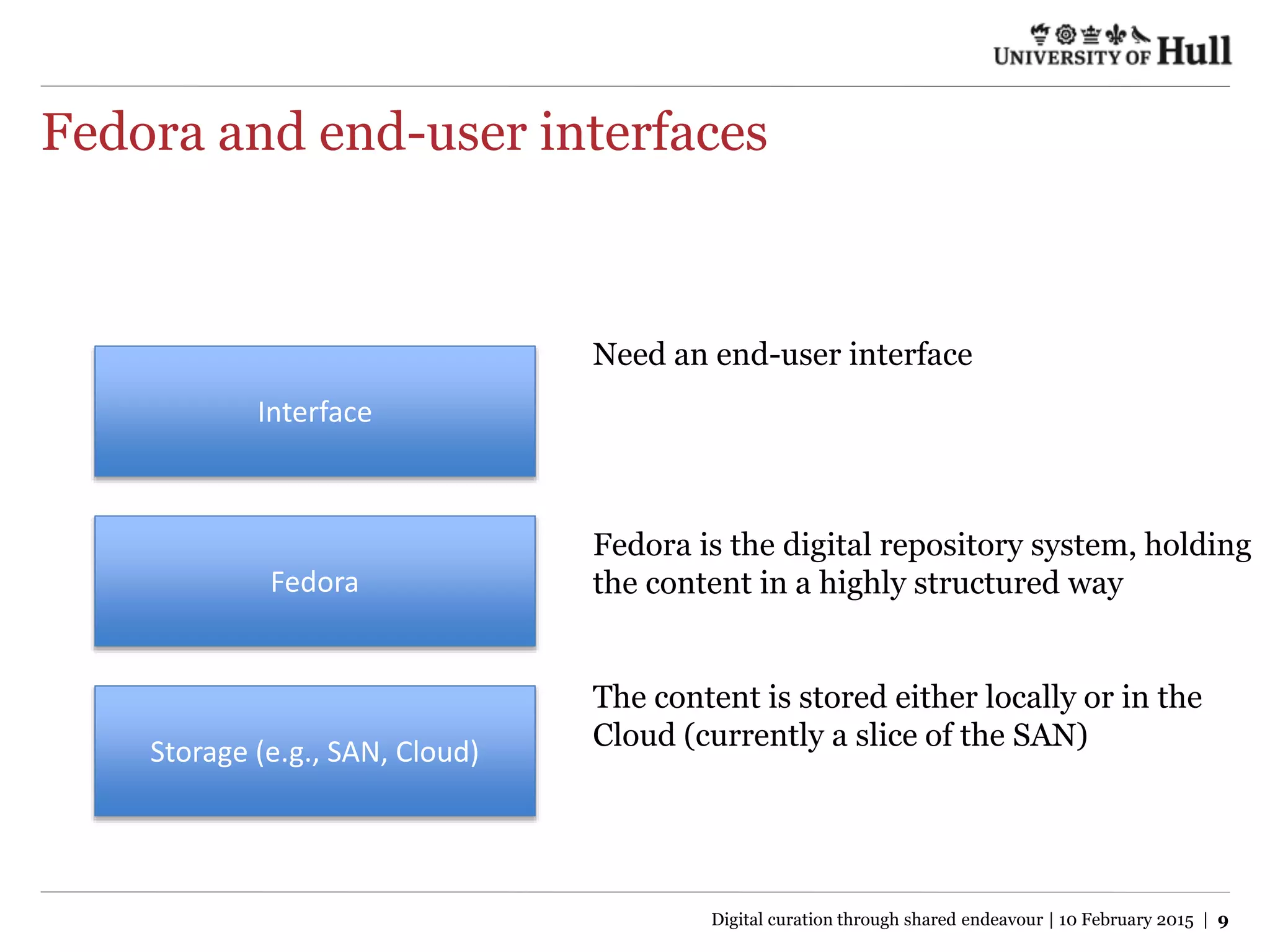
Fedora and end-user interfaces
Storage (e.g., SAN, Cloud)
Fedora
Interface
Need an end-user interface
Fedora is the digital repository system, holding
the content in a highly structured way
The content is stored either locally or in the
Cloud (currently a slice of the SAN)
Digital curation through shared endeavour | 10 February 2015 | 9
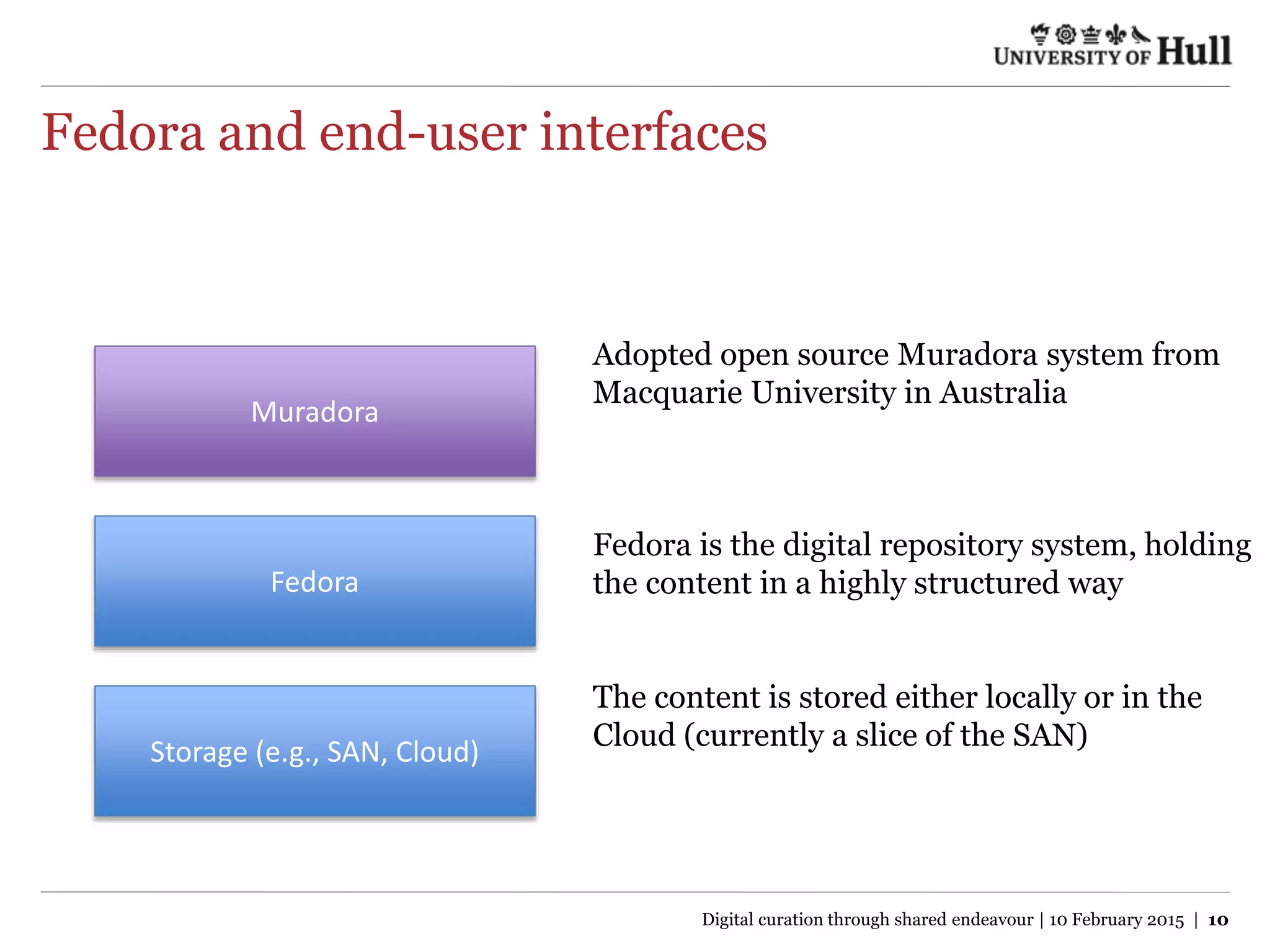
Fedora and end-user interfaces
Storage (e.g., SAN, Cloud)
Fedora
Muradora
Adopted open source Muradora system from
Macquarie University in Australia
Fedora is the digital repository system, holding
the content in a highly structured way
The content is stored either locally or in the
Cloud (currently a slice of the SAN)
Digital curation through shared endeavour | 10 February 2015 | 10
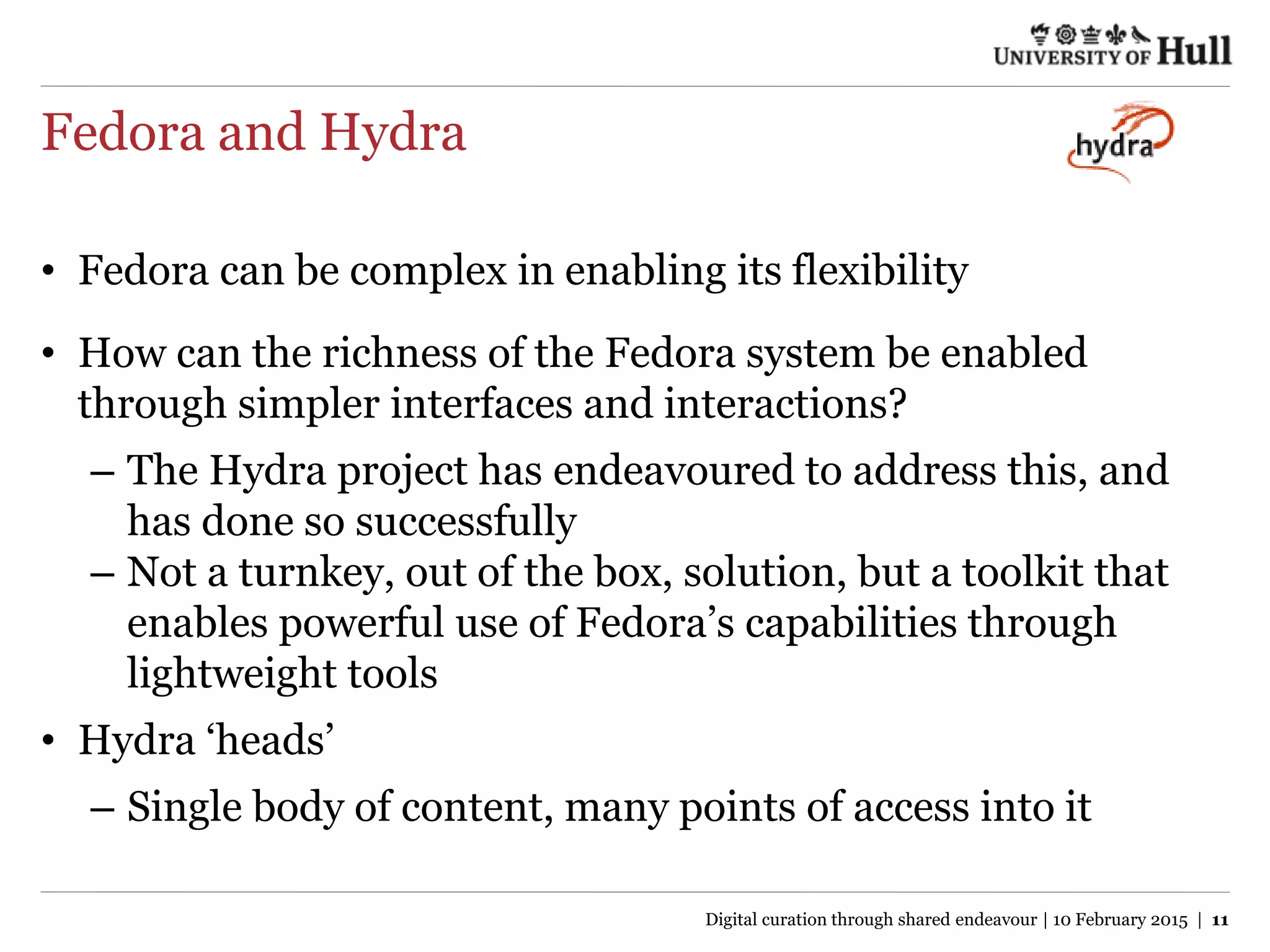
Fedora and Hydra
• Fedora can be complex in enabling its flexibility
• How can the richness of the Fedora system be enabled
through simpler interfaces and interactions?
– The Hydra project has endeavoured to address this, and
has done so successfully
– Not a turnkey, out of the box, solution, but a toolkit that
enables powerful use of Fedora’s capabilities through
lightweight tools
• Hydra ‘heads’
– Single body of content, many points of access into it
Digital curation through shared endeavour | 10 February 2015 | 11
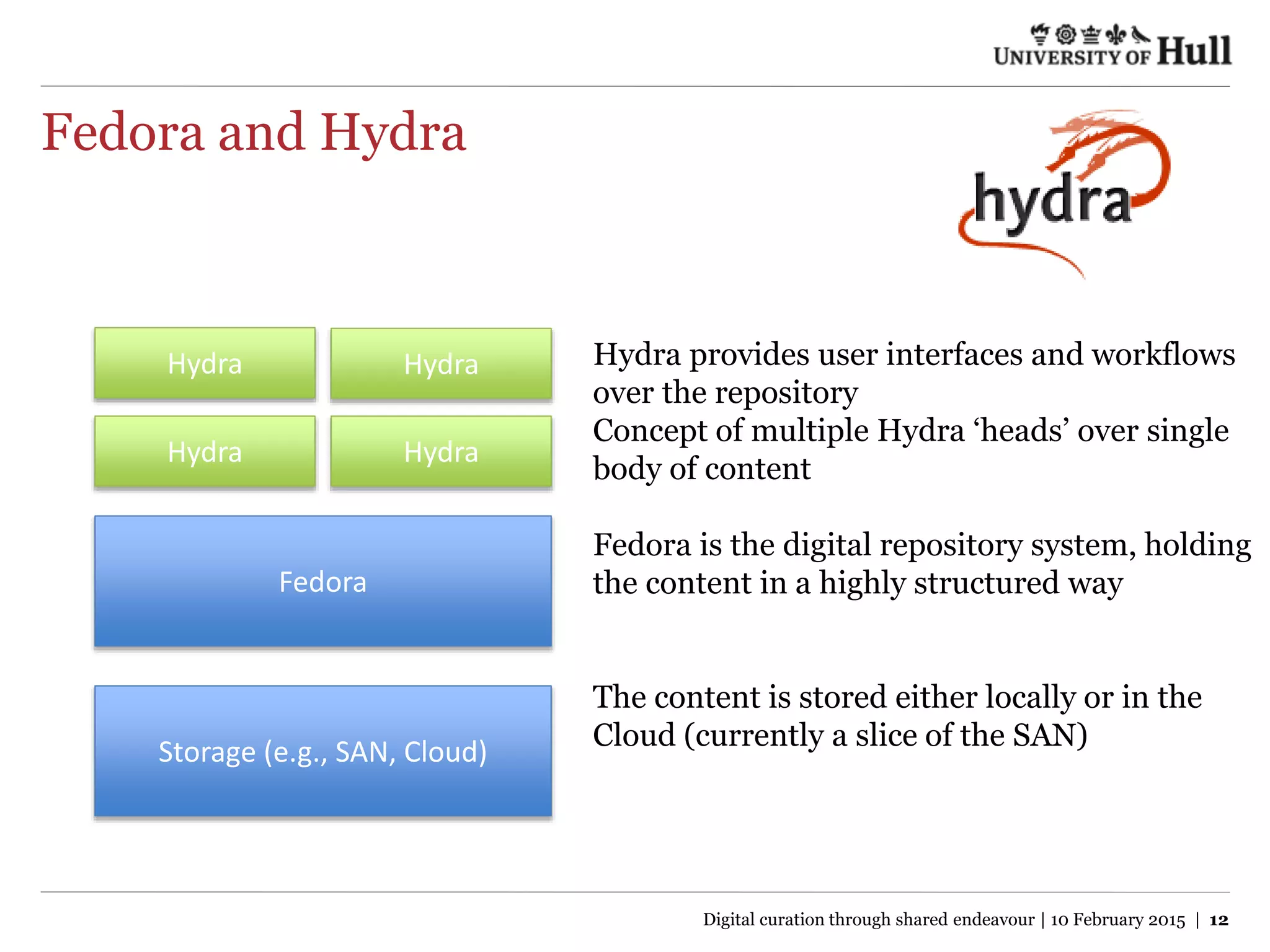
Fedora and Hydra
Storage (e.g., SAN, Cloud)
Fedora
Hydra Hydra provides user interfaces and workflows
over the repository
Concept of multiple Hydra ‘heads’ over single
body of content
Fedora is the digital repository system, holding
the content in a highly structured way
The content is stored either locally or in the
Cloud (currently a slice of the SAN)
Digital curation through shared endeavour | 10 February 2015 | 12
Hydra
Hydra Hydra
Hydra
Change the way you think about Hull | 7 October 2009 | 2
• A collaborative project between:
– University of Hull
– University of Virginia
– Stanford University
– Fedora Commons/DuraSpace
– MediaShelf LLC
• Unfunded (in itself)
– Activity based on identification of a common need
• Aim to work towards a reusable framework for multipurpose,
multifunction, multi-institutional repository-enabled
solutions
• Timeframe - 2008-11 (but now extended indefinitely)
TextDigital curation through shared endeavour | 10 February 2015 | 13
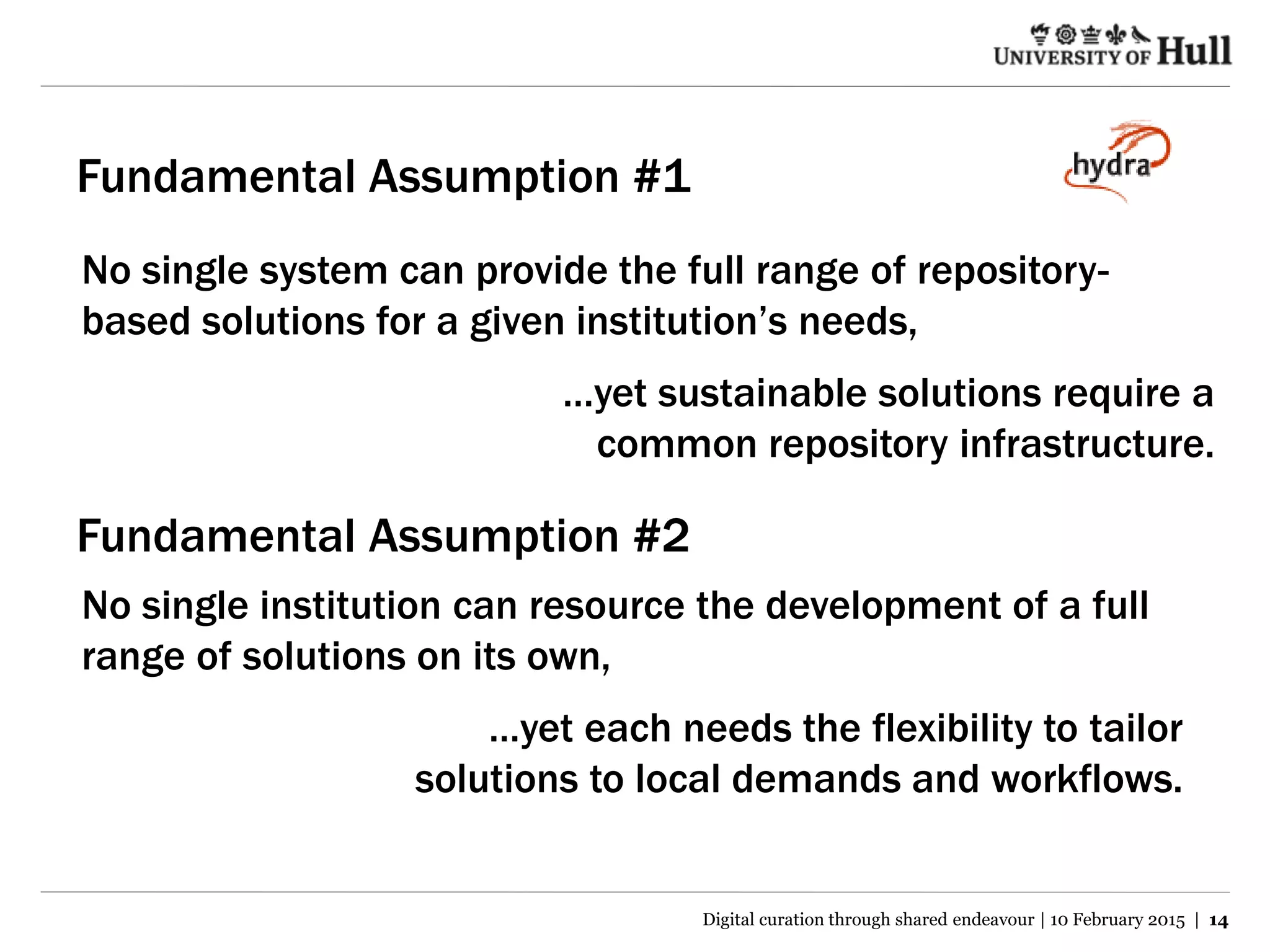
Fundamental Assumption #1
No single system can provide the full range of repository-
based solutions for a given institution’s needs,
…yet sustainable solutions require a
common repository infrastructure.
No single institution can resource the development of a full
range of solutions on its own,
…yet each needs the flexibility to tailor
solutions to local demands and workflows.
Fundamental Assumption #2
Digital curation through shared endeavour | 10 February 2015 | 14
Eight strategic priorities
1. Solution bundles
2. Turnkey applications
3. Vendor ecosystem
4. Training
5. Documentation
6. Code sharing
7. Community ties
8. Grow the User base
Digital curation through shared endeavour | 10 February 2015 | 15
Hydra partnership
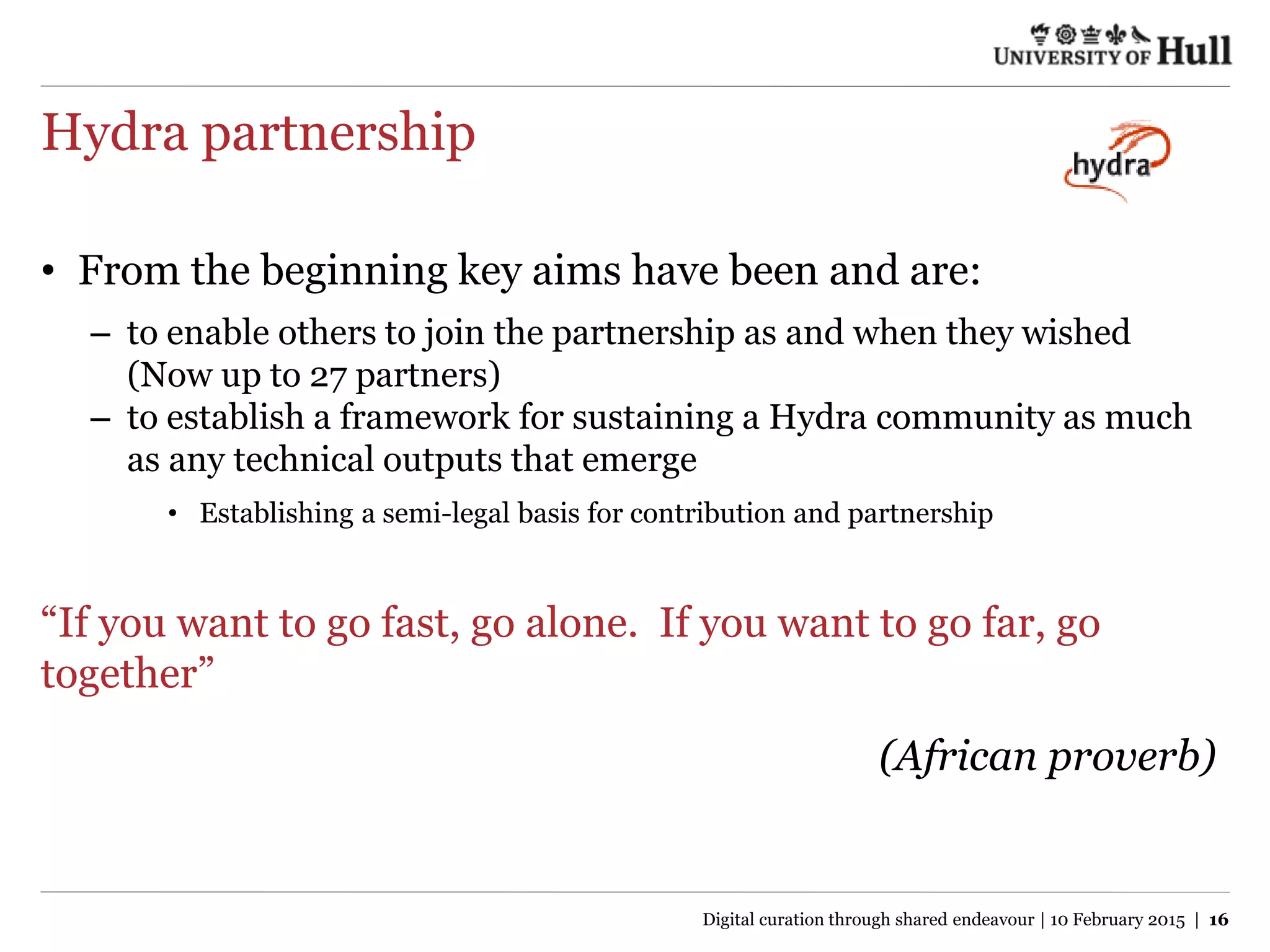
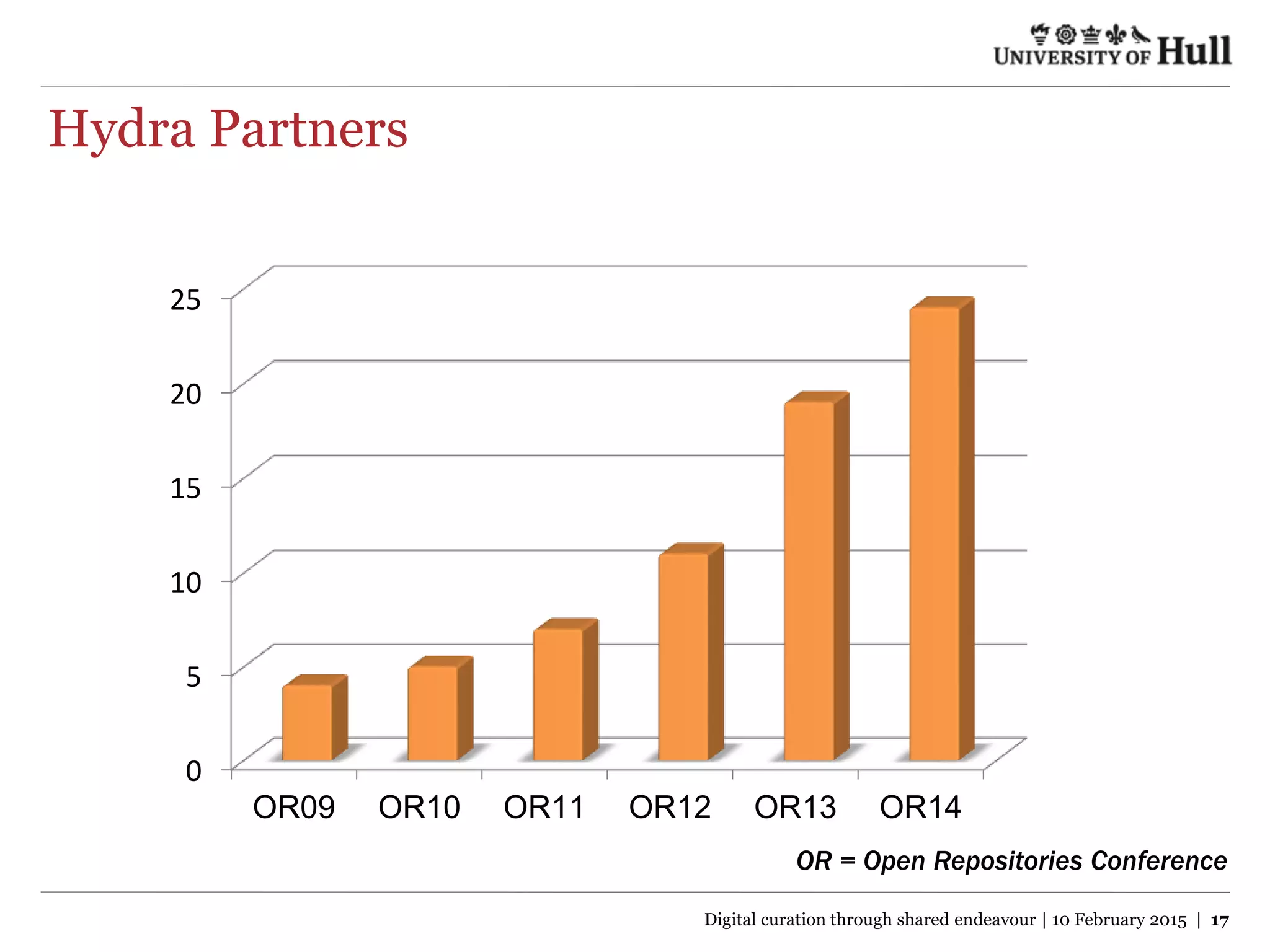
• From the beginning key aims have been and are:
– to enable others to join the partnership as and when they wished
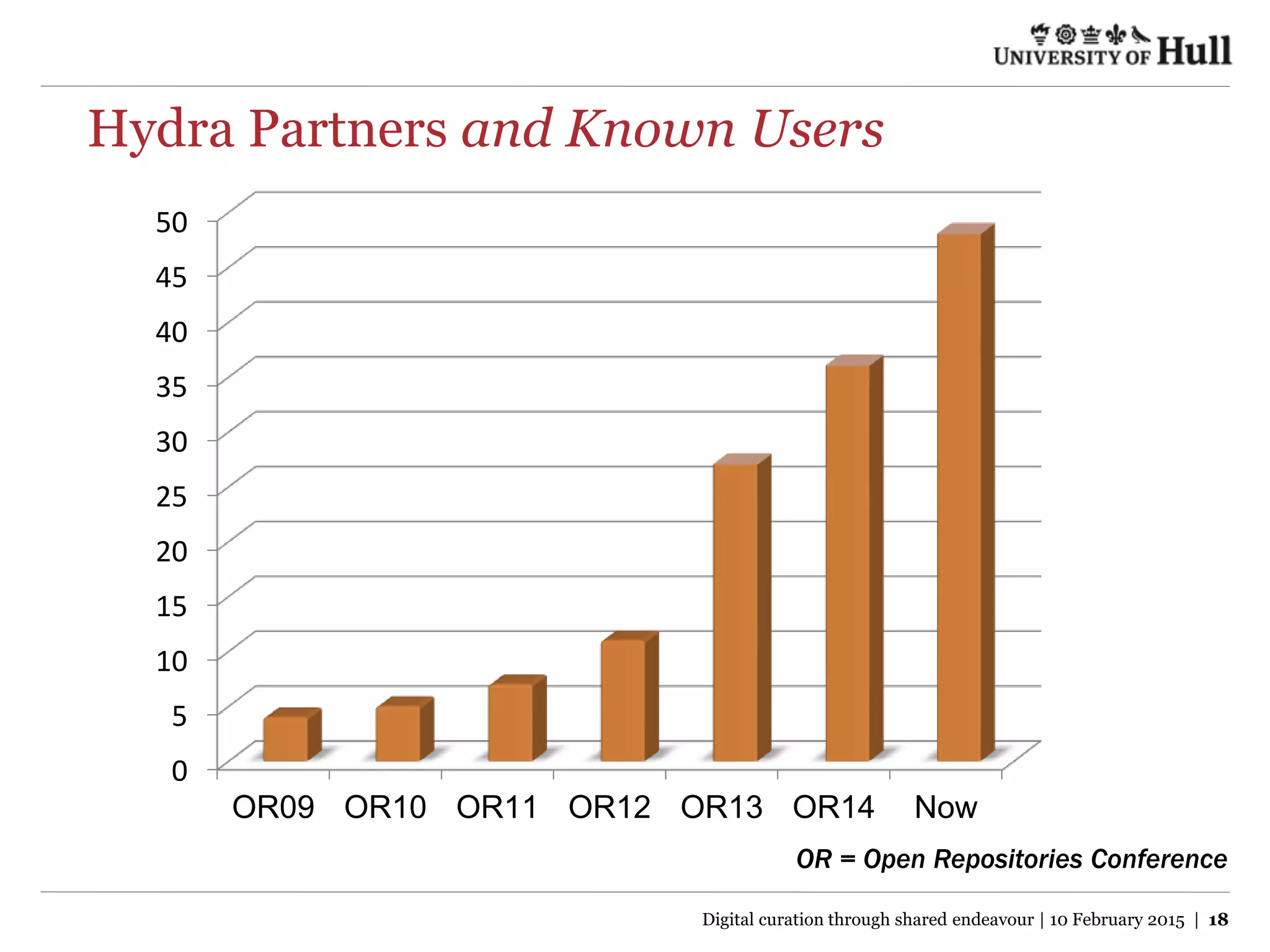
(Now up to 27 partners)
– to establish a framework for sustaining a Hydra community as much
as any technical outputs that emerge
• Establishing a semi-legal basis for contribution and partnership
“If you want to go fast, go alone. If you want to go far, go
together”
(African proverb)
Digital curation through shared endeavour | 10 February 2015 | 16
Hydra Partners
0
5
10
15
20
25
OR09 OR10 OR11 OR12 OR13 OR14
OR = Open Repositories Conference
Digital curation through shared endeavour | 10 February 2015 | 17
Hydra Partners and Known Users
0
5
10
15
20
25
30
35
40
45
50
OR09 OR10 OR11 OR12 OR13 OR14 Now
OR = Open Repositories Conference
Digital curation through shared endeavour | 10 February 2015 | 18
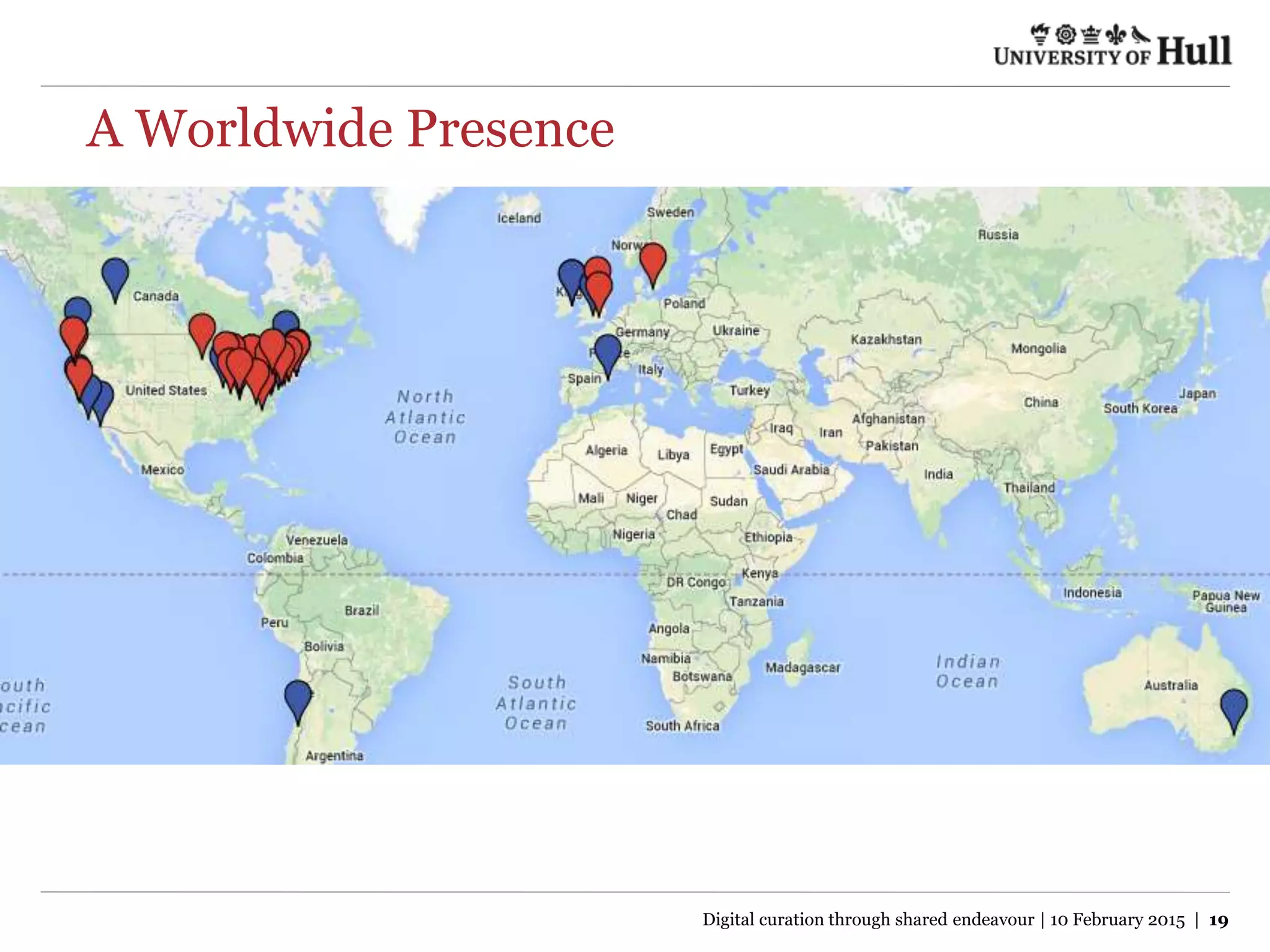
A Worldwide Presence
Digital curation through shared endeavour | 10 February 2015 | 19
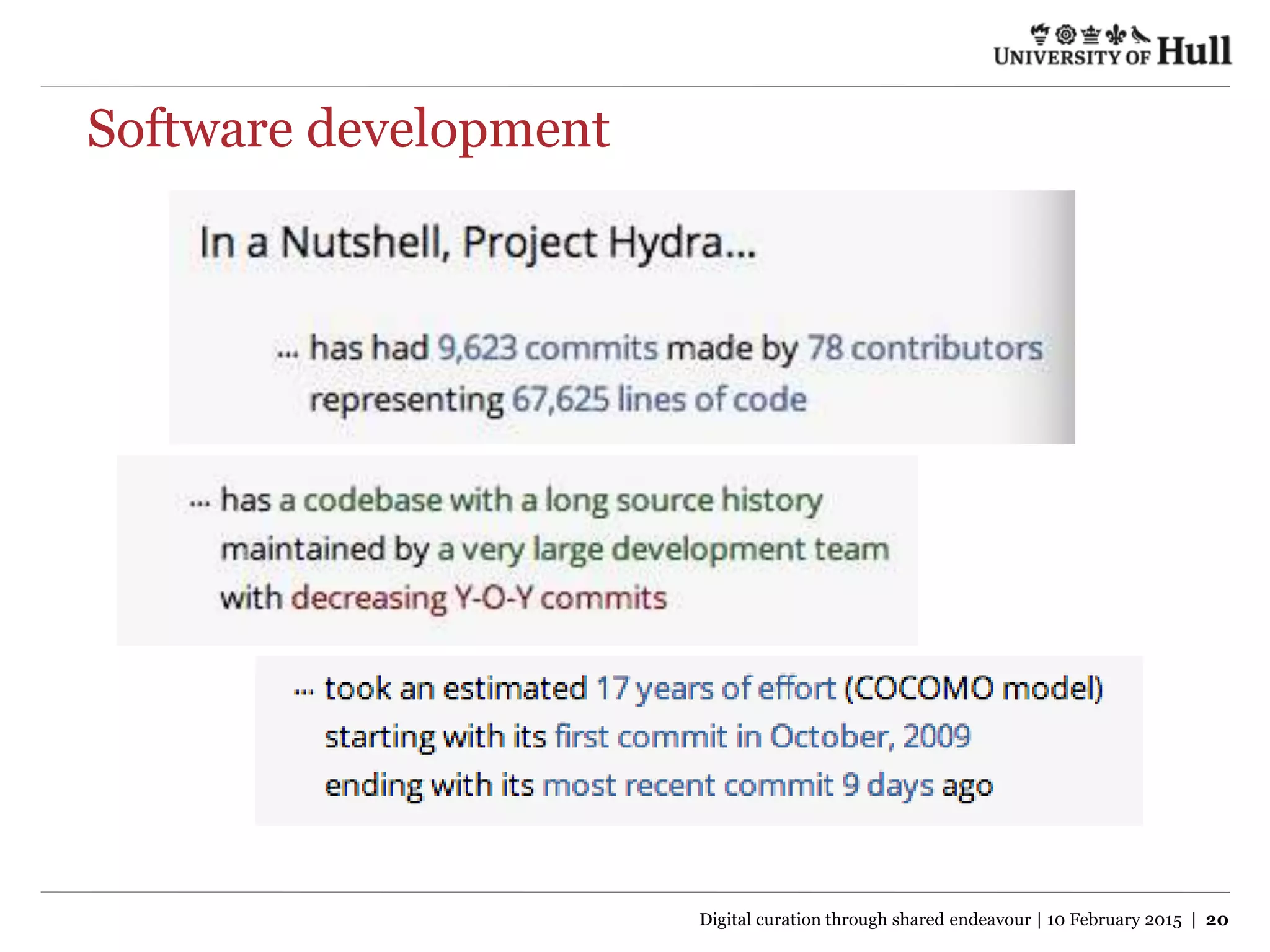
Software development
Digital curation through shared endeavour | 10 February 2015 | 20
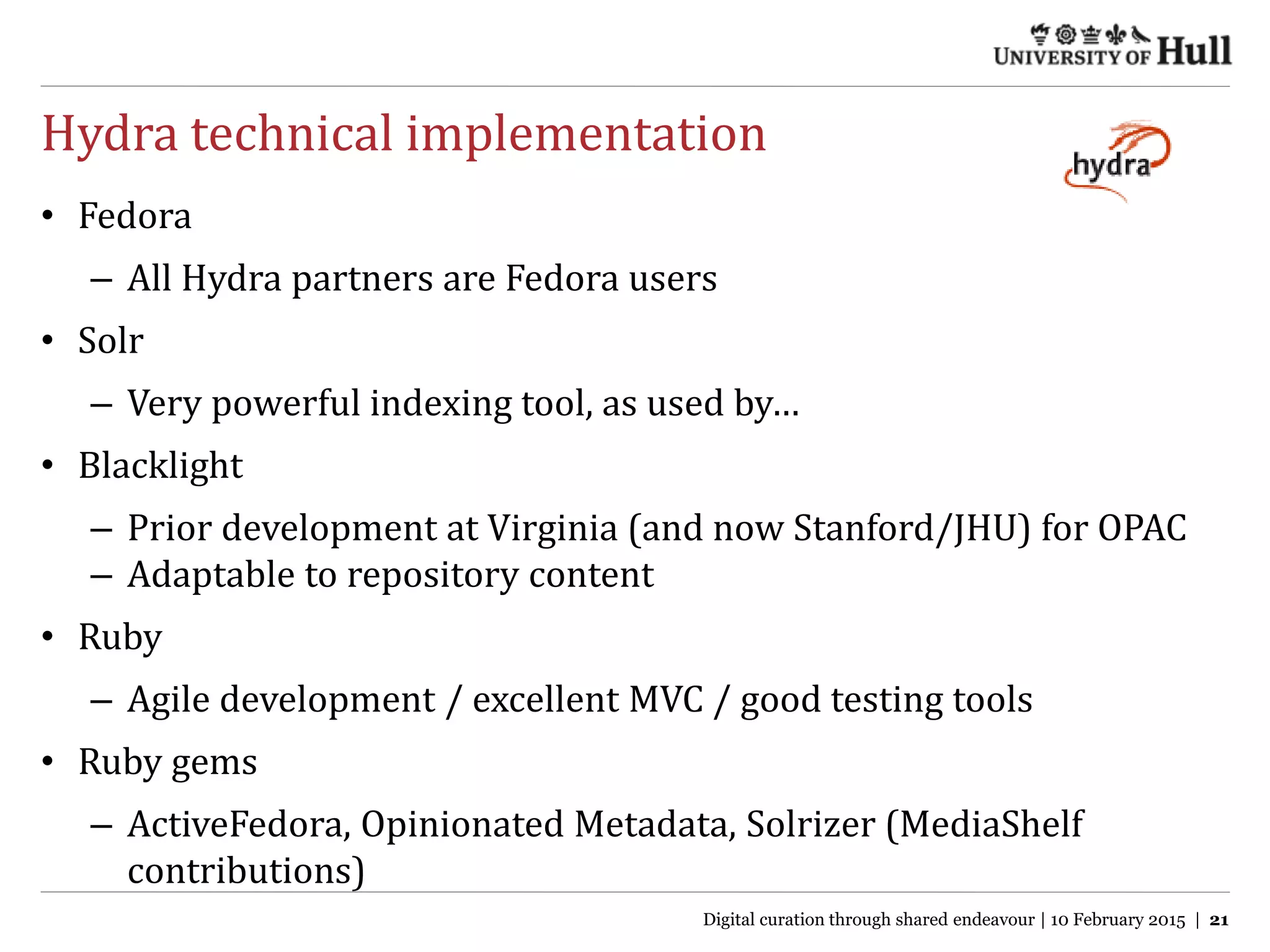
Hydra technical implementation
• Fedora
– All Hydra partners are Fedora users
• Solr
– Very powerful indexing tool, as used by…
• Blacklight
– Prior development at Virginia (and now Stanford/JHU) for OPAC
– Adaptable to repository content
• Ruby
– Agile development / excellent MVC / good testing tools
• Ruby gems
– ActiveFedora, Opinionated Metadata, Solrizer (MediaShelf
contributions)
Digital curation through shared endeavour | 10 February 2015 | 21
Four Key Capabilities
1. Support for any kind of record or metadata
2. Object-specific behaviors
– Books, Articles, Images, Music, Video, Manuscripts, etc.
3. Tailored views for domain or discipline-specific materials
4. Easy to augment & over-ride with local modifications
Digital curation through shared endeavour | 10 February 2015 | 22
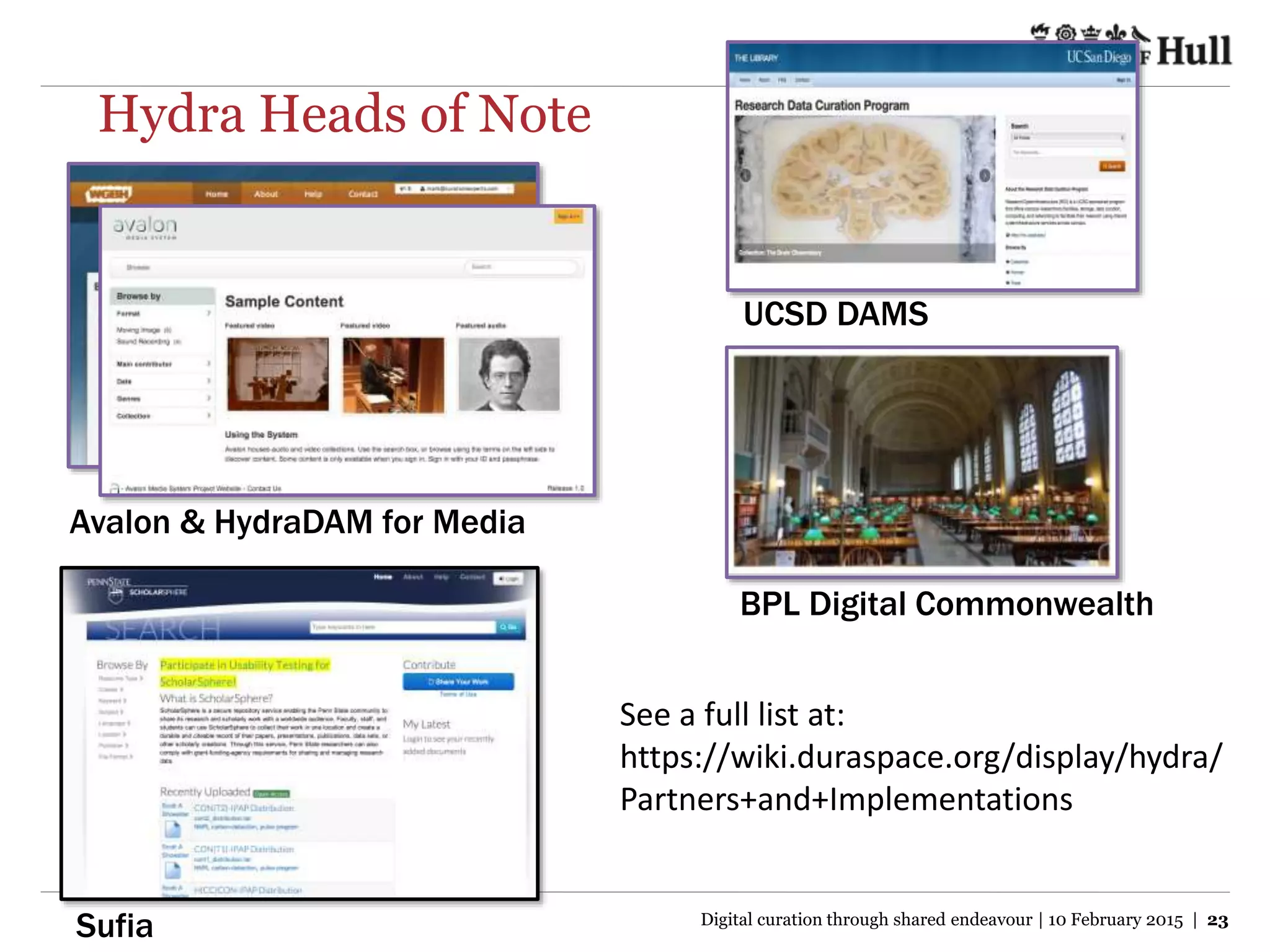
Hydra Heads of Note
Avalon & HydraDAM for Media
Sufia
BPL Digital Commonwealth
UCSD DAMS
Digital curation through shared endeavour | 10 February 2015 | 23
See a full list at:
https://wiki.duraspace.org/display/hydra/
Partners+and+Implementations
Hydra and Fedora/DuraSpace
• Hydra designed to work with and complement Fedora
– And is somewhat dependent on it
• Hydra project has tracked Fedora 4 developments
– Every release has been tested against Hydra (and
Islandora)
– New Hydra implementations now recommended to start
with Fedora 4.0
– Hydra becoming RDF-native alongside Fedora 4
• DuraSpace
– Sit on Hydra Steering Group
– Hydra is working with DuraSpace on support services
Digital curation through shared endeavour | 10 February 2015 | 24
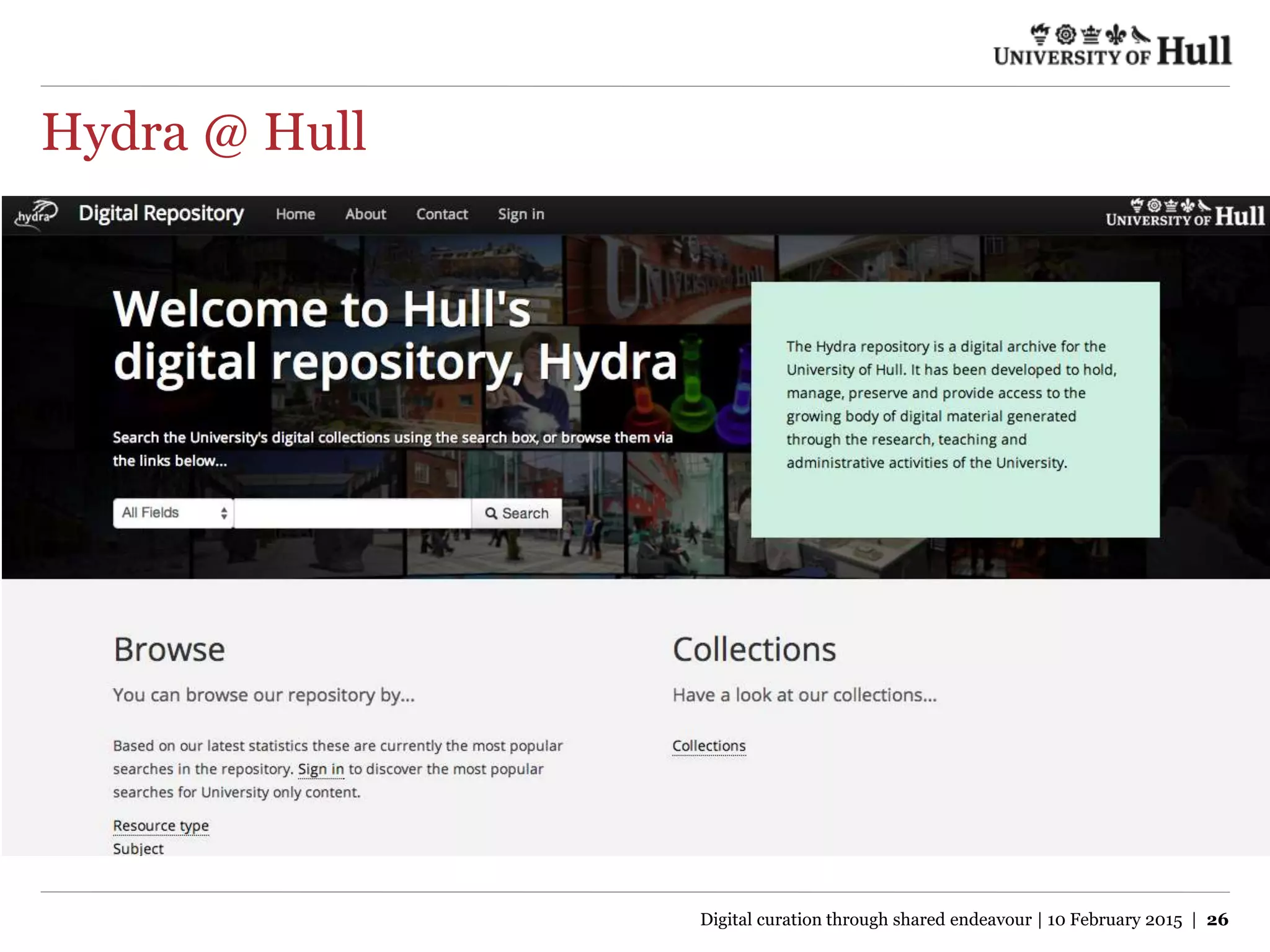
Hydra @ Hull
• Implemented during 2011
– Read interfaces went live Sep 2011
– Create, update and delete functions went live Feb 2013
• Developer had to learn Ruby technology base from scratch
– But came to want to do everything based on it
• Upgraded in 2013
– Now planning move to RDF, probably in 2016
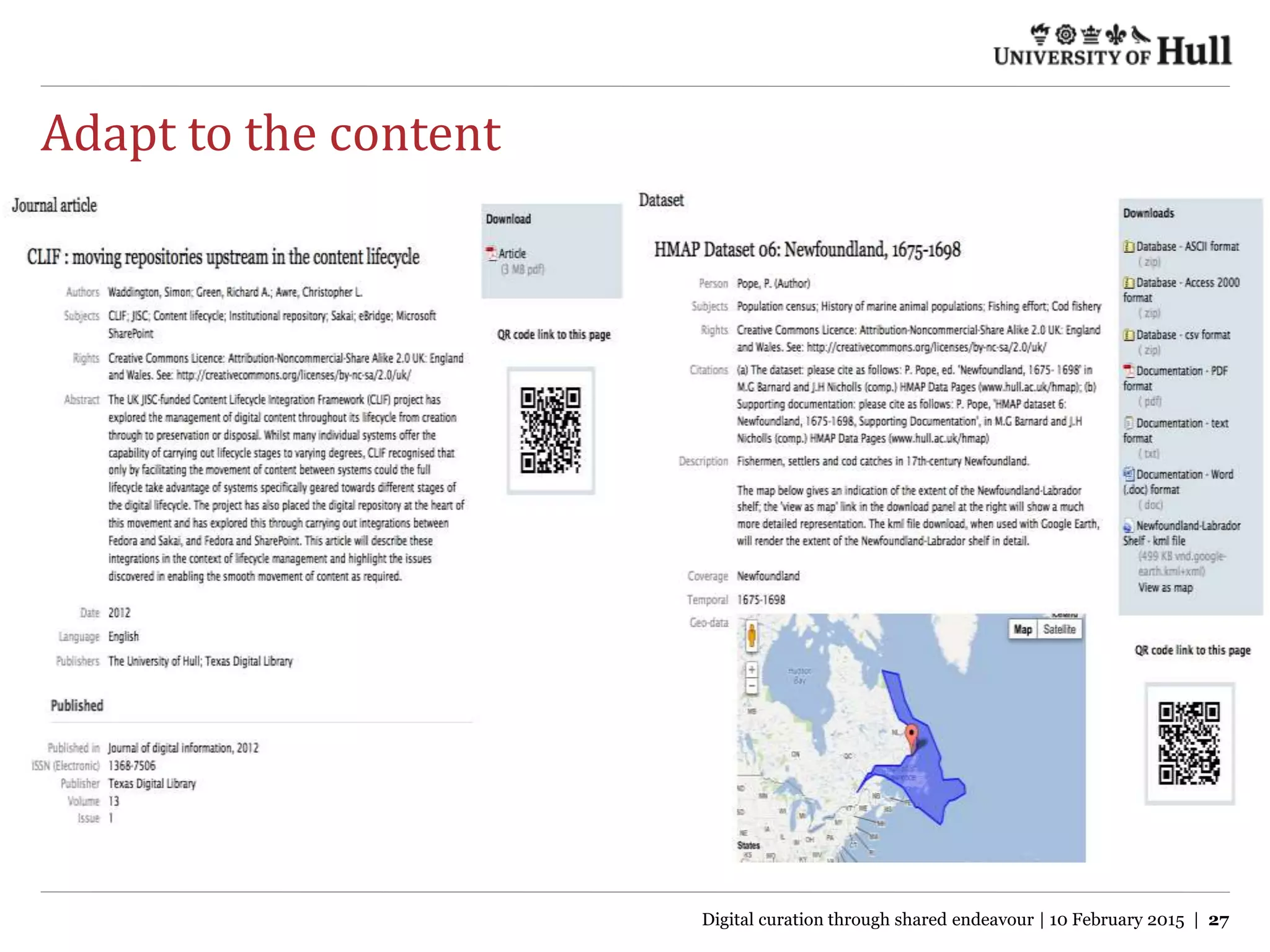
• Use cases expanding – and including data!
• http://hydra.hull.ac.uk
Digital curation through shared endeavour | 10 February 2015 | 25
Hydra @ Hull
Digital curation through shared endeavour | 10 February 2015 | 26
Adapt to the content
Digital curation through shared endeavour | 10 February 2015 | 27
Reflections
• Only could have provided local solution through
collaboration
• Hydra can’t do everything, but provides capability and
confidence we can adapt and implement solutions to meet
needs, now and in the future
– Our digital curation journey is ongoing, and we know
where we are going
• Relationship between Hydra and Fedora is vital
– Community support required for each and across them
• Success has come through good software design and
patterns as much as from ability to address digital curation
use cases
Digital curation through shared endeavour | 10 February 2015 | 28
Looking ahead
• RDF!
• Hydra has been successful in stimulating activity across
institutions in a dispersed way
– Now looking to explore better cohesion across all Hydra
initiatives
• Locally, do we address additional use cases through the same of
separate Hydra heads?
– Born-digital archives
– Multimedia content (cf. Avalon)
• Development of Hydra community in Europe
– Hydra Europe (23-24 Apr) and Hydra Camp (20-23 Apr)
– LSE, London, UK
Digital curation through shared endeavour | 10 February 2015 | 29
Thank you
c.awre@hull.ac.uk
(with thanks to Tom Cramer and Simon Wilson for use of
their slides)

Digital curation through shared endeavour - IDCC 2015

  • 1.
    Meeting institutional needs fordigital curation through shared endeavor The application of Hydra/Fedora at Hull Chris Awre Head of Information Management, Library and Learning Innovation IDCC, 10th February 2015
  • 2.
    To cover • Background/context •Digital repository development at Hull • Open source and community • Applying Fedora at Hull • Hydra development • Hydra and Fedora • Hydra and Hull • Reflections and looking ahead Digital curation through shared endeavour | 10 February 2015 | 2
  • 3.
    Background/context • 2005 – TheJisc FAIR (Focus on Access to Institutional Resources) programme was finishing • Lots of emphasis on having a stable platform upon which to base management of institutional assets • Led to first Digital Repositories programme, 2005-7 – University of Hull started down its path of implementing a digital repository • Desire to address multiple use cases together through a single solution • Practical and financial basis and limitations Digital curation through shared endeavour | 10 February 2015 | 3
  • 4.
    An institutional repository •Repositories are infrastructure – Maintaining infrastructure requires resource, which we need to minimise to justify costs in the long-term • Content doesn’t sit in silos – One repository facilitates cross-fertilisation of use • Integration with one system – Embedding the repository means linking to one place One institution = one repository? Digital curation through shared endeavour | 10 February 2015 | 4
  • 5.
    Five principles  Arepository should be content agnostic  A repository should be (open) standards-based  A repository should be scalable  A repository should understand how pieces of content relate to each other  A repository should be manageable with limited resource Digital curation through shared endeavour | 10 February 2015 | 5
  • 6.
    Five principles (leadingto our implementation)  Fedora is content agnostic  Fedora is (open) standards-based  Fedora is scalable  Fedora understands how pieces of content relate to each other  Fedora is manageable with limited resource – With help from the community Digital curation through shared endeavour | 10 February 2015 | 6
  • 7.
    Open source andcommunity • University of Hull had recognised that engaging in open source (community source) projects would enable more local implementation and innovation • uPortal – Institutional portal solution – Came out of JASIG community • Sakai – VLE solution – Community built as part of Mellon grant conditions • Now both part of Apereo Foundation – Hull contributed Executive Director! Digital curation through shared endeavour | 10 February 2015 | 7
  • 8.
    Implementing Fedora atHull • RepoMMan project, 2005-7 – Examining how a repository can be made part of day-to- day activity • Not just somewhere to put stuff at the end of a process • REMAP project, 2007-9 – Applying a repository to serving records management and preservation by starting to capture items from their creation • Institutional developments – Creation of local service in parallel (October 2008) • Initial use cases were e-theses and exam papers, not OA Digital curation through shared endeavour | 10 February 2015 | 8
  • 9.
    Fedora and end-userinterfaces Storage (e.g., SAN, Cloud) Fedora Interface Need an end-user interface Fedora is the digital repository system, holding the content in a highly structured way The content is stored either locally or in the Cloud (currently a slice of the SAN) Digital curation through shared endeavour | 10 February 2015 | 9
  • 10.
    Fedora and end-userinterfaces Storage (e.g., SAN, Cloud) Fedora Muradora Adopted open source Muradora system from Macquarie University in Australia Fedora is the digital repository system, holding the content in a highly structured way The content is stored either locally or in the Cloud (currently a slice of the SAN) Digital curation through shared endeavour | 10 February 2015 | 10
  • 11.
    Fedora and Hydra •Fedora can be complex in enabling its flexibility • How can the richness of the Fedora system be enabled through simpler interfaces and interactions? – The Hydra project has endeavoured to address this, and has done so successfully – Not a turnkey, out of the box, solution, but a toolkit that enables powerful use of Fedora’s capabilities through lightweight tools • Hydra ‘heads’ – Single body of content, many points of access into it Digital curation through shared endeavour | 10 February 2015 | 11
  • 12.
    Fedora and Hydra Storage(e.g., SAN, Cloud) Fedora Hydra Hydra provides user interfaces and workflows over the repository Concept of multiple Hydra ‘heads’ over single body of content Fedora is the digital repository system, holding the content in a highly structured way The content is stored either locally or in the Cloud (currently a slice of the SAN) Digital curation through shared endeavour | 10 February 2015 | 12 Hydra Hydra Hydra
  • 13.
    Hydra Change the wayyou think about Hull | 7 October 2009 | 2 • A collaborative project between: – University of Hull – University of Virginia – Stanford University – Fedora Commons/DuraSpace – MediaShelf LLC • Unfunded (in itself) – Activity based on identification of a common need • Aim to work towards a reusable framework for multipurpose, multifunction, multi-institutional repository-enabled solutions • Timeframe - 2008-11 (but now extended indefinitely) TextDigital curation through shared endeavour | 10 February 2015 | 13
  • 14.
    Fundamental Assumption #1 Nosingle system can provide the full range of repository- based solutions for a given institution’s needs, …yet sustainable solutions require a common repository infrastructure. No single institution can resource the development of a full range of solutions on its own, …yet each needs the flexibility to tailor solutions to local demands and workflows. Fundamental Assumption #2 Digital curation through shared endeavour | 10 February 2015 | 14
  • 15.
    Eight strategic priorities 1.Solution bundles 2. Turnkey applications 3. Vendor ecosystem 4. Training 5. Documentation 6. Code sharing 7. Community ties 8. Grow the User base Digital curation through shared endeavour | 10 February 2015 | 15
  • 16.
    Hydra partnership • Fromthe beginning key aims have been and are: – to enable others to join the partnership as and when they wished (Now up to 27 partners) – to establish a framework for sustaining a Hydra community as much as any technical outputs that emerge • Establishing a semi-legal basis for contribution and partnership “If you want to go fast, go alone. If you want to go far, go together” (African proverb) Digital curation through shared endeavour | 10 February 2015 | 16
  • 17.
    Hydra Partners 0 5 10 15 20 25 OR09 OR10OR11 OR12 OR13 OR14 OR = Open Repositories Conference Digital curation through shared endeavour | 10 February 2015 | 17
  • 18.
    Hydra Partners andKnown Users 0 5 10 15 20 25 30 35 40 45 50 OR09 OR10 OR11 OR12 OR13 OR14 Now OR = Open Repositories Conference Digital curation through shared endeavour | 10 February 2015 | 18
  • 19.
    A Worldwide Presence Digitalcuration through shared endeavour | 10 February 2015 | 19
  • 20.
    Software development Digital curationthrough shared endeavour | 10 February 2015 | 20
  • 21.
    Hydra technical implementation •Fedora – All Hydra partners are Fedora users • Solr – Very powerful indexing tool, as used by… • Blacklight – Prior development at Virginia (and now Stanford/JHU) for OPAC – Adaptable to repository content • Ruby – Agile development / excellent MVC / good testing tools • Ruby gems – ActiveFedora, Opinionated Metadata, Solrizer (MediaShelf contributions) Digital curation through shared endeavour | 10 February 2015 | 21
  • 22.
    Four Key Capabilities 1.Support for any kind of record or metadata 2. Object-specific behaviors – Books, Articles, Images, Music, Video, Manuscripts, etc. 3. Tailored views for domain or discipline-specific materials 4. Easy to augment & over-ride with local modifications Digital curation through shared endeavour | 10 February 2015 | 22
  • 23.
    Hydra Heads ofNote Avalon & HydraDAM for Media Sufia BPL Digital Commonwealth UCSD DAMS Digital curation through shared endeavour | 10 February 2015 | 23 See a full list at: https://wiki.duraspace.org/display/hydra/ Partners+and+Implementations
  • 24.
    Hydra and Fedora/DuraSpace •Hydra designed to work with and complement Fedora – And is somewhat dependent on it • Hydra project has tracked Fedora 4 developments – Every release has been tested against Hydra (and Islandora) – New Hydra implementations now recommended to start with Fedora 4.0 – Hydra becoming RDF-native alongside Fedora 4 • DuraSpace – Sit on Hydra Steering Group – Hydra is working with DuraSpace on support services Digital curation through shared endeavour | 10 February 2015 | 24
  • 25.
    Hydra @ Hull •Implemented during 2011 – Read interfaces went live Sep 2011 – Create, update and delete functions went live Feb 2013 • Developer had to learn Ruby technology base from scratch – But came to want to do everything based on it • Upgraded in 2013 – Now planning move to RDF, probably in 2016 • Use cases expanding – and including data! • http://hydra.hull.ac.uk Digital curation through shared endeavour | 10 February 2015 | 25
  • 26.
    Hydra @ Hull Digitalcuration through shared endeavour | 10 February 2015 | 26
  • 27.
    Adapt to thecontent Digital curation through shared endeavour | 10 February 2015 | 27
  • 28.
    Reflections • Only couldhave provided local solution through collaboration • Hydra can’t do everything, but provides capability and confidence we can adapt and implement solutions to meet needs, now and in the future – Our digital curation journey is ongoing, and we know where we are going • Relationship between Hydra and Fedora is vital – Community support required for each and across them • Success has come through good software design and patterns as much as from ability to address digital curation use cases Digital curation through shared endeavour | 10 February 2015 | 28
  • 29.
    Looking ahead • RDF! •Hydra has been successful in stimulating activity across institutions in a dispersed way – Now looking to explore better cohesion across all Hydra initiatives • Locally, do we address additional use cases through the same of separate Hydra heads? – Born-digital archives – Multimedia content (cf. Avalon) • Development of Hydra community in Europe – Hydra Europe (23-24 Apr) and Hydra Camp (20-23 Apr) – LSE, London, UK Digital curation through shared endeavour | 10 February 2015 | 29
  • 30.
    Thank you c.awre@hull.ac.uk (with thanksto Tom Cramer and Simon Wilson for use of their slides)