Agricultural Marketing:
Concepts and definitions of
market, marketing,
agricultural marketing
Lec 1
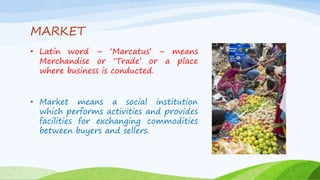
MARKET
• Latin word – ‘Marcatus’ – means
Merchandise or ‘Trade’ or a place
where business is conducted.
• Market means a social institution
which performs activities and provides
facilities for exchanging commodities
between buyers and sellers.
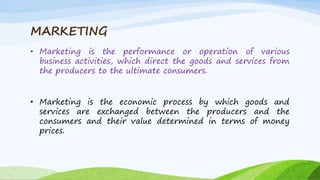
MARKETING
• Marketing is the performance or operation of various
business activities, which direct the goods and services from
the producers to the ultimate consumers.
• Marketing is the economic process by which goods and
services are exchanged between the producers and the
consumers and their value determined in terms of money
prices.
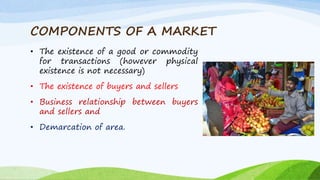
COMPONENTS OF A MARKET
• The existence of a good or commodity
for transactions (however physical
existence is not necessary)
• The existence of buyers and sellers
• Business relationship between buyers
and sellers and
• Demarcation of area.
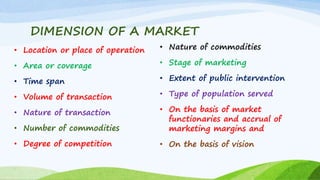
DIMENSION OF A MARKET
• Location or place of operation
• Area or coverage
• Time span
• Volume of transaction
• Nature of transaction
• Number of commodities
• Degree of competition
• Nature of commodities
• Stage of marketing
• Extent of public intervention
• Type of population served
• On the basis of market
functionaries and accrual of
marketing margins and
• On the basis of vision
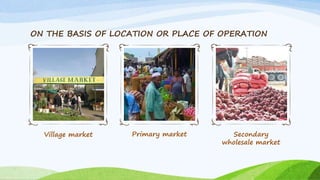
ON THE BASIS OF LOCATION OR PLACE OF OPERATION
Village market Primary market Secondary
wholesale market
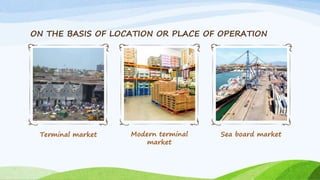
ON THE BASIS OF LOCATION OR PLACE OF OPERATION
Terminal market Modern terminal
market
Sea board market
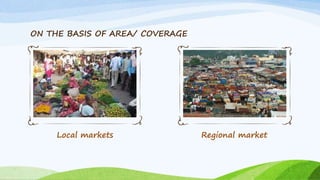
ON THE BASIS OF AREA/ COVERAGE
Local markets Regional market
ON THE BASIS OF AREA/ COVERAGE
National markets International market
ON THE BASIS OF TIME SPAN
Short period market
Periodic market
Long period market
Secular market
ON THE BASIS OF VOLUME OF TRANSACTIONS
Wholesale markets Retail market
ON THE BASIS OF NATURE OF TRANSACTIONS
Spot or cash markets Forward market
ON THE BASIS OF NUMBER OF COMMODITES IN WHICH
TRANSACTION TAKES PLACE
General markets Specialized market
ON THE BASIS OF DEGREE OF COMPETITON
• Perfect market
• Imperfect market
1. Monopoly market
2. Duopoly market
3. Oligopoly market
4. Monopolistic competitive market
ON THE BASIS OF NATURE OF COMMODITIES
Commodity markets Capital market
Share market
ON THE BASIS OF STAGE OF MARKETING
Producing markets Consuming market
ON THE BASIS OF GOVERNMENT INTERVENTION &
REGULATION
Regulated markets Unregulated market
ON THE BASIS OF TYPE OF POPULATION SERVED
Urban markets Rural market
ON THE BASIS OF VISION
Black market or invisible
market
Open market or visible
market
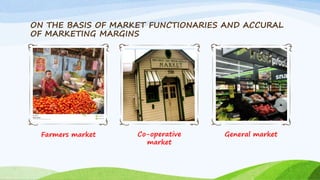
ON THE BASIS OF MARKET FUNCTIONARIES AND ACCURAL
OF MARKETING MARGINS
Farmers market Co-operative
market
General market
AGRICULTURAL MARKETING
• Two words – Agriculture and Marketing.
• Agricultural Marketing is defined as comprising of all
activities involved in supply of farm inputs to the farmers
and movement of agricultural products from the farms to
the ultimate consumers.
• Agricultural Marketing included both output (product)
marketing and input (factor) marketing
IMPORTANCE OF AGRICULTURAL MARKETING
• Optimization of Resource use
and Output Management
• Increase in Farm Income
• Widening of Markets
• Growth of Agro-based
Industries
• Price Signals
• Adoption and Spread of New
Technology
• Employment
• Better Living
• Creation of Utility
1. Time Utility
2. Place Utility
3. Form Utility
4. Possession Utility
Agricultural marketing lecture notes 1

Agricultural marketing lecture notes 1

  • 1.
    Agricultural Marketing: Concepts anddefinitions of market, marketing, agricultural marketing Lec 1
  • 2.
    MARKET • Latin word– ‘Marcatus’ – means Merchandise or ‘Trade’ or a place where business is conducted. • Market means a social institution which performs activities and provides facilities for exchanging commodities between buyers and sellers.
  • 3.
    MARKETING • Marketing isthe performance or operation of various business activities, which direct the goods and services from the producers to the ultimate consumers. • Marketing is the economic process by which goods and services are exchanged between the producers and the consumers and their value determined in terms of money prices.
  • 4.
    COMPONENTS OF AMARKET • The existence of a good or commodity for transactions (however physical existence is not necessary) • The existence of buyers and sellers • Business relationship between buyers and sellers and • Demarcation of area.
  • 5.
    DIMENSION OF AMARKET • Location or place of operation • Area or coverage • Time span • Volume of transaction • Nature of transaction • Number of commodities • Degree of competition • Nature of commodities • Stage of marketing • Extent of public intervention • Type of population served • On the basis of market functionaries and accrual of marketing margins and • On the basis of vision
  • 6.
    ON THE BASISOF LOCATION OR PLACE OF OPERATION Village market Primary market Secondary wholesale market
  • 7.
    ON THE BASISOF LOCATION OR PLACE OF OPERATION Terminal market Modern terminal market Sea board market
  • 8.
    ON THE BASISOF AREA/ COVERAGE Local markets Regional market
  • 9.
    ON THE BASISOF AREA/ COVERAGE National markets International market
  • 10.
    ON THE BASISOF TIME SPAN Short period market Periodic market Long period market Secular market
  • 11.
    ON THE BASISOF VOLUME OF TRANSACTIONS Wholesale markets Retail market
  • 12.
    ON THE BASISOF NATURE OF TRANSACTIONS Spot or cash markets Forward market
  • 13.
    ON THE BASISOF NUMBER OF COMMODITES IN WHICH TRANSACTION TAKES PLACE General markets Specialized market
  • 14.
    ON THE BASISOF DEGREE OF COMPETITON • Perfect market • Imperfect market 1. Monopoly market 2. Duopoly market 3. Oligopoly market 4. Monopolistic competitive market
  • 15.
    ON THE BASISOF NATURE OF COMMODITIES Commodity markets Capital market Share market
  • 16.
    ON THE BASISOF STAGE OF MARKETING Producing markets Consuming market
  • 17.
    ON THE BASISOF GOVERNMENT INTERVENTION & REGULATION Regulated markets Unregulated market
  • 18.
    ON THE BASISOF TYPE OF POPULATION SERVED Urban markets Rural market
  • 19.
    ON THE BASISOF VISION Black market or invisible market Open market or visible market
  • 20.
    ON THE BASISOF MARKET FUNCTIONARIES AND ACCURAL OF MARKETING MARGINS Farmers market Co-operative market General market
  • 21.
    AGRICULTURAL MARKETING • Twowords – Agriculture and Marketing. • Agricultural Marketing is defined as comprising of all activities involved in supply of farm inputs to the farmers and movement of agricultural products from the farms to the ultimate consumers. • Agricultural Marketing included both output (product) marketing and input (factor) marketing
  • 22.
    IMPORTANCE OF AGRICULTURALMARKETING • Optimization of Resource use and Output Management • Increase in Farm Income • Widening of Markets • Growth of Agro-based Industries • Price Signals • Adoption and Spread of New Technology • Employment • Better Living • Creation of Utility 1. Time Utility 2. Place Utility 3. Form Utility 4. Possession Utility