

 DISTRIBUTION MIX
 DISTRIBUTION CHANNEL
 PHYSICAL DISTRIBUTION
Distribution is the process of
making a product or service
available for use or consumption
by a consumer or business
user, using direct or indirect
means with intermediaries.
 Combination of five
major components of effective distribution of goods,
namely
 (1) inventory,
 (2) warehousing,
 (3) communications,
 (4) packaging, and
 (5) transport.
(
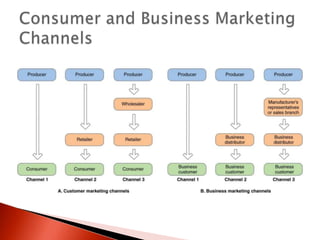
A distribution channel can be as short as
a direct transaction from the vendor to the
consumer, or may include several
interconnected intermediaries
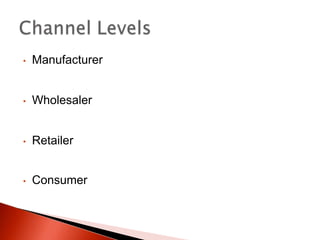
• Manufacturer
• Wholesaler
• Retailer
• Consumer
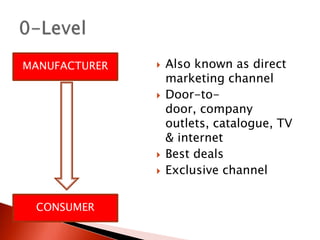
 Also known as direct
marketing channel
 Door-to-
door, company
outlets, catalogue, TV
& internet
 Best deals
 Exclusive channel
MANUFACTURER
CONSUMER
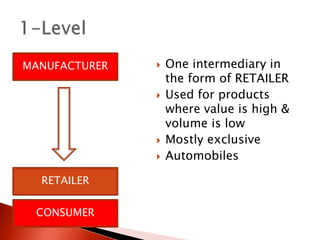
 One intermediary in
the form of RETAILER
 Used for products
where value is high &
volume is low
 Mostly exclusive
 Automobiles
MANUFACTURER
CONSUMER
RETAILER
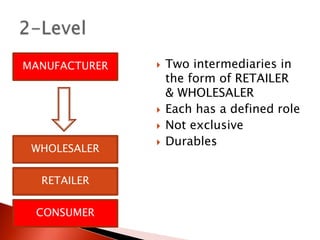
 Two intermediaries in
the form of RETAILER
& WHOLESALER
 Each has a defined role
 Not exclusive
 Durables
MANUFACTURER
CONSUMER
RETAILER
WHOLESALER
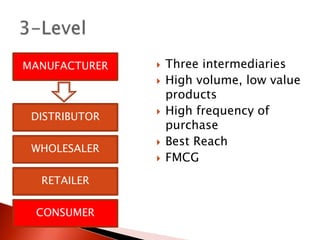
 Three intermediaries
 High volume, low value
products
 High frequency of
purchase
 Best Reach
 FMCG
MANUFACTURER
CONSUMER
RETAILER
WHOLESALER
DISTRIBUTOR
The process of
planning, implementing, and controlling
the efficient, effective flow and storage
of goods, services, and related information
from point of origin to point of consumption
for the purpose of conforming to customer's
requirements.
 It includes all those activities concerned with
the efficient movement of goods from the
place of production to the place of
consumption
 It involves the handling of raw material
fabricates parts, supplies & finished goods
from producers to consumers via
intermediaries
 Attain customer satisfaction
 Profit maximization
 Getting the right product, at the right
place, at the right time, in right quantity, at
the right customer at the lower cost
 Proper co-ordination of distribution activities
 5. To use powerful tool of competitive mktg.
 6. To provide better service of lower prices
 7. To increase profit margin
 Supplier
 Manufacturer
 Intermediaries
Wholesalers, Retailers
 Agents – Selling, Manufacturing, C & F etc.
 Planning the overall physical distribution
system
 In bound transport
 Receiving – Raw material, orders
 In plant warehousing
 Inventory management
 Order processing
 Packaging
 Dispatch of goods
 Field warehousing
 Customer service
Distribution mix (mm)

Distribution mix (mm)

  • 2.
     DISTRIBUTION MIX DISTRIBUTION CHANNEL  PHYSICAL DISTRIBUTION
  • 3.
    Distribution is theprocess of making a product or service available for use or consumption by a consumer or business user, using direct or indirect means with intermediaries.
  • 4.
     Combination offive major components of effective distribution of goods, namely  (1) inventory,  (2) warehousing,  (3) communications,  (4) packaging, and  (5) transport.
  • 5.
    ( A distribution channelcan be as short as a direct transaction from the vendor to the consumer, or may include several interconnected intermediaries
  • 6.
  • 8.
     Also knownas direct marketing channel  Door-to- door, company outlets, catalogue, TV & internet  Best deals  Exclusive channel MANUFACTURER CONSUMER
  • 9.
     One intermediaryin the form of RETAILER  Used for products where value is high & volume is low  Mostly exclusive  Automobiles MANUFACTURER CONSUMER RETAILER
  • 10.
     Two intermediariesin the form of RETAILER & WHOLESALER  Each has a defined role  Not exclusive  Durables MANUFACTURER CONSUMER RETAILER WHOLESALER
  • 11.
     Three intermediaries High volume, low value products  High frequency of purchase  Best Reach  FMCG MANUFACTURER CONSUMER RETAILER WHOLESALER DISTRIBUTOR
  • 12.
    The process of planning,implementing, and controlling the efficient, effective flow and storage of goods, services, and related information from point of origin to point of consumption for the purpose of conforming to customer's requirements.
  • 13.
     It includesall those activities concerned with the efficient movement of goods from the place of production to the place of consumption  It involves the handling of raw material fabricates parts, supplies & finished goods from producers to consumers via intermediaries
  • 14.
     Attain customersatisfaction  Profit maximization  Getting the right product, at the right place, at the right time, in right quantity, at the right customer at the lower cost  Proper co-ordination of distribution activities
  • 15.
     5. Touse powerful tool of competitive mktg.  6. To provide better service of lower prices  7. To increase profit margin
  • 16.
     Supplier  Manufacturer Intermediaries Wholesalers, Retailers  Agents – Selling, Manufacturing, C & F etc.
  • 17.
     Planning theoverall physical distribution system  In bound transport  Receiving – Raw material, orders  In plant warehousing  Inventory management
  • 18.
     Order processing Packaging  Dispatch of goods  Field warehousing  Customer service