

Slide © 2010 by Lovelock & Wirtz Services Marketing 7/e Chapter 3 – Page 1
Chapter 3:
Positioning Services
in Competitive Markets
Services Marketing 7e, Global Edition
Slide © 2010 by Lovelock & Wirtz Services Marketing 7/e Chapter 3 – Page 2
Overview of Chapter 3
 Focus Strategies for Services
 Market Segmentation
 Service Attributes and Levels
 Positioning Distinguishes a Brand from its Competitors
 Developing an Effective Positioning Strategy
 Using Positioning Maps to Analyze Competitive Strategy
 Changing Competitive Positioning
Slide © 2010 by Lovelock & Wirtz Services Marketing 7/e Chapter 3 – Page 3
Focused Strategies for
Services
Slide © 2010 by Lovelock & Wirtz Services Marketing 7/e Chapter 3 – Page 4
Standing Apart from the
Competition
“A business must set itself apart from its
competition. To be successful it must identify and
promote itself as the best provider of attributes that
are important to target customers.”
George S. Day
Slide © 2010 by Lovelock & Wirtz Services Marketing 7/e Chapter 3 – Page 5
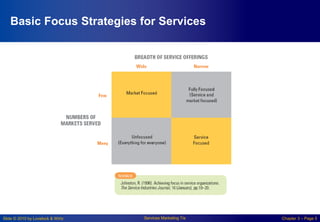
Basic Focus Strategies for Services
Slide © 2010 by Lovelock & Wirtz Services Marketing 7/e Chapter 3 – Page 6
Considerations for using Focused
Strategies
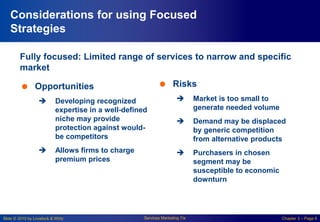
Fully focused: Limited range of services to narrow and specific
market
 Opportunities
 Developing recognized
expertise in a well-defined
niche may provide
protection against would-
be competitors
 Allows firms to charge
premium prices
 Risks
 Market is too small to
generate needed volume
 Demand may be displaced
by generic competition
from alternative products
 Purchasers in chosen
segment may be
susceptible to economic
downturn
Slide © 2010 by Lovelock & Wirtz Services Marketing 7/e Chapter 3 – Page 7
Considerations for using Focused
Strategies
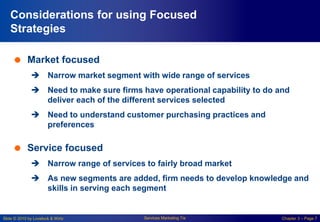
 Market focused
 Narrow market segment with wide range of services
 Need to make sure firms have operational capability to do and
deliver each of the different services selected
 Need to understand customer purchasing practices and
preferences
 Service focused
 Narrow range of services to fairly broad market
 As new segments are added, firm needs to develop knowledge and
skills in serving each segment
Slide © 2010 by Lovelock & Wirtz Services Marketing 7/e Chapter 3 – Page 8
Considerations for Using
Focus Strategies
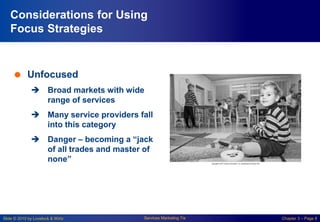
 Unfocused
 Broad markets with wide
range of services
 Many service providers fall
into this category
 Danger – becoming a “jack
of all trades and master of
none”
Slide © 2010 by Lovelock & Wirtz Services Marketing 7/e Chapter 3 – Page 9
Market Segmentation
Slide © 2010 by Lovelock & Wirtz Services Marketing 7/e Chapter 3 – Page 10
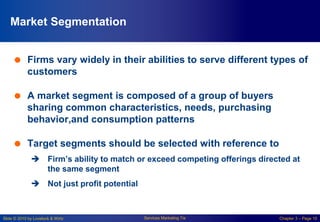
Market Segmentation
 Firms vary widely in their abilities to serve different types of
customers
 A market segment is composed of a group of buyers
sharing common characteristics, needs, purchasing
behavior,and consumption patterns
 Target segments should be selected with reference to
 Firm’s ability to match or exceed competing offerings directed at
the same segment
 Not just profit potential
Slide © 2010 by Lovelock & Wirtz Services Marketing 7/e Chapter 3 – Page 11
Service Attributes and Levels
Slide © 2010 by Lovelock & Wirtz Services Marketing 7/e Chapter 3 – Page 12
Developing Right Service Concept
for a Specific Segment
 Use research to identify and prioritize which attributes of a given
service are important to specific market segments
 Individuals may set different priorities according to:
 Purpose of using the service
 Who makes decision
 Timing of use
 Whether service is used alone or with a group
 Composition of that group
Slide © 2010 by Lovelock & Wirtz Services Marketing 7/e Chapter 3 – Page 13
Important vs. Determinant Attributes
 Consumers usually choose between alternative service offerings
based on perceived differences between them
 Attributes that distinguish competing services from one another
are not necessarily the most important ones
 Determinant attributes determine buyers’ choices between
competing alternatives
 service characteristics that are important to purchasers
 customers see significant differences between competing alternatives on
these attributes
Slide © 2010 by Lovelock & Wirtz Services Marketing 7/e Chapter 3 – Page 14
Establishing Service Levels
 Make decisions on service levels – level of performance firm
plans to offer on each attribute
 Easily quantified attributes are easier to understand – e.g.,vehicle speed,
physical dimensions
 Qualitative attributes subject to individual interpretation – e.g., physical
comfort, noise levels
 Can often segment customers according to willingness to trade
off price versus service level:
 Price-insensitive customers willing to pay relatively high price for high
levels of service
 Price-sensitive customers look for inexpensive service with relatively low
performance
Slide © 2010 by Lovelock & Wirtz Services Marketing 7/e Chapter 3 – Page 15
Positioning Distinguishes a
Brand from its Competitors
Slide © 2010 by Lovelock & Wirtz Services Marketing 7/e Chapter 3 – Page 16
Four Principles of Positioning
Strategy
 Must establish position for firm or product in minds of
customers
 Position should be distinctive, providing one simple,
consistent message
 Position must set firm/product apart from competitors
 A company cannot be all things to all people– must focus
its efforts
Slide © 2010 by Lovelock & Wirtz Services Marketing 7/e Chapter 3 – Page 17
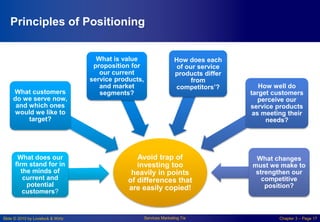
Principles of Positioning
Avoid trap of
investing too
heavily in points
of differences that
are easily copied!
What does our
firm stand for in
the minds of
current and
potential
customers?
What customers
do we serve now,
and which ones
would we like to
target?
What is value
proposition for
our current
service products,
and market
segments?
How does each
of our service
products differ
from
competitors’? How well do
target customers
perceive our
service products
as meeting their
needs?
What changes
must we make to
strengthen our
competitive
position?
Slide © 2010 by Lovelock & Wirtz Services Marketing 7/e Chapter 3 – Page 18
Developing an Effective
Positioning Strategy
Slide © 2010 by Lovelock & Wirtz Services Marketing 7/e Chapter 3 – Page 19
Developing an Effective Positioning
Strategy
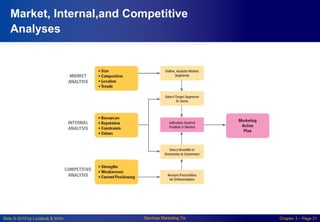
 Positioning links market analysis and competitive analysis
to internal corporate analysis
 Market Analysis
 Focus on overall level and trend of demand and geographic
locations of demand
 Look into size and potential of different market segments
 Understand customer needs and preferences and how they
perceive the competition
Slide © 2010 by Lovelock & Wirtz Services Marketing 7/e Chapter 3 – Page 20
Developing an Effective Positioning
Strategy
 Internal Corporate Analysis
 Identify organization’s resources, limitations, goals, and values
 Select limited number of target segments to serve
 Competitor Analysis
 Understand competitors’ strengths and weaknesses
 Anticipate responses to potential positioning strategies
Slide © 2010 by Lovelock & Wirtz Services Marketing 7/e Chapter 3 – Page 21
Market, Internal,and Competitive
Analyses
Slide © 2010 by Lovelock & Wirtz Services Marketing 7/e Chapter 3 – Page 22
Anticipating Competitive Response
 Competitors might pursue same market position
 Independently do same positioning analysis and arrive at similar
conclusions
 Threatened by new strategy, take steps to reposition own service
 New entrant plays “follow the leader”
 Conduct internal corporate analysis for challengers and analyze
possible effects of alternative moves
 Impact of price cut on demand, market share,and profits
 Responses of different segments to changes in service attributes
Slide © 2010 by Lovelock & Wirtz Services Marketing 7/e Chapter 3 – Page 23
Using Positioning Maps to
Analyze Competitive Strategy
Slide © 2010 by Lovelock & Wirtz Services Marketing 7/e Chapter 3 – Page 24
Using Positioning Maps to Plot
Competitive Strategy
 Great tool to visualize competitive positioning and map
developments of time
 Useful way to represent consumer perceptions of alternative
products graphically
 Typically confined to two attributes, but 3-D models can be used
to portray positions on three attributes simultaneously
 Information about a product can be obtained from market data,
derived from ratings by representative consumers, or both
Slide © 2010 by Lovelock & Wirtz Services Marketing 7/e Chapter 3 – Page 25
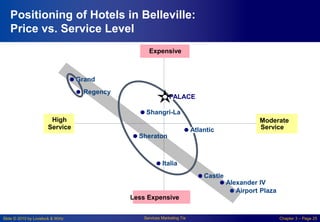
Positioning of Hotels in Belleville:
Price vs. Service Level
Expensive
Shangri-La
High
Service
Moderate
Service
Grand
Regency
Sheraton
Italia
Castle
Alexander IV
Airport Plaza
PALACE
Atlantic
Less Expensive
Slide © 2010 by Lovelock & Wirtz Services Marketing 7/e Chapter 3 – Page 26
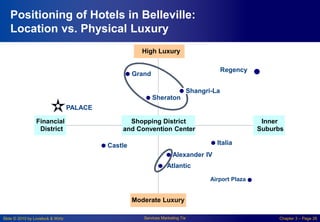
Positioning of Hotels in Belleville:
Location vs. Physical Luxury
High Luxury
Shopping District
and Convention Center
Shangri-La
Moderate Luxury
Financial
District
Inner
Suburbs
Grand
Regency
Sheraton
ItaliaCastle
Alexander IV
Airport Plaza
PALACE
Atlantic
Slide © 2010 by Lovelock & Wirtz Services Marketing 7/e Chapter 3 – Page 27
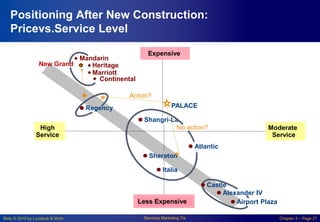
Positioning After New Construction:
Pricevs.Service Level
Expensive
Shangri-La
High
Service
Moderate
Service
Heritage
Mandarin
New Grand
Marriott
Continental
Regency
Sheraton
Italia
Alexander IV
Airport Plaza
PALACE
Atlantic
No action?
Action?
Less Expensive
Castle
Slide © 2010 by Lovelock & Wirtz Services Marketing 7/e Chapter 3 – Page 28
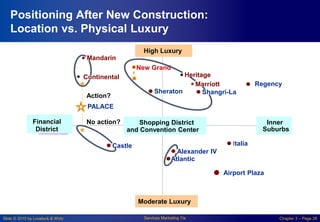
Positioning After New Construction:
Location vs. Physical Luxury
High Luxury
Shangri-La
Financial
District
Inner
Suburbs
Heritage
Mandarin
New Grand
Marriott
Continental
Regency
Sheraton
Italia
Alexander IV
Airport Plaza
PALACE
Atlantic
No action?
Action?
Moderate Luxury
Castle
Shopping District
and Convention Center
Slide © 2010 by Lovelock & Wirtz Services Marketing 7/e Chapter 3 – Page 29
Positioning Maps Help Managers to
Visualize Strategy
 Research provides input to development of positioning
maps– challenge is to ensure that
 Attributes employed in maps are important to target segments
 Performance of individual firms on each attribute accurately
reflects perceptions of customers in target segments
 Predictions can be made of how positions may change in
light of future developments
 Charts and maps can facilitate “visual awakening” to
threats and opportunities, suggest alternative strategic
directions
Slide © 2010 by Lovelock & Wirtz Services Marketing 7/e Chapter 3 – Page 30
Changing Competitive
Positioning
Slide © 2010 by Lovelock & Wirtz Services Marketing 7/e Chapter 3 – Page 31
Repositioning
 Firm may have to make significant change in existing
position
 Revising service characteristics; redefining target market
segments; abandoning certain products; withdrawing from certain
market segments
 Improving negative brand perceptions may require
extensive redesign of core product
 Repositioning introduces new dimensions into positioning
equation that other firms cannot immediately match
Slide © 2010 by Lovelock & Wirtz Services Marketing 7/e Chapter 3 – Page 32
Summary
 Focus Strategies:
 Fully focused
 Service focused
 Marketfocused
 Unfocused
 Market Segmentation – buyers share common
characteristics, needs, purchasing behavior & consumption
patterns
 Service attributes–determinant attributes are often the ones
most important to customers
Slide © 2010 by Lovelock & Wirtz Services Marketing 7/e Chapter 3 – Page 33
Summary
 Positioning links:
 Market Analysis
 Internal Analysis
 Competitive Analysis
 Positioning maps are useful for plotting competitive
strategy:
 Identify potential competitive responses
 Help executives to visualize strategy

Mktg 436 - Chapter 3

  • 1.
    Slide © 2010by Lovelock & Wirtz Services Marketing 7/e Chapter 3 – Page 1 Chapter 3: Positioning Services in Competitive Markets Services Marketing 7e, Global Edition
  • 2.
    Slide © 2010by Lovelock & Wirtz Services Marketing 7/e Chapter 3 – Page 2 Overview of Chapter 3  Focus Strategies for Services  Market Segmentation  Service Attributes and Levels  Positioning Distinguishes a Brand from its Competitors  Developing an Effective Positioning Strategy  Using Positioning Maps to Analyze Competitive Strategy  Changing Competitive Positioning
  • 3.
    Slide © 2010by Lovelock & Wirtz Services Marketing 7/e Chapter 3 – Page 3 Focused Strategies for Services
  • 4.
    Slide © 2010by Lovelock & Wirtz Services Marketing 7/e Chapter 3 – Page 4 Standing Apart from the Competition “A business must set itself apart from its competition. To be successful it must identify and promote itself as the best provider of attributes that are important to target customers.” George S. Day
  • 5.
    Slide © 2010by Lovelock & Wirtz Services Marketing 7/e Chapter 3 – Page 5 Basic Focus Strategies for Services
  • 6.
    Slide © 2010by Lovelock & Wirtz Services Marketing 7/e Chapter 3 – Page 6 Considerations for using Focused Strategies Fully focused: Limited range of services to narrow and specific market  Opportunities  Developing recognized expertise in a well-defined niche may provide protection against would- be competitors  Allows firms to charge premium prices  Risks  Market is too small to generate needed volume  Demand may be displaced by generic competition from alternative products  Purchasers in chosen segment may be susceptible to economic downturn
  • 7.
    Slide © 2010by Lovelock & Wirtz Services Marketing 7/e Chapter 3 – Page 7 Considerations for using Focused Strategies  Market focused  Narrow market segment with wide range of services  Need to make sure firms have operational capability to do and deliver each of the different services selected  Need to understand customer purchasing practices and preferences  Service focused  Narrow range of services to fairly broad market  As new segments are added, firm needs to develop knowledge and skills in serving each segment
  • 8.
    Slide © 2010by Lovelock & Wirtz Services Marketing 7/e Chapter 3 – Page 8 Considerations for Using Focus Strategies  Unfocused  Broad markets with wide range of services  Many service providers fall into this category  Danger – becoming a “jack of all trades and master of none”
  • 9.
    Slide © 2010by Lovelock & Wirtz Services Marketing 7/e Chapter 3 – Page 9 Market Segmentation
  • 10.
    Slide © 2010by Lovelock & Wirtz Services Marketing 7/e Chapter 3 – Page 10 Market Segmentation  Firms vary widely in their abilities to serve different types of customers  A market segment is composed of a group of buyers sharing common characteristics, needs, purchasing behavior,and consumption patterns  Target segments should be selected with reference to  Firm’s ability to match or exceed competing offerings directed at the same segment  Not just profit potential
  • 11.
    Slide © 2010by Lovelock & Wirtz Services Marketing 7/e Chapter 3 – Page 11 Service Attributes and Levels
  • 12.
    Slide © 2010by Lovelock & Wirtz Services Marketing 7/e Chapter 3 – Page 12 Developing Right Service Concept for a Specific Segment  Use research to identify and prioritize which attributes of a given service are important to specific market segments  Individuals may set different priorities according to:  Purpose of using the service  Who makes decision  Timing of use  Whether service is used alone or with a group  Composition of that group
  • 13.
    Slide © 2010by Lovelock & Wirtz Services Marketing 7/e Chapter 3 – Page 13 Important vs. Determinant Attributes  Consumers usually choose between alternative service offerings based on perceived differences between them  Attributes that distinguish competing services from one another are not necessarily the most important ones  Determinant attributes determine buyers’ choices between competing alternatives  service characteristics that are important to purchasers  customers see significant differences between competing alternatives on these attributes
  • 14.
    Slide © 2010by Lovelock & Wirtz Services Marketing 7/e Chapter 3 – Page 14 Establishing Service Levels  Make decisions on service levels – level of performance firm plans to offer on each attribute  Easily quantified attributes are easier to understand – e.g.,vehicle speed, physical dimensions  Qualitative attributes subject to individual interpretation – e.g., physical comfort, noise levels  Can often segment customers according to willingness to trade off price versus service level:  Price-insensitive customers willing to pay relatively high price for high levels of service  Price-sensitive customers look for inexpensive service with relatively low performance
  • 15.
    Slide © 2010by Lovelock & Wirtz Services Marketing 7/e Chapter 3 – Page 15 Positioning Distinguishes a Brand from its Competitors
  • 16.
    Slide © 2010by Lovelock & Wirtz Services Marketing 7/e Chapter 3 – Page 16 Four Principles of Positioning Strategy  Must establish position for firm or product in minds of customers  Position should be distinctive, providing one simple, consistent message  Position must set firm/product apart from competitors  A company cannot be all things to all people– must focus its efforts
  • 17.
    Slide © 2010by Lovelock & Wirtz Services Marketing 7/e Chapter 3 – Page 17 Principles of Positioning Avoid trap of investing too heavily in points of differences that are easily copied! What does our firm stand for in the minds of current and potential customers? What customers do we serve now, and which ones would we like to target? What is value proposition for our current service products, and market segments? How does each of our service products differ from competitors’? How well do target customers perceive our service products as meeting their needs? What changes must we make to strengthen our competitive position?
  • 18.
    Slide © 2010by Lovelock & Wirtz Services Marketing 7/e Chapter 3 – Page 18 Developing an Effective Positioning Strategy
  • 19.
    Slide © 2010by Lovelock & Wirtz Services Marketing 7/e Chapter 3 – Page 19 Developing an Effective Positioning Strategy  Positioning links market analysis and competitive analysis to internal corporate analysis  Market Analysis  Focus on overall level and trend of demand and geographic locations of demand  Look into size and potential of different market segments  Understand customer needs and preferences and how they perceive the competition
  • 20.
    Slide © 2010by Lovelock & Wirtz Services Marketing 7/e Chapter 3 – Page 20 Developing an Effective Positioning Strategy  Internal Corporate Analysis  Identify organization’s resources, limitations, goals, and values  Select limited number of target segments to serve  Competitor Analysis  Understand competitors’ strengths and weaknesses  Anticipate responses to potential positioning strategies
  • 21.
    Slide © 2010by Lovelock & Wirtz Services Marketing 7/e Chapter 3 – Page 21 Market, Internal,and Competitive Analyses
  • 22.
    Slide © 2010by Lovelock & Wirtz Services Marketing 7/e Chapter 3 – Page 22 Anticipating Competitive Response  Competitors might pursue same market position  Independently do same positioning analysis and arrive at similar conclusions  Threatened by new strategy, take steps to reposition own service  New entrant plays “follow the leader”  Conduct internal corporate analysis for challengers and analyze possible effects of alternative moves  Impact of price cut on demand, market share,and profits  Responses of different segments to changes in service attributes
  • 23.
    Slide © 2010by Lovelock & Wirtz Services Marketing 7/e Chapter 3 – Page 23 Using Positioning Maps to Analyze Competitive Strategy
  • 24.
    Slide © 2010by Lovelock & Wirtz Services Marketing 7/e Chapter 3 – Page 24 Using Positioning Maps to Plot Competitive Strategy  Great tool to visualize competitive positioning and map developments of time  Useful way to represent consumer perceptions of alternative products graphically  Typically confined to two attributes, but 3-D models can be used to portray positions on three attributes simultaneously  Information about a product can be obtained from market data, derived from ratings by representative consumers, or both
  • 25.
    Slide © 2010by Lovelock & Wirtz Services Marketing 7/e Chapter 3 – Page 25 Positioning of Hotels in Belleville: Price vs. Service Level Expensive Shangri-La High Service Moderate Service Grand Regency Sheraton Italia Castle Alexander IV Airport Plaza PALACE Atlantic Less Expensive
  • 26.
    Slide © 2010by Lovelock & Wirtz Services Marketing 7/e Chapter 3 – Page 26 Positioning of Hotels in Belleville: Location vs. Physical Luxury High Luxury Shopping District and Convention Center Shangri-La Moderate Luxury Financial District Inner Suburbs Grand Regency Sheraton ItaliaCastle Alexander IV Airport Plaza PALACE Atlantic
  • 27.
    Slide © 2010by Lovelock & Wirtz Services Marketing 7/e Chapter 3 – Page 27 Positioning After New Construction: Pricevs.Service Level Expensive Shangri-La High Service Moderate Service Heritage Mandarin New Grand Marriott Continental Regency Sheraton Italia Alexander IV Airport Plaza PALACE Atlantic No action? Action? Less Expensive Castle
  • 28.
    Slide © 2010by Lovelock & Wirtz Services Marketing 7/e Chapter 3 – Page 28 Positioning After New Construction: Location vs. Physical Luxury High Luxury Shangri-La Financial District Inner Suburbs Heritage Mandarin New Grand Marriott Continental Regency Sheraton Italia Alexander IV Airport Plaza PALACE Atlantic No action? Action? Moderate Luxury Castle Shopping District and Convention Center
  • 29.
    Slide © 2010by Lovelock & Wirtz Services Marketing 7/e Chapter 3 – Page 29 Positioning Maps Help Managers to Visualize Strategy  Research provides input to development of positioning maps– challenge is to ensure that  Attributes employed in maps are important to target segments  Performance of individual firms on each attribute accurately reflects perceptions of customers in target segments  Predictions can be made of how positions may change in light of future developments  Charts and maps can facilitate “visual awakening” to threats and opportunities, suggest alternative strategic directions
  • 30.
    Slide © 2010by Lovelock & Wirtz Services Marketing 7/e Chapter 3 – Page 30 Changing Competitive Positioning
  • 31.
    Slide © 2010by Lovelock & Wirtz Services Marketing 7/e Chapter 3 – Page 31 Repositioning  Firm may have to make significant change in existing position  Revising service characteristics; redefining target market segments; abandoning certain products; withdrawing from certain market segments  Improving negative brand perceptions may require extensive redesign of core product  Repositioning introduces new dimensions into positioning equation that other firms cannot immediately match
  • 32.
    Slide © 2010by Lovelock & Wirtz Services Marketing 7/e Chapter 3 – Page 32 Summary  Focus Strategies:  Fully focused  Service focused  Marketfocused  Unfocused  Market Segmentation – buyers share common characteristics, needs, purchasing behavior & consumption patterns  Service attributes–determinant attributes are often the ones most important to customers
  • 33.
    Slide © 2010by Lovelock & Wirtz Services Marketing 7/e Chapter 3 – Page 33 Summary  Positioning links:  Market Analysis  Internal Analysis  Competitive Analysis  Positioning maps are useful for plotting competitive strategy:  Identify potential competitive responses  Help executives to visualize strategy