K.S.SENDHIL KUMAR
SCOPE,VIT University
Operating Systems – Structuring
Methods
SENDHIL KUMAR KS
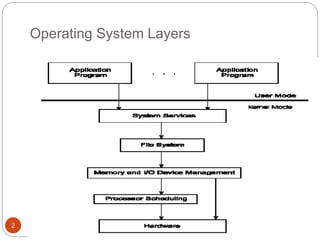
Operating System Layers
2
SENDHIL KUMAR KS
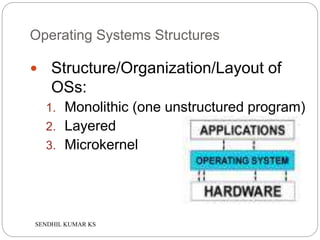
Operating Systems Structures
 Structure/Organization/Layout of
OSs:
1. Monolithic (one unstructured program)
2. Layered
3. Microkernel
SENDHIL KUMAR KS
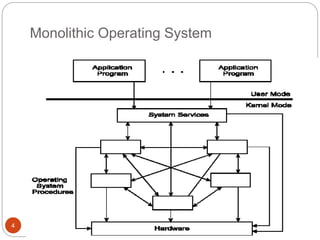
Monolithic Operating System
4
SENDHIL KUMAR KS
Monolithic OS – basic structure
 Application programs that invokes the requested
system services.
 A set of system services that carry out the
operating system procedures/calls.
 A set of utility procedures that help the system
services.
5
SENDHIL KUMAR KS
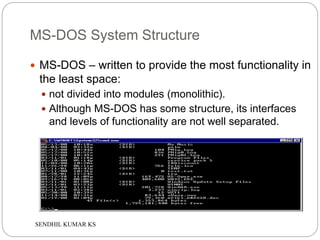
MS-DOS System Structure
 MS-DOS – written to provide the most functionality in
the least space:
 not divided into modules (monolithic).
 Although MS-DOS has some structure, its interfaces
and levels of functionality are not well separated.
SENDHIL KUMAR KS
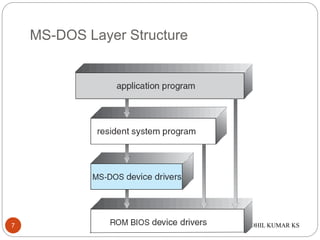
MS-DOS Layer Structure
7
SENDHIL KUMAR KS
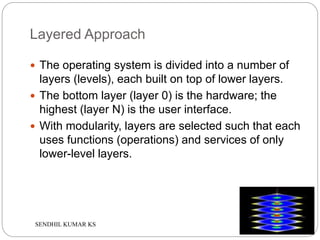
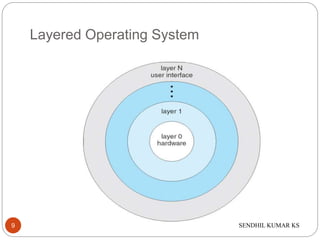
Layered Approach
 The operating system is divided into a number of
layers (levels), each built on top of lower layers.
 The bottom layer (layer 0) is the hardware; the
highest (layer N) is the user interface.
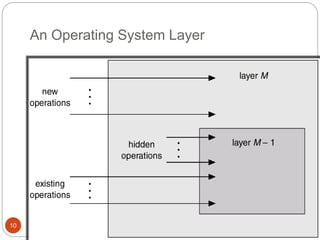
 With modularity, layers are selected such that each
uses functions (operations) and services of only
lower-level layers.
SENDHIL KUMAR KS
Layered Operating System
9
SENDHIL KUMAR KS
An Operating System Layer
10
SENDHIL KUMAR KS
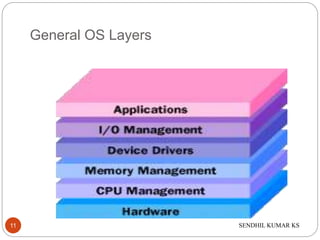
General OS Layers
11
SENDHIL KUMAR KS
12
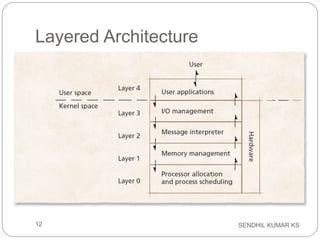
Layered Architecture
SENDHIL KUMAR KS
Microkernel System Structure (1)
 Move as much functionality as possible from the
kernel into “user” space.
 Only a few essential functions in the kernel:
 primitive memory management (address space)
 I/O and interrupt management
 Inter-Process Communication (IPC)
 basic scheduling
 Other OS services are provided by processes
running in user mode (vertical servers):
 device drivers, file system, virtual memory…
13
SENDHIL KUMAR KS
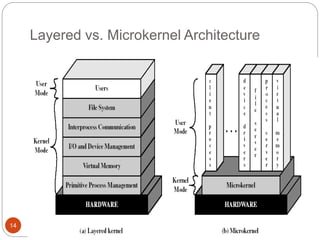
Layered vs. Microkernel Architecture
14
SENDHIL KUMAR KS
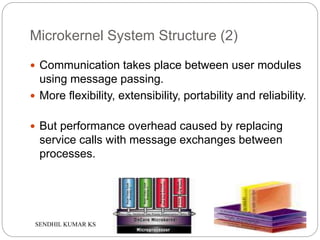
Microkernel System Structure (2)
 Communication takes place between user modules
using message passing.
 More flexibility, extensibility, portability and reliability.
 But performance overhead caused by replacing
service calls with message exchanges between
processes.
SENDHIL KUMAR KS
16
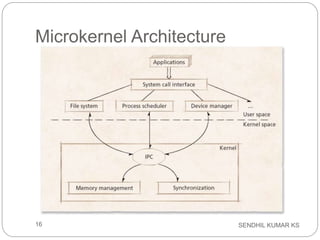
Microkernel Architecture
SENDHIL KUMAR KS
Benefits of a Microkernel Organization (1)
 Extensibility/Reliability
 easier to extend a microkernel
 easier to port the operating system to new architectures
 more reliable (less code is running in kernel mode)
 more secure
 small microkernel can be rigorously tested.
 Portability
 changes needed to port the system to a new processor
is done in the microkernel, not in the other services.
17
SENDHIL KUMAR KS
Benefits of Microkernel Organization (2)
Distributed system support
message are sent without knowing
what the target machine is.
Object-oriented operating system
components are objects with clearly
defined interfaces that can be
interconnected to form software.
SENDHIL KUMAR KS
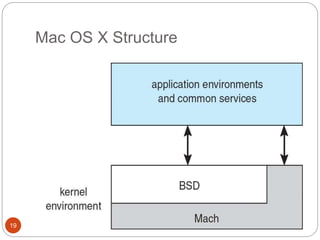
Mac OS X Structure
19
SENDHIL KUMAR KS
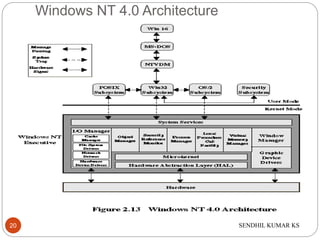
Windows NT 4.0 Architecture
20
SENDHIL KUMAR KS
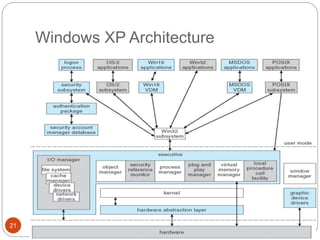
Windows XP Architecture
21
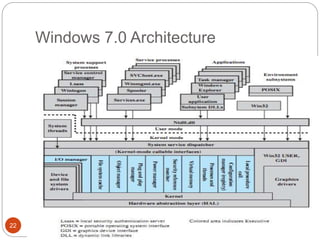
Windows 7.0 Architecture
SENDHIL KUMAR KS
22

Operating Systems – Structuring Methods.pptx

  • 1.
    K.S.SENDHIL KUMAR SCOPE,VIT University OperatingSystems – Structuring Methods
  • 2.
  • 3.
    SENDHIL KUMAR KS OperatingSystems Structures  Structure/Organization/Layout of OSs: 1. Monolithic (one unstructured program) 2. Layered 3. Microkernel
  • 4.
    SENDHIL KUMAR KS MonolithicOperating System 4
  • 5.
    SENDHIL KUMAR KS MonolithicOS – basic structure  Application programs that invokes the requested system services.  A set of system services that carry out the operating system procedures/calls.  A set of utility procedures that help the system services. 5
  • 6.
    SENDHIL KUMAR KS MS-DOSSystem Structure  MS-DOS – written to provide the most functionality in the least space:  not divided into modules (monolithic).  Although MS-DOS has some structure, its interfaces and levels of functionality are not well separated.
  • 7.
    SENDHIL KUMAR KS MS-DOSLayer Structure 7
  • 8.
    SENDHIL KUMAR KS LayeredApproach  The operating system is divided into a number of layers (levels), each built on top of lower layers.  The bottom layer (layer 0) is the hardware; the highest (layer N) is the user interface.  With modularity, layers are selected such that each uses functions (operations) and services of only lower-level layers.
  • 9.
    SENDHIL KUMAR KS LayeredOperating System 9
  • 10.
    SENDHIL KUMAR KS AnOperating System Layer 10
  • 11.
  • 12.
  • 13.
    SENDHIL KUMAR KS MicrokernelSystem Structure (1)  Move as much functionality as possible from the kernel into “user” space.  Only a few essential functions in the kernel:  primitive memory management (address space)  I/O and interrupt management  Inter-Process Communication (IPC)  basic scheduling  Other OS services are provided by processes running in user mode (vertical servers):  device drivers, file system, virtual memory… 13
  • 14.
    SENDHIL KUMAR KS Layeredvs. Microkernel Architecture 14
  • 15.
    SENDHIL KUMAR KS MicrokernelSystem Structure (2)  Communication takes place between user modules using message passing.  More flexibility, extensibility, portability and reliability.  But performance overhead caused by replacing service calls with message exchanges between processes.
  • 16.
  • 17.
    SENDHIL KUMAR KS Benefitsof a Microkernel Organization (1)  Extensibility/Reliability  easier to extend a microkernel  easier to port the operating system to new architectures  more reliable (less code is running in kernel mode)  more secure  small microkernel can be rigorously tested.  Portability  changes needed to port the system to a new processor is done in the microkernel, not in the other services. 17
  • 18.
    SENDHIL KUMAR KS Benefitsof Microkernel Organization (2) Distributed system support message are sent without knowing what the target machine is. Object-oriented operating system components are objects with clearly defined interfaces that can be interconnected to form software.
  • 19.
    SENDHIL KUMAR KS MacOS X Structure 19
  • 20.
    SENDHIL KUMAR KS WindowsNT 4.0 Architecture 20
  • 21.
    SENDHIL KUMAR KS WindowsXP Architecture 21
  • 22.