What is anOperating System
Structure?
• The structure of an Operating System (OS)
defines how its components are organized and
interact.
• It determines how key functions like process
management, memory management, and I/O
are implemented.
3.
Objectives of OSStructure
• • Efficient management of system resources
• • Provides user interface to interact with
hardware
• • Ensures system security and stability
• • Organizes OS components for performance
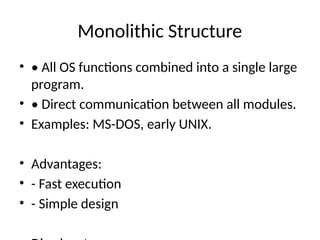
Monolithic Structure
• •All OS functions combined into a single large
program.
• • Direct communication between all modules.
• Examples: MS-DOS, early UNIX.
• Advantages:
• - Fast execution
• - Simple design
6.
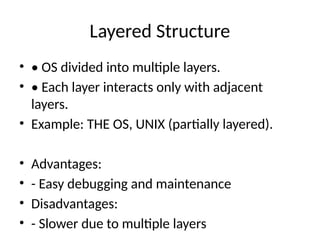
Layered Structure
• •OS divided into multiple layers.
• • Each layer interacts only with adjacent
layers.
• Example: THE OS, UNIX (partially layered).
• Advantages:
• - Easy debugging and maintenance
• Disadvantages:
• - Slower due to multiple layers
7.
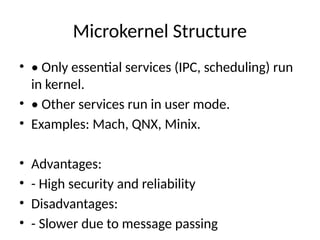
Microkernel Structure
• •Only essential services (IPC, scheduling) run
in kernel.
• • Other services run in user mode.
• Examples: Mach, QNX, Minix.
• Advantages:
• - High security and reliability
• Disadvantages:
• - Slower due to message passing
8.
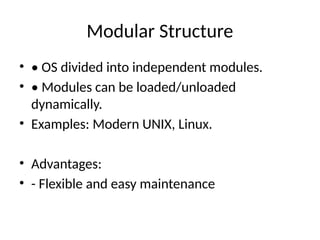
Modular Structure
• •OS divided into independent modules.
• • Modules can be loaded/unloaded
dynamically.
• Examples: Modern UNIX, Linux.
• Advantages:
• - Flexible and easy maintenance
9.
Hybrid Structure
• •Combines features of monolithic,
microkernel, and modular systems.
• • Used in modern OS.
• Examples: Windows, macOS, Android.
• Advantages:
• - High performance, flexibility, and security.
10.
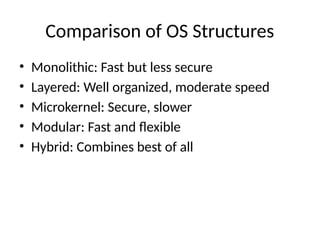
Comparison of OSStructures
• Monolithic: Fast but less secure
• Layered: Well organized, moderate speed
• Microkernel: Secure, slower
• Modular: Fast and flexible
• Hybrid: Combines best of all