3.2 Variable Partitioning
• There are three algorithms for searching the list of free blocks
for a specific amount of memory.
– First Fit
– Best Fit
– Worst Fit
1
first fit
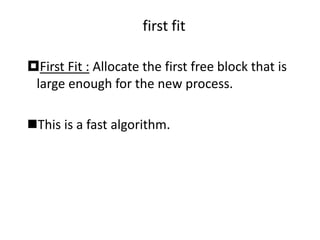
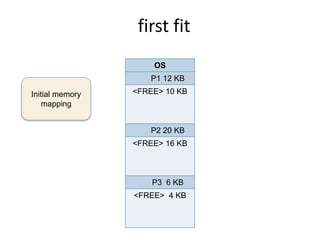
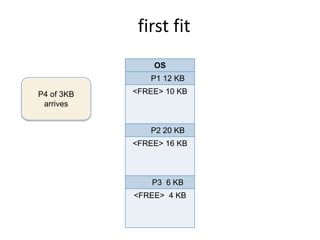
First Fit : Allocate the first free block that is
large enough for the new process.
This is a fast algorithm.
2
first fit
OS
P1 12 KB
<FREE> 10 KB
P2 20 KB
<FREE> 16 KB
P3 6 KB
<FREE> 4 KB
Initial memory
mapping
3
first fit
OS
P1 12 KB
<FREE> 10 KB
P2 20 KB
<FREE> 16 KB
P3 6 KB
<FREE> 4 KB
P4 of 3KB
arrives
4
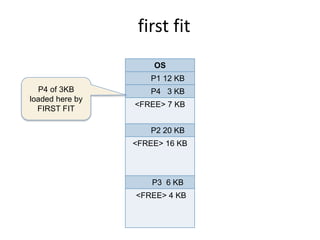
first fit
OS
P1 12 KB
P4 3 KB
<FREE> 7 KB
P2 20 KB
<FREE> 16 KB
P3 6 KB
<FREE> 4 KB
P4 of 3KB
loaded here by
FIRST FIT
5
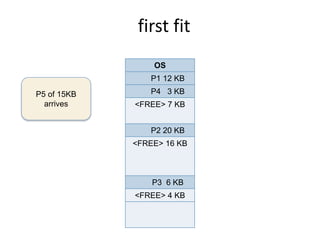
first fit
OS
P1 12 KB
P4 3 KB
<FREE> 7 KB
P2 20 KB
<FREE> 16 KB
P3 6 KB
<FREE> 4 KB
P5 of 15KB
arrives
6
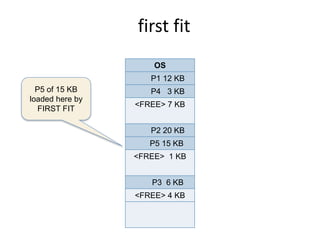
first fit
OS
P1 12 KB
P4 3 KB
<FREE> 7 KB
P2 20 KB
P5 15 KB
<FREE> 1 KB
P3 6 KB
<FREE> 4 KB
P5 of 15 KB
loaded here by
FIRST FIT
7
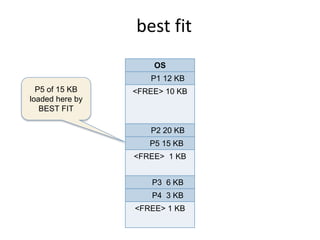
Best fit
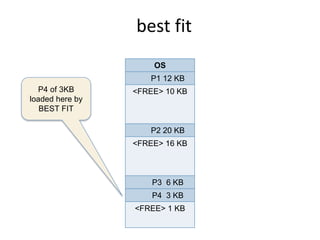
Best Fit : Allocate the smallest block among those that are
large enough for the new process.
In this method, the OS has to search the entire list, or it can
keep it sorted and stop when it hits an entry which has a size
larger than the size of new process.
 This algorithm produces the smallest left over block.
However, it requires more time for searching all the list or
sorting it
If sorting is used, merging the area released when a process
terminates to neighboring free blocks, becomes complicated.
8
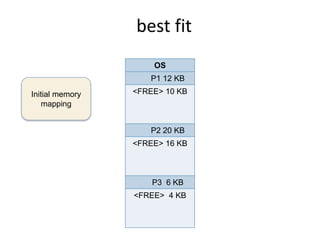
best fit
OS
P1 12 KB
<FREE> 10 KB
P2 20 KB
<FREE> 16 KB
P3 6 KB
<FREE> 4 KB
Initial memory
mapping
9
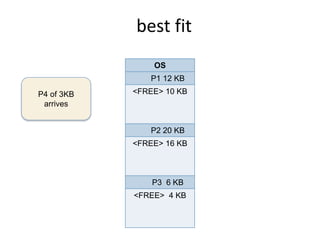
best fit
OS
P1 12 KB
<FREE> 10 KB
P2 20 KB
<FREE> 16 KB
P3 6 KB
<FREE> 4 KB
P4 of 3KB
arrives
10
best fit
OS
P1 12 KB
<FREE> 10 KB
P2 20 KB
<FREE> 16 KB
P3 6 KB
P4 3 KB
<FREE> 1 KB
P4 of 3KB
loaded here by
BEST FIT
11
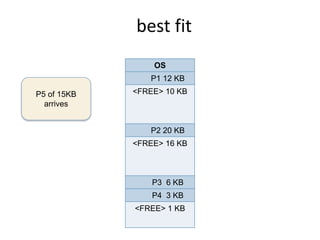
best fit
OS
P1 12 KB
<FREE> 10 KB
P2 20 KB
<FREE> 16 KB
P3 6 KB
P4 3 KB
<FREE> 1 KB
P5 of 15KB
arrives
12
best fit
OS
P1 12 KB
<FREE> 10 KB
P2 20 KB
P5 15 KB
<FREE> 1 KB
P3 6 KB
P4 3 KB
<FREE> 1 KB
P5 of 15 KB
loaded here by
BEST FIT
13
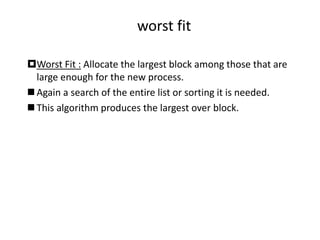
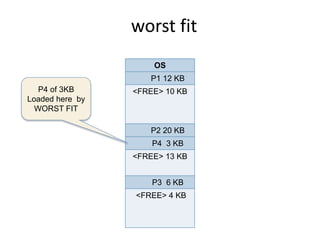
worst fit
Worst Fit : Allocate the largest block among those that are
large enough for the new process.
Again a search of the entire list or sorting it is needed.
This algorithm produces the largest over block.
14
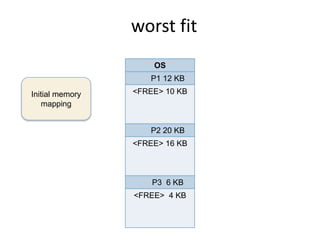
worst fit
OS
P1 12 KB
<FREE> 10 KB
P2 20 KB
<FREE> 16 KB
P3 6 KB
<FREE> 4 KB
Initial memory
mapping
15
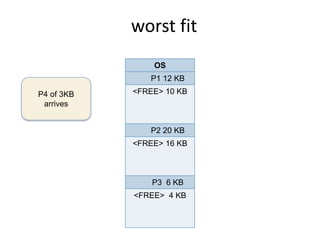
worst fit
OS
P1 12 KB
<FREE> 10 KB
P2 20 KB
<FREE> 16 KB
P3 6 KB
<FREE> 4 KB
P4 of 3KB
arrives
16
worst fit
OS
P1 12 KB
<FREE> 10 KB
P2 20 KB
P4 3 KB
<FREE> 13 KB
P3 6 KB
<FREE> 4 KB
P4 of 3KB
Loaded here by
WORST FIT
17
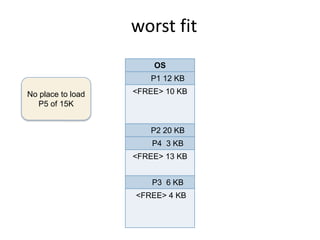
worst fit
OS
P1 12 KB
<FREE> 10 KB
P2 20 KB
P4 3 KB
<FREE> 13 KB
P3 6 KB
<FREE> 4 KB
No place to load
P5 of 15K
18
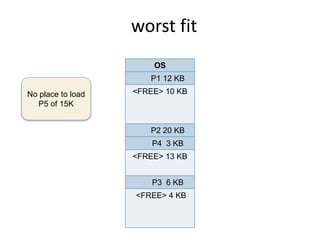
worst fit
OS
P1 12 KB
<FREE> 10 KB
P2 20 KB
P4 3 KB
<FREE> 13 KB
P3 6 KB
<FREE> 4 KB
No place to load
P5 of 15K
19
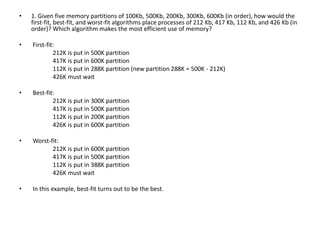
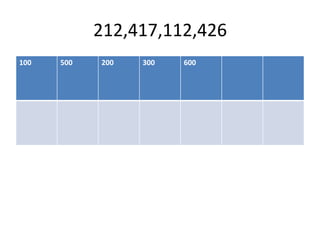
• 1. Given five memory partitions of 100Kb, 500Kb, 200Kb, 300Kb, 600Kb (in order), how would the
first-fit, best-fit, and worst-fit algorithms place processes of 212 Kb, 417 Kb, 112 Kb, and 426 Kb (in
order)? Which algorithm makes the most efficient use of memory?
• First-fit:
212K is put in 500K partition
417K is put in 600K partition
112K is put in 288K partition (new partition 288K = 500K - 212K)
426K must wait
• Best-fit:
212K is put in 300K partition
417K is put in 500K partition
112K is put in 200K partition
426K is put in 600K partition
• Worst-fit:
212K is put in 600K partition
417K is put in 500K partition
112K is put in 388K partition
426K must wait
• In this example, best-fit turns out to be the best.
212,417,112,426
100 500 200 300 600

First Best and Worst Fit.pptx

  • 1.
    3.2 Variable Partitioning •There are three algorithms for searching the list of free blocks for a specific amount of memory. – First Fit – Best Fit – Worst Fit 1
  • 2.
    first fit First Fit: Allocate the first free block that is large enough for the new process. This is a fast algorithm. 2
  • 3.
    first fit OS P1 12KB <FREE> 10 KB P2 20 KB <FREE> 16 KB P3 6 KB <FREE> 4 KB Initial memory mapping 3
  • 4.
    first fit OS P1 12KB <FREE> 10 KB P2 20 KB <FREE> 16 KB P3 6 KB <FREE> 4 KB P4 of 3KB arrives 4
  • 5.
    first fit OS P1 12KB P4 3 KB <FREE> 7 KB P2 20 KB <FREE> 16 KB P3 6 KB <FREE> 4 KB P4 of 3KB loaded here by FIRST FIT 5
  • 6.
    first fit OS P1 12KB P4 3 KB <FREE> 7 KB P2 20 KB <FREE> 16 KB P3 6 KB <FREE> 4 KB P5 of 15KB arrives 6
  • 7.
    first fit OS P1 12KB P4 3 KB <FREE> 7 KB P2 20 KB P5 15 KB <FREE> 1 KB P3 6 KB <FREE> 4 KB P5 of 15 KB loaded here by FIRST FIT 7
  • 8.
    Best fit Best Fit: Allocate the smallest block among those that are large enough for the new process. In this method, the OS has to search the entire list, or it can keep it sorted and stop when it hits an entry which has a size larger than the size of new process.  This algorithm produces the smallest left over block. However, it requires more time for searching all the list or sorting it If sorting is used, merging the area released when a process terminates to neighboring free blocks, becomes complicated. 8
  • 9.
    best fit OS P1 12KB <FREE> 10 KB P2 20 KB <FREE> 16 KB P3 6 KB <FREE> 4 KB Initial memory mapping 9
  • 10.
    best fit OS P1 12KB <FREE> 10 KB P2 20 KB <FREE> 16 KB P3 6 KB <FREE> 4 KB P4 of 3KB arrives 10
  • 11.
    best fit OS P1 12KB <FREE> 10 KB P2 20 KB <FREE> 16 KB P3 6 KB P4 3 KB <FREE> 1 KB P4 of 3KB loaded here by BEST FIT 11
  • 12.
    best fit OS P1 12KB <FREE> 10 KB P2 20 KB <FREE> 16 KB P3 6 KB P4 3 KB <FREE> 1 KB P5 of 15KB arrives 12
  • 13.
    best fit OS P1 12KB <FREE> 10 KB P2 20 KB P5 15 KB <FREE> 1 KB P3 6 KB P4 3 KB <FREE> 1 KB P5 of 15 KB loaded here by BEST FIT 13
  • 14.
    worst fit Worst Fit: Allocate the largest block among those that are large enough for the new process. Again a search of the entire list or sorting it is needed. This algorithm produces the largest over block. 14
  • 15.
    worst fit OS P1 12KB <FREE> 10 KB P2 20 KB <FREE> 16 KB P3 6 KB <FREE> 4 KB Initial memory mapping 15
  • 16.
    worst fit OS P1 12KB <FREE> 10 KB P2 20 KB <FREE> 16 KB P3 6 KB <FREE> 4 KB P4 of 3KB arrives 16
  • 17.
    worst fit OS P1 12KB <FREE> 10 KB P2 20 KB P4 3 KB <FREE> 13 KB P3 6 KB <FREE> 4 KB P4 of 3KB Loaded here by WORST FIT 17
  • 18.
    worst fit OS P1 12KB <FREE> 10 KB P2 20 KB P4 3 KB <FREE> 13 KB P3 6 KB <FREE> 4 KB No place to load P5 of 15K 18
  • 19.
    worst fit OS P1 12KB <FREE> 10 KB P2 20 KB P4 3 KB <FREE> 13 KB P3 6 KB <FREE> 4 KB No place to load P5 of 15K 19
  • 20.
    • 1. Givenfive memory partitions of 100Kb, 500Kb, 200Kb, 300Kb, 600Kb (in order), how would the first-fit, best-fit, and worst-fit algorithms place processes of 212 Kb, 417 Kb, 112 Kb, and 426 Kb (in order)? Which algorithm makes the most efficient use of memory? • First-fit: 212K is put in 500K partition 417K is put in 600K partition 112K is put in 288K partition (new partition 288K = 500K - 212K) 426K must wait • Best-fit: 212K is put in 300K partition 417K is put in 500K partition 112K is put in 200K partition 426K is put in 600K partition • Worst-fit: 212K is put in 600K partition 417K is put in 500K partition 112K is put in 388K partition 426K must wait • In this example, best-fit turns out to be the best.
  • 21.