Mrs. V.BACKIYALAKSHMI M.Phil., NET
Assistant professor of Computer Science
E.M.G. Yadava Women’s College, Madurai.
Introduction
What Operating Systems Do
Computer System Organization
Computer System Architecture
Operating System Structure
Operating System Operations
Distributed Systems
Open Source Operating Systems.
UNIT – 1
What Operating Systems Do
 Depends on the point of view
 Users want convenience, ease of use and good performance
 Don’t care about resource utilization
 But shared computer such as mainframe or minicomputer must keep all users
happy
 Operating system is a resource allocator and control program making efficient use of HW
and managing execution of user programs
 Users of dedicate systems such as workstations have dedicated resources but
frequently use shared resources from servers
 Mobile devices like smartphones and tables are resource poor, optimized for
usability and battery life
 Mobile user interfaces such as touch screens, voice recognition
 Some computers have little or no user interface, such as embedded computers in
devices and automobiles
 Run primarily without user intervention
Operating System Definition
● No universally accepted definition
● “Everything a vendor ships when you order an operating system” is a good
approximation
○ But varies wildly
● “The one program running at all times on the computer” is the kernel, part
of the operating system
● Everything else is either
○ A system program (ships with the operating system, but not part of the kernel) , or
○ An application program, all programs not associated with the operating system
● Today’s OS for general purpose and mobile computing also include
middleware – a set of software frameworks that provide additional
services to application developers such as databases, multimedia, graphics
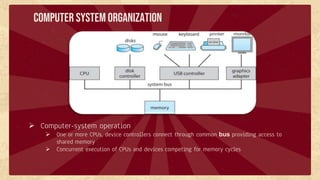
Computer System Organization
 Computer-system operation
 One or more CPUs, device controllers connect through common bus providing access to
shared memory
 Concurrent execution of CPUs and devices competing for memory cycles
Computer-System Operation
● I/O devices and the CPU can execute concurrently
● Each device controller is in charge of a particular device type
● Each device controller has a local buffer
● Each device controller type has an operating system device driver to
manage it
● CPU moves data from/to main memory to/from local buffers
● I/O is from the device to local buffer of controller
● Device controller informs CPU that it has finished its operation by
causing an interrupt
Operating-System Operations
● Bootstrap program – simple code to initialize the system, load the kernel
● Kernel loads
● Starts system daemons (services provided outside of the kernel)
● Kernel interrupt driven (hardware and software)
○ Hardware interrupt by one of the devices
○ Software interrupt (exception or trap):
■ Software error (e.g., division by zero)
■ Request for operating system service – system call
■ Other process problems include infinite loop, processes modifying each other or
the operating system
Multiprogramming (Batch system)
● Single user cannot always keep CPU and I/O devices busy
● Multiprogramming organizes jobs (code and data) so CPU always
has one to execute
● A subset of total jobs in system is kept in memory
● One job selected and run via job scheduling
● When job has to wait (for I/O for example), OS switches to another
job
Multitasking (Timesharing)
● A logical extension of Batch systems– the CPU switches jobs so frequently that
users can interact with each job while it is running, creating interactive
computing
○ Response time should be < 1 second
○ Each user has at least one program executing in memory  process
○ If several jobs ready to run at the same time  CPU scheduling
○ If processes don’t fit in memory, swapping moves them in and out to run
○ Virtual memory allows execution of processes not completely in memory
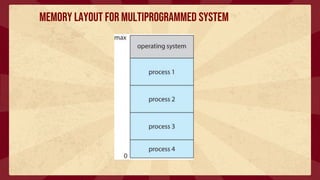
Memory Layout for Multiprogrammed System
Dual-mode Operation
● Dual-mode operation allows OS to protect itself and other
system components
○ User mode and kernel mode
● Mode bit provided by hardware
○ Provides ability to distinguish when system is running user code or kernel
code.
○ When a user is running  mode bit is “user”
○ When kernel code is executing  mode bit is “kernel”
● How do we guarantee that user does not explicitly set the mode
bit to “kernel”?
○ System call changes mode to kernel, return from call resets it to user
● Some instructions designated as privileged, only executable in
kernel mode
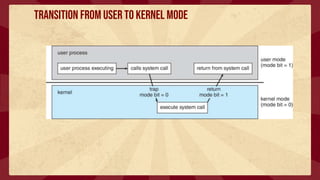
Transition from User to Kernel Mode
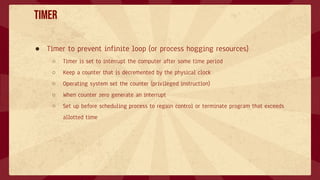
Timer
● Timer to prevent infinite loop (or process hogging resources)
○ Timer is set to interrupt the computer after some time period
○ Keep a counter that is decremented by the physical clock
○ Operating system set the counter (privileged instruction)
○ When counter zero generate an interrupt
○ Set up before scheduling process to regain control or terminate program that exceeds
allotted time
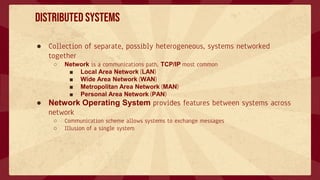
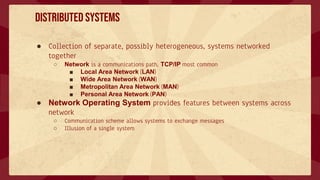
Distributed Systems
● Collection of separate, possibly heterogeneous, systems networked
together
○ Network is a communications path, TCP/IP most common
■ Local Area Network (LAN)
■ Wide Area Network (WAN)
■ Metropolitan Area Network (MAN)
■ Personal Area Network (PAN)
● Network Operating System provides features between systems across
network
○ Communication scheme allows systems to exchange messages
○ Illusion of a single system
Distributed Systems
● Collection of separate, possibly heterogeneous, systems networked
together
○ Network is a communications path, TCP/IP most common
■ Local Area Network (LAN)
■ Wide Area Network (WAN)
■ Metropolitan Area Network (MAN)
■ Personal Area Network (PAN)
● Network Operating System provides features between systems across
network
○ Communication scheme allows systems to exchange messages
○ Illusion of a single system
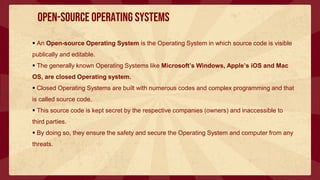
Open-Source Operating Systems
 An Open-source Operating System is the Operating System in which source code is visible
publically and editable.
 The generally known Operating Systems like Microsoft’s Windows, Apple’s iOS and Mac
OS, are closed Operating system.
 Closed Operating Systems are built with numerous codes and complex programming and that
is called source code.
 This source code is kept secret by the respective companies (owners) and inaccessible to
third parties.
 By doing so, they ensure the safety and secure the Operating System and computer from any
threats.
Open-Source Operating Systems
● Operating systems made available in source-code format rather than just
binary closed-source and proprietary
● Counter to the copy protection and Digital Rights Management
(DRM) movement
● Started by Free Software Foundation (FSF), which has “copyleft”
GNU Public License (GPL)
○ Free software and open-source software are two different ideas championed by
different groups of people
■ https://www.gnu.org/philosophy/open-source-misses-the-point.en.html
● Examples include GNU/Linux and BSD UNIX (including core of Mac
OS X), and many more
● Can use VMM like VMware Player (Free on Windows), Virtualbox (open
source and free on many platforms - http://www.virtualbox.com)
○ Use to run guest operating systems for exploration
Operating System concepts

Operating System concepts

  • 1.
    Mrs. V.BACKIYALAKSHMI M.Phil.,NET Assistant professor of Computer Science E.M.G. Yadava Women’s College, Madurai.
  • 2.
    Introduction What Operating SystemsDo Computer System Organization Computer System Architecture Operating System Structure Operating System Operations Distributed Systems Open Source Operating Systems. UNIT – 1
  • 3.
    What Operating SystemsDo  Depends on the point of view  Users want convenience, ease of use and good performance  Don’t care about resource utilization  But shared computer such as mainframe or minicomputer must keep all users happy  Operating system is a resource allocator and control program making efficient use of HW and managing execution of user programs  Users of dedicate systems such as workstations have dedicated resources but frequently use shared resources from servers  Mobile devices like smartphones and tables are resource poor, optimized for usability and battery life  Mobile user interfaces such as touch screens, voice recognition  Some computers have little or no user interface, such as embedded computers in devices and automobiles  Run primarily without user intervention
  • 4.
    Operating System Definition ●No universally accepted definition ● “Everything a vendor ships when you order an operating system” is a good approximation ○ But varies wildly ● “The one program running at all times on the computer” is the kernel, part of the operating system ● Everything else is either ○ A system program (ships with the operating system, but not part of the kernel) , or ○ An application program, all programs not associated with the operating system ● Today’s OS for general purpose and mobile computing also include middleware – a set of software frameworks that provide additional services to application developers such as databases, multimedia, graphics
  • 5.
    Computer System Organization Computer-system operation  One or more CPUs, device controllers connect through common bus providing access to shared memory  Concurrent execution of CPUs and devices competing for memory cycles
  • 6.
    Computer-System Operation ● I/Odevices and the CPU can execute concurrently ● Each device controller is in charge of a particular device type ● Each device controller has a local buffer ● Each device controller type has an operating system device driver to manage it ● CPU moves data from/to main memory to/from local buffers ● I/O is from the device to local buffer of controller ● Device controller informs CPU that it has finished its operation by causing an interrupt
  • 7.
    Operating-System Operations ● Bootstrapprogram – simple code to initialize the system, load the kernel ● Kernel loads ● Starts system daemons (services provided outside of the kernel) ● Kernel interrupt driven (hardware and software) ○ Hardware interrupt by one of the devices ○ Software interrupt (exception or trap): ■ Software error (e.g., division by zero) ■ Request for operating system service – system call ■ Other process problems include infinite loop, processes modifying each other or the operating system
  • 8.
    Multiprogramming (Batch system) ●Single user cannot always keep CPU and I/O devices busy ● Multiprogramming organizes jobs (code and data) so CPU always has one to execute ● A subset of total jobs in system is kept in memory ● One job selected and run via job scheduling ● When job has to wait (for I/O for example), OS switches to another job
  • 9.
    Multitasking (Timesharing) ● Alogical extension of Batch systems– the CPU switches jobs so frequently that users can interact with each job while it is running, creating interactive computing ○ Response time should be < 1 second ○ Each user has at least one program executing in memory  process ○ If several jobs ready to run at the same time  CPU scheduling ○ If processes don’t fit in memory, swapping moves them in and out to run ○ Virtual memory allows execution of processes not completely in memory
  • 10.
    Memory Layout forMultiprogrammed System
  • 11.
    Dual-mode Operation ● Dual-modeoperation allows OS to protect itself and other system components ○ User mode and kernel mode ● Mode bit provided by hardware ○ Provides ability to distinguish when system is running user code or kernel code. ○ When a user is running  mode bit is “user” ○ When kernel code is executing  mode bit is “kernel” ● How do we guarantee that user does not explicitly set the mode bit to “kernel”? ○ System call changes mode to kernel, return from call resets it to user ● Some instructions designated as privileged, only executable in kernel mode
  • 12.
    Transition from Userto Kernel Mode
  • 13.
    Timer ● Timer toprevent infinite loop (or process hogging resources) ○ Timer is set to interrupt the computer after some time period ○ Keep a counter that is decremented by the physical clock ○ Operating system set the counter (privileged instruction) ○ When counter zero generate an interrupt ○ Set up before scheduling process to regain control or terminate program that exceeds allotted time
  • 14.
    Distributed Systems ● Collectionof separate, possibly heterogeneous, systems networked together ○ Network is a communications path, TCP/IP most common ■ Local Area Network (LAN) ■ Wide Area Network (WAN) ■ Metropolitan Area Network (MAN) ■ Personal Area Network (PAN) ● Network Operating System provides features between systems across network ○ Communication scheme allows systems to exchange messages ○ Illusion of a single system
  • 15.
    Distributed Systems ● Collectionof separate, possibly heterogeneous, systems networked together ○ Network is a communications path, TCP/IP most common ■ Local Area Network (LAN) ■ Wide Area Network (WAN) ■ Metropolitan Area Network (MAN) ■ Personal Area Network (PAN) ● Network Operating System provides features between systems across network ○ Communication scheme allows systems to exchange messages ○ Illusion of a single system
  • 16.
    Open-Source Operating Systems An Open-source Operating System is the Operating System in which source code is visible publically and editable.  The generally known Operating Systems like Microsoft’s Windows, Apple’s iOS and Mac OS, are closed Operating system.  Closed Operating Systems are built with numerous codes and complex programming and that is called source code.  This source code is kept secret by the respective companies (owners) and inaccessible to third parties.  By doing so, they ensure the safety and secure the Operating System and computer from any threats.
  • 17.
    Open-Source Operating Systems ●Operating systems made available in source-code format rather than just binary closed-source and proprietary ● Counter to the copy protection and Digital Rights Management (DRM) movement ● Started by Free Software Foundation (FSF), which has “copyleft” GNU Public License (GPL) ○ Free software and open-source software are two different ideas championed by different groups of people ■ https://www.gnu.org/philosophy/open-source-misses-the-point.en.html ● Examples include GNU/Linux and BSD UNIX (including core of Mac OS X), and many more ● Can use VMM like VMware Player (Free on Windows), Virtualbox (open source and free on many platforms - http://www.virtualbox.com) ○ Use to run guest operating systems for exploration