www.NetAppIT.com
© 2019 NetApp, Inc. All rights reserved. No portions of this document may be reproduced without prior written consent of
NetApp, Inc. Specifications are subject to change without notice. NetApp, the NetApp logo OnCommand, and ONTAP are
trademarks or registered trademarks of NetApp, Inc. the United States and/or other countries. All other brands or products
are trademarks or registered trademarks of their respective holders and should be treated as such. A current list of NetApp
trademarks is available on the web.
Achieving Target
State Architecture
in NetApp IT
OPERATIONAL&TECHNICALRISK
BUSINESS FIT & VALUE
TOLERATE
ELIMINATE
INVEST
MIGRATE
Containers provide application portability within
our enterprise. We are heavy on Kubernetes,
using Docker as our platform.
Configuration Management allows for
consistent environments. We are avid users of
RedHat Ansible and RedHat CloudForms for
getting infrastructure up and running.
Code and Binary Management provides fast,
real-time data access. For this, NetApp IT uses
Git and JFrog.
CI/CD (Continuous Integration, Continuous
Deployment) provides a secure streamlined
development experience. Our primary tool for
this function is Jenkins.
Cloud and PaaS allow data access without
infrastructure management. Our team uses
OpenShift and various cloud providers.
Monitoring offers actionable insights into
environments. As we define and gather more
metrics from our applications, this pillar will evolve
to become analytics. We monitor with Zenoss and
Splunk.
CLOUD NATIVE
EFFORT
Rehost
Refactor
Rearchitect
Rebuild
Replace
IaaS
PaaS
SaaS
• Know what applications are critical
to business and focus on the ones
that matter
• Use framework like Gartner’s TIME
model to map your entire app
portfolio and align business with IT
- Tolerate and Eliminate apps
will phase out
- Focus on Migrate and Invest
apps and align them to correct
target state
Further categorize Migrate and Invest applications based on their business value
• Keep Business Running Apps (KBR): Commodity Services and Systems of Record
• Business Transformation Apps: Systems of Innovation and Differentiation
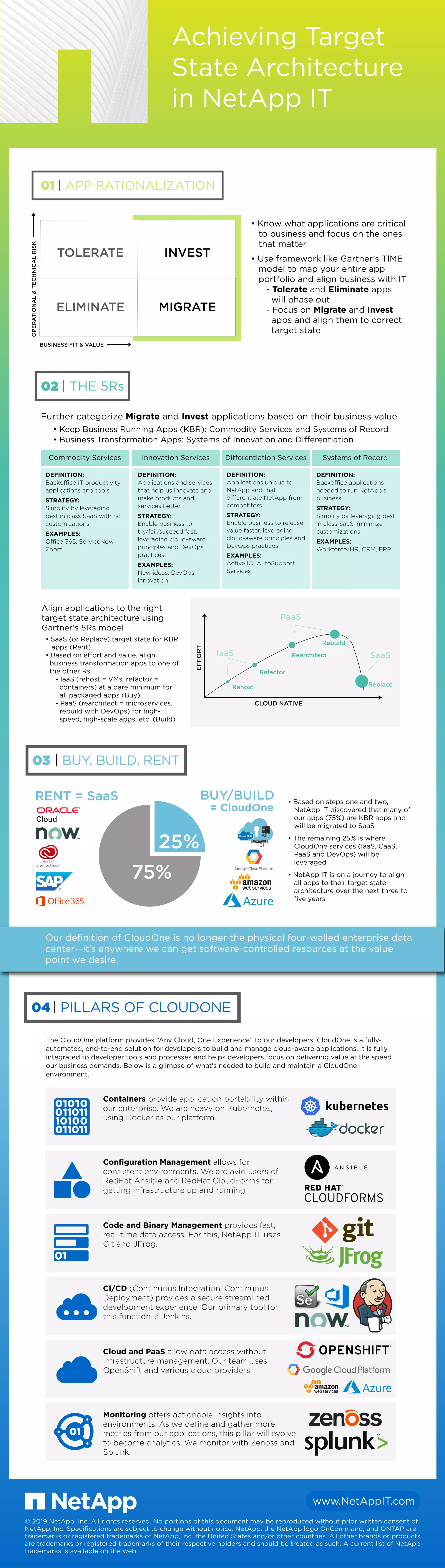
• Based on steps one and two,
NetApp IT discovered that many of
our apps (75%) are KBR apps and
will be migrated to SaaS
• The remaining 25% is where
CloudOne services (IaaS, CaaS,
PaaS and DevOps) will be
leveraged
• NetApp IT is on a journey to align
all apps to their target state
architecture over the next three to
five years
Our definition of CloudOne is no longer the physical four-walled enterprise data
center—it’s anywhere we can get software-controlled resources at the value
point we desire.
The CloudOne platform provides “Any Cloud, One Experience” to our developers. CloudOne is a fully-
automated, end-to-end solution for developers to build and manage cloud-aware applications. It is fully
integrated to developer tools and processes and helps developers focus on delivering value at the speed
our business demands. Below is a glimpse of what’s needed to build and maintain a CloudOne
environment.
DEFINITION:
Backoffice IT productivity
applications and tools
STRATEGY:
Simplify by leveraging
best in class SaaS with no
customizations
EXAMPLES:
Office 365, ServiceNow,
Zoom
Commodity Services Innovation Services
DEFINITION:
Applications and services
that help us innovate and
make products and
services better
STRATEGY:
Enable business to
try/fail/succeed fast,
leveraging cloud-aware
principles and DevOps
practices
EXAMPLES:
New ideas, DevOps
innovation
DEFINITION:
Applications unique to
NetApp and that
differentiate NetApp from
competitors
STRATEGY:
Enable business to release
value faster, leveraging
cloud-aware principles and
DevOps practices
EXAMPLES:
Active IQ, AutoSupport
Services
DEFINITION:
Backoffice applications
needed to run NetApp’s
business
STRATEGY:
Simplify by leveraging best
in class SaaS, minimize
customizations
EXAMPLES:
Workforce/HR, CRM, ERP
Differentiation Services Systems of Record
Align applications to the right
target state architecture using
Gartner’s 5Rs model
• SaaS (or Replace) target state for KBR
apps (Rent)
• Based on effort and value, align
business transformation apps to one of
the other Rs
- IaaS (rehost = VMs, refactor =
containers) at a bare minimum for
all packaged apps (Buy)
- PaaS (rearchitect = microservices,
rebuild with DevOps) for high-
speed, high-scale apps, etc. (Build)
= CloudOne

Achieving Target State Architecture in NetApp IT

  • 1.
    www.NetAppIT.com © 2019 NetApp,Inc. All rights reserved. No portions of this document may be reproduced without prior written consent of NetApp, Inc. Specifications are subject to change without notice. NetApp, the NetApp logo OnCommand, and ONTAP are trademarks or registered trademarks of NetApp, Inc. the United States and/or other countries. All other brands or products are trademarks or registered trademarks of their respective holders and should be treated as such. A current list of NetApp trademarks is available on the web. Achieving Target State Architecture in NetApp IT OPERATIONAL&TECHNICALRISK BUSINESS FIT & VALUE TOLERATE ELIMINATE INVEST MIGRATE Containers provide application portability within our enterprise. We are heavy on Kubernetes, using Docker as our platform. Configuration Management allows for consistent environments. We are avid users of RedHat Ansible and RedHat CloudForms for getting infrastructure up and running. Code and Binary Management provides fast, real-time data access. For this, NetApp IT uses Git and JFrog. CI/CD (Continuous Integration, Continuous Deployment) provides a secure streamlined development experience. Our primary tool for this function is Jenkins. Cloud and PaaS allow data access without infrastructure management. Our team uses OpenShift and various cloud providers. Monitoring offers actionable insights into environments. As we define and gather more metrics from our applications, this pillar will evolve to become analytics. We monitor with Zenoss and Splunk. CLOUD NATIVE EFFORT Rehost Refactor Rearchitect Rebuild Replace IaaS PaaS SaaS • Know what applications are critical to business and focus on the ones that matter • Use framework like Gartner’s TIME model to map your entire app portfolio and align business with IT - Tolerate and Eliminate apps will phase out - Focus on Migrate and Invest apps and align them to correct target state Further categorize Migrate and Invest applications based on their business value • Keep Business Running Apps (KBR): Commodity Services and Systems of Record • Business Transformation Apps: Systems of Innovation and Differentiation • Based on steps one and two, NetApp IT discovered that many of our apps (75%) are KBR apps and will be migrated to SaaS • The remaining 25% is where CloudOne services (IaaS, CaaS, PaaS and DevOps) will be leveraged • NetApp IT is on a journey to align all apps to their target state architecture over the next three to five years Our definition of CloudOne is no longer the physical four-walled enterprise data center—it’s anywhere we can get software-controlled resources at the value point we desire. The CloudOne platform provides “Any Cloud, One Experience” to our developers. CloudOne is a fully- automated, end-to-end solution for developers to build and manage cloud-aware applications. It is fully integrated to developer tools and processes and helps developers focus on delivering value at the speed our business demands. Below is a glimpse of what’s needed to build and maintain a CloudOne environment. DEFINITION: Backoffice IT productivity applications and tools STRATEGY: Simplify by leveraging best in class SaaS with no customizations EXAMPLES: Office 365, ServiceNow, Zoom Commodity Services Innovation Services DEFINITION: Applications and services that help us innovate and make products and services better STRATEGY: Enable business to try/fail/succeed fast, leveraging cloud-aware principles and DevOps practices EXAMPLES: New ideas, DevOps innovation DEFINITION: Applications unique to NetApp and that differentiate NetApp from competitors STRATEGY: Enable business to release value faster, leveraging cloud-aware principles and DevOps practices EXAMPLES: Active IQ, AutoSupport Services DEFINITION: Backoffice applications needed to run NetApp’s business STRATEGY: Simplify by leveraging best in class SaaS, minimize customizations EXAMPLES: Workforce/HR, CRM, ERP Differentiation Services Systems of Record Align applications to the right target state architecture using Gartner’s 5Rs model • SaaS (or Replace) target state for KBR apps (Rent) • Based on effort and value, align business transformation apps to one of the other Rs - IaaS (rehost = VMs, refactor = containers) at a bare minimum for all packaged apps (Buy) - PaaS (rearchitect = microservices, rebuild with DevOps) for high- speed, high-scale apps, etc. (Build) = CloudOne