BIODIVERSITY, CLIMATE
CHANGE AND
AGRICULTURE: TOWARDS
COHERENT APPROACHES
Simon Buckle, Head of Climate, Biodiversity and Water Division
Environment Directorate
OECD workshop
25 October 2017
• Biodiversity and agriculture linkages
• Climate change and agriculture
• The need for coherent approaches
Overview
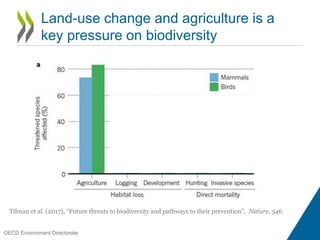
Land-use change and agriculture is a
key pressure on biodiversity
OECD Environment Directorate
Tilman et al. (2017), “Future threats to biodiversity and pathways to their prevention”, Nature, 546.
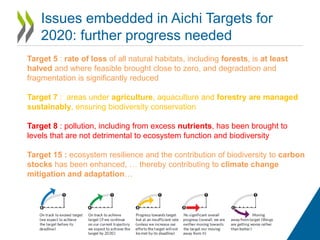
Issues embedded in Aichi Targets for
2020: further progress needed
Target 5 : rate of loss of all natural habitats, including forests, is at least
halved and where feasible brought close to zero, and degradation and
fragmentation is significantly reduced
Target 7 : areas under agriculture, aquaculture and forestry are managed
sustainably, ensuring biodiversity conservation
Target 8 : pollution, including from excess nutrients, has been brought to
levels that are not detrimental to ecosystem function and biodiversity
Target 15 : ecosystem resilience and the contribution of biodiversity to carbon
stocks has been enhanced, … thereby contributing to climate change
mitigation and adaptation…
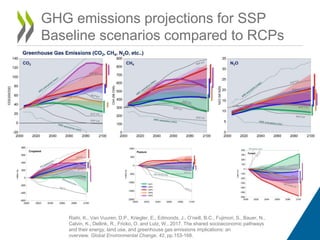
GHG emissions projections for SSP
Baseline scenarios compared to RCPs
Riahi, K., Van Vuuren, D.P., Kriegler, E., Edmonds, J., O’neill, B.C., Fujimori, S., Bauer, N.,
Calvin, K., Dellink, R., Fricko, O. and Lutz, W., 2017. The shared socioeconomic pathways
and their energy, land use, and greenhouse gas emissions implications: an
overview. Global Environmental Change, 42, pp.153-168.
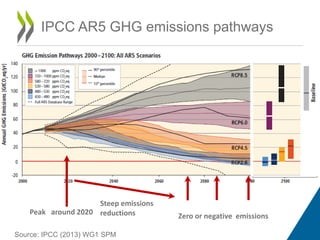
IPCC AR5 GHG emissions pathways
Peak around 2020
Steep emissions
reductions Zero or negative emissions
Source: IPCC (2013) WG1 SPM
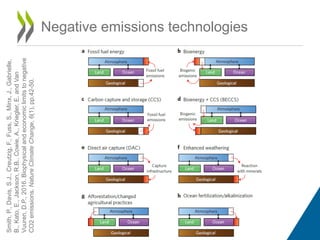
Negative emissions technologies
Smith,P.,Davis,S.J.,Creutzig,F.,Fuss,S.,Minx,J.,Gabrielle,
B.,Kato,E.,Jackson,R.B.,Cowie,A.,Kriegler,E.andVan
Vuuren,D.P.,2016.Biophysicalandeconomiclimitstonegative
CO2emissions.NatureClimateChange,6(1),pp.42-50.
• As CO2 levels and temperature rises, this affects
ability of some reservoirs to take up CO2
(increases and decreases)
• Difficult to quantify and manage
• Policy to limit impacts of these feedbacks on
climate change include (Prentice 2015):
– Avoid deforestation (keep stocks and maintain ability
of existing forests to take up new CO2 emissions)
– Limit over-use of fertilisers because of the long-term
effects of N2O [linked N and C-cycles]
Biosphere feedbacks
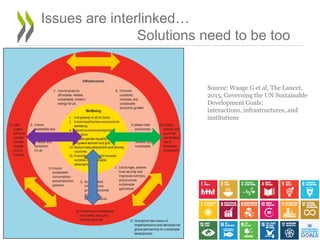
Issues are interlinked…
Solutions need to be too
Source: Waage G et al, The Lancet,
2015, Governing the UN Sustainable
Development Goals:
interactions, infrastructures, and
institutions
Opening presentation - Simon Buckle, OECD

Opening presentation - Simon Buckle, OECD

  • 1.
    BIODIVERSITY, CLIMATE CHANGE AND AGRICULTURE:TOWARDS COHERENT APPROACHES Simon Buckle, Head of Climate, Biodiversity and Water Division Environment Directorate OECD workshop 25 October 2017
  • 2.
    • Biodiversity andagriculture linkages • Climate change and agriculture • The need for coherent approaches Overview
  • 3.
    Land-use change andagriculture is a key pressure on biodiversity OECD Environment Directorate Tilman et al. (2017), “Future threats to biodiversity and pathways to their prevention”, Nature, 546.
  • 4.
    Issues embedded inAichi Targets for 2020: further progress needed Target 5 : rate of loss of all natural habitats, including forests, is at least halved and where feasible brought close to zero, and degradation and fragmentation is significantly reduced Target 7 : areas under agriculture, aquaculture and forestry are managed sustainably, ensuring biodiversity conservation Target 8 : pollution, including from excess nutrients, has been brought to levels that are not detrimental to ecosystem function and biodiversity Target 15 : ecosystem resilience and the contribution of biodiversity to carbon stocks has been enhanced, … thereby contributing to climate change mitigation and adaptation…
  • 5.
    GHG emissions projectionsfor SSP Baseline scenarios compared to RCPs Riahi, K., Van Vuuren, D.P., Kriegler, E., Edmonds, J., O’neill, B.C., Fujimori, S., Bauer, N., Calvin, K., Dellink, R., Fricko, O. and Lutz, W., 2017. The shared socioeconomic pathways and their energy, land use, and greenhouse gas emissions implications: an overview. Global Environmental Change, 42, pp.153-168.
  • 6.
    IPCC AR5 GHGemissions pathways Peak around 2020 Steep emissions reductions Zero or negative emissions Source: IPCC (2013) WG1 SPM
  • 7.
  • 8.
    • As CO2levels and temperature rises, this affects ability of some reservoirs to take up CO2 (increases and decreases) • Difficult to quantify and manage • Policy to limit impacts of these feedbacks on climate change include (Prentice 2015): – Avoid deforestation (keep stocks and maintain ability of existing forests to take up new CO2 emissions) – Limit over-use of fertilisers because of the long-term effects of N2O [linked N and C-cycles] Biosphere feedbacks
  • 9.
    Issues are interlinked… Solutionsneed to be too Source: Waage G et al, The Lancet, 2015, Governing the UN Sustainable Development Goals: interactions, infrastructures, and institutions