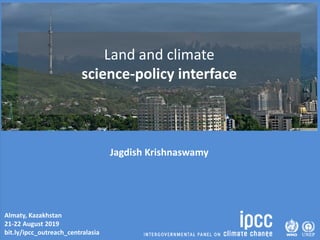
Almaty, Kazakhstan
21-22 August 2019
bit.ly/ipcc_outreach_centralasia
Land and climate
science-policy interface
Jagdish Krishnaswamy
Context
Productive land is a finite and increasingly vulnerable resource
under climate change
Land contributes to GHG emissions but is also a sink for carbon
There are limits to contribution of land sector to climate change
mitigation
Sustainable land management responses that contributes to
avoiding, reducing or reversing land degradation (LDN) can
provide co-benefits for mitigation, adaptation and ecosystem
services
Climate change poses severe challenges for well-being of
human societies and ecosystems
How we use land is both a problem and solution for land-
climate challenges
Marc Foggin
Many land based solutions have potential to reduce risk of
warming, help with adaptation options to live with climate change
and provide other benefits for humans, ecosystems and
biodiversity
Socio-economic pathways have implications for land-
climate challenge and trade-offs
Policy context
Mix of policies exist that can encourage sustainable land
management based on regional context
Regulation (eg land use zoning, land sparing and land
sharing approaches)
Land tenure could foster acceptance of sustainable land
management
Voluntary (change in diet, cropping patterns, standards and
certification, awareness generation, citizen science,
indigenous knowledge, collective action)
Persuasive (eg payments for ecosystem services)
Risk sharing mechanisms (eg insurance)
Science-policy: Informing magnitude of trade-offs for decision
making
Management of dams, barrages and reservoirs for
ecological flows down stream
Decision making under uncertainty
Spatial planning for and sharing and land sparing
Location and design of energy mitigation with land
implications (solar farms, small dams, wind energy farms) to
minimize impacts on biodiversity and pastoralists
How much land to allocate to bioenergy without impacting
food security, biodiversity and ecosystem services
Using existing knowledge for near term adaptation
Measuring and monitoring land-use and land-cover change
using shared and accessible remotely sensed data for
adaptive management and governance
Early warning systems linked to network of sensors for
extreme weather and pest outbreaks
Advisories for farmers based on improvements in short
term weather forecasting
Cooperation and knowledge transfer for best practices at
all levels of governance
Longer term
Early action on mitigation in all sectors (land use, food
systems, energy and transportation, consumption) will reduce
costs and burden on land and enable longer term ecological
restoration with adaptation and mitigation co-benefits
IPCC
IPCC
http://www.slideshare.net/ipcc-media/presentations
https://www.youtube.com/ipccgeneva
Find us on:
Website: http://ipcc.ch/
IPCC Secretariat: ipcc-sec@wmo.int
@IPCC_CH https://www.linkedin.com/company/ipcc
https://www.flickr.com/photos/ipccphoto/sets/
https://vimeo.com/ipcc
THANK YOU FOR YOUR ATTENTION!
For more information:

Land and climate science-policy interface

  • 1.
    Almaty, Kazakhstan 21-22 August2019 bit.ly/ipcc_outreach_centralasia Land and climate science-policy interface Jagdish Krishnaswamy
  • 2.
    Context Productive land isa finite and increasingly vulnerable resource under climate change Land contributes to GHG emissions but is also a sink for carbon There are limits to contribution of land sector to climate change mitigation Sustainable land management responses that contributes to avoiding, reducing or reversing land degradation (LDN) can provide co-benefits for mitigation, adaptation and ecosystem services
  • 3.
    Climate change posessevere challenges for well-being of human societies and ecosystems
  • 4.
    How we useland is both a problem and solution for land- climate challenges Marc Foggin
  • 5.
    Many land basedsolutions have potential to reduce risk of warming, help with adaptation options to live with climate change and provide other benefits for humans, ecosystems and biodiversity
  • 6.
    Socio-economic pathways haveimplications for land- climate challenge and trade-offs
  • 7.
    Policy context Mix ofpolicies exist that can encourage sustainable land management based on regional context Regulation (eg land use zoning, land sparing and land sharing approaches) Land tenure could foster acceptance of sustainable land management Voluntary (change in diet, cropping patterns, standards and certification, awareness generation, citizen science, indigenous knowledge, collective action) Persuasive (eg payments for ecosystem services) Risk sharing mechanisms (eg insurance)
  • 8.
    Science-policy: Informing magnitudeof trade-offs for decision making Management of dams, barrages and reservoirs for ecological flows down stream Decision making under uncertainty Spatial planning for and sharing and land sparing Location and design of energy mitigation with land implications (solar farms, small dams, wind energy farms) to minimize impacts on biodiversity and pastoralists How much land to allocate to bioenergy without impacting food security, biodiversity and ecosystem services
  • 9.
    Using existing knowledgefor near term adaptation Measuring and monitoring land-use and land-cover change using shared and accessible remotely sensed data for adaptive management and governance Early warning systems linked to network of sensors for extreme weather and pest outbreaks Advisories for farmers based on improvements in short term weather forecasting Cooperation and knowledge transfer for best practices at all levels of governance
  • 10.
    Longer term Early actionon mitigation in all sectors (land use, food systems, energy and transportation, consumption) will reduce costs and burden on land and enable longer term ecological restoration with adaptation and mitigation co-benefits
  • 11.
    IPCC IPCC http://www.slideshare.net/ipcc-media/presentations https://www.youtube.com/ipccgeneva Find us on: Website:http://ipcc.ch/ IPCC Secretariat: ipcc-sec@wmo.int @IPCC_CH https://www.linkedin.com/company/ipcc https://www.flickr.com/photos/ipccphoto/sets/ https://vimeo.com/ipcc THANK YOU FOR YOUR ATTENTION! For more information: