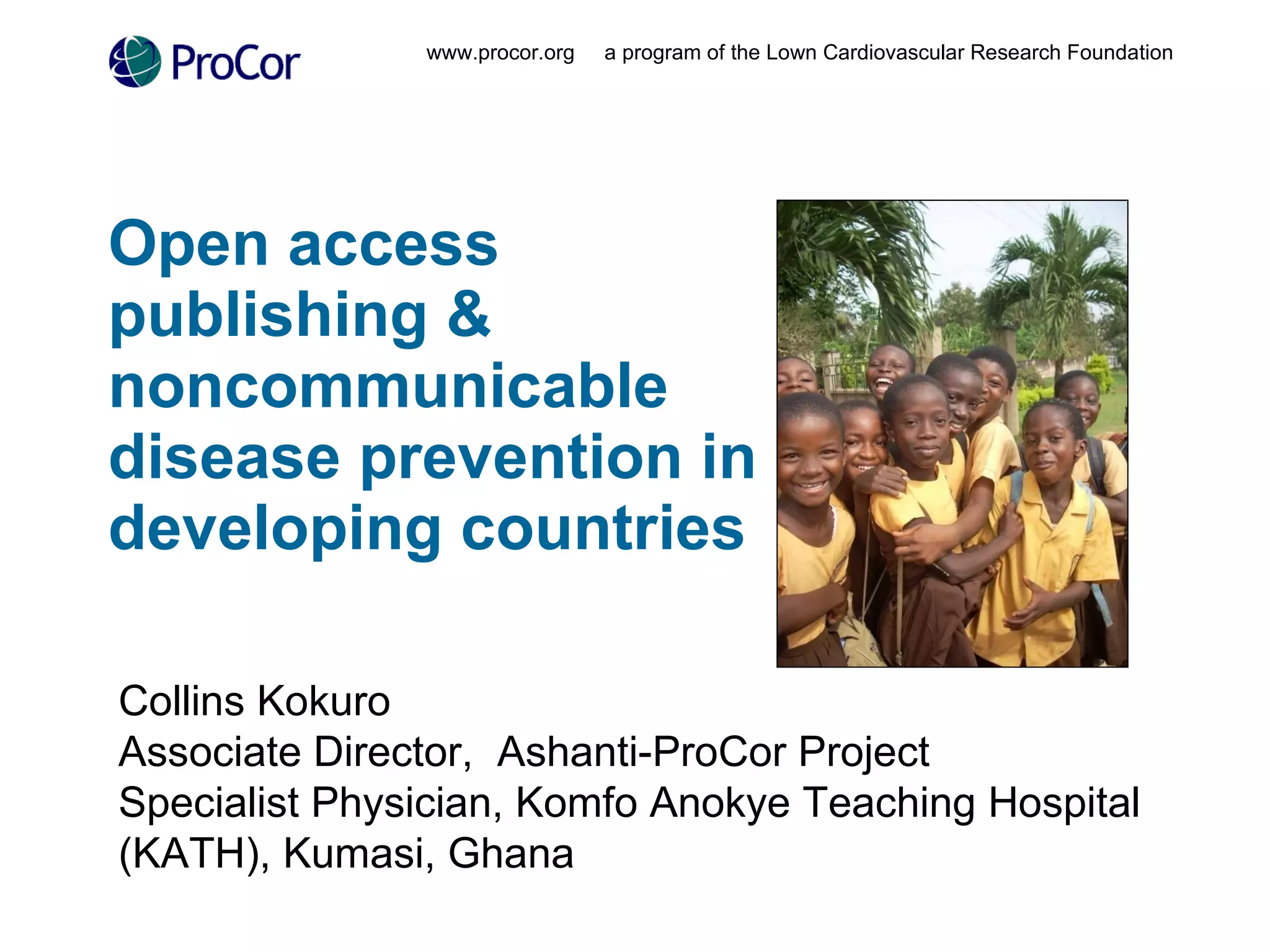
Open access publishing & noncommunicable disease prevention in developing countries www.procor.org  a program of the Lown Cardiovascular Research Foundation Collins Kokuro Associate Director,  Ashanti-ProCor Project Specialist Physician, Komfo Anokye Teaching Hospital (KATH), Kumasi, Ghana
Outline  Non Communicable Disease burden Global and local Information poverty in LMIC ProCor Ashanti ProCor project and its findings Recommendations. www.procor.org  a program of the Lown Cardiovascular Research Foundation
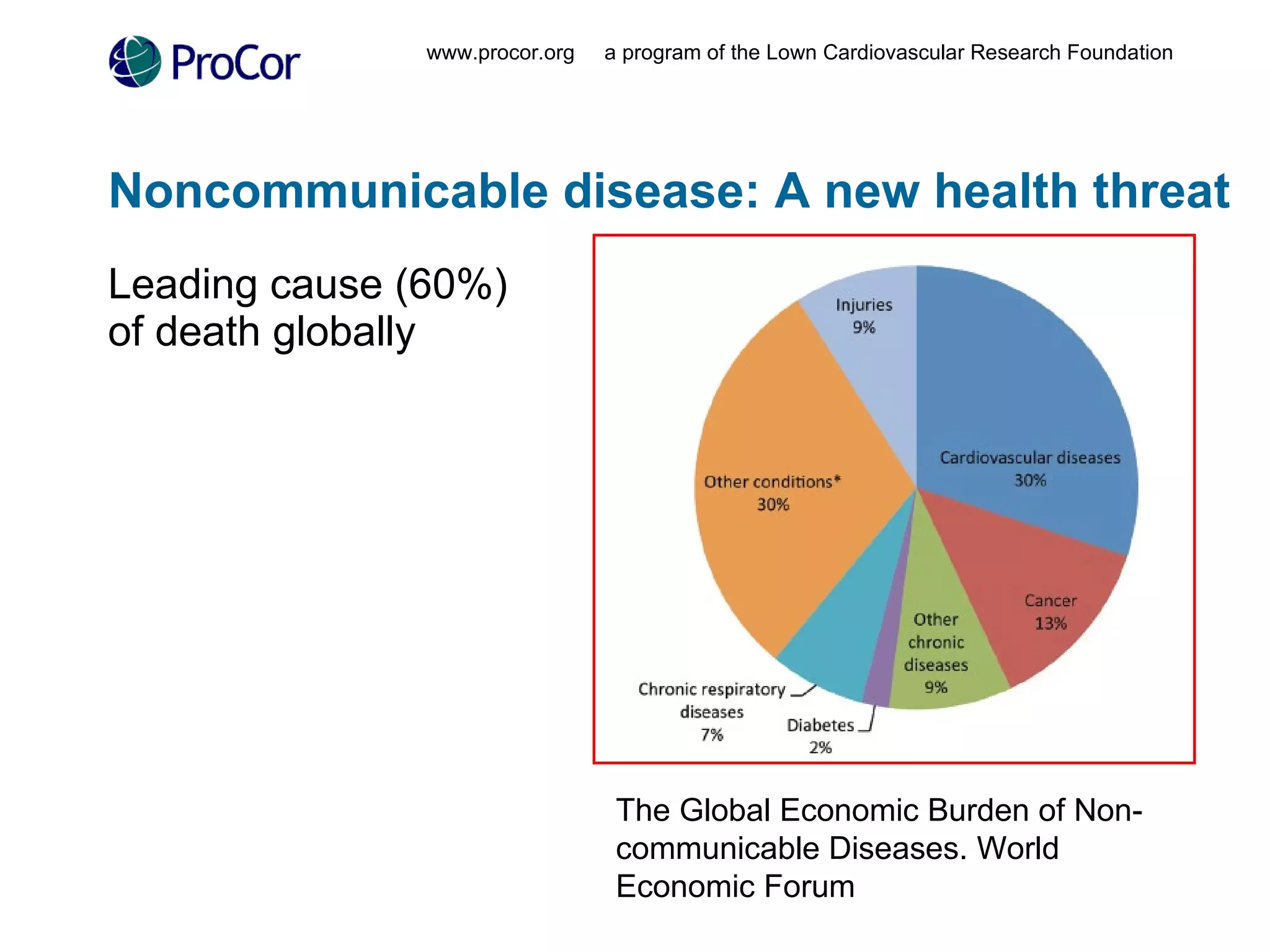
Noncommunicable disease: A new health threat Leading cause (60%) of death globally www.procor.org  a program of the Lown Cardiovascular Research Foundation The Global Economic Burden of Non-communicable Diseases. World Economic Forum
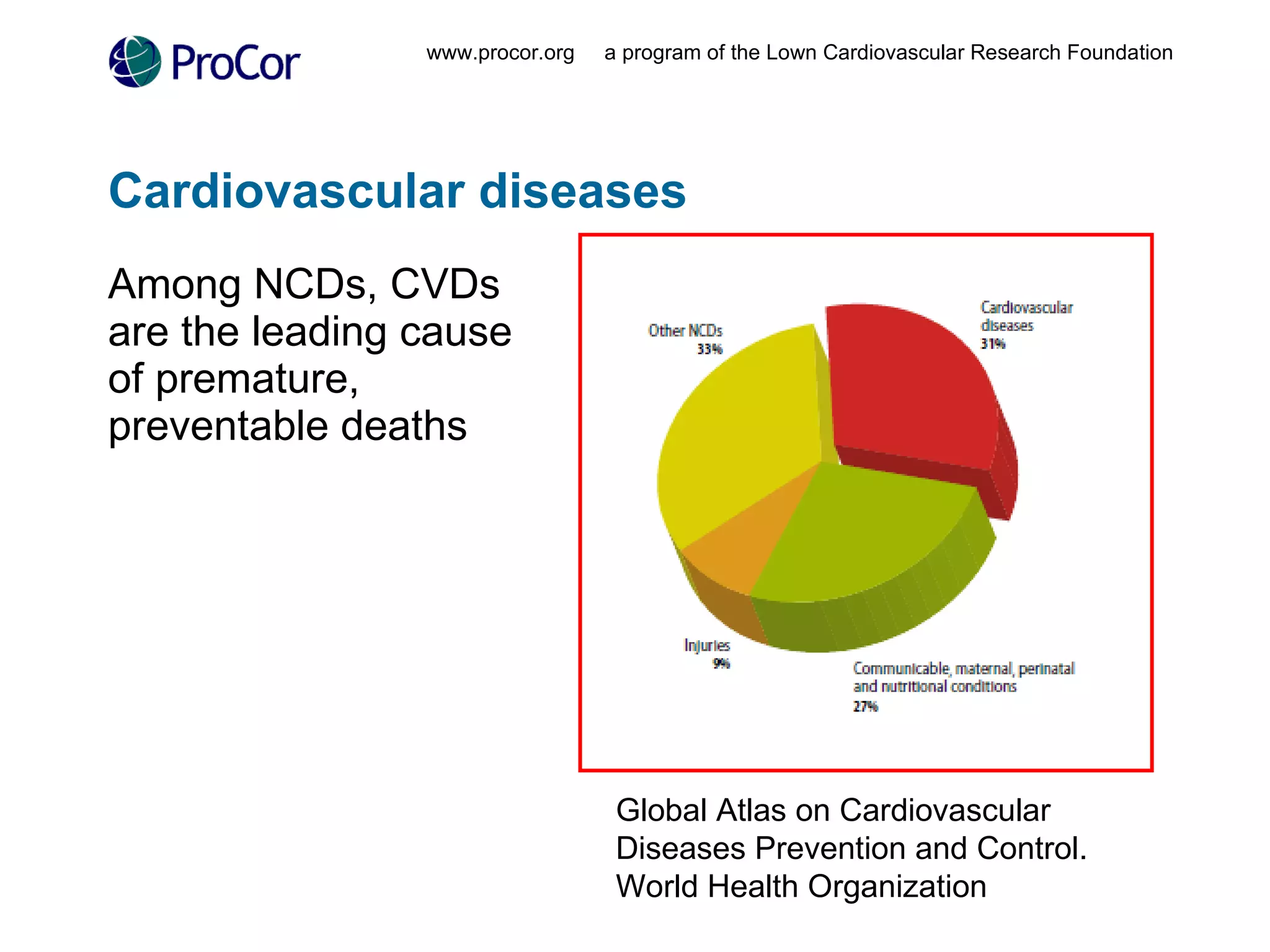
Cardiovascular diseases  Among NCDs, CVDs are the leading cause of premature, preventable deaths www.procor.org  a program of the Lown Cardiovascular Research Foundation Global Atlas on Cardiovascular Diseases Prevention and Control. World Health Organization
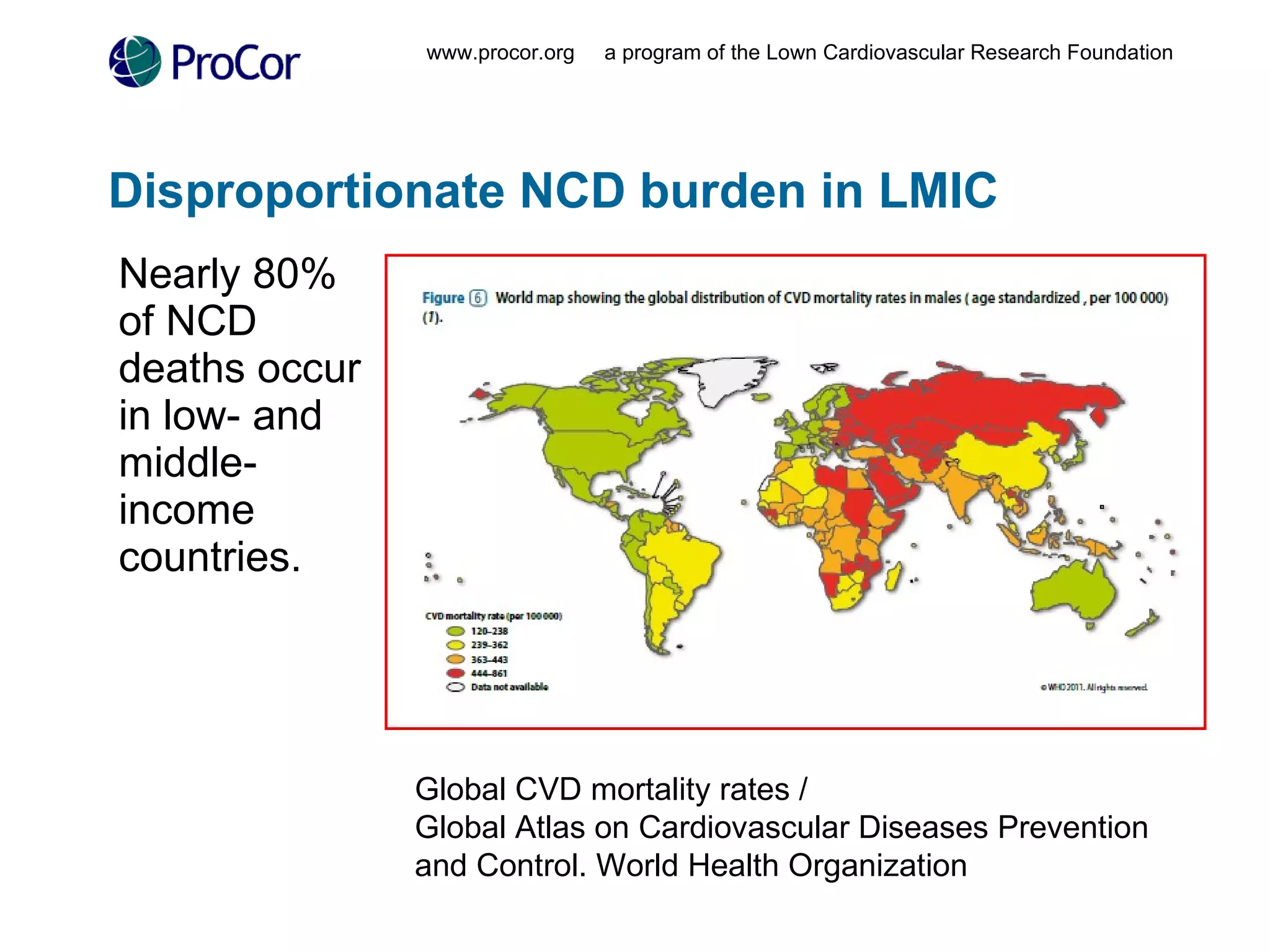
Disproportionate NCD burden in LMIC Nearly 80% of NCD deaths occur in low- and middle-income countries.  www.procor.org  a program of the Lown Cardiovascular Research Foundation Global CVD mortality rates /  Global Atlas on Cardiovascular Diseases Prevention and Control. World Health Organization
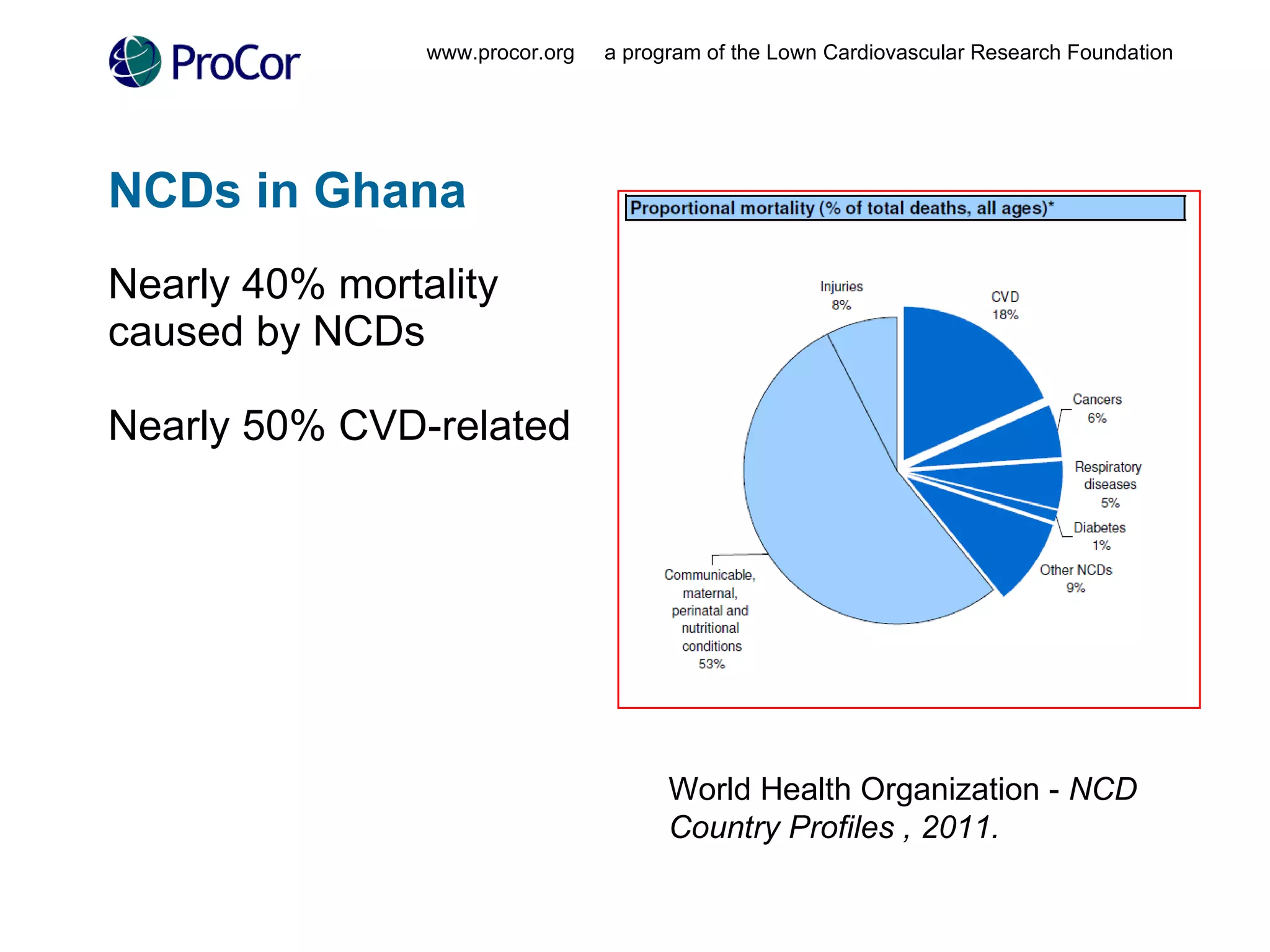
NCDs in Ghana Nearly 40% mortality caused by NCDs Nearly 50% CVD-related www.procor.org  a program of the Lown Cardiovascular Research Foundation World Health Organization -  NCD Country Profiles , 2011.
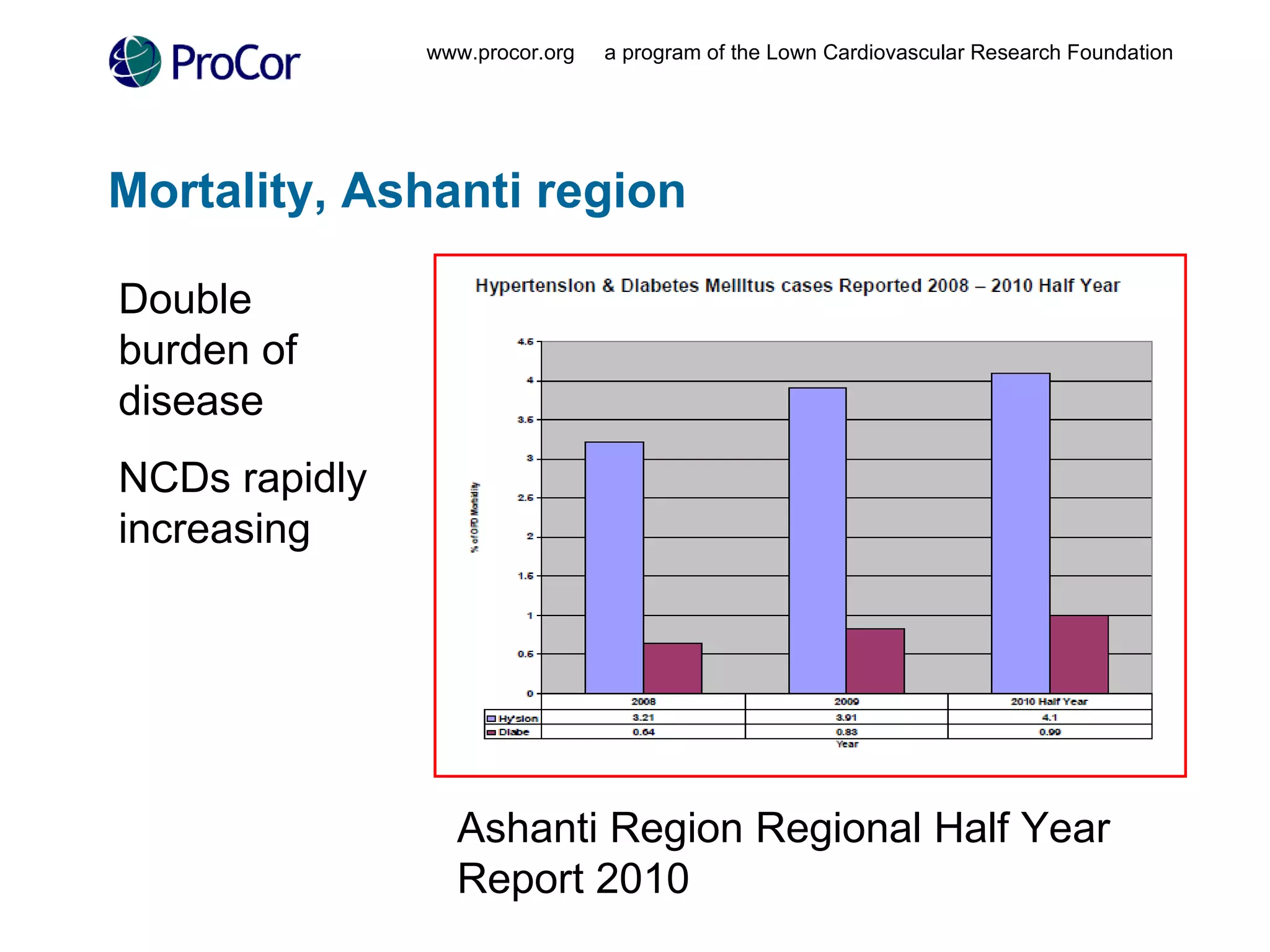
Mortality, Ashanti region www.procor.org  a program of the Lown Cardiovascular Research Foundation Ashanti Region Regional Half Year Report 2010  Double burden of disease  NCDs rapidly increasing
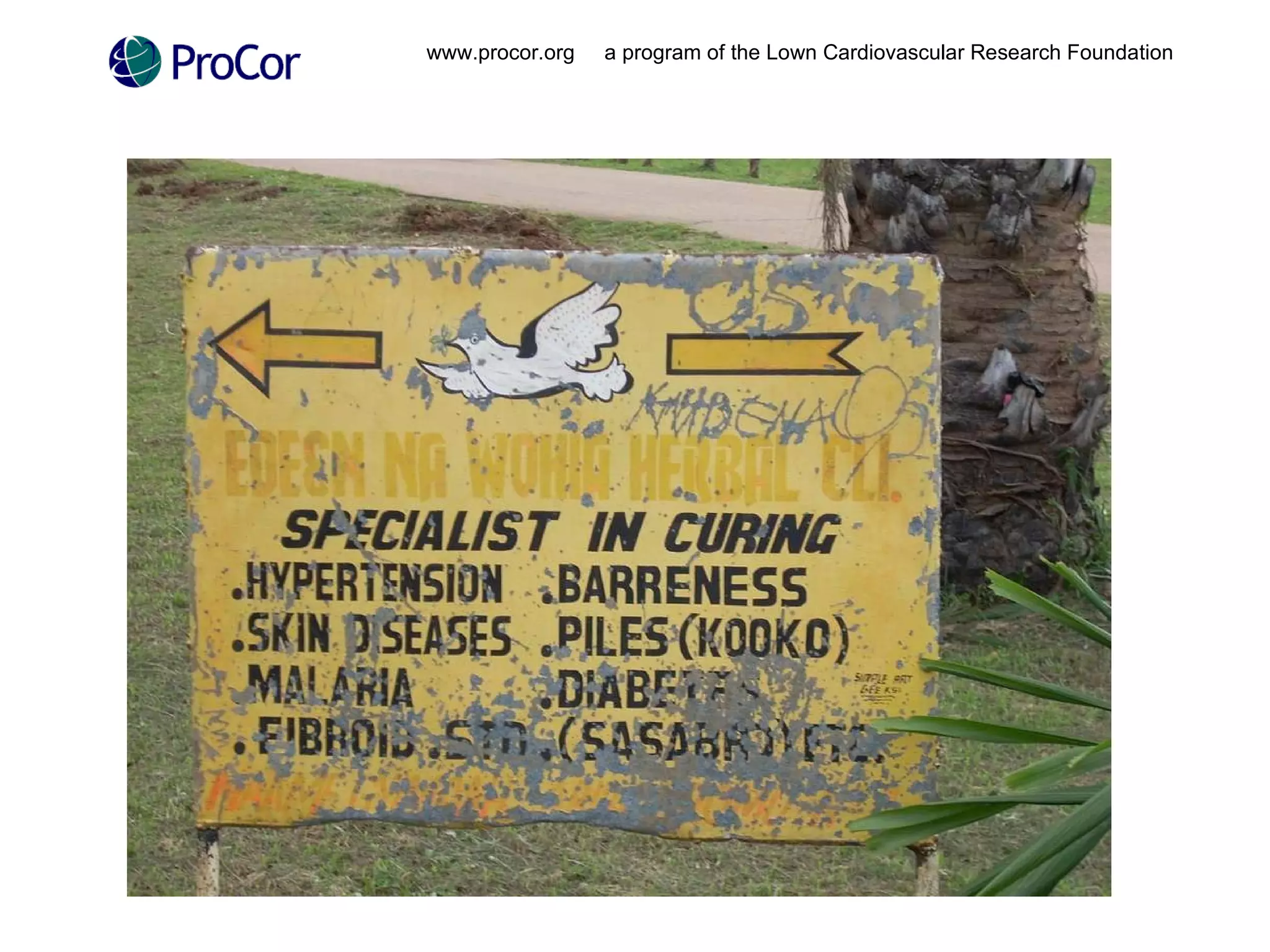
www.procor.org  a program of the Lown Cardiovascular Research Foundation
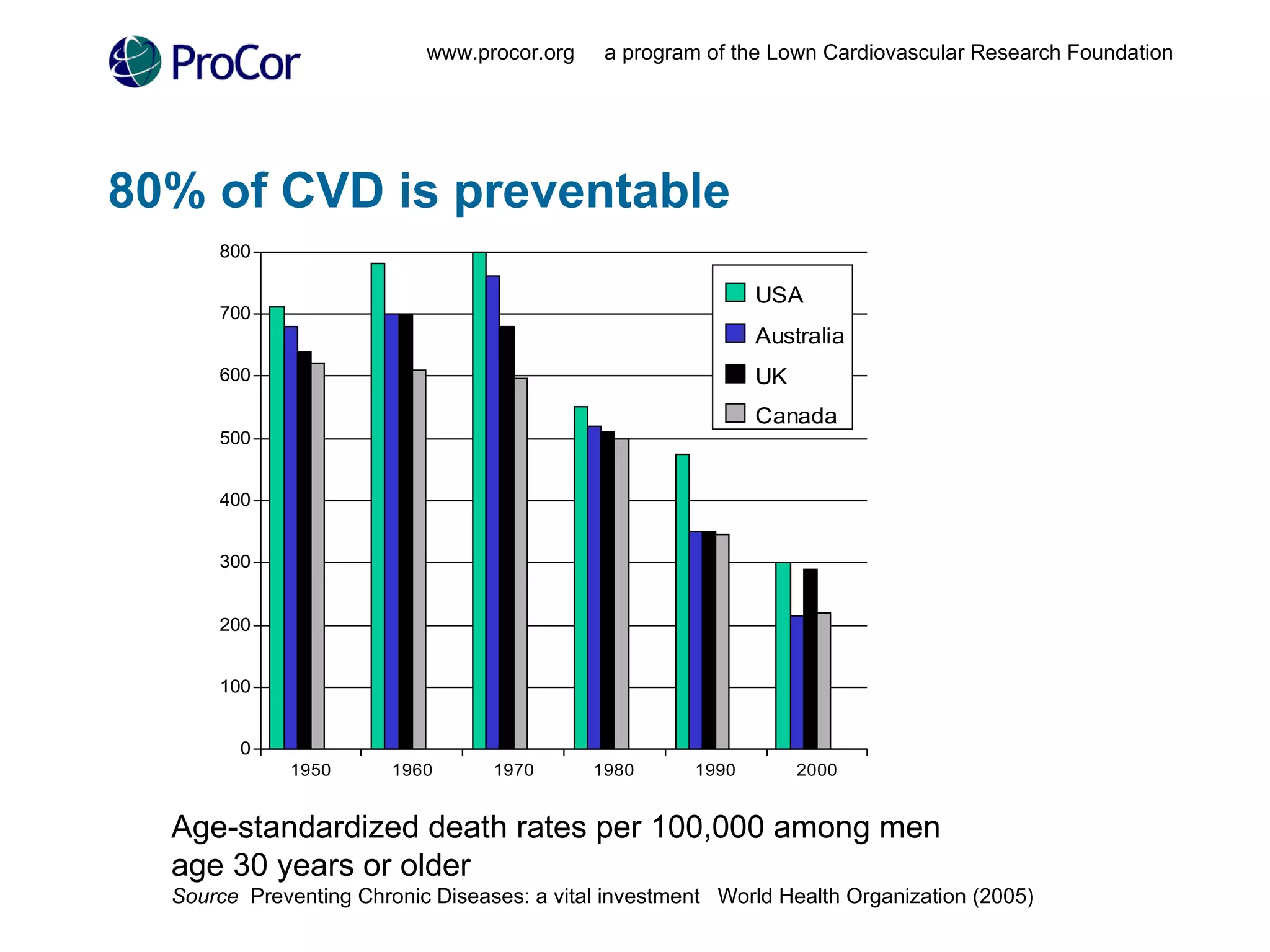
80% of CVD is preventable www.procor.org  a program of the Lown Cardiovascular Research Foundation Age-standardized death rates per 100,000 among men  age 30 years or older Source   Preventing Chronic Diseases: a vital investment  World Health Organization (2005)
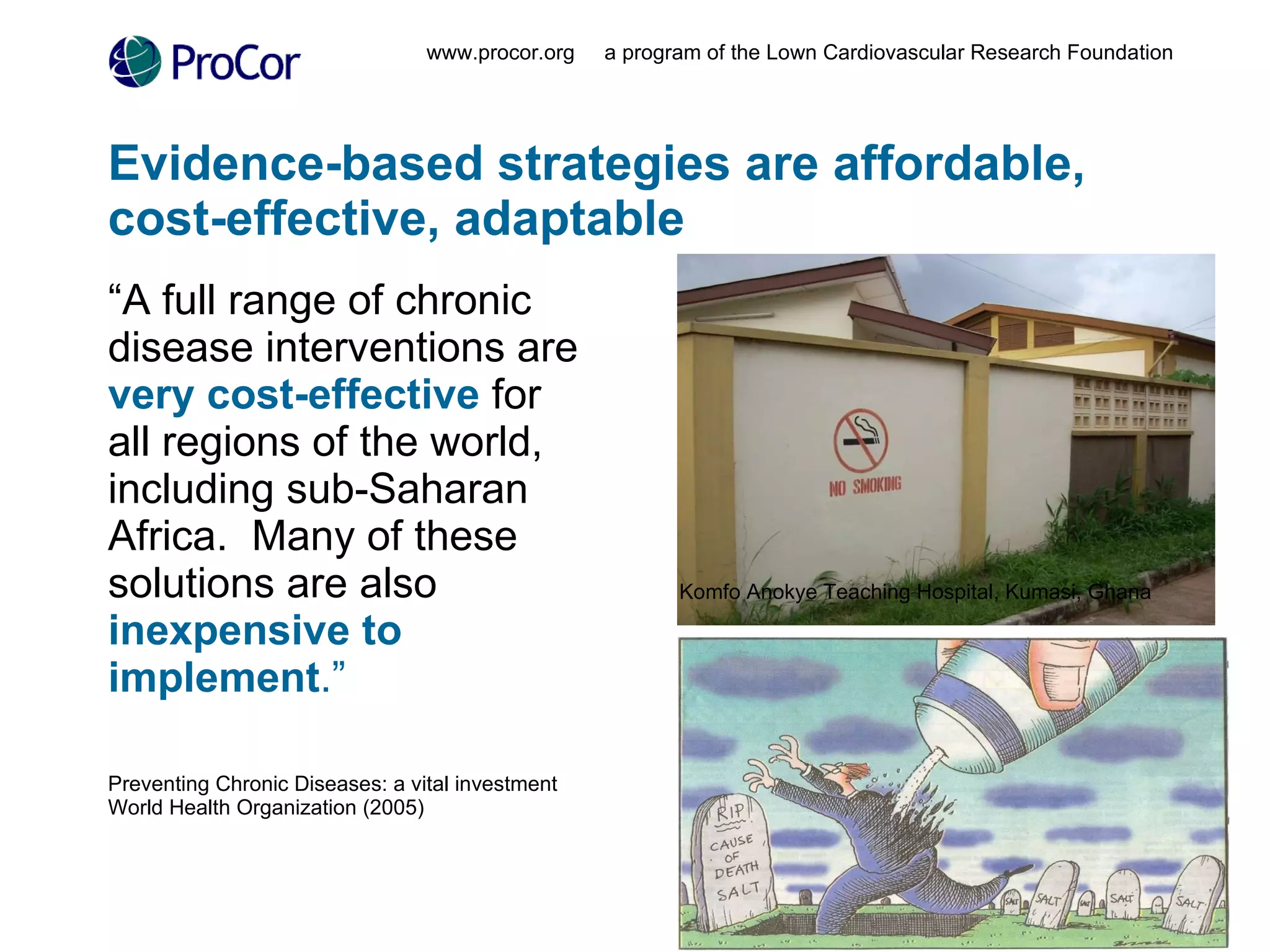
Evidence-based strategies are affordable, cost-effective, adaptable “ A full range of chronic disease interventions are  very cost-effective  for all regions of the world, including sub-Saharan Africa.  Many of these solutions are also  inexpensive to implement .”   Preventing Chronic Diseases: a vital investment  World Health Organization (2005) www.procor.org  a program of the Lown Cardiovascular Research Foundation Komfo Anokye Teaching Hospital, Kumasi, Ghana
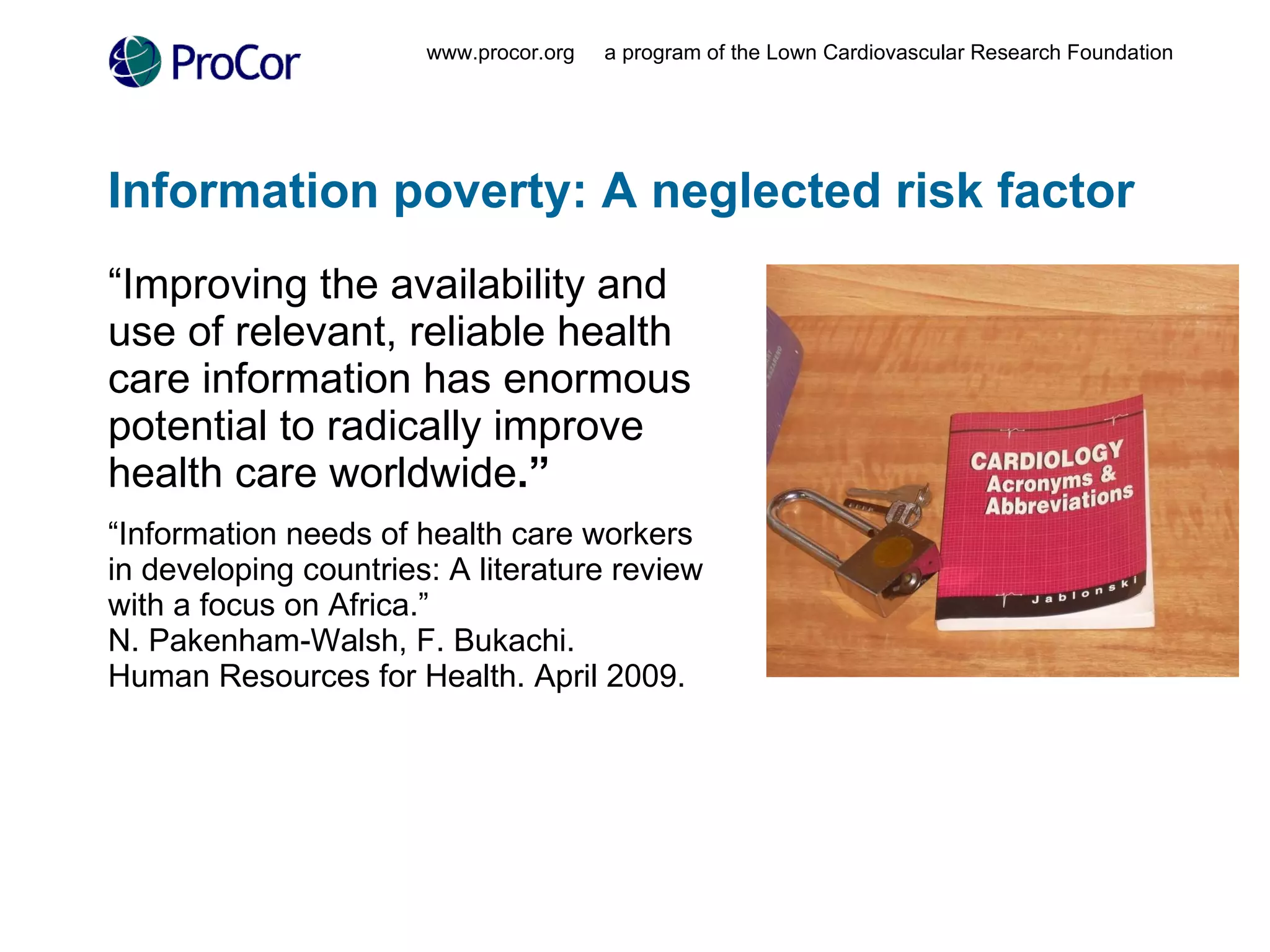
Information poverty: A neglected risk factor “ Improving the availability and use of relevant, reliable health care information has enormous potential to radically improve health care worldwide .” “ Information needs of health care workers in developing countries: A literature review with a focus on Africa.” N. Pakenham-Walsh, F. Bukachi.  Human Resources for Health. April 2009. www.procor.org  a program of the Lown Cardiovascular Research Foundation
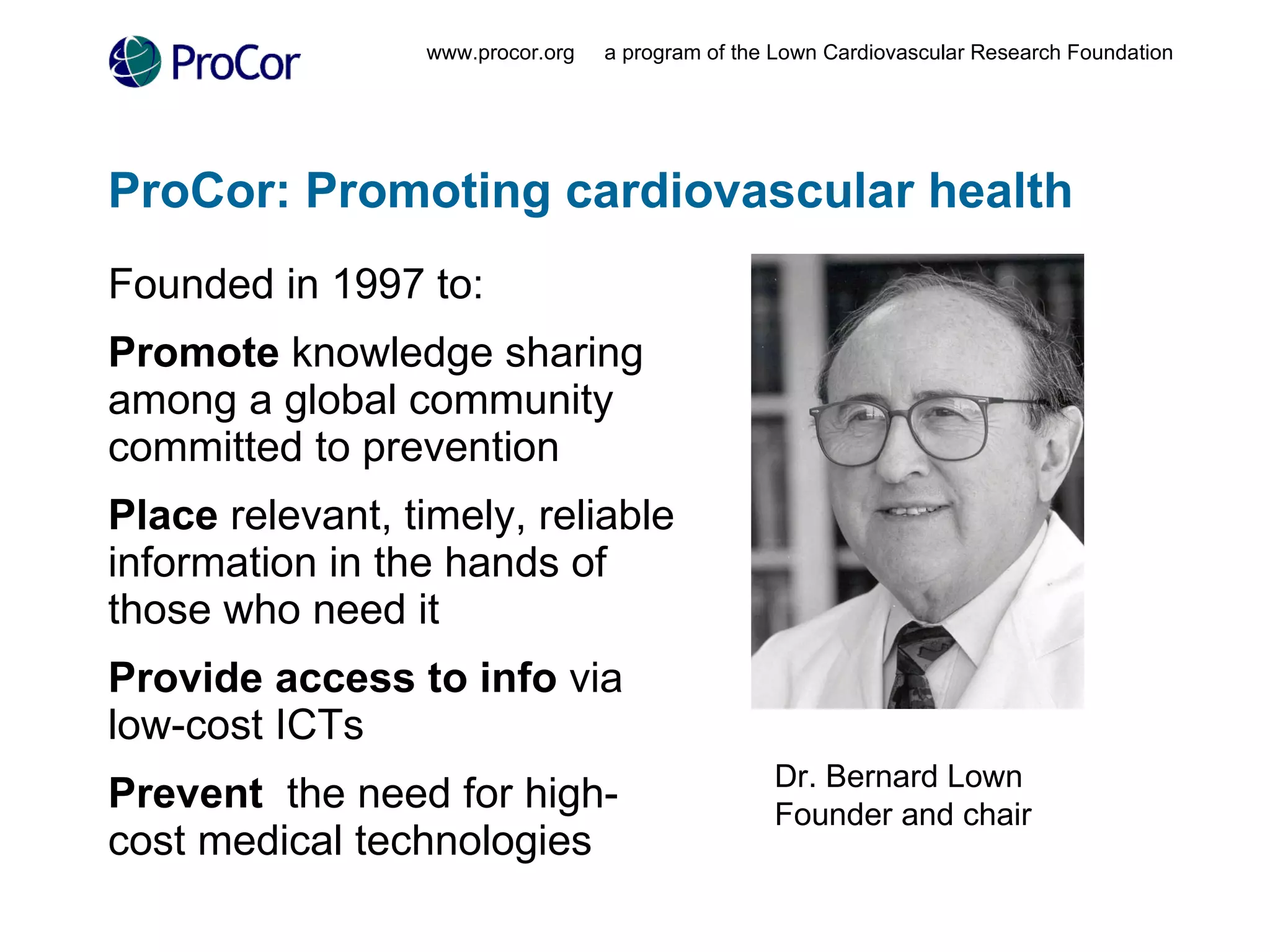
ProCor: Promoting cardiovascular health Founded in 1997 to: Promote  knowledge sharing among a global community committed to prevention Place  relevant, timely, reliable information in the hands of those who need it Provide access to info  via  low-cost ICTs Prevent   the need for high-cost medical technologies www.procor.org  a program of the Lown Cardiovascular Research Foundation Dr. Bernard Lown Founder and chair
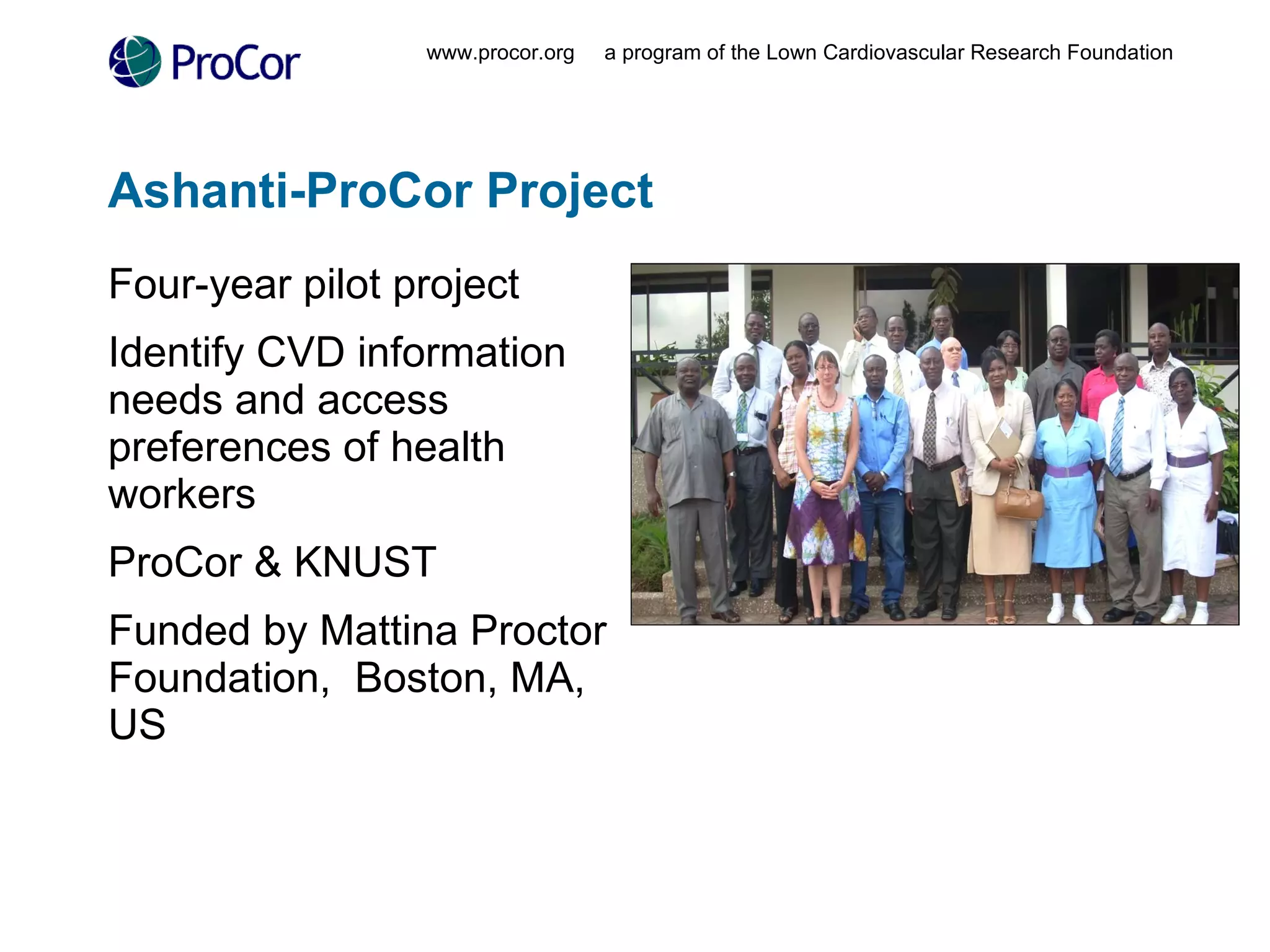
Ashanti-ProCor Project Four-year pilot project Identify CVD information needs and access preferences of health workers ProCor & KNUST Funded by Mattina Proctor Foundation,  Boston, MA, US www.procor.org  a program of the Lown Cardiovascular Research Foundation
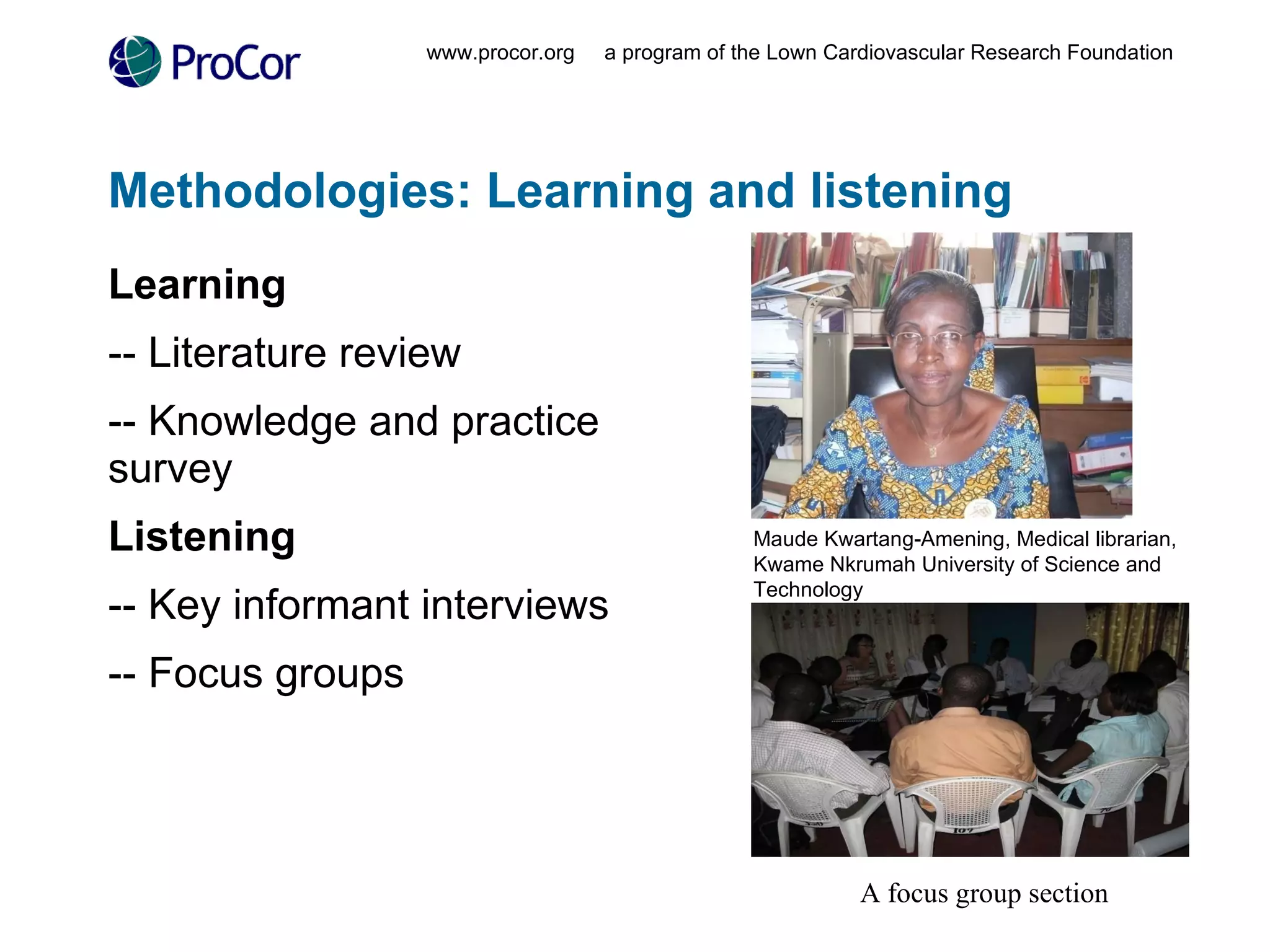
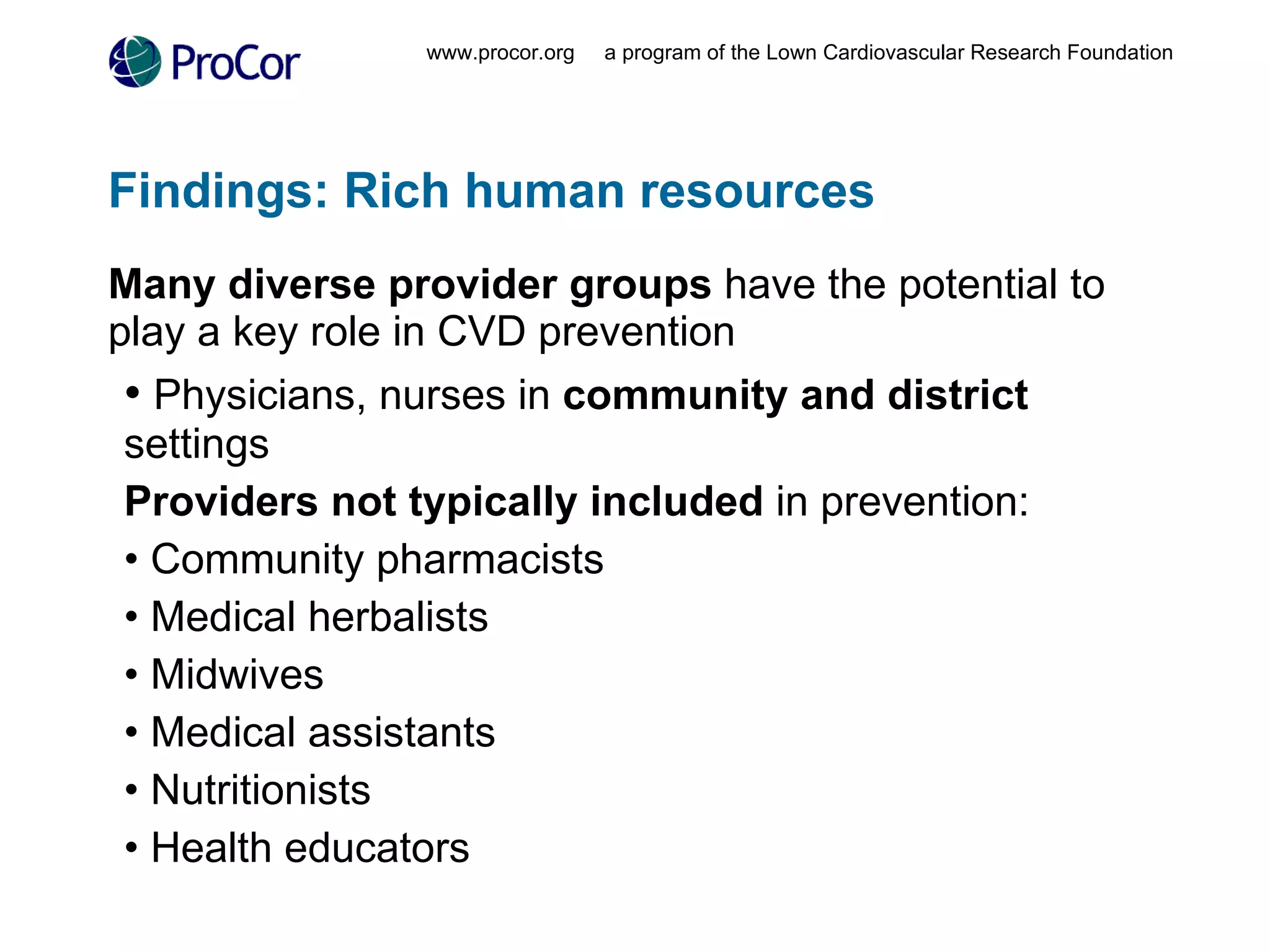
Methodologies: Learning and listening Learning -- Literature review -- Knowledge and practice survey Listening -- Key informant interviews -- Focus groups www.procor.org  a program of the Lown Cardiovascular Research Foundation Maude Kwartang-Amening, Medical librarian,  Kwame Nkrumah University of Science and Technology A focus group section
Findings: Rich human resources Many diverse provider groups  have the potential to play a key role in CVD prevention Physicians, nurses in  community and district  settings Providers not typically included  in prevention: Community pharmacists Medical herbalists Midwives Medical assistants Nutritionists Health educators www.procor.org  a program of the Lown Cardiovascular Research Foundation
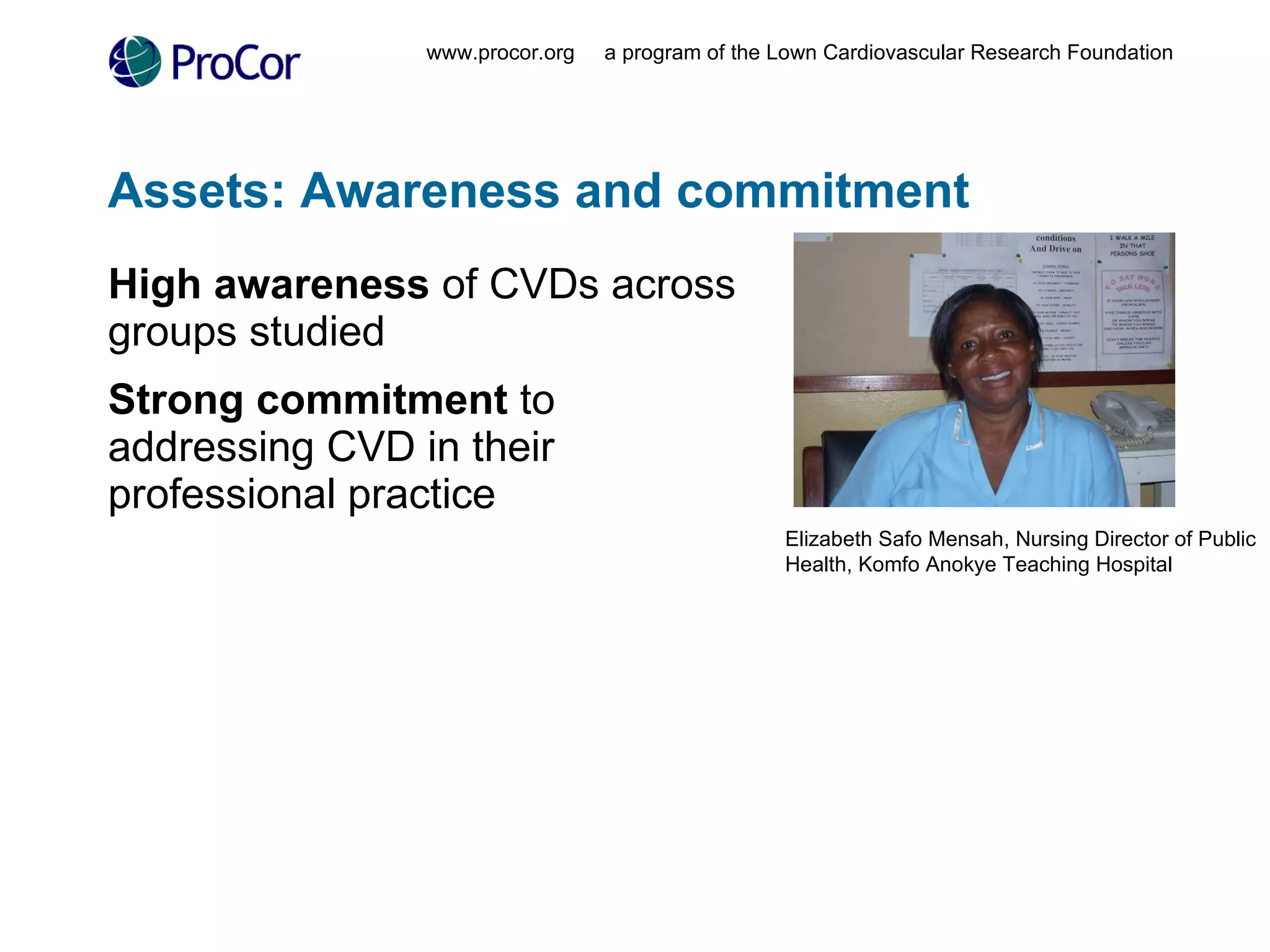
Assets: Awareness and commitment High awareness  of CVDs across groups studied Strong commitment  to addressing CVD in their professional practice www.procor.org  a program of the Lown Cardiovascular Research Foundation Elizabeth Safo Mensah, Nursing Director of Public Health, Komfo Anokye Teaching Hospital
Leapfrogging technologies  Laptops (often stand-alone) USB drives Mobile phones Wireless access Internet cafes Mobile Broadband (MBB) www.procor.org  a program of the Lown Cardiovascular Research Foundation
Barriers: Available resources  Hard copies (textbooks, journals) Frequently out of date Cumbersome to access Online Most frequently accessed: Google, Wikipedia  Low awareness of open-access journals www.procor.org  a program of the Lown Cardiovascular Research Foundation
Online barriers: Cost, time, connectivity Cost Service provider contracts Slow download speed > internet café charges Subscriptions, cost/article Credit card issues  Unreliable connectivity Time constraints www.procor.org  a program of the Lown Cardiovascular Research Foundation
“ Most of the faculty are research oriented and they want up-to-date information. We used to depend so much on journals but now we can’t afford the subscription. So we depend on the internet. But it can be frustrating when you get to the net and all you can get is an abstract. Then even if you have the money to pay, you don’t have a credit card.” Librarian www.procor.org  a program of the Lown Cardiovascular Research Foundation
Preferences Email Download options PDFs (easy storing) HTML (fast download) Interpersonal knowledge sharing Colleagues, faculty Social networks Locally/regionally relevant data, protocols, programs www.procor.org  a program of the Lown Cardiovascular Research Foundation
Role of open access No associated costs for accessing or publishing Email alerts Download options PDF HTML Current Peer reviewed www.procor.org  a program of the Lown Cardiovascular Research Foundation
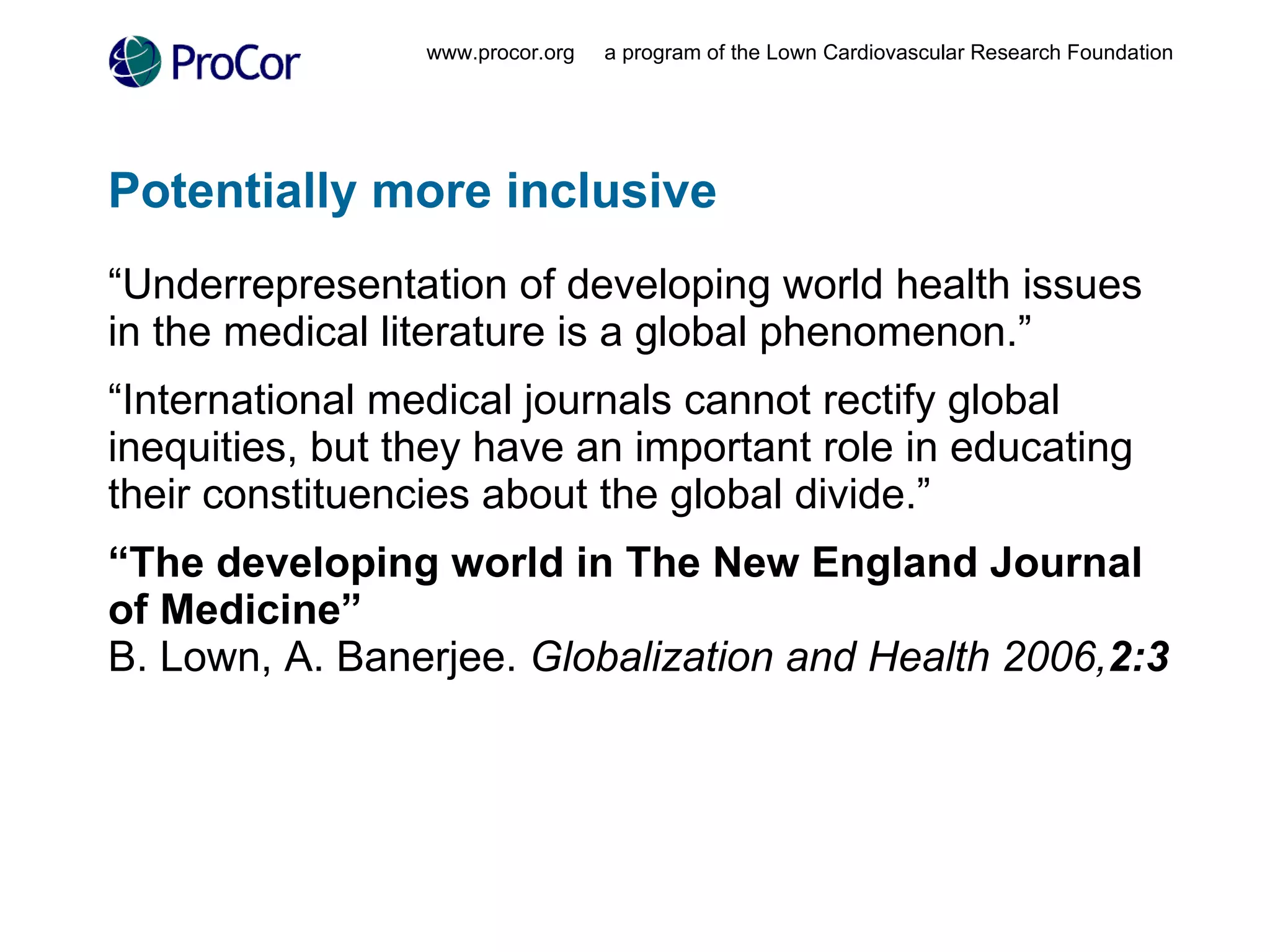
Potentially more inclusive “ Underrepresentation of developing world health issues in the medical literature is a global phenomenon.” “ International medical journals cannot rectify global inequities, but they have an important role in educating their constituencies about the global divide.” “ The developing world in The New England Journal of Medicine” B. Lown, A. Banerjee.  Globalization and Health 2006, 2:3 www.procor.org  a program of the Lown Cardiovascular Research Foundation
Future directions Respond to identified need for local/regionally relevant research Maximize access via mobile formats, local knowledge-sharing networks www.procor.org  a program of the Lown Cardiovascular Research Foundation
Thank you for your attention www.procor.org  a program of the Lown Cardiovascular Research Foundation
Support prevention.  Share knowledge.  Subscribe to ProCor. www.procor.org  [email_address] Benn Grover Editor, ProCor Lown Cardiovascular Research  Foundation 21 Longwood Avenue Brookline, MA 02446 www.procor.org [email_address] www.procor.org  a program of the Lown Cardiovascular Research Foundation

Open-access publishing and noncommunicable disease prevention

  • 1.
    Open access publishing& noncommunicable disease prevention in developing countries www.procor.org a program of the Lown Cardiovascular Research Foundation Collins Kokuro Associate Director, Ashanti-ProCor Project Specialist Physician, Komfo Anokye Teaching Hospital (KATH), Kumasi, Ghana
  • 2.
    Outline NonCommunicable Disease burden Global and local Information poverty in LMIC ProCor Ashanti ProCor project and its findings Recommendations. www.procor.org a program of the Lown Cardiovascular Research Foundation
  • 3.
    Noncommunicable disease: Anew health threat Leading cause (60%) of death globally www.procor.org a program of the Lown Cardiovascular Research Foundation The Global Economic Burden of Non-communicable Diseases. World Economic Forum
  • 4.
    Cardiovascular diseases Among NCDs, CVDs are the leading cause of premature, preventable deaths www.procor.org a program of the Lown Cardiovascular Research Foundation Global Atlas on Cardiovascular Diseases Prevention and Control. World Health Organization
  • 5.
    Disproportionate NCD burdenin LMIC Nearly 80% of NCD deaths occur in low- and middle-income countries. www.procor.org a program of the Lown Cardiovascular Research Foundation Global CVD mortality rates / Global Atlas on Cardiovascular Diseases Prevention and Control. World Health Organization
  • 6.
    NCDs in GhanaNearly 40% mortality caused by NCDs Nearly 50% CVD-related www.procor.org a program of the Lown Cardiovascular Research Foundation World Health Organization - NCD Country Profiles , 2011.
  • 7.
    Mortality, Ashanti regionwww.procor.org a program of the Lown Cardiovascular Research Foundation Ashanti Region Regional Half Year Report 2010 Double burden of disease NCDs rapidly increasing
  • 8.
    www.procor.org aprogram of the Lown Cardiovascular Research Foundation
  • 9.
    80% of CVDis preventable www.procor.org a program of the Lown Cardiovascular Research Foundation Age-standardized death rates per 100,000 among men age 30 years or older Source Preventing Chronic Diseases: a vital investment World Health Organization (2005)
  • 10.
    Evidence-based strategies areaffordable, cost-effective, adaptable “ A full range of chronic disease interventions are very cost-effective for all regions of the world, including sub-Saharan Africa. Many of these solutions are also inexpensive to implement .” Preventing Chronic Diseases: a vital investment World Health Organization (2005) www.procor.org a program of the Lown Cardiovascular Research Foundation Komfo Anokye Teaching Hospital, Kumasi, Ghana
  • 11.
    Information poverty: Aneglected risk factor “ Improving the availability and use of relevant, reliable health care information has enormous potential to radically improve health care worldwide .” “ Information needs of health care workers in developing countries: A literature review with a focus on Africa.” N. Pakenham-Walsh, F. Bukachi. Human Resources for Health. April 2009. www.procor.org a program of the Lown Cardiovascular Research Foundation
  • 12.
    ProCor: Promoting cardiovascularhealth Founded in 1997 to: Promote knowledge sharing among a global community committed to prevention Place relevant, timely, reliable information in the hands of those who need it Provide access to info via low-cost ICTs Prevent the need for high-cost medical technologies www.procor.org a program of the Lown Cardiovascular Research Foundation Dr. Bernard Lown Founder and chair
  • 13.
    Ashanti-ProCor Project Four-yearpilot project Identify CVD information needs and access preferences of health workers ProCor & KNUST Funded by Mattina Proctor Foundation, Boston, MA, US www.procor.org a program of the Lown Cardiovascular Research Foundation
  • 14.
    Methodologies: Learning andlistening Learning -- Literature review -- Knowledge and practice survey Listening -- Key informant interviews -- Focus groups www.procor.org a program of the Lown Cardiovascular Research Foundation Maude Kwartang-Amening, Medical librarian, Kwame Nkrumah University of Science and Technology A focus group section
  • 15.
    Findings: Rich humanresources Many diverse provider groups have the potential to play a key role in CVD prevention Physicians, nurses in community and district settings Providers not typically included in prevention: Community pharmacists Medical herbalists Midwives Medical assistants Nutritionists Health educators www.procor.org a program of the Lown Cardiovascular Research Foundation
  • 16.
    Assets: Awareness andcommitment High awareness of CVDs across groups studied Strong commitment to addressing CVD in their professional practice www.procor.org a program of the Lown Cardiovascular Research Foundation Elizabeth Safo Mensah, Nursing Director of Public Health, Komfo Anokye Teaching Hospital
  • 17.
    Leapfrogging technologies Laptops (often stand-alone) USB drives Mobile phones Wireless access Internet cafes Mobile Broadband (MBB) www.procor.org a program of the Lown Cardiovascular Research Foundation
  • 18.
    Barriers: Available resources Hard copies (textbooks, journals) Frequently out of date Cumbersome to access Online Most frequently accessed: Google, Wikipedia Low awareness of open-access journals www.procor.org a program of the Lown Cardiovascular Research Foundation
  • 19.
    Online barriers: Cost,time, connectivity Cost Service provider contracts Slow download speed > internet café charges Subscriptions, cost/article Credit card issues Unreliable connectivity Time constraints www.procor.org a program of the Lown Cardiovascular Research Foundation
  • 20.
    “ Most ofthe faculty are research oriented and they want up-to-date information. We used to depend so much on journals but now we can’t afford the subscription. So we depend on the internet. But it can be frustrating when you get to the net and all you can get is an abstract. Then even if you have the money to pay, you don’t have a credit card.” Librarian www.procor.org a program of the Lown Cardiovascular Research Foundation
  • 21.
    Preferences Email Downloadoptions PDFs (easy storing) HTML (fast download) Interpersonal knowledge sharing Colleagues, faculty Social networks Locally/regionally relevant data, protocols, programs www.procor.org a program of the Lown Cardiovascular Research Foundation
  • 22.
    Role of openaccess No associated costs for accessing or publishing Email alerts Download options PDF HTML Current Peer reviewed www.procor.org a program of the Lown Cardiovascular Research Foundation
  • 23.
    Potentially more inclusive“ Underrepresentation of developing world health issues in the medical literature is a global phenomenon.” “ International medical journals cannot rectify global inequities, but they have an important role in educating their constituencies about the global divide.” “ The developing world in The New England Journal of Medicine” B. Lown, A. Banerjee. Globalization and Health 2006, 2:3 www.procor.org a program of the Lown Cardiovascular Research Foundation
  • 24.
    Future directions Respondto identified need for local/regionally relevant research Maximize access via mobile formats, local knowledge-sharing networks www.procor.org a program of the Lown Cardiovascular Research Foundation
  • 25.
    Thank you foryour attention www.procor.org a program of the Lown Cardiovascular Research Foundation
  • 26.
    Support prevention. Share knowledge. Subscribe to ProCor. www.procor.org [email_address] Benn Grover Editor, ProCor Lown Cardiovascular Research Foundation 21 Longwood Avenue Brookline, MA 02446 www.procor.org [email_address] www.procor.org a program of the Lown Cardiovascular Research Foundation

Editor's Notes

  • #11 A major reduction in the burden of NCDs will come from population-wide interventions, which are cost effective and may even be revenue-generating, as is the case with tobacco and alcohol tax increases, for instance.
  • #15 Literature review (1) on information needs of heatlh workers in developing countries, with focus on Africa Knowledge and practice survey of medical students & public health/community health nurses Key informant interviews with stakeholders in medicine, academia, public health, and information services Focus groups with physicians; nurses; students in KNUST’s Colleges of Medicine, Pharmacy, Herbal Medicine; nursing students; information specialists (1) “Information needs of health care workers in developing countries: A literature review with a focus on Africa. N. Pakenham-Walsh, F. Bukachi. Human Resources for Health. April 2009. 20 focus groups Published in open access journal
  • #18 20 focus groups Published in open access journal
  • #24 The developing world in The New England Journal of Medicine Lown B, Banerjee A Globalization and Health 2006, 2 :3 (16 March 2006) [ Abstract ] [ Full Text ] [ PDF ] [ PubMed ] [ Related articles ] http://www.globalizationandhealth.com/content/2/1/3 Lancet since 1963 401 Lancet Searching journal content for cardiovascular africa (all words) in full text, from Jan 1963 through Oct 2011. New Search Next 10 Displaying results 1-10 of 812 http://www.thelancet.com/search/results?searchTerm=cardiovascular&fieldName=AllFields&op=and&searchterm2=africa&fieldname2=AllFields&year=&volume=&page=&jrnl=&artypes=&advsrch=t&journalFromWhichSearchStarted=&sort=date&order=desc&collectionName=All%20Lancet%20Journals
  • #25 The developing world in The New England Journal of Medicine Lown B, Banerjee A Globalization and Health 2006, 2 :3 (16 March 2006) [ Abstract ] [ Full Text ] [ PDF ] [ PubMed ] [ Related articles ] http://www.globalizationandhealth.com/content/2/1/3 Lancet since 1963 401 Lancet Searching journal content for cardiovascular africa (all words) in full text, from Jan 1963 through Oct 2011. New Search Next 10 Displaying results 1-10 of 812 http://www.thelancet.com/search/results?searchTerm=cardiovascular&fieldName=AllFields&op=and&searchterm2=africa&fieldname2=AllFields&year=&volume=&page=&jrnl=&artypes=&advsrch=t&journalFromWhichSearchStarted=&sort=date&order=desc&collectionName=All%20Lancet%20Journals