futureagenda.org
What do you think? Join In | Add your views into the mix
Work
Health
Learning
1
Dr. Devi Shetty - Founder of Narayana Hrudayalaya Hospitals and Narayana Health.
The Future of Health
The healthcare and wellness industry is
going to drive the world economy of the
21st century. Globally healthcare is already
well over a $6 trillion industry. But, despite
its size, it only addresses about 30 per cent
of the world population; nearly 70 per cent
is nowhere near receiving decent healthcare
services. We need a revolution in order to
service the entire market.
The major issue is primarily revolving
healthcare. The world’s first heart surgery was
done in Oslo in 1895 – well over a century
ago. A hundred and twenty years later only
10% of the world’s population can afford
it. We can and must do better. The future
cannot be just an extension of the past. It
must embrace new technology, implement
innovative approaches and aim higher than
people previously thought possible.
The 21st century will see a rapidly growing
demand for healthcare, but this demand
looks unlikely to be met in the way the
past century was. For one thing, to treat the
21st century’s problems with a 20th century
approach to healthcare would require an
impossible number of doctors. For another,
caring for the chronic diseases that are
growing in prevalence are not what doctors
are best at.
Before we explore the future challenges and
options, we should however recognize that
over recent years we have already achieved
a good deal. Globally, on average, we have
never been so healthy, wealthy and educated.
Although there have been long-term
improvements in health delivery and care, it
is over the past few decades that progress
has really started to build momentum. This
has happened partly because advances in
technology, public health and governance
have all aligned, and partly because there
has been shared understanding of what the
big issues are and how to address them. As
the IMF has highlighted, child death rates
have fallen by more than 30%, with about
three million children’s lives saved each year
compared to 2000. Deaths from malaria have
fallen by one quarter in the same period.
But, as the WHO points out, we still have
major challenges to address:
• The average annual rate of decline of
women dying due to complications during
pregnancy and childbirth is far below target
to reach the Millennium Development Goal
• While HIV infections have declined by 33%
globally, sub-Saharan Africa still accounts
for 70% of all new infections
• Although the global tuberculosis mortality
rate has fallen by 45% since 1990, multi-
drug resistance TB continues to pose
problems with an estimated 450,000 per
year developing it.
Healthcare for All
Globally healthcare is
already well over a $6
trillion industry. But, despite
its size, it only addresses
about 30 per cent of the
world population; nearly 70
per cent is nowhere near
receiving decent healthcare
services. We need a revolution
in order to service the
entire market.
The Global Challenge
nergy
ood
Government
oyalty
rivacy
Resources
Transport
Travel
Water
Wealth
Work
Health
Learning
Options and Possibilities
nergy
ood
Government
oyalty
rivacy
Resources
Transport
Travel
Water
Wealth
Work
Health
Learning
•	In 2012 almost half the world’s population 	
	 were still estimated to be at risk of malaria 	
	 with Africa bearing 80% of new cases and 	
	 90% of associated deaths
•	Moreover, as the current e-bola pandemic 	
	 in West Africa highlights, our ability to 	
	 prevent such disease epidemics is limited, 	
	 primarily due to low levels of public health 	
	 in many key centres of major population.
Increasing access to affordable essential
medicines is vitally important but several
factors undermine availability in many
countries. These include poor medicine
supply and distribution, insufficient health
facilities and staff, low investment in health
and the high cost of many medicines.
Contrasting the world’s most developed
healthcare market with that in India we can
see many significant issues. US healthcare
spend is spiraling upwards above 18% of GDP
while in India, for example, the figure is just
over 4% against a global average of 10%.
Worldwide health spending is expected to
increase by 5% next year. In India, where the
government has now promised to introduce
universal health insurance, spending is
expected to rise by 18%.
While US life expectancy at birth is now
around 80, in India we have just reached 67.
Over the past thirty years, our infant mortality
rates have dropped from 118 to 42 per
100,000 births compared to less than 5 in the
US. In the US the prevailing market means
that a healthy person can expect to spend
$142,000 on out-of-pocket health expenses
in the 20 years after turning 65. If they have
a chronic disease this figure doubles and
if they live until 90, they will need an extra
$75,000. In the US there are 2.5 physicians
per 10,000 population: in India we have 0.7.
2
Barriers to Access
Increasing access to
affordable essential
medicines is vitally important
but several factors undermine
availability in many countries.
These include poor medicine
supply and distribution,
insufficient health facilities
and staff, low investment in
health and the high cost of
many medicines.
Personalised Medicine
With most current medicines
only working for 1 in 10
patients and many $1bn
blockbuster cancer drugs
effective with 25% of
patients, the potential for
bespoke treatments is
significant. However, some
see that, in the short term,
these innovations will be
primarily focused on the
developed world’s more
established healthcare
markets and will take time to
have global impact.
What do you think? Join In | Add your views into the mix
Many in the ‘developed’ world are focused
on the benefits of technology improving the
effectiveness and the efficiency of healthcare.
With many countries expecting to be
spending up to a fifth of GDP on healthcare
by 2050, the need for more effective use of
resources is clear.
Certainly the potential to use information
to drive for more personalised care may
well open up access and raise quality
while controlling costs. Especially in the
pharmaceutical arena, personalized medicine
and the prospect of customized therapies
based on more sophisticated diagnostics
is a major focus for many researchers and
the opportunities for genetically orientated
pharmacogentics are substantial. With most
current medicines only working for 1 in
10 patients and many $1bn blockbuster
cancer drugs effective with 25% of patients,
the potential for bespoke treatments is
significant. However, some see that, in
the short term, these innovations will be
primarily focused on the developed world’s
more established healthcare markets and will
take time to have global impact.
Tele-health, and especially ‘m-health’ has
already shown great promise globally.
Especially in sub-Saharan Africa and India
but also elsewhere in Asia, the opportunity
to use mobile as a platform for both
curative and preventative healthcare
has been attracting much attention from
governments, entrepreneurs and the mobile
networks alike. With real-time monitoring
an increasing norm and the entrance of
major global technology companies such as
Apple and Google into the area of personal
and remote monitoring, the potential is
indeed significant. While the business model
for preventative healthcare is yet to be
fully defined, those such as McKinsey and
the GSMA see this as a means of saving
of $200bn a year just in treating chronic
diseases across the OECD and BRIC countries.
Alongside these significant new platforms
shifts there is also the need to improve
access to effective treatment of fast rising
chronic diseases. According to WHO figures,
Proposed Way Forward
nergy
ood
Government
oyalty
rivacy
Resources
Transport
Travel
Water
Wealth
Work
Health
Learning
3
Impact of mHealth
Especially in sub-Saharan
Africa and India but also
elsewhere in Asia, the
opportunity to use mobile as
a platform for both curative
and preventative healthcare
has been attracting much
attention from governments,
entrepreneurs and the
mobile networks alike. With
real-time monitoring an
increasing norm and the
entrance of major global
technology companies such
as Apple and Google into the
area of personal and remote
monitoring, the potential is
indeed significant.
Chronic Diseases
If we are going to stem
the rising tide of chronic
disease and deal with its
consequences we need a far
more integrated approach to
wellness and healthcare that
works across all societies
and not just a select few. We
need to integrate primary,
secondary and tertiary
prevention and health
promotion across sectors and
different disciplines.
Need for Process Innovation
Today, most healthcare
interventions are not
accessible to nearly 90% of
the world’s population. The
way forward is not a new
medicine or a new scanner
or a new operation - it is a
process innovation to bring
healthcare to everyone.
by 2020 major chronic diseases are expected
to contribute to 73% of all deaths and 60% of
the global disease burden. Moreover, 79% of
the deaths attributed to these diseases will
continue to occur in the developing countries.
Addressing this requires both behavioural
changes across many areas of society
around consumption and exercise as well
as structural change in the way healthcare
and sick-care is provided. If we are going to
stem the rising tide of chronic disease and
deal with its consequences we need a far
more integrated approach to wellness and
healthcare that works across all societies and
not just a select few. We need to integrate
primary, secondary and tertiary prevention
and health promotion across sectors and
different disciplines.
What do you think? Join In | Add your views into the mix
I want to enable every man, woman and
child to have access to high-tech healthcare
within the next 15 to 20 years, including in
the poorest regions of the world. Today, most
healthcare interventions are not accessible
to nearly 90% of the world’s population. The
way forward is not a new medicine or a new
scanner or a new operation - it is a process
innovation to bring healthcare to everyone.
Most countries suffer from a simple
mismatch: the demand for health care is
rising faster than the supply of doctors. One
approach to making doctors more effective is
to focus what they do. This is something that
we in India have been dedicated to.
At Narayana Health our focus has been on
offering as many operations as possible using
the core resource without compromising
on quality. Surgeons do the most complex
procedures and other medical staff do
everything else. In addition, by using the
latest technologies such as tablets in the
ICU instead of patient charts, simulations to
train critical care nurses and telemedicine to
access those patients in remote parts of the
country, a far higher quality of healthcare is
delivered than the global norm.
Alongside our process innovation priority, this
means that surgeries in the organisation’s 18
hospitals across 14 Indian cities typically cost
between $1600 and $2000 each – less than
half that of other Indian hospitals and about
one-fiftieth as much as a similar procedure
in the US: Two per cent of the cost with
outcomes that rival the best in the US.
Equally in other areas of Indian healthcare,
similar efficiencies are also being achieved.
LifeSpring hospitals have reduced the price
of childbirth by augmenting doctors with less
expensive midwives: Their costs are about 20%
of those in a private clinic. In addition,Aravind
Eyecare provides cataract surgery to about
350,000 patients each year for around $50
each: Operating rooms have at least two beds
so that surgeons can quickly move from one
patient to the next and, for every surgeon, there
are six‘eye-care technicians’ specifically trained
by Aravind to perform many of the other tasks
in the operating theatre that, in other countries,
require a surgeons training.
Japanese companies reinvented the process
of making cars. That’s what we are doing
in healthcare: What healthcare needs is
process innovation, not product innovation.
It’s all about numbers. Because we do a large
number of operations, our overheads are
distributed over a larger number of patients.
Equally, because we implant the largest
number of heart valves in the world we get
heart valves at a lesser price.
Looking ahead, I see that the efficiencies
we have achieved through the approaches
that we have taken in India can be applied
globally. With an aging society and escalating
costs, the 20th century model of healthcare
still practiced in many countries today is
unsustainable and we need to shift the
model forward.
In addition, I also see a need to change the
world of health insurance. There has to be
an alternative way of funding healthcare.
Impact and Implications
nergy
ood
Government
oyalty
rivacy
Resources
Transport
Travel
Water
Wealth
Work
Health
Learning
10 years ago we convinced our local
government to launch a health insurance
programme and convinced 1.7m farmers
to contribute 5 INR (8c) per month and the
government became the reinsurer. Today the
premium has risen to 18 INR (US$0.27) per
month. In 10 years, 450,000 famers have had
treatment and 60,000 of them have had a
heart operation all because of the power of
5 rupees per month. Today we are covering
high technology healthcare for nearly 3
million farmers.
Now we are trying to convince policy makers
that micro-health insurance is the best model
for the whole of society. In India we have 850
mobile phone subscribers who are spending
150 rupees per month just to speak on the
phone. So if we can collect 20 rupees from
each mobile phone subscriber, we can cover
the healthcare of another 850 million people.
The Indian government will soon become
a health insurance provider. Not only a
healthcare provider.
4
What do you think? Join In | Add your views into the mixWhat do you think? Join In | Add your views into the mix
Healthcare is a unique industry that creates
millions of jobs for millions of households, both
skilled and unskilled. Unlike manufacturing,
healthcare is not dependent on any finite
components. It is dependent mostly on
human skill.And human skill is replenishable.
We can technically reduce the price of any
service to any level we want: Surgeons are
like technicians - the more surgeries they
perform, the better they get at it. But behind
every skilled doctor you need to have at least
two highly skilled nurses, at least four or five
technicians, and good administrators.
By 2022 India needs to have 200,000
specialists, 450,000 doctors and over 1.2m
nurses. If every country has an adequate
number of surgeons, radiologists, anesthetists
and cardiac surgeons, believe me, costs will
come down by more than 50%. It is a question
of demand and supply.
In global forums everyone talks about
reducing the cost of healthcare. But no
one knows how much they are spending
today.At Narayana Health we have invested
in technology. Every day at noon I get an
SMS on my cell phone with yesterday’s
revenue, expenses and EBIDTA (earnings
before interest, depreciation, taxation and
amortization) margin. For us looking at a profit
and loss account at the end of the month is
like reading a post-mortem report.You cannot
do anything about it. Whereas, if you monitor
it on a daily basis, it works as a diagnostic tool.
You can take remedial measures.
The principles that we have developed and
refined in India can certainly be applied
elsewhere.We have developed what some see
as a ‘frugal’ innovation approach to several
healthcare challenges and hence have proven
design solutions for low-income populations.
These solutions can also be applied to
higher income economies with even greater
efficiency benefits.
As an example of how the Indian approach
can provide more efficient high quality
healthcare, you can look at Health City in
the Cayman Islands that we opened in 2014.
Health City is not only a lower cost alternative
for patients needing heart, cancer and eye
surgery in North and South America, it will
make clear how over priced and inefficient
hospitals in the US really are. Health City in
the Cayman Islands will show that lower costs
and better outcomes can be done outside
India just as well as in Bangalore. In the US it
currently costs approximately $1.25 million
per bed to build a hospital. Health City is
costing only $250,000 per bed. Furthermore,
in the Cayman facility prices are less than half
the average US costs for surgical procedures
with quality outcomes matching the very best.
Global healthcare affordability will not come
from the Unites States or any of the current
world leaders, but rather from those nations
of the world that have little today and have
no choice but to perform at the highest levels
possible in the future.
High Quality Support
Surgeons are like technicians
- the more surgeries they
perform, the better they
get at it. But behind every
skilled doctor you need to
have at least two highly
skilled nurses, at least four
or five technicians, and good
administrators.
Wider Impact of Frugal
Innovation
The principles that we
have developed and refined
in India can certainly be
applied elsewhere. We have
developed what some see as
a ‘frugal’ innovation approach
to several healthcare
challenges and hence have
proven design solutions for
low-income populations.
These solutions can also be
applied to higher income
economies with even greater
efficiency benefits.
Sources of Global Solutions
Global healthcare
affordability will not come
from the Unites States or any
of the current world leaders,
but rather from those nations
of the world that have little
today and have no choice
but to perform at the highest
levels possible in the future.
Micro-health Insurance -
The Best Model for Society
In India we have 850 mobile
phone subscribers who are
spending 150 rupees per
month just to speak on the
phone. So if we can collect
20 rupees from each mobile
phone subscriber, we can
cover the healthcare of
another 850 million people.
Founder of Narayana Hrudayalaya Hospitals
and Narayana Health.
Lead expert on the Future of Health.
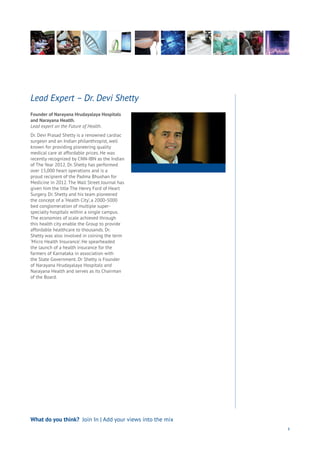
Dr. Devi Prasad Shetty is a renowned cardiac
surgeon and an Indian philanthropist, well
known for providing pioneering quality
medical care at affordable prices. He was
recently recognized by CNN-IBN as the Indian
of The Year 2012. Dr. Shetty has performed
over 15,000 heart operations and is a
proud recipient of the Padma Bhushan for
Medicine in 2012. The Wall Street Journal has
given him the title The Henry Ford of Heart
Surgery. Dr. Shetty and his team pioneered
the concept of a ‘Health City’, a 2000-5000
bed conglomeration of multiple super-
specialty hospitals within a single campus.
The economies of scale achieved through
this health city enable the Group to provide
affordable healthcare to thousands. Dr.
Shetty was also involved in coining the term
‘Micro Health Insurance’. He spearheaded
the launch of a health insurance for the
farmers of Karnataka in association with
the State Government. Dr Shetty is Founder
of Narayana Hrudayalaya Hospitals and
Narayana Health and serves as its Chairman
of the Board.
Lead Expert – Dr. Devi Shetty
53
What do you think? Join In | Add your views into the mix
In an increasingly interconnected, complex
and uncertain world, many organisations
are looking for a better understanding
of how the future may unfold. To do this
successfully, many companies, institutions
and governments are working to improve
their use of strategic foresight in order to
anticipate emerging issues and prepare for
new opportunities.
Experience shows that change often occurs
at the intersection of different disciplines,
industries or challenges. This means that
views of the future that focus on one sector
alone have limited relevance in today’s world.
In order to have real value, foresight needs
to bring together multiple informed and
credible views of emerging change to form
a coherent picture of the world ahead. The
Future Agenda programme aims to do this
by providing a global platform for collective
thought and innovation discussions.
Get Involved
To discuss the future agenda programme and
potential participation please contact:
Dr.Tim Jones
Programme Director
Future Agenda
84 Brook Street, London. W1K 5EH
+44 203 0088 141 +44 780 1755 054
tim.jones@futureagenda.org
@futureagenda
The Future Agenda is the world’s largest open
foresight initiative. It was created in 2009 to
bring together views on the future from many
leading organizations. Building on expert
perspectives that addressed everything from
the future of health to the future of money,
over 1500 organizations debated the big
issues and emerging challenges for the next
decade. Sponsored globally by Vodafone
Group, this groundbreaking programme
looked out ten years to the world in 2020
and connected CEOs and mayors with
academics and students across 25 countries.
Additional online interaction connected over
50,000 people from more than 145 countries
who added their views to the mix. All output
from these discussions was shared via the
futureagenda.org website.
The success of the first Future Agenda
Programme stimulated several organizations
to ask that it should be repeated. Therefore
this second programme is running
throughout 2015 looking at key changes
in the world by 2025. Following a similar
approach to the first project, Future Agenda
2.0 builds on the initial success and adds
extra features, such as providing more
workshops in more countries to gain an
even wider input and enable regional
differences to be explored. There is also
a specific focus on the next generation
including collaborating with educational
organizations to engage future leaders. There
is a more refined use of social networks
to share insights and earlier link-ups with
global media organizations to ensure wider
engagement on the pivotal topics. In addition,
rather than having a single global sponsor,
this time multiple hosts are owning specific
topics wither globally or in their regions of
interest. Run as a not for profit project, Future
Agenda 2.0 is a major collaboration involving
many leading, forward-thinking organisations
around the world.
Context – Why Foresight?
6
What do you think? Join In | Add your views into the mix www.futureagenda.org
About Future Agenda
Future Agenda 1.0 Future Agenda 2.0

Future of health - An initial perspective - Devi Shetty

  • 1.
    futureagenda.org What do youthink? Join In | Add your views into the mix Work Health Learning 1 Dr. Devi Shetty - Founder of Narayana Hrudayalaya Hospitals and Narayana Health. The Future of Health The healthcare and wellness industry is going to drive the world economy of the 21st century. Globally healthcare is already well over a $6 trillion industry. But, despite its size, it only addresses about 30 per cent of the world population; nearly 70 per cent is nowhere near receiving decent healthcare services. We need a revolution in order to service the entire market. The major issue is primarily revolving healthcare. The world’s first heart surgery was done in Oslo in 1895 – well over a century ago. A hundred and twenty years later only 10% of the world’s population can afford it. We can and must do better. The future cannot be just an extension of the past. It must embrace new technology, implement innovative approaches and aim higher than people previously thought possible. The 21st century will see a rapidly growing demand for healthcare, but this demand looks unlikely to be met in the way the past century was. For one thing, to treat the 21st century’s problems with a 20th century approach to healthcare would require an impossible number of doctors. For another, caring for the chronic diseases that are growing in prevalence are not what doctors are best at. Before we explore the future challenges and options, we should however recognize that over recent years we have already achieved a good deal. Globally, on average, we have never been so healthy, wealthy and educated. Although there have been long-term improvements in health delivery and care, it is over the past few decades that progress has really started to build momentum. This has happened partly because advances in technology, public health and governance have all aligned, and partly because there has been shared understanding of what the big issues are and how to address them. As the IMF has highlighted, child death rates have fallen by more than 30%, with about three million children’s lives saved each year compared to 2000. Deaths from malaria have fallen by one quarter in the same period. But, as the WHO points out, we still have major challenges to address: • The average annual rate of decline of women dying due to complications during pregnancy and childbirth is far below target to reach the Millennium Development Goal • While HIV infections have declined by 33% globally, sub-Saharan Africa still accounts for 70% of all new infections • Although the global tuberculosis mortality rate has fallen by 45% since 1990, multi- drug resistance TB continues to pose problems with an estimated 450,000 per year developing it. Healthcare for All Globally healthcare is already well over a $6 trillion industry. But, despite its size, it only addresses about 30 per cent of the world population; nearly 70 per cent is nowhere near receiving decent healthcare services. We need a revolution in order to service the entire market. The Global Challenge nergy ood Government oyalty rivacy Resources Transport Travel Water Wealth Work Health Learning
  • 2.
    Options and Possibilities nergy ood Government oyalty rivacy Resources Transport Travel Water Wealth Work Health Learning • In2012 almost half the world’s population were still estimated to be at risk of malaria with Africa bearing 80% of new cases and 90% of associated deaths • Moreover, as the current e-bola pandemic in West Africa highlights, our ability to prevent such disease epidemics is limited, primarily due to low levels of public health in many key centres of major population. Increasing access to affordable essential medicines is vitally important but several factors undermine availability in many countries. These include poor medicine supply and distribution, insufficient health facilities and staff, low investment in health and the high cost of many medicines. Contrasting the world’s most developed healthcare market with that in India we can see many significant issues. US healthcare spend is spiraling upwards above 18% of GDP while in India, for example, the figure is just over 4% against a global average of 10%. Worldwide health spending is expected to increase by 5% next year. In India, where the government has now promised to introduce universal health insurance, spending is expected to rise by 18%. While US life expectancy at birth is now around 80, in India we have just reached 67. Over the past thirty years, our infant mortality rates have dropped from 118 to 42 per 100,000 births compared to less than 5 in the US. In the US the prevailing market means that a healthy person can expect to spend $142,000 on out-of-pocket health expenses in the 20 years after turning 65. If they have a chronic disease this figure doubles and if they live until 90, they will need an extra $75,000. In the US there are 2.5 physicians per 10,000 population: in India we have 0.7. 2 Barriers to Access Increasing access to affordable essential medicines is vitally important but several factors undermine availability in many countries. These include poor medicine supply and distribution, insufficient health facilities and staff, low investment in health and the high cost of many medicines. Personalised Medicine With most current medicines only working for 1 in 10 patients and many $1bn blockbuster cancer drugs effective with 25% of patients, the potential for bespoke treatments is significant. However, some see that, in the short term, these innovations will be primarily focused on the developed world’s more established healthcare markets and will take time to have global impact. What do you think? Join In | Add your views into the mix Many in the ‘developed’ world are focused on the benefits of technology improving the effectiveness and the efficiency of healthcare. With many countries expecting to be spending up to a fifth of GDP on healthcare by 2050, the need for more effective use of resources is clear. Certainly the potential to use information to drive for more personalised care may well open up access and raise quality while controlling costs. Especially in the pharmaceutical arena, personalized medicine and the prospect of customized therapies based on more sophisticated diagnostics is a major focus for many researchers and the opportunities for genetically orientated pharmacogentics are substantial. With most current medicines only working for 1 in 10 patients and many $1bn blockbuster cancer drugs effective with 25% of patients, the potential for bespoke treatments is significant. However, some see that, in the short term, these innovations will be primarily focused on the developed world’s more established healthcare markets and will take time to have global impact. Tele-health, and especially ‘m-health’ has already shown great promise globally. Especially in sub-Saharan Africa and India but also elsewhere in Asia, the opportunity to use mobile as a platform for both curative and preventative healthcare has been attracting much attention from governments, entrepreneurs and the mobile networks alike. With real-time monitoring an increasing norm and the entrance of major global technology companies such as Apple and Google into the area of personal and remote monitoring, the potential is indeed significant. While the business model for preventative healthcare is yet to be fully defined, those such as McKinsey and the GSMA see this as a means of saving of $200bn a year just in treating chronic diseases across the OECD and BRIC countries. Alongside these significant new platforms shifts there is also the need to improve access to effective treatment of fast rising chronic diseases. According to WHO figures,
  • 3.
    Proposed Way Forward nergy ood Government oyalty rivacy Resources Transport Travel Water Wealth Work Health Learning 3 Impactof mHealth Especially in sub-Saharan Africa and India but also elsewhere in Asia, the opportunity to use mobile as a platform for both curative and preventative healthcare has been attracting much attention from governments, entrepreneurs and the mobile networks alike. With real-time monitoring an increasing norm and the entrance of major global technology companies such as Apple and Google into the area of personal and remote monitoring, the potential is indeed significant. Chronic Diseases If we are going to stem the rising tide of chronic disease and deal with its consequences we need a far more integrated approach to wellness and healthcare that works across all societies and not just a select few. We need to integrate primary, secondary and tertiary prevention and health promotion across sectors and different disciplines. Need for Process Innovation Today, most healthcare interventions are not accessible to nearly 90% of the world’s population. The way forward is not a new medicine or a new scanner or a new operation - it is a process innovation to bring healthcare to everyone. by 2020 major chronic diseases are expected to contribute to 73% of all deaths and 60% of the global disease burden. Moreover, 79% of the deaths attributed to these diseases will continue to occur in the developing countries. Addressing this requires both behavioural changes across many areas of society around consumption and exercise as well as structural change in the way healthcare and sick-care is provided. If we are going to stem the rising tide of chronic disease and deal with its consequences we need a far more integrated approach to wellness and healthcare that works across all societies and not just a select few. We need to integrate primary, secondary and tertiary prevention and health promotion across sectors and different disciplines. What do you think? Join In | Add your views into the mix I want to enable every man, woman and child to have access to high-tech healthcare within the next 15 to 20 years, including in the poorest regions of the world. Today, most healthcare interventions are not accessible to nearly 90% of the world’s population. The way forward is not a new medicine or a new scanner or a new operation - it is a process innovation to bring healthcare to everyone. Most countries suffer from a simple mismatch: the demand for health care is rising faster than the supply of doctors. One approach to making doctors more effective is to focus what they do. This is something that we in India have been dedicated to. At Narayana Health our focus has been on offering as many operations as possible using the core resource without compromising on quality. Surgeons do the most complex procedures and other medical staff do everything else. In addition, by using the latest technologies such as tablets in the ICU instead of patient charts, simulations to train critical care nurses and telemedicine to access those patients in remote parts of the country, a far higher quality of healthcare is delivered than the global norm. Alongside our process innovation priority, this means that surgeries in the organisation’s 18 hospitals across 14 Indian cities typically cost between $1600 and $2000 each – less than half that of other Indian hospitals and about one-fiftieth as much as a similar procedure in the US: Two per cent of the cost with outcomes that rival the best in the US. Equally in other areas of Indian healthcare, similar efficiencies are also being achieved. LifeSpring hospitals have reduced the price of childbirth by augmenting doctors with less expensive midwives: Their costs are about 20% of those in a private clinic. In addition,Aravind Eyecare provides cataract surgery to about 350,000 patients each year for around $50 each: Operating rooms have at least two beds so that surgeons can quickly move from one patient to the next and, for every surgeon, there are six‘eye-care technicians’ specifically trained by Aravind to perform many of the other tasks in the operating theatre that, in other countries, require a surgeons training. Japanese companies reinvented the process of making cars. That’s what we are doing in healthcare: What healthcare needs is process innovation, not product innovation. It’s all about numbers. Because we do a large number of operations, our overheads are distributed over a larger number of patients. Equally, because we implant the largest number of heart valves in the world we get heart valves at a lesser price. Looking ahead, I see that the efficiencies we have achieved through the approaches that we have taken in India can be applied globally. With an aging society and escalating costs, the 20th century model of healthcare still practiced in many countries today is unsustainable and we need to shift the model forward. In addition, I also see a need to change the world of health insurance. There has to be an alternative way of funding healthcare.
  • 4.
    Impact and Implications nergy ood Government oyalty rivacy Resources Transport Travel Water Wealth Work Health Learning 10years ago we convinced our local government to launch a health insurance programme and convinced 1.7m farmers to contribute 5 INR (8c) per month and the government became the reinsurer. Today the premium has risen to 18 INR (US$0.27) per month. In 10 years, 450,000 famers have had treatment and 60,000 of them have had a heart operation all because of the power of 5 rupees per month. Today we are covering high technology healthcare for nearly 3 million farmers. Now we are trying to convince policy makers that micro-health insurance is the best model for the whole of society. In India we have 850 mobile phone subscribers who are spending 150 rupees per month just to speak on the phone. So if we can collect 20 rupees from each mobile phone subscriber, we can cover the healthcare of another 850 million people. The Indian government will soon become a health insurance provider. Not only a healthcare provider. 4 What do you think? Join In | Add your views into the mixWhat do you think? Join In | Add your views into the mix Healthcare is a unique industry that creates millions of jobs for millions of households, both skilled and unskilled. Unlike manufacturing, healthcare is not dependent on any finite components. It is dependent mostly on human skill.And human skill is replenishable. We can technically reduce the price of any service to any level we want: Surgeons are like technicians - the more surgeries they perform, the better they get at it. But behind every skilled doctor you need to have at least two highly skilled nurses, at least four or five technicians, and good administrators. By 2022 India needs to have 200,000 specialists, 450,000 doctors and over 1.2m nurses. If every country has an adequate number of surgeons, radiologists, anesthetists and cardiac surgeons, believe me, costs will come down by more than 50%. It is a question of demand and supply. In global forums everyone talks about reducing the cost of healthcare. But no one knows how much they are spending today.At Narayana Health we have invested in technology. Every day at noon I get an SMS on my cell phone with yesterday’s revenue, expenses and EBIDTA (earnings before interest, depreciation, taxation and amortization) margin. For us looking at a profit and loss account at the end of the month is like reading a post-mortem report.You cannot do anything about it. Whereas, if you monitor it on a daily basis, it works as a diagnostic tool. You can take remedial measures. The principles that we have developed and refined in India can certainly be applied elsewhere.We have developed what some see as a ‘frugal’ innovation approach to several healthcare challenges and hence have proven design solutions for low-income populations. These solutions can also be applied to higher income economies with even greater efficiency benefits. As an example of how the Indian approach can provide more efficient high quality healthcare, you can look at Health City in the Cayman Islands that we opened in 2014. Health City is not only a lower cost alternative for patients needing heart, cancer and eye surgery in North and South America, it will make clear how over priced and inefficient hospitals in the US really are. Health City in the Cayman Islands will show that lower costs and better outcomes can be done outside India just as well as in Bangalore. In the US it currently costs approximately $1.25 million per bed to build a hospital. Health City is costing only $250,000 per bed. Furthermore, in the Cayman facility prices are less than half the average US costs for surgical procedures with quality outcomes matching the very best. Global healthcare affordability will not come from the Unites States or any of the current world leaders, but rather from those nations of the world that have little today and have no choice but to perform at the highest levels possible in the future. High Quality Support Surgeons are like technicians - the more surgeries they perform, the better they get at it. But behind every skilled doctor you need to have at least two highly skilled nurses, at least four or five technicians, and good administrators. Wider Impact of Frugal Innovation The principles that we have developed and refined in India can certainly be applied elsewhere. We have developed what some see as a ‘frugal’ innovation approach to several healthcare challenges and hence have proven design solutions for low-income populations. These solutions can also be applied to higher income economies with even greater efficiency benefits. Sources of Global Solutions Global healthcare affordability will not come from the Unites States or any of the current world leaders, but rather from those nations of the world that have little today and have no choice but to perform at the highest levels possible in the future. Micro-health Insurance - The Best Model for Society In India we have 850 mobile phone subscribers who are spending 150 rupees per month just to speak on the phone. So if we can collect 20 rupees from each mobile phone subscriber, we can cover the healthcare of another 850 million people.
  • 5.
    Founder of NarayanaHrudayalaya Hospitals and Narayana Health. Lead expert on the Future of Health. Dr. Devi Prasad Shetty is a renowned cardiac surgeon and an Indian philanthropist, well known for providing pioneering quality medical care at affordable prices. He was recently recognized by CNN-IBN as the Indian of The Year 2012. Dr. Shetty has performed over 15,000 heart operations and is a proud recipient of the Padma Bhushan for Medicine in 2012. The Wall Street Journal has given him the title The Henry Ford of Heart Surgery. Dr. Shetty and his team pioneered the concept of a ‘Health City’, a 2000-5000 bed conglomeration of multiple super- specialty hospitals within a single campus. The economies of scale achieved through this health city enable the Group to provide affordable healthcare to thousands. Dr. Shetty was also involved in coining the term ‘Micro Health Insurance’. He spearheaded the launch of a health insurance for the farmers of Karnataka in association with the State Government. Dr Shetty is Founder of Narayana Hrudayalaya Hospitals and Narayana Health and serves as its Chairman of the Board. Lead Expert – Dr. Devi Shetty 53 What do you think? Join In | Add your views into the mix
  • 6.
    In an increasinglyinterconnected, complex and uncertain world, many organisations are looking for a better understanding of how the future may unfold. To do this successfully, many companies, institutions and governments are working to improve their use of strategic foresight in order to anticipate emerging issues and prepare for new opportunities. Experience shows that change often occurs at the intersection of different disciplines, industries or challenges. This means that views of the future that focus on one sector alone have limited relevance in today’s world. In order to have real value, foresight needs to bring together multiple informed and credible views of emerging change to form a coherent picture of the world ahead. The Future Agenda programme aims to do this by providing a global platform for collective thought and innovation discussions. Get Involved To discuss the future agenda programme and potential participation please contact: Dr.Tim Jones Programme Director Future Agenda 84 Brook Street, London. W1K 5EH +44 203 0088 141 +44 780 1755 054 tim.jones@futureagenda.org @futureagenda The Future Agenda is the world’s largest open foresight initiative. It was created in 2009 to bring together views on the future from many leading organizations. Building on expert perspectives that addressed everything from the future of health to the future of money, over 1500 organizations debated the big issues and emerging challenges for the next decade. Sponsored globally by Vodafone Group, this groundbreaking programme looked out ten years to the world in 2020 and connected CEOs and mayors with academics and students across 25 countries. Additional online interaction connected over 50,000 people from more than 145 countries who added their views to the mix. All output from these discussions was shared via the futureagenda.org website. The success of the first Future Agenda Programme stimulated several organizations to ask that it should be repeated. Therefore this second programme is running throughout 2015 looking at key changes in the world by 2025. Following a similar approach to the first project, Future Agenda 2.0 builds on the initial success and adds extra features, such as providing more workshops in more countries to gain an even wider input and enable regional differences to be explored. There is also a specific focus on the next generation including collaborating with educational organizations to engage future leaders. There is a more refined use of social networks to share insights and earlier link-ups with global media organizations to ensure wider engagement on the pivotal topics. In addition, rather than having a single global sponsor, this time multiple hosts are owning specific topics wither globally or in their regions of interest. Run as a not for profit project, Future Agenda 2.0 is a major collaboration involving many leading, forward-thinking organisations around the world. Context – Why Foresight? 6 What do you think? Join In | Add your views into the mix www.futureagenda.org About Future Agenda Future Agenda 1.0 Future Agenda 2.0