Introduction to
Computer Applications
Lecture # 14
Objective of Lecture
 Software
 Types of Software
 Application software
 Description
 Examples
Application software
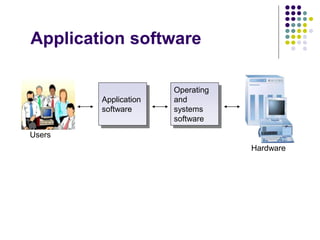
 Application Software run under System Software ,
and are made to do a specific task i.e ( Word
Processing etc) , which have indirect access to the
hardware (i.e Behind System Software)
 Designed to make users more productive and to
assist them to complete tasks
 Programs that help users solve particular computing
problems
Users
Application
software
Operating
and
systems
software
Hardware
Application software
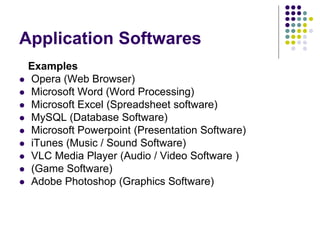
Application Softwares
Examples
 Opera (Web Browser)
 Microsoft Word (Word Processing)
 Microsoft Excel (Spreadsheet software)
 MySQL (Database Software)
 Microsoft Powerpoint (Presentation Software)
 iTunes (Music / Sound Software)
 VLC Media Player (Audio / Video Software )
 (Game Software)
 Adobe Photoshop (Graphics Software)
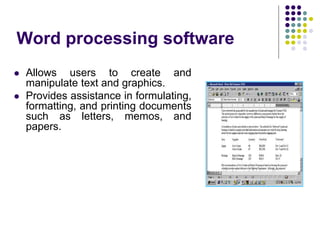
Word processing software
 Allows users to create and
manipulate text and graphics.
 Provides assistance in formulating,
formatting, and printing documents
such as letters, memos, and
papers.
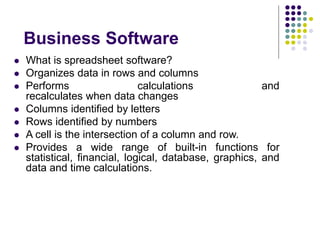
Business Software
 What is spreadsheet software?
 Organizes data in rows and columns
 Performs calculations and
recalculates when data changes
 Columns identified by letters
 Rows identified by numbers
 A cell is the intersection of a column and row.
 Provides a wide range of built-in functions for
statistical, financial, logical, database, graphics, and
data and time calculations.
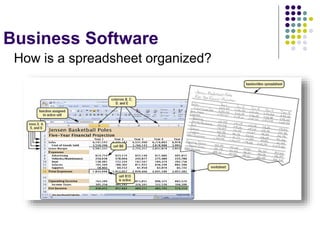
Business Software
How is a spreadsheet organized?
Business Software
What is database software?
Allows you to create,
access, and
manage data
Add, change, delete,
sort, and retrieve data
Business Software
What is power point (presentation
software)?
 Used to create visual aids for presentations
 A presentation is sometimes
called a slide show
Application Software
Software can be purchased or acquired as:
 Shareware:
 Usually intended for sale after a trial period.
 Freeware:
 Free software but with copyright restrictions .
 Licenses:
A software is a legal instrument (usually by way of contract law)
governing the usage or redistribution of software. All software is
copyright protected, except material in the public domain
 Key Generator
A license or product key generator (keygen) is a computer program
that generates a product licensing key, serial number, or some other
registration information necessary to activate for use a software
application
Shareware
 Is provided to users without payment on a trial basis and
is often limited by any combination of functionality.
 Shareware is often offered as a download from an
Internet website or as a compact disc to give buyers the
opportunity to use the program and judge its usefulness
before purchasing a license for the full version of the
software.
Shareware cont’d
 Firms with superior software thus have an incentive to
offer samples, except if their product is already well
known,
 or as a full version but for a limited trial period of time.
Once the trial period has passed, the program may stop
running until a license is purchased.
Freeware
 Freeware (from "free" and "software") is computer
software that is available for use at no cost or for an
optional fee, but usually with one or more restricted
usage rights.
 Freeware is in contrast to commercial software, which is
typically sold for profit, but might be distributed for a
business or commercial purpose in the aim to expand
the marketshare of product.
 Popular examples of freeware include Firefox, Google
Chrome, 7-Zip and Adobe Flash Player.
Software license
 A software license is a legal instrument (usually by way
of contract law) governing the usage or redistribution of
software. All softwares are copyright protected except
public domain softwares.
 Public domain software is software that has been
placed in the public domain, in other words there is
absolutely no ownership such as copyright, trademark,
or patent. Unlike other classes of licenses, there are no
restrictions as to what can be done with the software.
The software can be modified, distributed, or sold even
without any attribution.
 A typical software license grants an end-user permission
to use one or more copies of software giving user
exclusive rights under copyright law.
Freeware
 Freeware (from "free" and "software") is computer
software that is available for use at no cost or for an
optional fee, but usually with one or more restricted
usage rights.
 Freeware is in contrast to commercial software, which is
typically sold for profit, but might be distributed for a
business or commercial purpose in the aim to expand
the marketshare of product.
 Popular examples of freeware include Firefox, Google
Chrome, 7-Zip and Adobe Flash Player.
Key generator
 A license or product key generator (keygen) is a
computer program that generates a product licensing
key, serial number, or some other registration
information necessary to activate for using a software
application.
Questions??

ITC_lec_14.ppt

  • 1.
  • 2.
    Objective of Lecture Software  Types of Software  Application software  Description  Examples
  • 3.
    Application software  ApplicationSoftware run under System Software , and are made to do a specific task i.e ( Word Processing etc) , which have indirect access to the hardware (i.e Behind System Software)  Designed to make users more productive and to assist them to complete tasks  Programs that help users solve particular computing problems
  • 4.
  • 5.
    Application Softwares Examples  Opera(Web Browser)  Microsoft Word (Word Processing)  Microsoft Excel (Spreadsheet software)  MySQL (Database Software)  Microsoft Powerpoint (Presentation Software)  iTunes (Music / Sound Software)  VLC Media Player (Audio / Video Software )  (Game Software)  Adobe Photoshop (Graphics Software)
  • 6.
    Word processing software Allows users to create and manipulate text and graphics.  Provides assistance in formulating, formatting, and printing documents such as letters, memos, and papers.
  • 7.
    Business Software  Whatis spreadsheet software?  Organizes data in rows and columns  Performs calculations and recalculates when data changes  Columns identified by letters  Rows identified by numbers  A cell is the intersection of a column and row.  Provides a wide range of built-in functions for statistical, financial, logical, database, graphics, and data and time calculations.
  • 8.
    Business Software How isa spreadsheet organized?
  • 9.
    Business Software What isdatabase software? Allows you to create, access, and manage data Add, change, delete, sort, and retrieve data
  • 10.
    Business Software What ispower point (presentation software)?  Used to create visual aids for presentations  A presentation is sometimes called a slide show
  • 11.
    Application Software Software canbe purchased or acquired as:  Shareware:  Usually intended for sale after a trial period.  Freeware:  Free software but with copyright restrictions .  Licenses: A software is a legal instrument (usually by way of contract law) governing the usage or redistribution of software. All software is copyright protected, except material in the public domain  Key Generator A license or product key generator (keygen) is a computer program that generates a product licensing key, serial number, or some other registration information necessary to activate for use a software application
  • 12.
    Shareware  Is providedto users without payment on a trial basis and is often limited by any combination of functionality.  Shareware is often offered as a download from an Internet website or as a compact disc to give buyers the opportunity to use the program and judge its usefulness before purchasing a license for the full version of the software.
  • 13.
    Shareware cont’d  Firmswith superior software thus have an incentive to offer samples, except if their product is already well known,  or as a full version but for a limited trial period of time. Once the trial period has passed, the program may stop running until a license is purchased.
  • 14.
    Freeware  Freeware (from"free" and "software") is computer software that is available for use at no cost or for an optional fee, but usually with one or more restricted usage rights.  Freeware is in contrast to commercial software, which is typically sold for profit, but might be distributed for a business or commercial purpose in the aim to expand the marketshare of product.  Popular examples of freeware include Firefox, Google Chrome, 7-Zip and Adobe Flash Player.
  • 15.
    Software license  Asoftware license is a legal instrument (usually by way of contract law) governing the usage or redistribution of software. All softwares are copyright protected except public domain softwares.  Public domain software is software that has been placed in the public domain, in other words there is absolutely no ownership such as copyright, trademark, or patent. Unlike other classes of licenses, there are no restrictions as to what can be done with the software. The software can be modified, distributed, or sold even without any attribution.  A typical software license grants an end-user permission to use one or more copies of software giving user exclusive rights under copyright law.
  • 16.
    Freeware  Freeware (from"free" and "software") is computer software that is available for use at no cost or for an optional fee, but usually with one or more restricted usage rights.  Freeware is in contrast to commercial software, which is typically sold for profit, but might be distributed for a business or commercial purpose in the aim to expand the marketshare of product.  Popular examples of freeware include Firefox, Google Chrome, 7-Zip and Adobe Flash Player.
  • 17.
    Key generator  Alicense or product key generator (keygen) is a computer program that generates a product licensing key, serial number, or some other registration information necessary to activate for using a software application.
  • 18.