Hybrid Online Collaborative Learning EnvironmentsJennifer CourduffEDUC8841Dr. Jana Willis
The need: sustained learning in university and K-12 educational settingsAsynchronous online models offer no element of human contact and interactionF2F models are restricted by geography and timeLack of time during the day to collaborateLack of access due to district firewalls, blocking of collaborative websites
The solution	Development of distributed learningCombination of face-to-face and onlineExtends opportunities for student/faculty interactionIncorporates simulations and visualizationsIncorporates collaborative learninghttp://supportblogging.com/Links+to+School+Bloggershttp://ateacherswrites.wordpress.com/about-this-blog/Uses multiple technology resources as teaching and learning toolsAccommodates multiple learning needs and styles
BenefitsExploration – access and explore informationExperience – synchronous and asynchronousEngagement – enables creative approaches to learningEase of use – content immediately available across platformsEmpowerment – student drives the learningEffectiveness – personalized learning that enables high levels of interaction between faculty and student
Hybrid Learning EnvironmentsEverest Colleges and Universities: a student viewhttp://www.youtube.com/watch?v=JK1T4EYAMmQThe Adventure Channel: Hybrid Learning in Theory and Actionhttp://www.youtube.com/watch?v=Rg4et4DtBfcThe Future of Learning Management Systemshttp://www.youtube.com/watch?v=nsLgzllQ69I
Pedagogical ChallengesAlignment with institution’s mission, vision, cultureAppropriate and ethical use of informationInformation navigation – learning to filter huge amounts of informationBalancing doing and knowing / playing and producing
Institutional benefitsMeet needs for expanded access to underserved populationsMeet needs to increase student population without new buildingsIncreases revenueAids in institutional transformation to 21st century teaching and learning
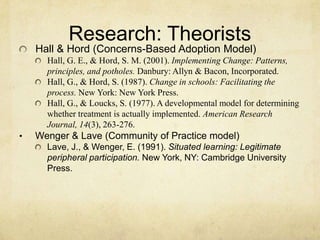
Research: TheoristsHall & Hord (Concerns-Based Adoption Model)Hall, G. E., & Hord, S. M. (2001). Implementing Change: Patterns, principles, and potholes. Danbury: Allyn & Bacon, Incorporated.Hall, G., & Hord, S. (1987). Change in schools: Facilitating the process. New York: New York Press.Hall, G., & Loucks, S. (1977). A developmental model for determining whether treatment is actually implemented. American Research Journal, 14(3), 263-276.Wenger & Lave (Community of Practice model)Lave, J., & Wenger, E. (1991). Situated learning: Legitimate peripheral participation. New York, NY: Cambridge University Press.
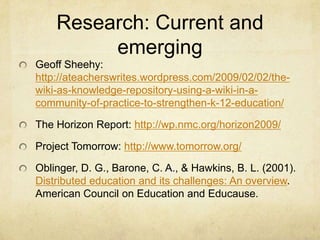
Research: Current and emergingGeoff Sheehy: http://ateacherswrites.wordpress.com/2009/02/02/the-wiki-as-knowledge-repository-using-a-wiki-in-a-community-of-practice-to-strengthen-k-12-education/The Horizon Report: http://wp.nmc.org/horizon2009/Project Tomorrow: http://www.tomorrow.org/Oblinger, D. G., Barone, C. A., & Hawkins, B. L. (2001). Distributed education and its challenges: An overview. American Council on Education and Educause.
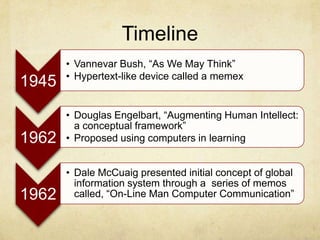
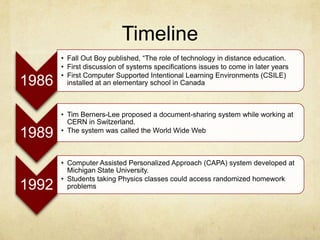
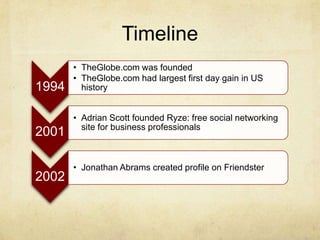
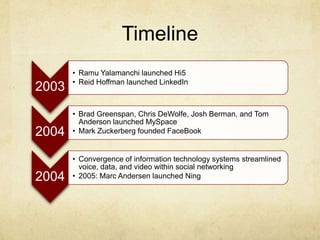
Timeline
Timeline
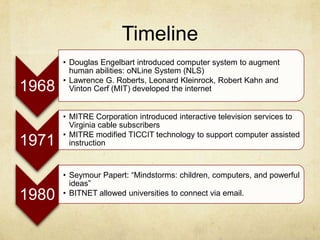
Timeline
Timeline
Timeline
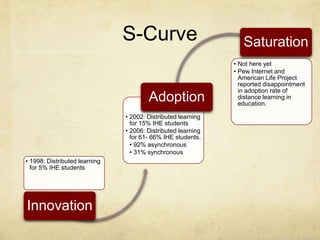
S-Curve
Pew Internet and American Life Projecthttp://www.pewinternet.org/Reports/2005/The-Future-of-the-Internet/06-Looking-back-looking-forward/01-Where-has-the-internet-fallen-short-of-expectations.aspx?r=1#
Student PerspectivesBlackboard K-12 Student Perspectiveshttp://www.youtube.com/watch?v=SHVs_C888Jc
Keys to change: The playersAlthough, on the surface, distributed learning environments logically fall into a centralized model for diffusion, this is not necessarily the case.Centralized diffusion works from a top-down philosophy.Culturally, education is a decentralized system. Professors and teachers have great autonomy in instructional practice. They are, essentially, the sole controller of the learning environment.Decentralized diffusion is culturally and systemically a natural fit for education.
Focus: Laser or spotlight?Research suggests that change can be approached from two perspectives (Clancey, 1997; Wenger & Lave, 1991)Laser: focusing on working with the few who will influence the many.Spotlight: focusing on the many who will adopt eventually.The critical role of the change agent is to use a laser to get to the spotlight. To do this, the agent must: Be the Champion for changeDevelop the need for changeEstablish information exchange relationship
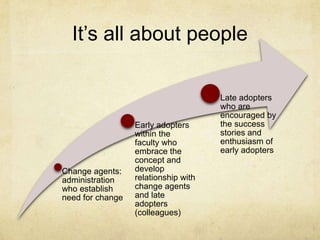
It’s all about people
Problems in DevelopmentLack of e-pedagogy for hybrid learning environmentsLack of resources including time, framework (samples), trainingLack of creativity in fully using available / free technology resources such as text messaging and social networking sitesLack of support from IT departments and leadershipMy Rant on Blogs (Alvarez, personal communication, 2008).
Point: My Rant on BlogsBlogs have an inherent liability risk associated with them, especially the common and popular unmoderated, publicly viewable Blog. Potentially Blogs under the direct control or even the auspices of the district can expose us to legal action ranging from defamation to wrongful death. I realize that this is a somewhat cynical view, but the key question is: Are the benefits worth the risks? In the majority of cases I think the answer is no.This is not to say all forms of Blogging should be automatically disqualified – I think exceptions can and should be made for controlled (i.e. login required), moderated or highly supervised Blogs for district employee and training use.While recognizing the benefits that Blogs can provide our students, I believe the safety, privacy and liability risks outweigh these benefits. As an aside, I also have to express my concern that the constantly changing content of Blogs and Social Networking sites combined with their often opinionated, impassioned and “gossipy” nature creates a sense of immediacy that has a tendency to promote an unhealthy over-usage of the internet, especially among teens and pre-teens. (Alvarez, M., ESD Systems Analyst, Personal Communication, April 25, 2008).
CounterPoint from a student-champion for changeCommunication is inescapable: It is part of the fabric of human existence.It is irreversible: The reality is that once the spoken or written word is out there, it cannot be taken back.It is complicated: Within any given exchange resides a combination of perspectives, innuendo, auditory and visual cues that lead to clear understanding or disaster.It is contextual: It resides within relationships, environment, situation, emotion, and culture.Above all, emerging technology resources have created a world where communication is perpetual.
Learning in the 21st CenturyMust enable learning that is inescapable, irreversible, complicated, contextual, and perpetual. This should be the goal of universitiesThis must not be considered a goal of change, but rather, of alignment to reality. Hybrid learning environments address the needs of 21st century learners on social, psychological, and technological levels. We can’t beat ‘em, so we better figure out how to join ‘em.
A Vision of Students TodayIf these walls could talk
..they would set us free
.http://www.youtube.com/watch?v=dGCJ46vyR9o
ReferencesGladwell, M. (2002). The tipping point: How little things can make a big difference. New York: Little, Brown and Company.Johnson, L., Levine, A., Smith, R., & Smythe, T. (2009). The 2009 horizon report: K-12 edition. Austin: The New Media Consortium.Loucks-Horsley, S., & Bybee, R. W. (2000). Advancing technology education: The role of professional development. Technology Teacher , 60(2), 31-34. Retrieved from Academic Search Premier.Miller, L., Miller, R., & Dismukes, J. (2006). The critical role of information and information technology in future accelerated radical innovation. Information Knowledge Systems Management , 63-99. Retrieved from Academic Search Premier.Rogers, E. M. (2003). Diffusion of innovations (3rd ed.). New York: Free Press.Sheehy, G. (2008). Using a wiki in a community of practice to strengthen k-12 eduacation. TechTrends: Linking Research & Practice to Improve Learning , 52 (6) , 55-60. Springer Science & Business Media B.V.

Hybrid Learning Environments J Courduff

  • 1.
    Hybrid Online CollaborativeLearning EnvironmentsJennifer CourduffEDUC8841Dr. Jana Willis
  • 2.
    The need: sustainedlearning in university and K-12 educational settingsAsynchronous online models offer no element of human contact and interactionF2F models are restricted by geography and timeLack of time during the day to collaborateLack of access due to district firewalls, blocking of collaborative websites
  • 3.
    The solution Development ofdistributed learningCombination of face-to-face and onlineExtends opportunities for student/faculty interactionIncorporates simulations and visualizationsIncorporates collaborative learninghttp://supportblogging.com/Links+to+School+Bloggershttp://ateacherswrites.wordpress.com/about-this-blog/Uses multiple technology resources as teaching and learning toolsAccommodates multiple learning needs and styles
  • 4.
    BenefitsExploration – accessand explore informationExperience – synchronous and asynchronousEngagement – enables creative approaches to learningEase of use – content immediately available across platformsEmpowerment – student drives the learningEffectiveness – personalized learning that enables high levels of interaction between faculty and student
  • 5.
    Hybrid Learning EnvironmentsEverestColleges and Universities: a student viewhttp://www.youtube.com/watch?v=JK1T4EYAMmQThe Adventure Channel: Hybrid Learning in Theory and Actionhttp://www.youtube.com/watch?v=Rg4et4DtBfcThe Future of Learning Management Systemshttp://www.youtube.com/watch?v=nsLgzllQ69I
  • 6.
    Pedagogical ChallengesAlignment withinstitution’s mission, vision, cultureAppropriate and ethical use of informationInformation navigation – learning to filter huge amounts of informationBalancing doing and knowing / playing and producing
  • 7.
    Institutional benefitsMeet needsfor expanded access to underserved populationsMeet needs to increase student population without new buildingsIncreases revenueAids in institutional transformation to 21st century teaching and learning
  • 8.
    Research: TheoristsHall &Hord (Concerns-Based Adoption Model)Hall, G. E., & Hord, S. M. (2001). Implementing Change: Patterns, principles, and potholes. Danbury: Allyn & Bacon, Incorporated.Hall, G., & Hord, S. (1987). Change in schools: Facilitating the process. New York: New York Press.Hall, G., & Loucks, S. (1977). A developmental model for determining whether treatment is actually implemented. American Research Journal, 14(3), 263-276.Wenger & Lave (Community of Practice model)Lave, J., & Wenger, E. (1991). Situated learning: Legitimate peripheral participation. New York, NY: Cambridge University Press.
  • 9.
    Research: Current andemergingGeoff Sheehy: http://ateacherswrites.wordpress.com/2009/02/02/the-wiki-as-knowledge-repository-using-a-wiki-in-a-community-of-practice-to-strengthen-k-12-education/The Horizon Report: http://wp.nmc.org/horizon2009/Project Tomorrow: http://www.tomorrow.org/Oblinger, D. G., Barone, C. A., & Hawkins, B. L. (2001). Distributed education and its challenges: An overview. American Council on Education and Educause.
  • 10.
  • 11.
  • 12.
  • 13.
  • 14.
  • 15.
  • 16.
    Pew Internet andAmerican Life Projecthttp://www.pewinternet.org/Reports/2005/The-Future-of-the-Internet/06-Looking-back-looking-forward/01-Where-has-the-internet-fallen-short-of-expectations.aspx?r=1#
  • 17.
    Student PerspectivesBlackboard K-12Student Perspectiveshttp://www.youtube.com/watch?v=SHVs_C888Jc
  • 18.
    Keys to change:The playersAlthough, on the surface, distributed learning environments logically fall into a centralized model for diffusion, this is not necessarily the case.Centralized diffusion works from a top-down philosophy.Culturally, education is a decentralized system. Professors and teachers have great autonomy in instructional practice. They are, essentially, the sole controller of the learning environment.Decentralized diffusion is culturally and systemically a natural fit for education.
  • 19.
    Focus: Laser orspotlight?Research suggests that change can be approached from two perspectives (Clancey, 1997; Wenger & Lave, 1991)Laser: focusing on working with the few who will influence the many.Spotlight: focusing on the many who will adopt eventually.The critical role of the change agent is to use a laser to get to the spotlight. To do this, the agent must: Be the Champion for changeDevelop the need for changeEstablish information exchange relationship
  • 20.
  • 21.
    Problems in DevelopmentLackof e-pedagogy for hybrid learning environmentsLack of resources including time, framework (samples), trainingLack of creativity in fully using available / free technology resources such as text messaging and social networking sitesLack of support from IT departments and leadershipMy Rant on Blogs (Alvarez, personal communication, 2008).
  • 22.
    Point: My Ranton BlogsBlogs have an inherent liability risk associated with them, especially the common and popular unmoderated, publicly viewable Blog. Potentially Blogs under the direct control or even the auspices of the district can expose us to legal action ranging from defamation to wrongful death. I realize that this is a somewhat cynical view, but the key question is: Are the benefits worth the risks? In the majority of cases I think the answer is no.This is not to say all forms of Blogging should be automatically disqualified – I think exceptions can and should be made for controlled (i.e. login required), moderated or highly supervised Blogs for district employee and training use.While recognizing the benefits that Blogs can provide our students, I believe the safety, privacy and liability risks outweigh these benefits. As an aside, I also have to express my concern that the constantly changing content of Blogs and Social Networking sites combined with their often opinionated, impassioned and “gossipy” nature creates a sense of immediacy that has a tendency to promote an unhealthy over-usage of the internet, especially among teens and pre-teens. (Alvarez, M., ESD Systems Analyst, Personal Communication, April 25, 2008).
  • 23.
    CounterPoint from astudent-champion for changeCommunication is inescapable: It is part of the fabric of human existence.It is irreversible: The reality is that once the spoken or written word is out there, it cannot be taken back.It is complicated: Within any given exchange resides a combination of perspectives, innuendo, auditory and visual cues that lead to clear understanding or disaster.It is contextual: It resides within relationships, environment, situation, emotion, and culture.Above all, emerging technology resources have created a world where communication is perpetual.
  • 24.
    Learning in the21st CenturyMust enable learning that is inescapable, irreversible, complicated, contextual, and perpetual. This should be the goal of universitiesThis must not be considered a goal of change, but rather, of alignment to reality. Hybrid learning environments address the needs of 21st century learners on social, psychological, and technological levels. We can’t beat ‘em, so we better figure out how to join ‘em.
  • 25.
    A Vision ofStudents TodayIf these walls could talk
..they would set us free
.http://www.youtube.com/watch?v=dGCJ46vyR9o
  • 26.
    ReferencesGladwell, M. (2002).The tipping point: How little things can make a big difference. New York: Little, Brown and Company.Johnson, L., Levine, A., Smith, R., & Smythe, T. (2009). The 2009 horizon report: K-12 edition. Austin: The New Media Consortium.Loucks-Horsley, S., & Bybee, R. W. (2000). Advancing technology education: The role of professional development. Technology Teacher , 60(2), 31-34. Retrieved from Academic Search Premier.Miller, L., Miller, R., & Dismukes, J. (2006). The critical role of information and information technology in future accelerated radical innovation. Information Knowledge Systems Management , 63-99. Retrieved from Academic Search Premier.Rogers, E. M. (2003). Diffusion of innovations (3rd ed.). New York: Free Press.Sheehy, G. (2008). Using a wiki in a community of practice to strengthen k-12 eduacation. TechTrends: Linking Research & Practice to Improve Learning , 52 (6) , 55-60. Springer Science & Business Media B.V.

Editor's Notes

  • #2 Background information:Need: What problem or need existed that gave rise to your innovation? Research: What research organization or people developed a solution to this problem or need? What were their findings? Who were the “lead thinkers” for this innovation, and how did they convince a manufacturer to produce it? Development: What problems did your innovation encounter in the development process? Who was the intended audience for your innovation?Commercialization: Describe the production, manufacturing, packaging, marketing, and distribution of your innovation.
  • #3 There is a need for sustained learning in university and k-12 educational settings.
  • #4 The solution includes a distributed learning model which uses a combination of face-to-face and online components. Two great videos found on YouTube have been included for your review. Click on the link to view the videos.
  • #6 On this slide, there are links to great examples of hybrid learning environments found on YouTube.
  • #9 Research: What research organization or people developed a solution to this problem or need? What were their findings? Who were the “lead thinkers” for this innovation, and how did they convince a manufacturer to produce it?
  • #25 If we can’t beat them, we need to join them. Click on the next slide to see a really cool video on how students feel about online hybrid learning environments.