Going the Distance: Best Practices in
Designing & Sharing Reusable Learning
Objects
Philip Russell
Deputy Librarian
Institute of Technology Tallaght
LIR Tech Tools for Teaching
DCU, December 9th 2014
Background
•Institute of Technology Tallaght
(ITT Dublin) - range of courses /
4500 FTEs
•Information literacy (IL) /
eLearning - strategic focus:
- 3 level IL Framework (2004)
- Strategic Plan (2009-2014)
- Learning, Teaching &
Assessment Strategy (2011)
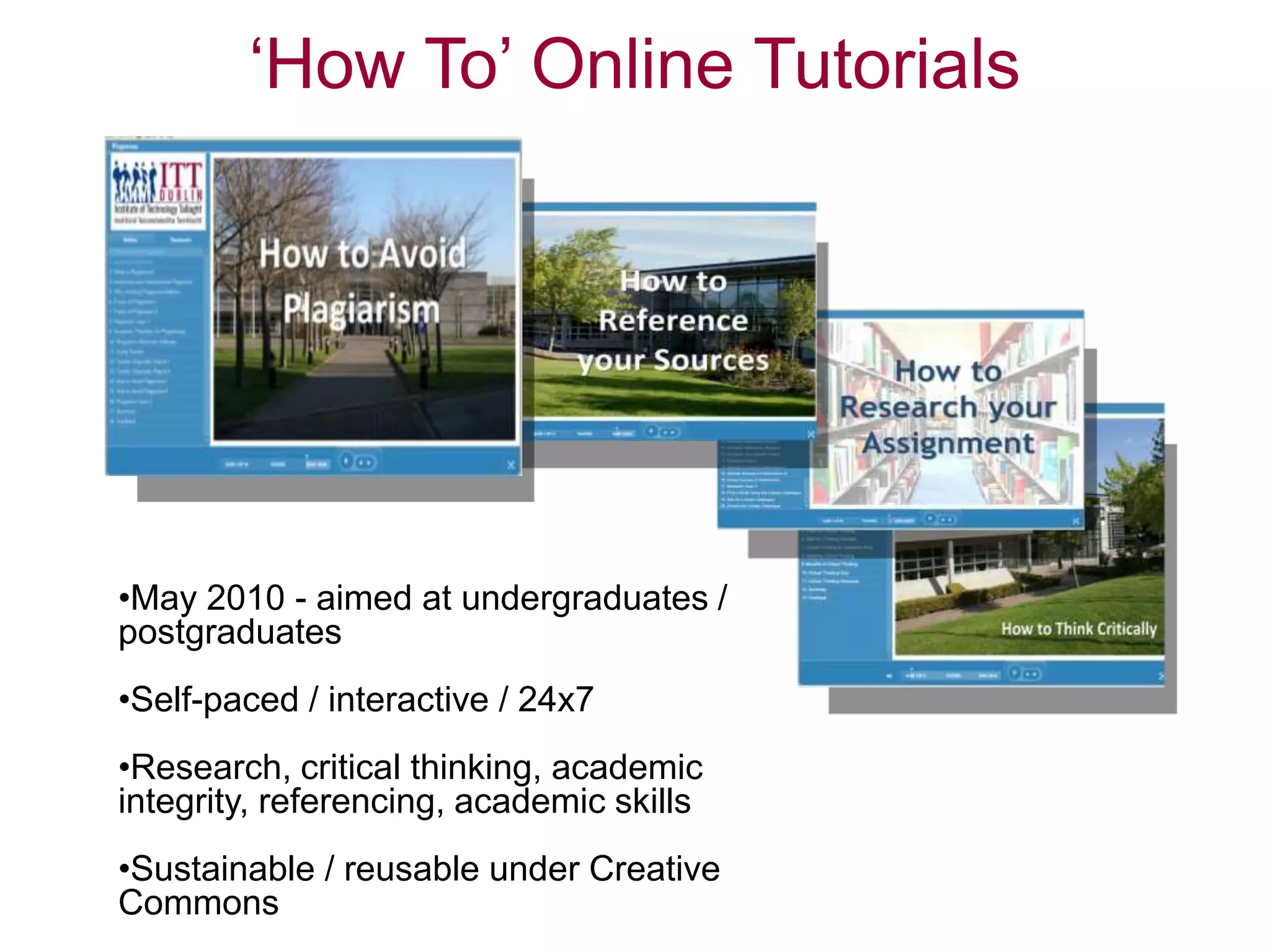
‘How To’ Online Tutorials
•May 2010 - aimed at undergraduates /
postgraduates
•Self-paced / interactive / 24x7
•Research, critical thinking, academic
integrity, referencing, academic skills
•Sustainable / reusable under Creative
Commons
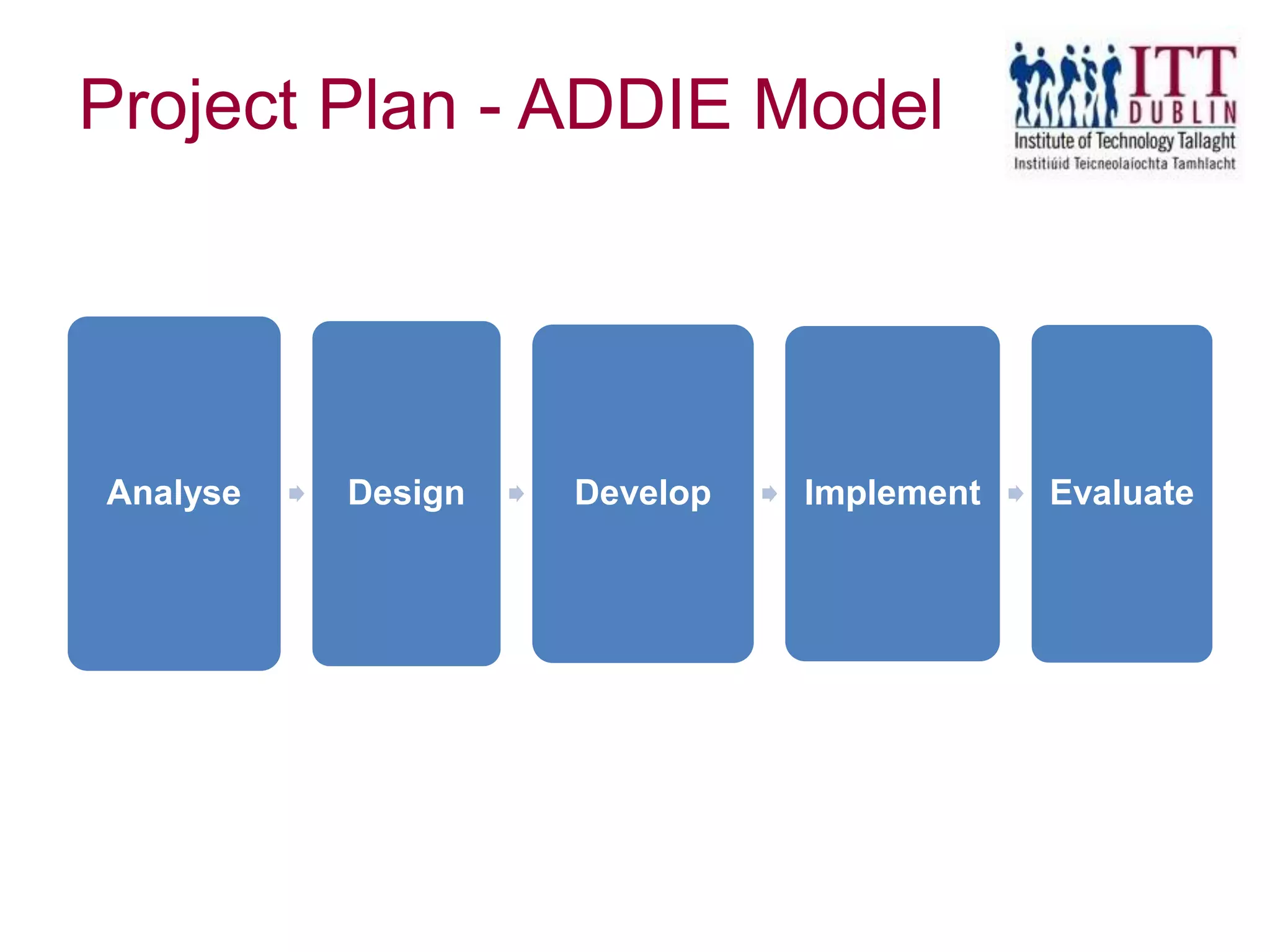
Project Plan - ADDIE Model
Analyse Design Develop Implement Evaluate
Planning
•Rationale
•Secured HE funding
•Reviewed existing online
tutorials
•ITT resources created from
scratch
•Support from IT / learning
technologists / Leeds
University
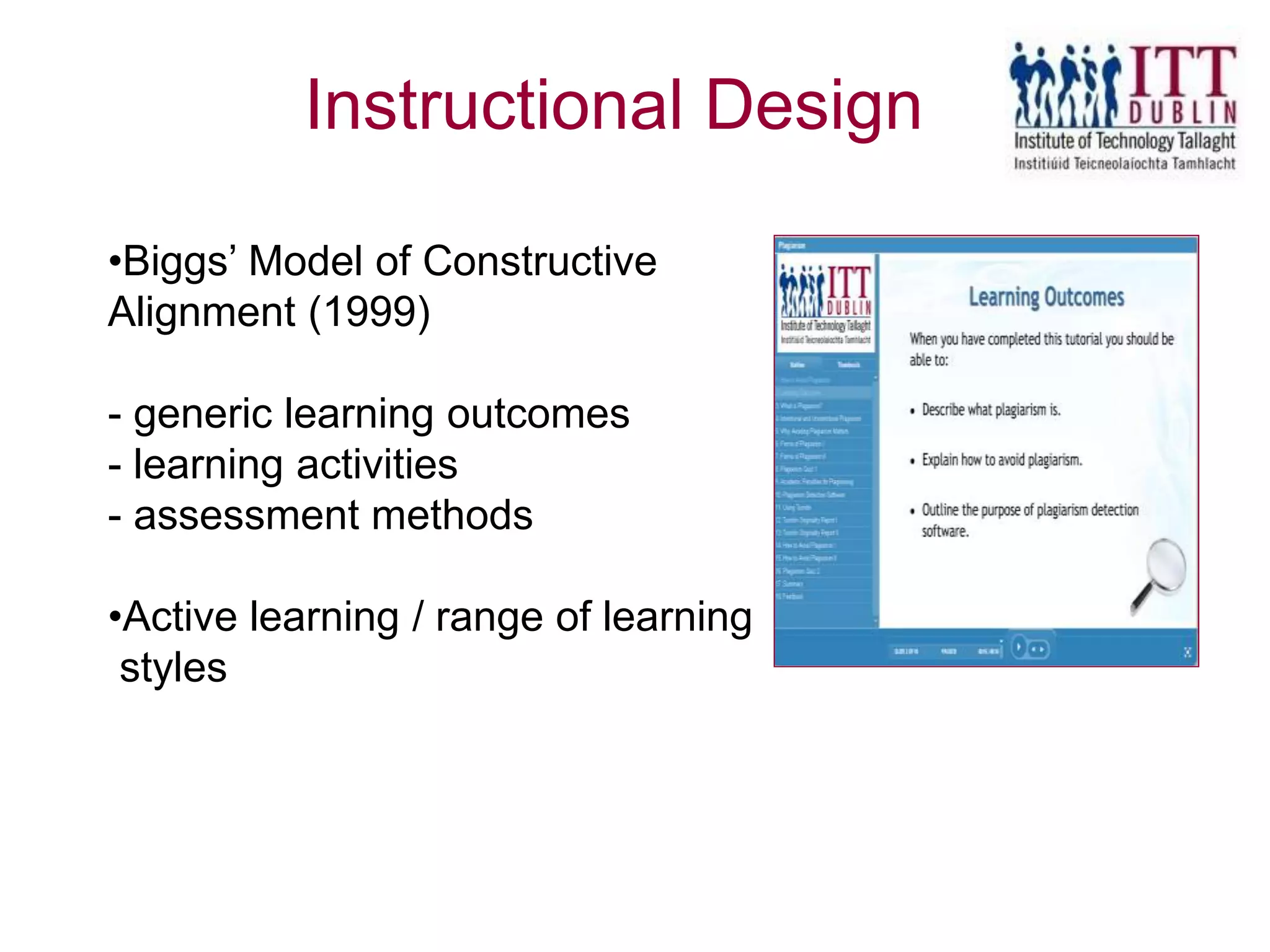
•Biggs’ Model of Constructive
Alignment (1999)
- generic learning outcomes
- learning activities
- assessment methods
•Active learning / range of learning
styles
Instructional Design
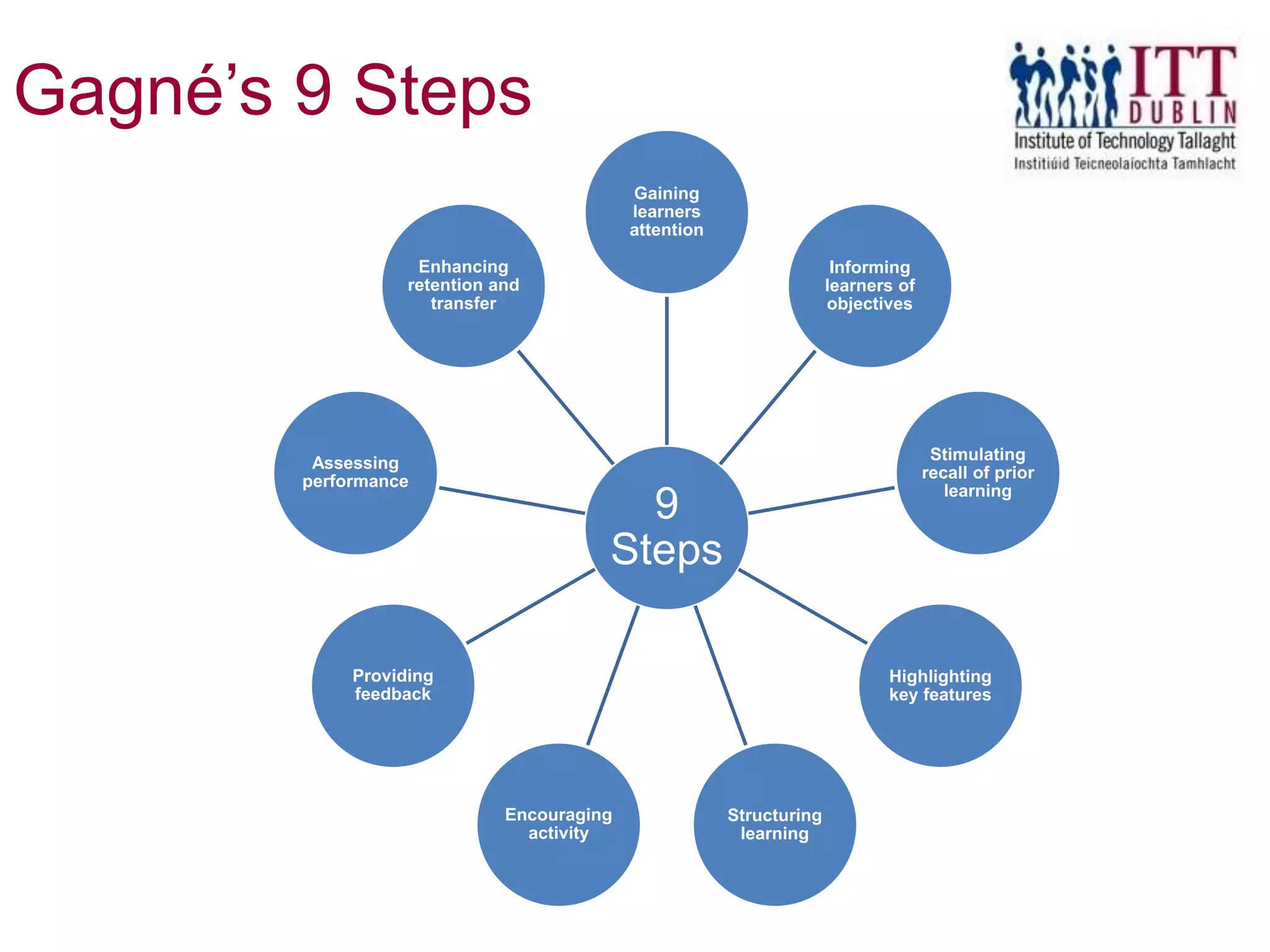
9
Steps
Gaining
learners
attention
Informing
learners of
objectives
Stimulating
recall of prior
learning
Highlighting
key features
Structuring
learning
Encouraging
activity
Providing
feedback
Assessing
performance
Enhancing
retention and
transfer
Gagné’s 9 Steps
•Detailed storyboarding
•Language / consistent
font / bullet points
•Branding / logo
•Accessible
Content Design
2004-2005
Learning
Landscape
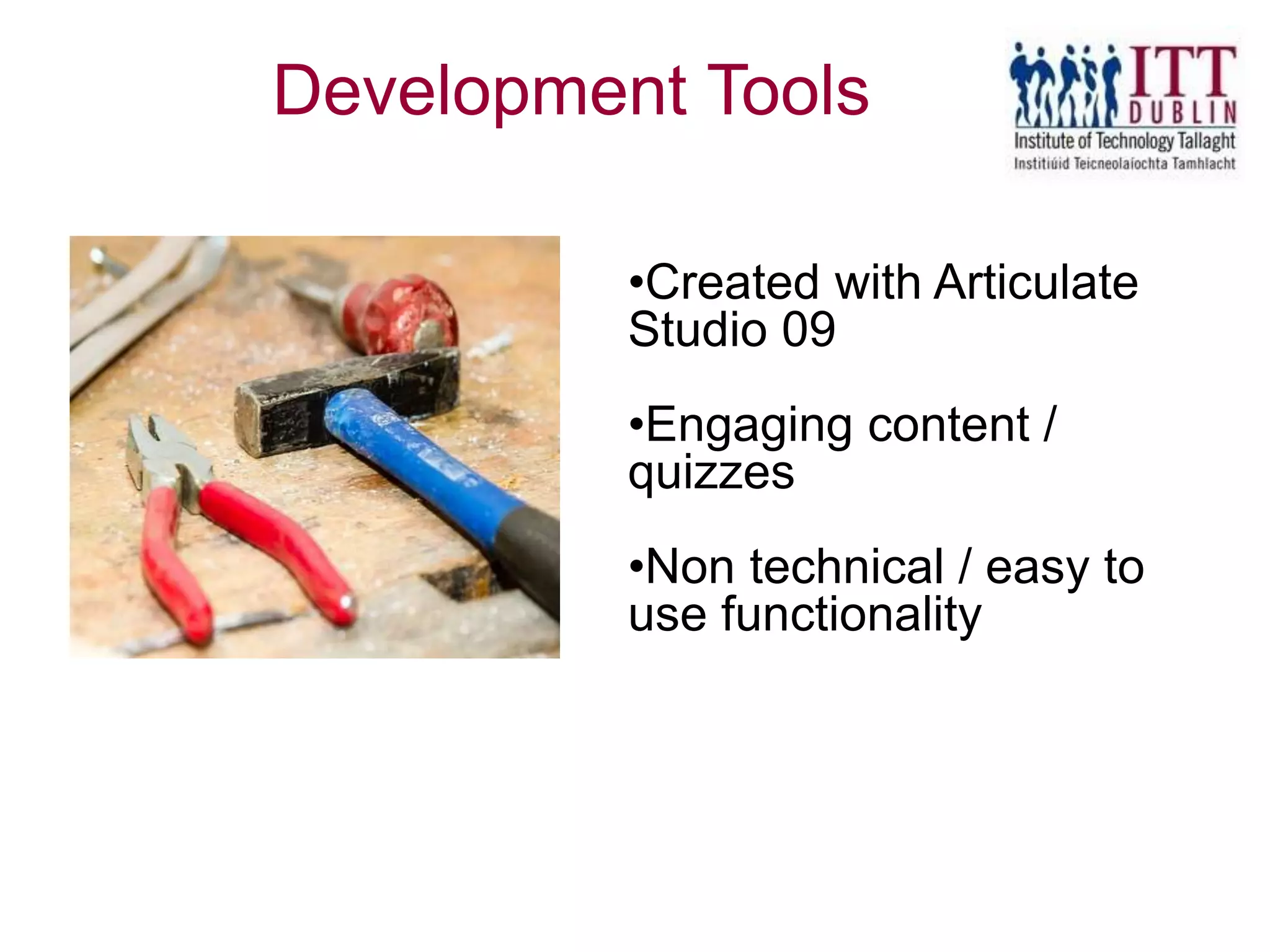
•Created with Articulate
Studio 09
•Engaging content /
quizzes
•Non technical / easy to
use functionality
Development Tools
•Pedagogical training
- learning styles / methodologies / assessment
- online instructional design
•ICT training
- eLearning software
- Image editing – Photoshop
- Web editing – HTML,Dreamweaver, CSS
Training
•September 2010 - extensive usability testing / feedback /
piloting
•SCORM (sharable content object reference model) 1.2
compliant
•W3C AAA (Web Content Accessibility) Guidelines 1.0
•Creative Commons Attribution-Non-commercial-Share
Alike 4.0 International licence
•Available via multiple delivery platforms (website, VLE,
institutional repository)
Testing & Accessibility
•Tutorials embedded into academic modules via
Institute VLE – Moodle
•Enhanced IL delivery
-Blended approach
-Learning to Learn module
-September 2014 – tutorials integrated into over 50
academic modules
Implementation
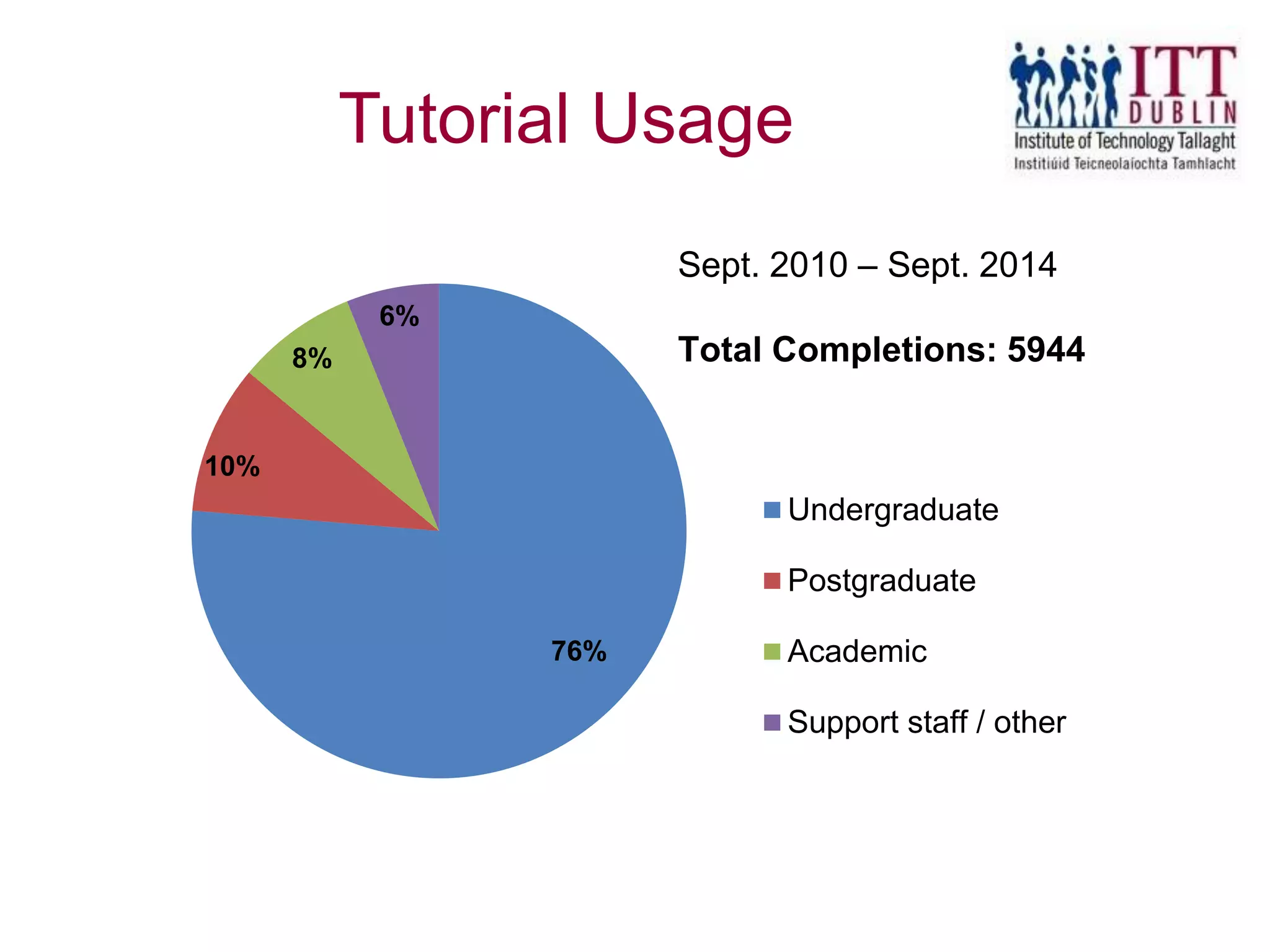
Tutorial Usage
76%
10%
8%
6%
Undergraduate
Postgraduate
Academic
Support staff / other
Sept. 2010 – Sept. 2014
Total Completions: 5944
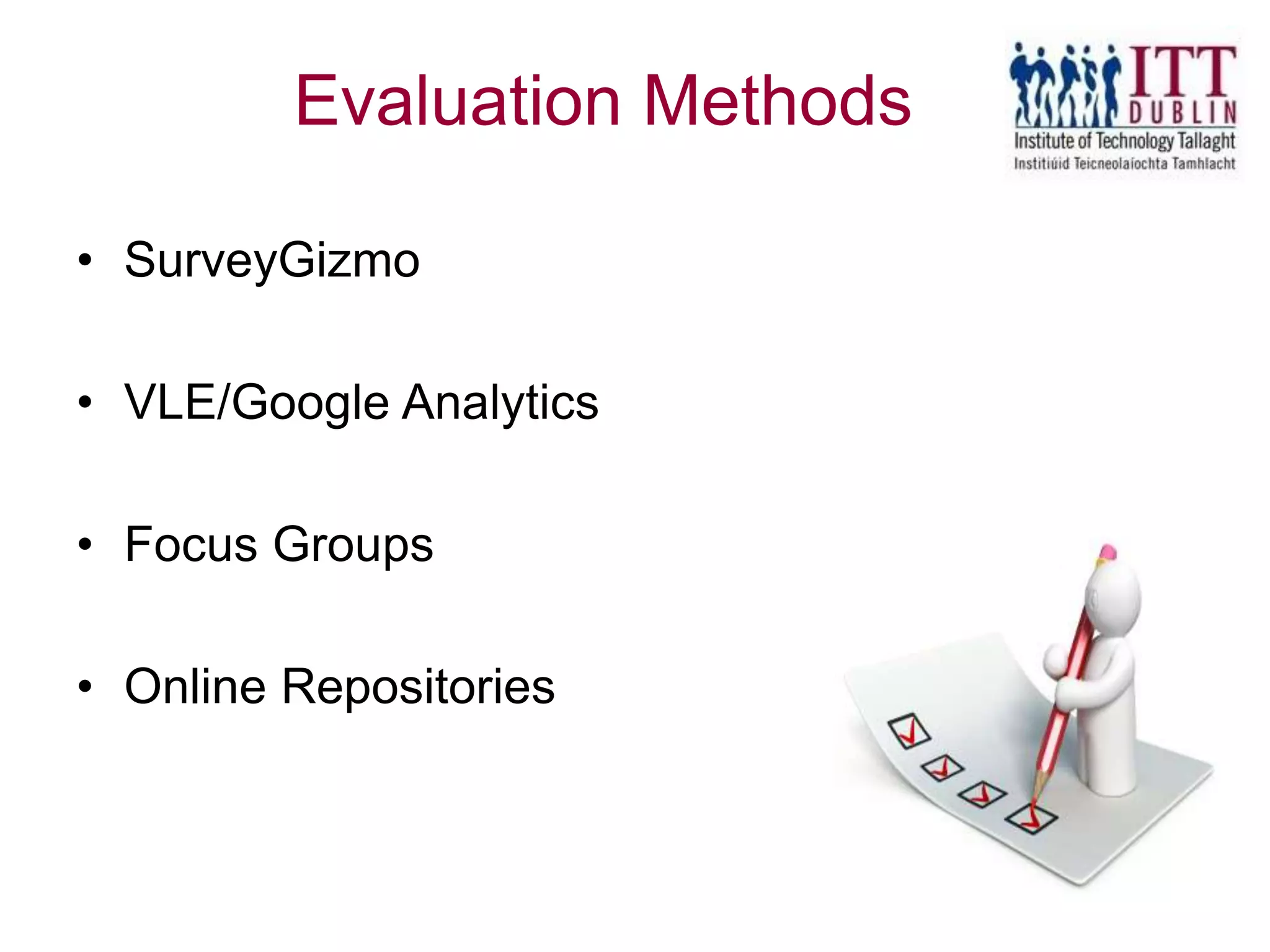
Evaluation Methods
• SurveyGizmo
• VLE/Google Analytics
• Focus Groups
• Online Repositories
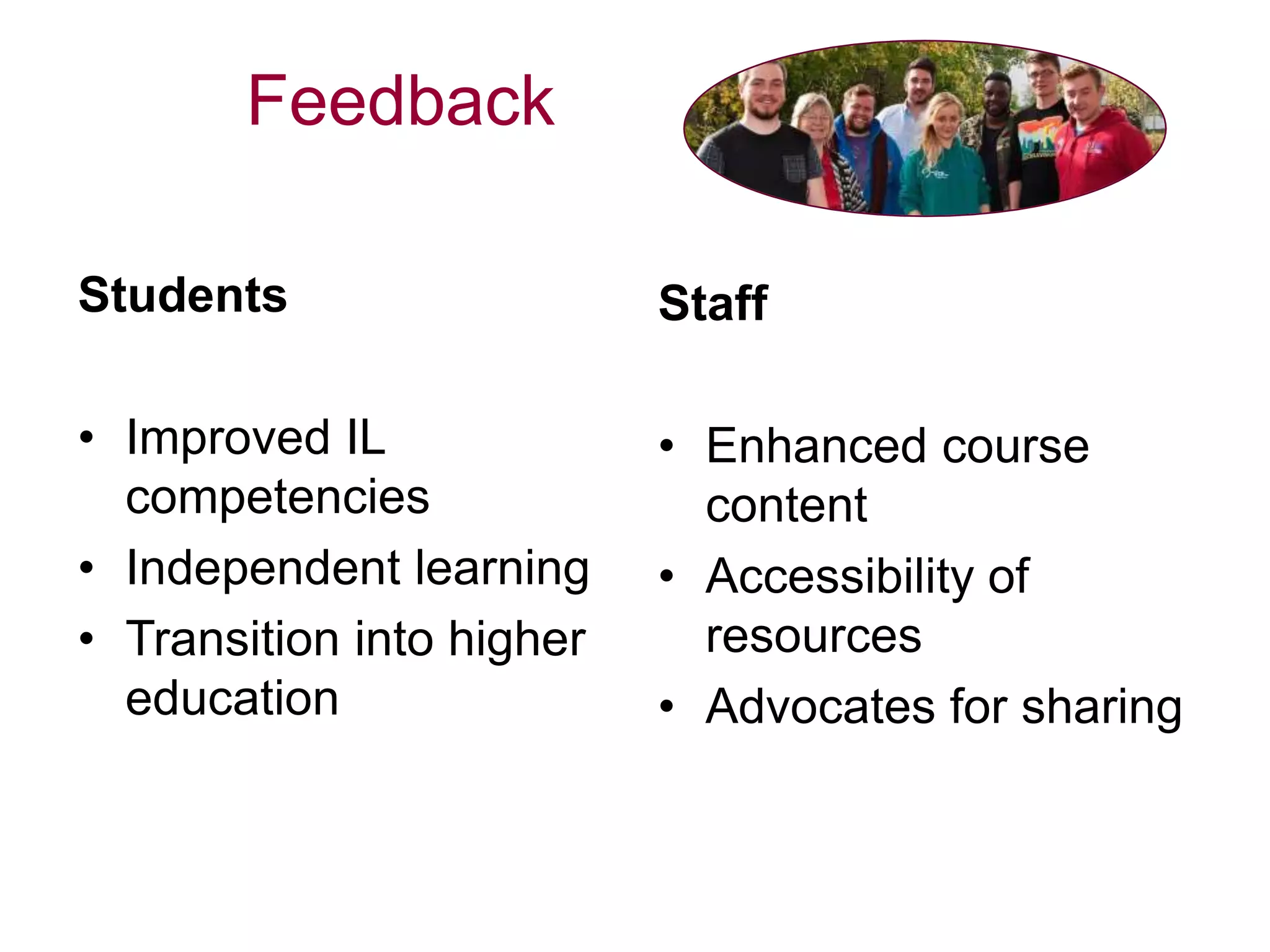
Feedback
Students
• Improved IL
competencies
• Independent learning
• Transition into higher
education
Staff
• Enhanced course
content
• Accessibility of
resources
• Advocates for sharing
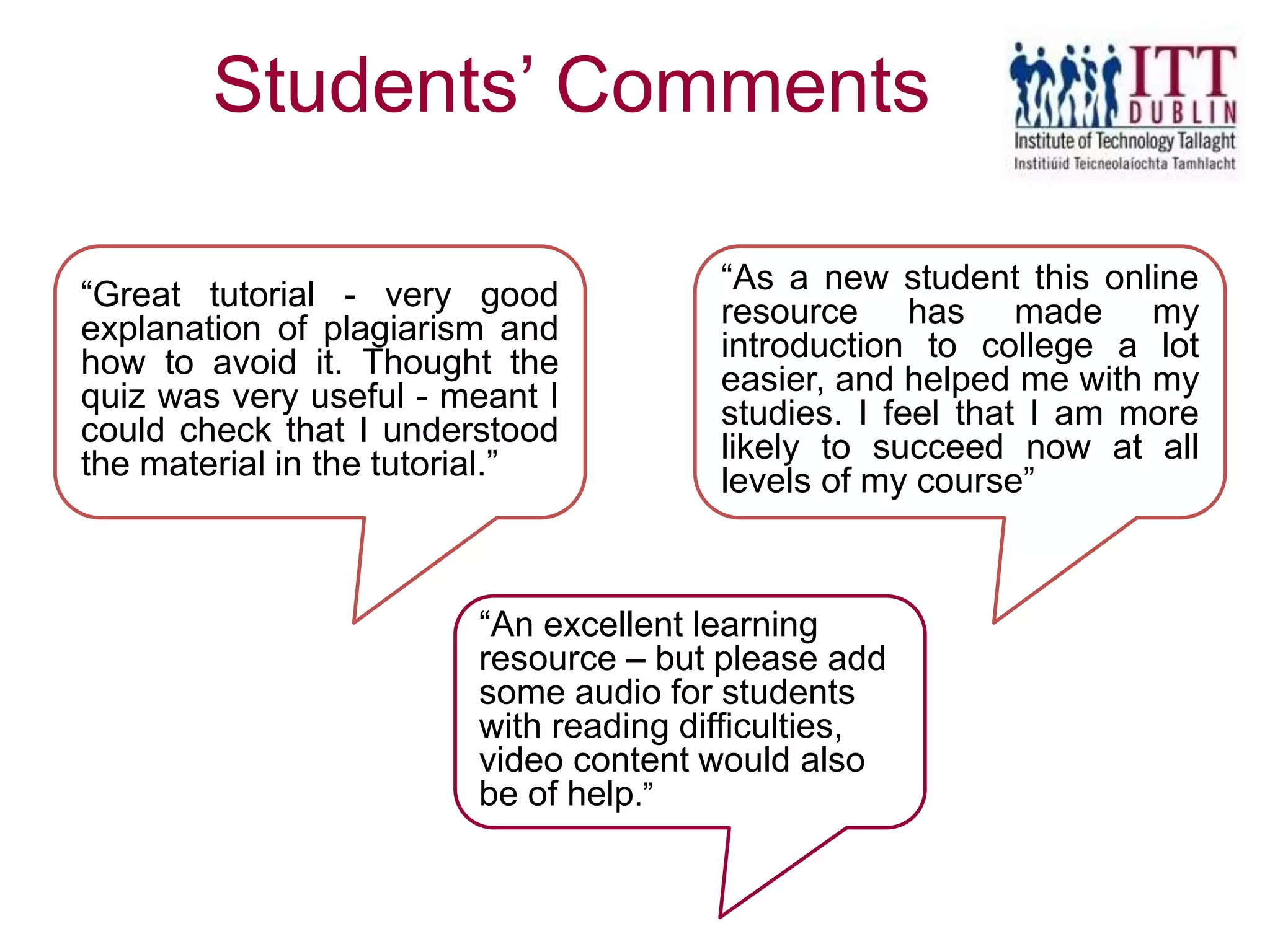
Students’ Comments
“As a new student this online
resource has made my
introduction to college a lot
easier, and helped me with my
studies. I feel that I am more
likely to succeed now at all
levels of my course”
“Great tutorial - very good
explanation of plagiarism and
how to avoid it. Thought the
quiz was very useful - meant I
could check that I understood
the material in the tutorial.”
“An excellent learning
resource – but please add
some audio for students
with reading difficulties,
video content would also
be of help.”
•Institutional
repositories / national
learning object
repositories
•Conferences,
seminars, workshops,
professional networks
•Publications
Share and Reuse
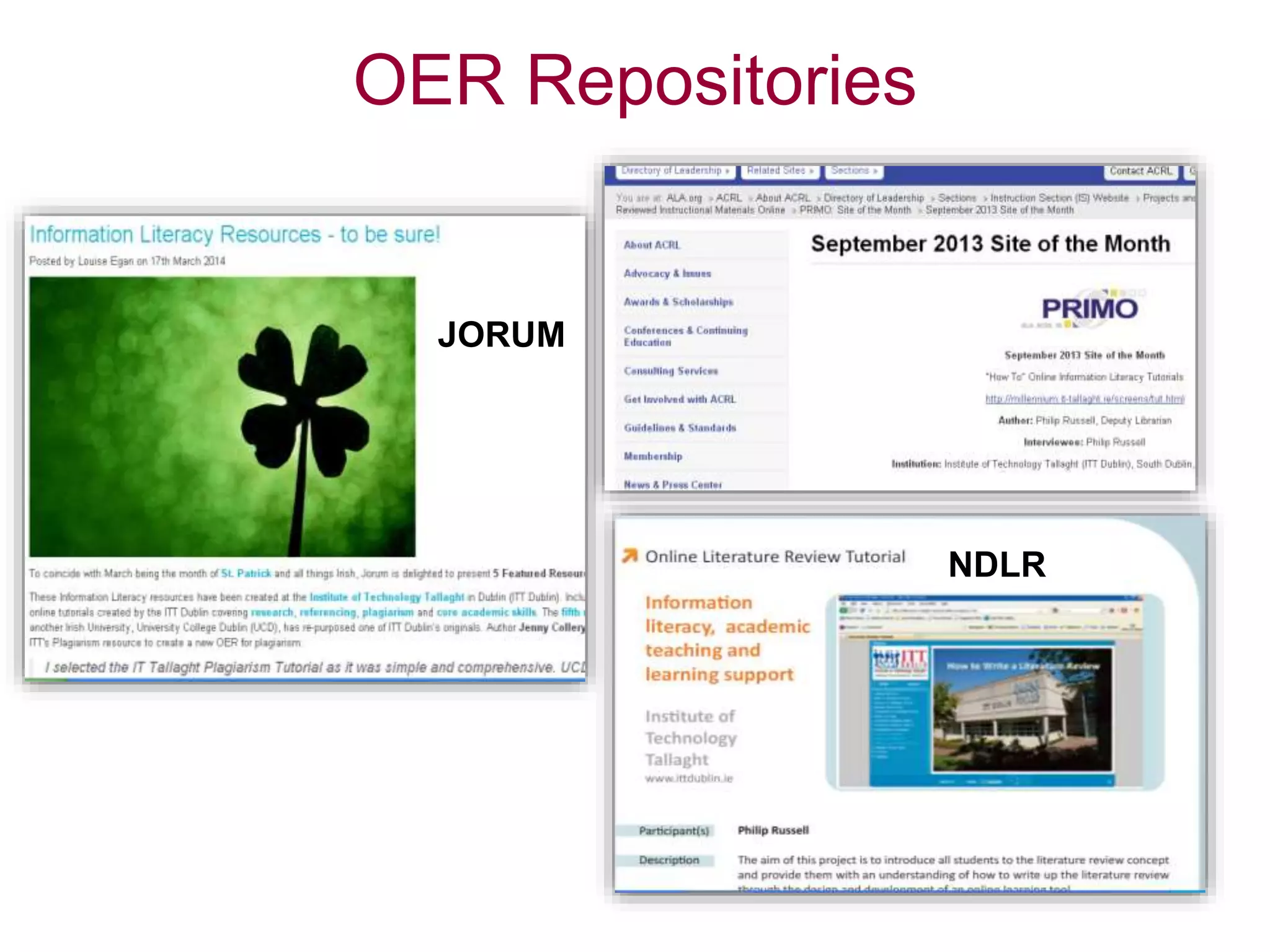
OER Repositories
NDLR
JORUM
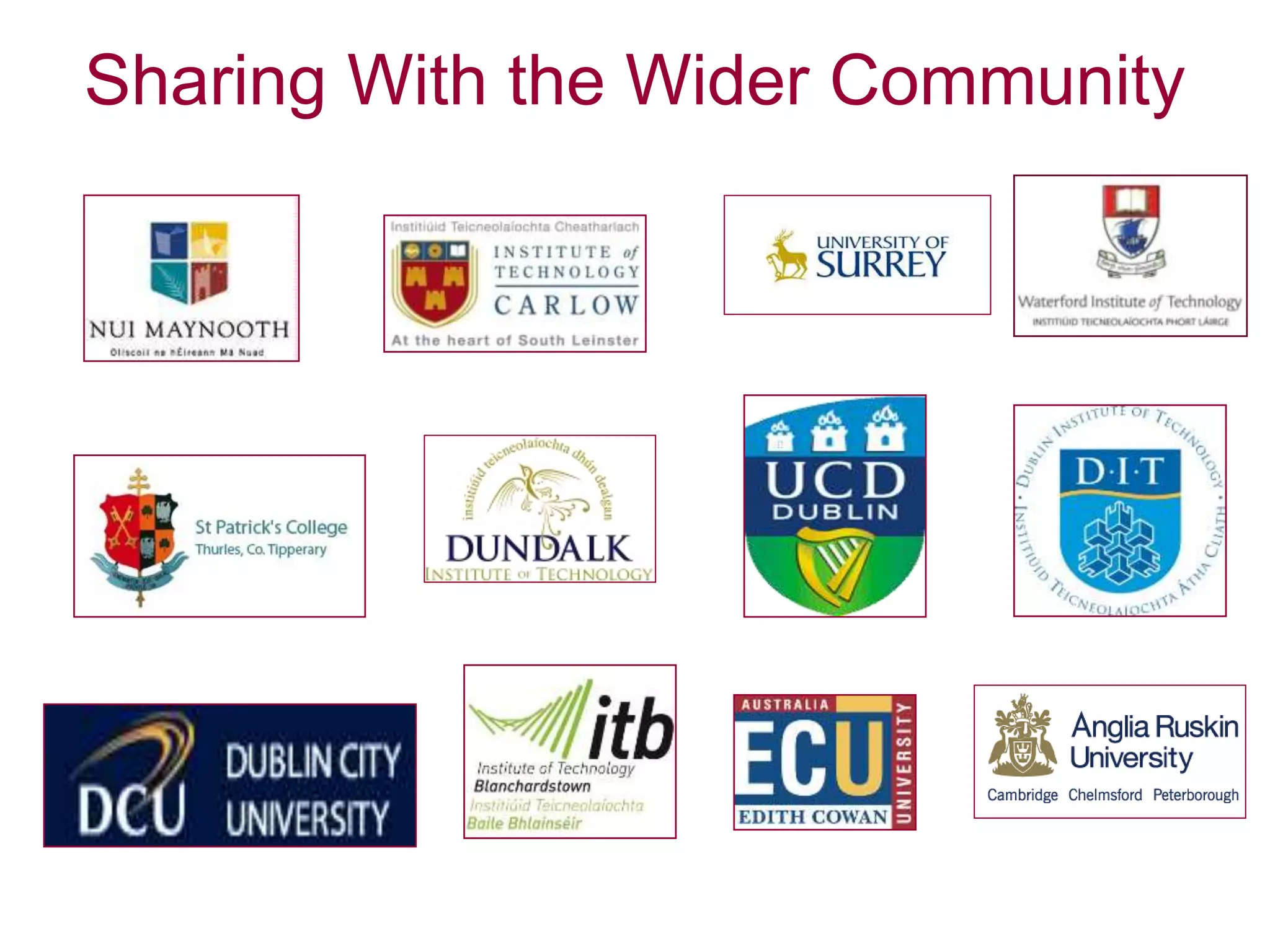
Sharing With the Wider Community
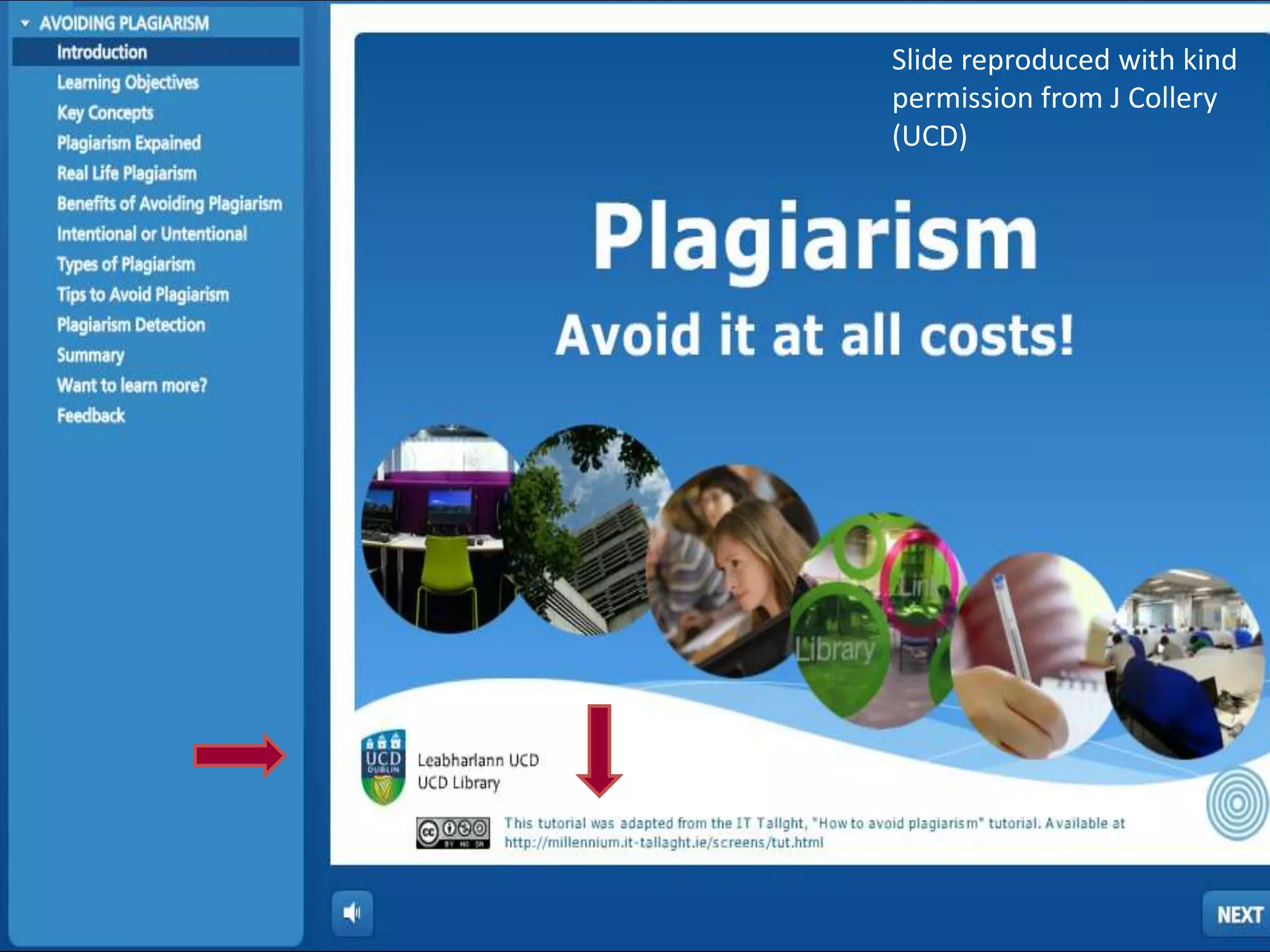
Slide reproduced with kind
permission from J Collery
(UCD)
•Generic resources
•Interoperable software / SCORM
•Explicit licencing details
•Accessible & discoverable
•Promote / lead by example
Factors to Consider for Reuse
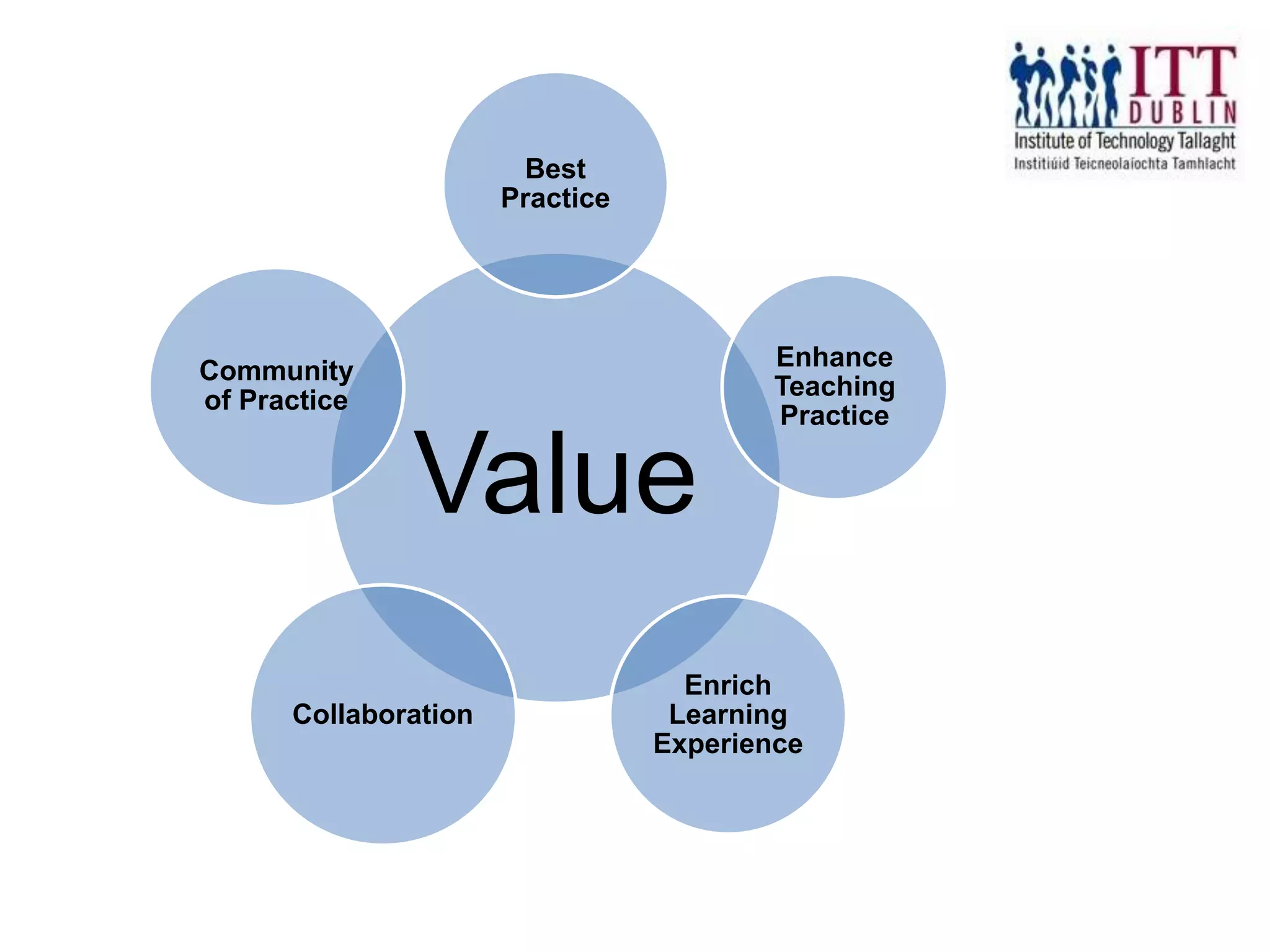
Value
Best
Practice
Enhance
Teaching
Practice
Enrich
Learning
Experience
Collaboration
Community
of Practice
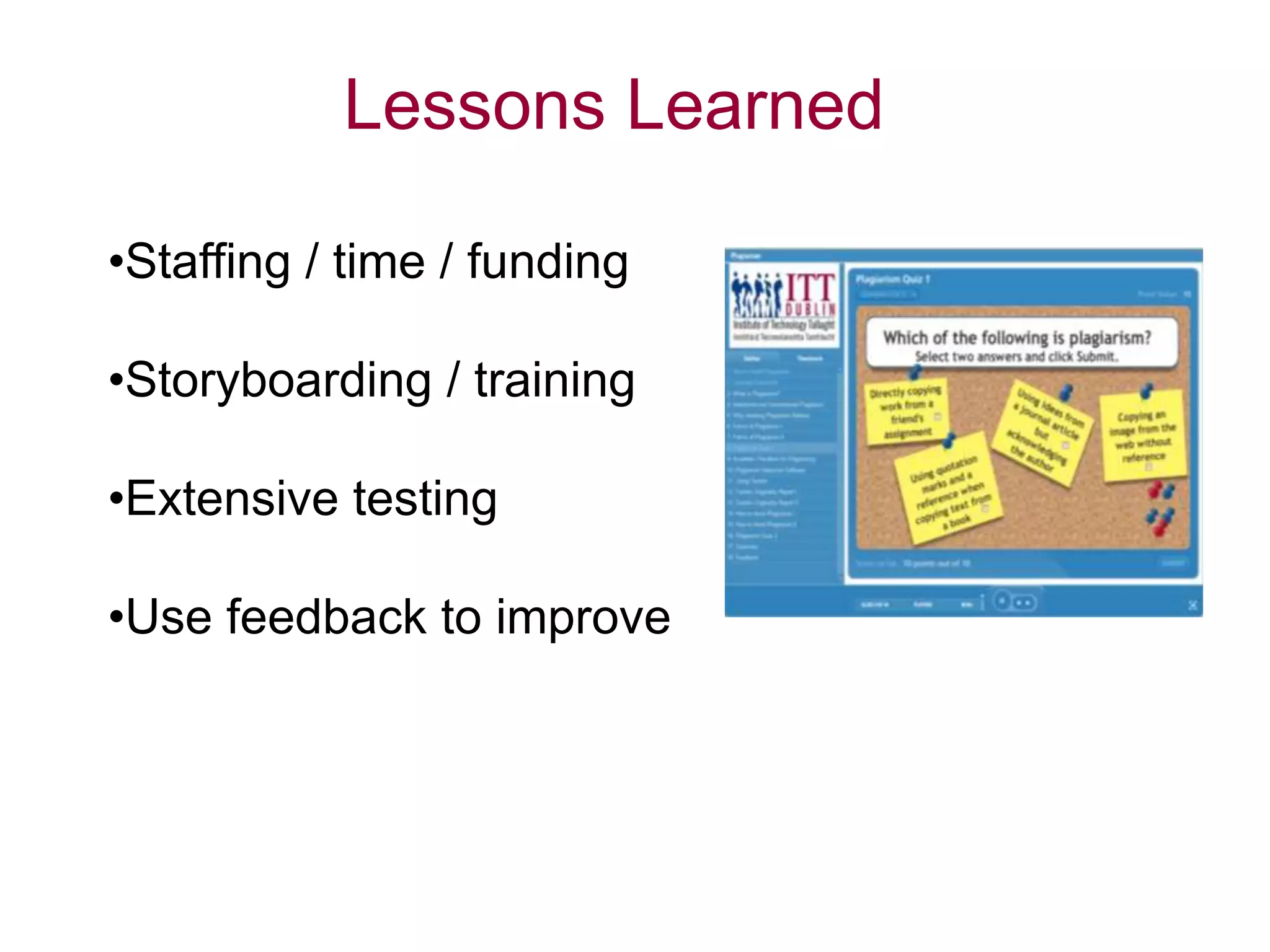
•Staffing / time / funding
•Storyboarding / training
•Extensive testing
•Use feedback to improve
Lessons Learned
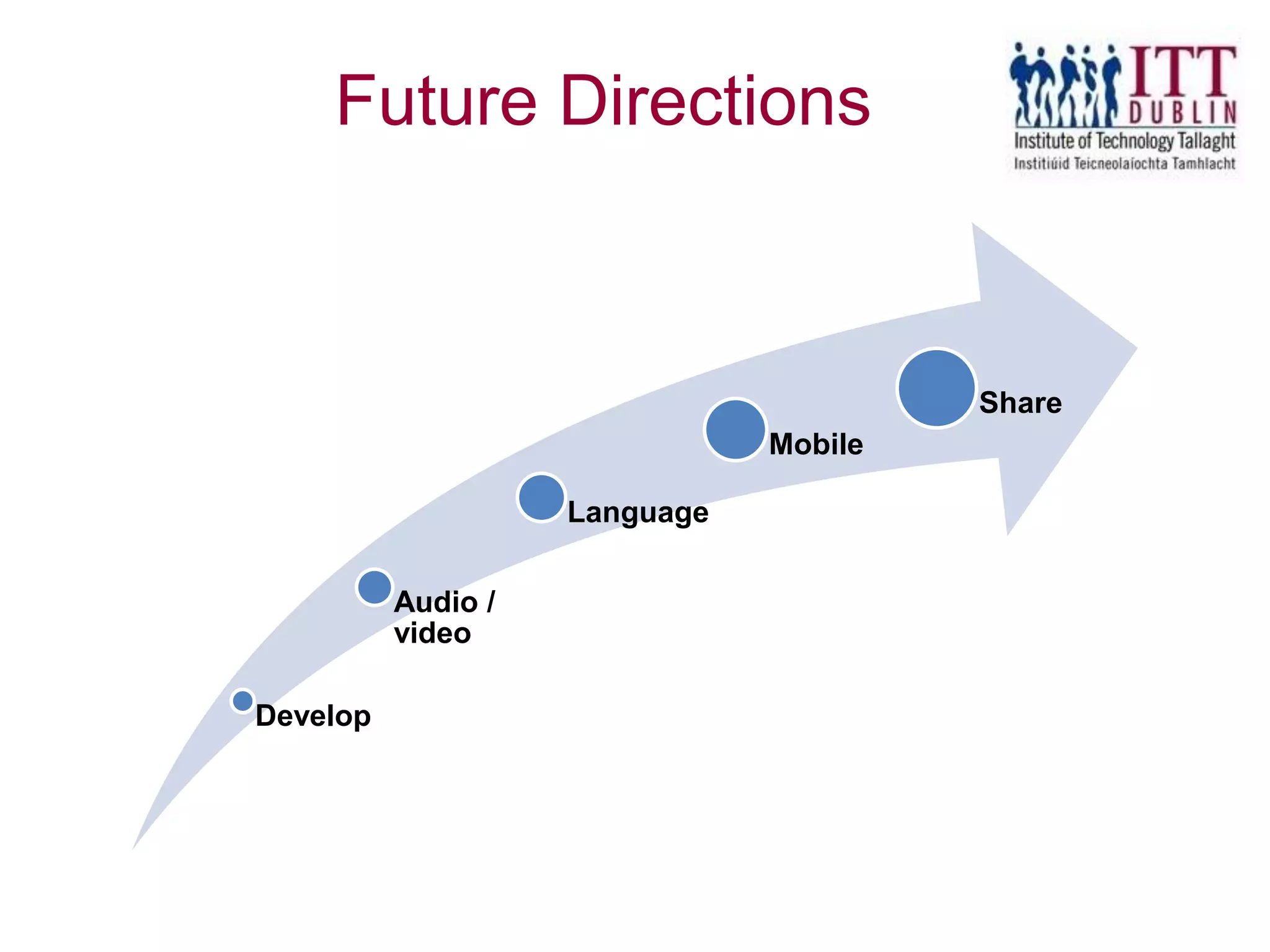
Future Directions
Develop
Audio /
video
Language
Mobile
Share
Thank You
ITT Dublin library RLOs at:
http://library.ittdublin.ie/screens/tut.html
philip.russell@ittdublin.ie
Biggs, J. (1999) Teaching for Quality Learning at University.
Buckingham: SRHE and Open University Press.
Blummer, B.A. and Kritskaya, O. (2009) Best practices for creating an
online tutorial: a literature review. Journal of Web Librarianship, 3(3),
pp.199-216.
Collery, J, (2014) Nuts and Bolts of Developing an Online Plagiarism
Tutorial. LIR Annual Seminar, Trinity College Dublin, 21st March 2014.
Graham, N. & Secker, J. (2012) Librarians, information literacy and
open educational resources: report of a survey. Available at:
http://delilaopen.files.wordpress.com/2012/04/findingsharingoers_rep
ortfinal1.pdf [Retrieved 4th September 2014].
].
Mackey, T.P and Jacobson, T.E. (2011) Teaching information
literacy online. London: Facet.
References
Mestre, L.S., et al (2011) Creating learning objects for information
literacy: an exploration in best practices. College & Research
Libraries, 72 (3), pp.236-252.
Russell P. et al (2013). Creating, sharing and reusing learning objects
to enhance information literacy. Journal of Information Literacy,
December 2013, Volume 7, Issue 2. Available at
http://dx.doi.org/10.11645/7.2.1744 [Retrieved 4th September 2014].
References
Slide 1: David Peters. Sharing Book Cover
http://commons.wikimedia.org/wiki/File:10_sharing_book_cover.pdf
Slide 5: Paul Kilne. Dad’s Helping Hand
https://www.flickr.com/photos/paulelijah/14116599256/sizes/l/
Slide 9: Gerd Altmann. Learning
http://pixabay.com/en/learn-note-sign-directory-64058/
Slide 11: Sabine Schulte. Tools
http://pixabay.com/p-384740/?no_redirect
Slide 15: AJ Cann. Feedback Checklist.
https://www.flickr.com/photos/ajc1/9568156463/
Slide 18: Blink and you’ll miss it
https://secure.flickr.com/photos/comedynose/4058757916/
Image Attributions

reusable learning objects. author: philip russell

  • 1.
    Going the Distance:Best Practices in Designing & Sharing Reusable Learning Objects Philip Russell Deputy Librarian Institute of Technology Tallaght LIR Tech Tools for Teaching DCU, December 9th 2014
  • 2.
    Background •Institute of TechnologyTallaght (ITT Dublin) - range of courses / 4500 FTEs •Information literacy (IL) / eLearning - strategic focus: - 3 level IL Framework (2004) - Strategic Plan (2009-2014) - Learning, Teaching & Assessment Strategy (2011)
  • 3.
    ‘How To’ OnlineTutorials •May 2010 - aimed at undergraduates / postgraduates •Self-paced / interactive / 24x7 •Research, critical thinking, academic integrity, referencing, academic skills •Sustainable / reusable under Creative Commons
  • 4.
    Project Plan -ADDIE Model Analyse Design Develop Implement Evaluate
  • 5.
    Planning •Rationale •Secured HE funding •Reviewedexisting online tutorials •ITT resources created from scratch •Support from IT / learning technologists / Leeds University
  • 6.
    •Biggs’ Model ofConstructive Alignment (1999) - generic learning outcomes - learning activities - assessment methods •Active learning / range of learning styles Instructional Design
  • 7.
    9 Steps Gaining learners attention Informing learners of objectives Stimulating recall ofprior learning Highlighting key features Structuring learning Encouraging activity Providing feedback Assessing performance Enhancing retention and transfer Gagné’s 9 Steps
  • 8.
    •Detailed storyboarding •Language /consistent font / bullet points •Branding / logo •Accessible Content Design
  • 9.
    2004-2005 Learning Landscape •Created with Articulate Studio09 •Engaging content / quizzes •Non technical / easy to use functionality Development Tools
  • 10.
    •Pedagogical training - learningstyles / methodologies / assessment - online instructional design •ICT training - eLearning software - Image editing – Photoshop - Web editing – HTML,Dreamweaver, CSS Training
  • 11.
    •September 2010 -extensive usability testing / feedback / piloting •SCORM (sharable content object reference model) 1.2 compliant •W3C AAA (Web Content Accessibility) Guidelines 1.0 •Creative Commons Attribution-Non-commercial-Share Alike 4.0 International licence •Available via multiple delivery platforms (website, VLE, institutional repository) Testing & Accessibility
  • 12.
    •Tutorials embedded intoacademic modules via Institute VLE – Moodle •Enhanced IL delivery -Blended approach -Learning to Learn module -September 2014 – tutorials integrated into over 50 academic modules Implementation
  • 13.
    Tutorial Usage 76% 10% 8% 6% Undergraduate Postgraduate Academic Support staff/ other Sept. 2010 – Sept. 2014 Total Completions: 5944
  • 14.
    Evaluation Methods • SurveyGizmo •VLE/Google Analytics • Focus Groups • Online Repositories
  • 15.
    Feedback Students • Improved IL competencies •Independent learning • Transition into higher education Staff • Enhanced course content • Accessibility of resources • Advocates for sharing
  • 16.
    Students’ Comments “As anew student this online resource has made my introduction to college a lot easier, and helped me with my studies. I feel that I am more likely to succeed now at all levels of my course” “Great tutorial - very good explanation of plagiarism and how to avoid it. Thought the quiz was very useful - meant I could check that I understood the material in the tutorial.” “An excellent learning resource – but please add some audio for students with reading difficulties, video content would also be of help.”
  • 17.
    •Institutional repositories / national learningobject repositories •Conferences, seminars, workshops, professional networks •Publications Share and Reuse
  • 18.
  • 19.
    Sharing With theWider Community
  • 20.
    Slide reproduced withkind permission from J Collery (UCD)
  • 21.
    •Generic resources •Interoperable software/ SCORM •Explicit licencing details •Accessible & discoverable •Promote / lead by example Factors to Consider for Reuse
  • 22.
  • 23.
    •Staffing / time/ funding •Storyboarding / training •Extensive testing •Use feedback to improve Lessons Learned
  • 24.
  • 25.
    Thank You ITT Dublinlibrary RLOs at: http://library.ittdublin.ie/screens/tut.html philip.russell@ittdublin.ie
  • 26.
    Biggs, J. (1999)Teaching for Quality Learning at University. Buckingham: SRHE and Open University Press. Blummer, B.A. and Kritskaya, O. (2009) Best practices for creating an online tutorial: a literature review. Journal of Web Librarianship, 3(3), pp.199-216. Collery, J, (2014) Nuts and Bolts of Developing an Online Plagiarism Tutorial. LIR Annual Seminar, Trinity College Dublin, 21st March 2014. Graham, N. & Secker, J. (2012) Librarians, information literacy and open educational resources: report of a survey. Available at: http://delilaopen.files.wordpress.com/2012/04/findingsharingoers_rep ortfinal1.pdf [Retrieved 4th September 2014]. ]. Mackey, T.P and Jacobson, T.E. (2011) Teaching information literacy online. London: Facet. References
  • 27.
    Mestre, L.S., etal (2011) Creating learning objects for information literacy: an exploration in best practices. College & Research Libraries, 72 (3), pp.236-252. Russell P. et al (2013). Creating, sharing and reusing learning objects to enhance information literacy. Journal of Information Literacy, December 2013, Volume 7, Issue 2. Available at http://dx.doi.org/10.11645/7.2.1744 [Retrieved 4th September 2014]. References
  • 28.
    Slide 1: DavidPeters. Sharing Book Cover http://commons.wikimedia.org/wiki/File:10_sharing_book_cover.pdf Slide 5: Paul Kilne. Dad’s Helping Hand https://www.flickr.com/photos/paulelijah/14116599256/sizes/l/ Slide 9: Gerd Altmann. Learning http://pixabay.com/en/learn-note-sign-directory-64058/ Slide 11: Sabine Schulte. Tools http://pixabay.com/p-384740/?no_redirect Slide 15: AJ Cann. Feedback Checklist. https://www.flickr.com/photos/ajc1/9568156463/ Slide 18: Blink and you’ll miss it https://secure.flickr.com/photos/comedynose/4058757916/ Image Attributions