Gauging MOOC Learners’
Adherence to the Designed
Learning Path
Dan Davis
Web Information Systems
EEMCS, Delft University of Technology
WIS.Lambda
Using and advancing user modeling techniques in the context
of open online education at scale in developing a learner
modeling-focused approach to learning analytics
Learning transfer in MOOCs
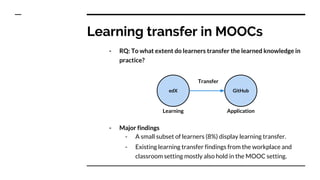
- RQ: To what extent do learners transfer the learned knowledge in
practice?
- Major findings
- A small subset of learners (8%) display learning transfer.
- Existing learning transfer findings from the workplace and
classroom setting mostly also hold in the MOOC setting.
edX GitHub
Transfer
Learning Application
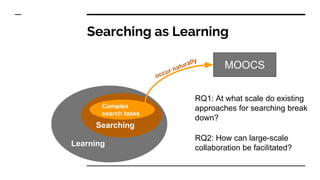
Searching as Learning
Learning
Searching
Complex
search tasks
MOOCS
occur naturally
RQ1: At what scale do existing
approaches for searching break
down?
RQ2: How can large-scale
collaboration be facilitated?
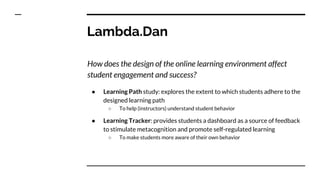
Lambda.Dan
How does the design of the online learning environment affect
student engagement and success?
● Learning Path study: explores the extent to which students adhere to the
designed learning path
○ To help (instructors) understand student behavior
● Learning Tracker: provides students a dashboard as a source of feedback
to stimulate metacognition and promote self-regulated learning
○ To make students more aware of their own behavior
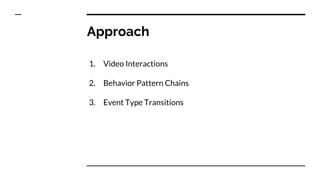
Approach
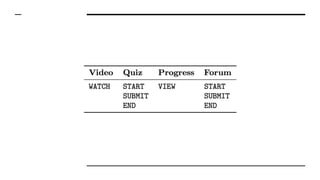
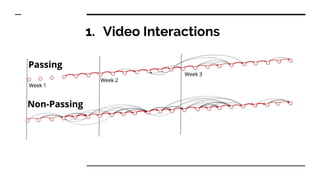
1. Video Interactions
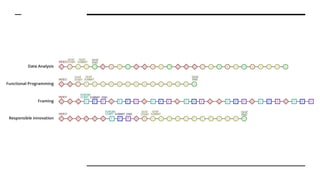
2. Behavior Pattern Chains
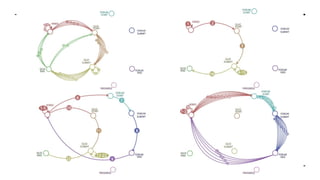
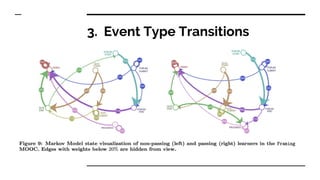
3. Event Type Transitions
1. Video Interactions
2. Behavior Pattern Chains
3. Event Type Transitions
Conclusion
Before adaptive learning systems can reach their potential, two important
baselines must be established:
1. the precise learning path the instructor wants the student to follow and
2. students’ natural behavior within the course.
Adaptive instruction will be most effective when the differences between
these two baselines are both identified and addressed.
Thank you!
Dan Davis
Web Information Systems
EEMCS, Delft University of Technology

Gauging MOOC Learners' Adherence to the Designed Learning Path

  • 1.
    Gauging MOOC Learners’ Adherenceto the Designed Learning Path Dan Davis Web Information Systems EEMCS, Delft University of Technology
  • 2.
    WIS.Lambda Using and advancinguser modeling techniques in the context of open online education at scale in developing a learner modeling-focused approach to learning analytics
  • 3.
    Learning transfer inMOOCs - RQ: To what extent do learners transfer the learned knowledge in practice? - Major findings - A small subset of learners (8%) display learning transfer. - Existing learning transfer findings from the workplace and classroom setting mostly also hold in the MOOC setting. edX GitHub Transfer Learning Application
  • 4.
    Searching as Learning Learning Searching Complex searchtasks MOOCS occur naturally RQ1: At what scale do existing approaches for searching break down? RQ2: How can large-scale collaboration be facilitated?
  • 5.
    Lambda.Dan How does thedesign of the online learning environment affect student engagement and success? ● Learning Path study: explores the extent to which students adhere to the designed learning path ○ To help (instructors) understand student behavior ● Learning Tracker: provides students a dashboard as a source of feedback to stimulate metacognition and promote self-regulated learning ○ To make students more aware of their own behavior
  • 10.
    Approach 1. Video Interactions 2.Behavior Pattern Chains 3. Event Type Transitions
  • 11.
  • 12.
  • 13.
    3. Event TypeTransitions
  • 14.
    Conclusion Before adaptive learningsystems can reach their potential, two important baselines must be established: 1. the precise learning path the instructor wants the student to follow and 2. students’ natural behavior within the course. Adaptive instruction will be most effective when the differences between these two baselines are both identified and addressed.
  • 15.
    Thank you! Dan Davis WebInformation Systems EEMCS, Delft University of Technology