OPERATING SYSTEM
PROGRAMS
PREPARED BY:
JOTHAM A. GADOT
OPERATING SYSTEM
 is a set of programs containing
instructions that work together to
coordinate all the activities among
hardware resources.
 Most operating perform similar functions
that includes the following:
starting and shutting down a computer
 providing a user interface
 managing programs
Operating System
memory coordinating tasks
configuring devices
establishing an internet connection
and other utilities, and automatically
updating itself and certain utility programs.
STAND ALONE OPERATING SYSTEM
 a complete Os that works on a
desktop computer, notebook computer
or mobile computing device.
 are called client OS because they also
work in conjunction with a server OS.
EXAMPLES OF CURRENTLY USE STAND
ALONE OPERATING SYSTEM
Windows 7 - Microsoft fastest, most
efficient OS to date, offering quicker
program start up, built in diagnostics,
automatic recovery, improved security and
others.
Mac Os X - Macintosh OS has a standard
for operating System ease of use and has
been the model for most of the new GUI’s
developed for non – Macintosh systems.
 LINUX – One of the fastest growing OS.
Includes many programming languages and utility
programs.
 UNIX – is a multitasking OS. Several versions of
this operating system exist, each slightly different.
Although some versions of UNIX have a command
line interface. Most versions of UNIX offer a graphical
user interface.
Types of Operating System
Programs
REAL TIME
a multitasking operating system that aims at
executing real-time applications.
often use specialized scheduling algorithms so that
they can achieve a deterministic nature of behavior.
 The main objective of real-time operating systems
is their quick and predictable response to events.
They have an event-driven or time-sharing design
and often aspects of both. An event-driven system
switches between tasks based on their priorities or
external events while time-sharing operating
systems switch tasks based on clock interrupts.
Multi-user
 allows multiple users to access a
computer system at the same time. Time-
sharing systems and Internet servers can
be classified as multi-user systems as they
enable multiple-user access to a computer
through the sharing of time. Single-user
operating systems have only one user but
may allow multiple programs to run at the
same time.
Multi-tasking vs. Single-Tasking
 This is the type of operating system most people use
on their desktop and laptop computer today.
 Microsoft Windows and Apple’s Mac OS platform are
both example of operating system that will let a single
user have several programs in operation at the same
time.
 For example, its entirely possible for a Windows user
to be writing a note in a word processor while
downloading a file from the internet while printing the
text of an email message.
Single User/Single Tasks
 This operating system is designed to manage the
computer so that user can effectively do one thing at a
time.
Example:
The Palm OS for palm handheld computer is a good
example of modern single users, single tasks operating
system.
CONTROL PROGRAMS
 A program that enhances an operating system by
creating an environment in which you
can run other programs. Control programs
generally provide a graphical interface and
enable you to run several programs at once in
different windows.
 Control programs are also called operating
environments.
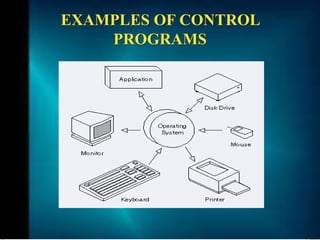
EXAMPLES OF CONTROL
PROGRAMS
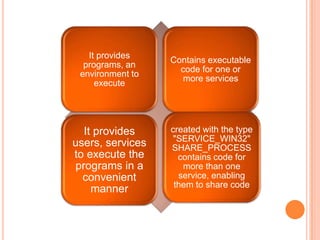
It provides
programs, an
environment to
execute
Contains executable
code for one or
more services
It provides
users, services
to execute the
programs in a
convenient
manner
created with the type
"SERVICE_WIN32"
SHARE_PROCESS
contains code for
more than one
service, enabling
them to share code
Common Services Provided by
Operating System
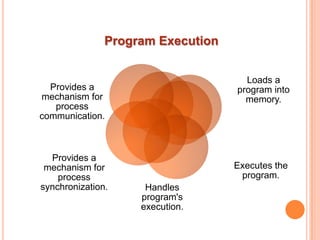
Program Execution
Loads a
program into
memory.
Executes the
program.
Handles
program's
execution.
Provides a
mechanism for
process
synchronization.
Provides a
mechanism for
process
communication.
I/O Operation
I/O operation means read or write operation
with any file or any specific I/O device.
Program may require any I/O device while
running.
Operating system provides the access to
the required I/O device when required.
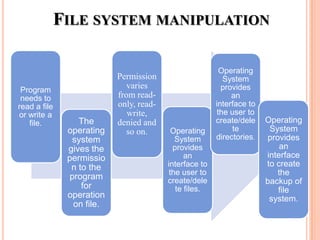
FILE SYSTEM MANIPULATION
Program
needs to
read a file
or write a
file. The
operating
system
gives the
permissio
n to the
program
for
operation
on file.
Permission
varies
from read-
only, read-
write,
denied and
so on. Operating
System
provides
an
interface to
the user to
create/dele
te files.
Operating
System
provides
an
interface to
the user to
create/dele
te
directories.
Operating
System
provides
an
interface
to create
the
backup of
file
system.
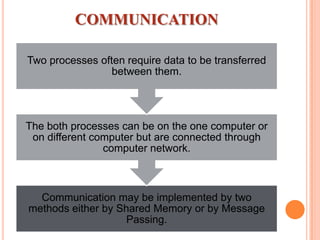
COMMUNICATION
Communication may be implemented by two
methods either by Shared Memory or by Message
Passing.
The both processes can be on the one computer or
on different computer but are connected through
computer network.
Two processes often require data to be transferred
between them.
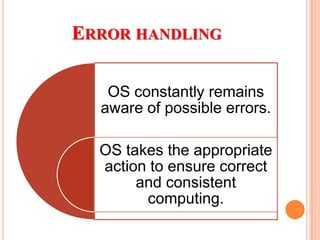
ERROR HANDLING
OS constantly remains
aware of possible errors.
OS takes the appropriate
action to ensure correct
and consistent
computing.
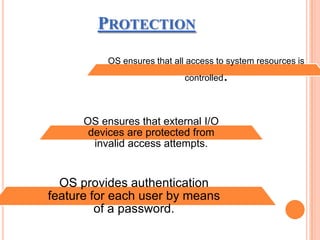
PROTECTION
OS ensures that all access to system resources is
controlled.
OS ensures that external I/O
devices are protected from
invalid access attempts.
OS provides authentication
feature for each user by means
of a password.
COPYRIGHT
 protects the original expression of ideas in tangible
forms such as literature, music, drama and art.
Copyright protection also extends to computer
software. A work is automatically subject to
copyright as soon as it is recorded in a tangible form.
 Under copyright law, people must not:
 Copy the software for other people
 Lend the software to other people the software to
other people
 Install the software on a network when other users
can access it (unless it is a special ‘network’
version
SOFTWARE COPYRIGHT
 all software is protected by copyright--
even Linux (Linux just has a really broad
license).
 There is also a program called Official
Copyright Software that helps creators
through the process of registering their
works.
SOFTWARE LICENSE
 a legal instrument (usually by way of contract law, with or
without printed material) governing the use or
redistribution of software.
 Under United States copyright law
all software is copyright protected, except material in the
public domain.
 A typical software license grants an end-user permission to
use one or more copies of software in ways where such a
use would otherwise potentially constitute copyright
infringement of the software owner's exclusive rights under
copyright law.
EXAMPLES OF SOFTWARE LICENSE
 shrink wrap contract: an example of a license for which
the originators maintain strict control over the software
component is the Microsoft Windows Operating System
software. This has helped Microsoft successfully gain a
dominant position in the software market: Microsoft
Licensing.
 free software license: The GNU GPL is aimed at
providing licenses with significant permissions and rights.
There are restrictions in the license -- the licensee must
pass on the receivthey provide the software. Once a piece
of software is distributed under the GPL that released
copy will always be available with the permissions and
rights received.
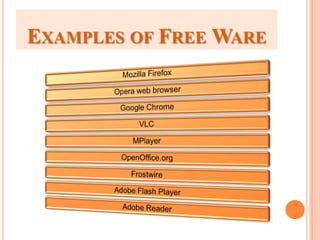
FREEWARE
FREEWARE
Copyrighted software given away for free by
the author. Although it is available for free,
the author retains the copyright, which
means that you cannot do anything with it
that is not expressly allowed by the author.
Usually, the author allows people to use the
software, but not sell it.
EXAMPLES OF FREE WARE
SHAREWARE
 Software distributed on the basis of an
honor system. Most shareware is delivered free
of charge, but the author usually requests that
you pay a small fee if you like the program and
use it regularly. By sending the small fee, you
become registered with the producer so that you
can receive service assistance and updates. You
can copy shareware and pass it along to friends
and colleagues, but they too are expected to pay
a fee if they use the product.
 shareware is inexpensive because it
is usually produced by a single
programmer and is offered directly to
customers. Thus, there are practically
no packaging or advertising expenses.
Note that shareware differs from public-
domain in that shareware is copyrighted.
This means that you cannot sell a
shareware product as your own.
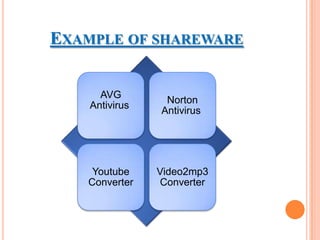
EXAMPLE OF SHAREWARE
AVG
Antivirus
Norton
Antivirus
Youtube
Converter
Video2mp3
Converter
A software is computer software that is
distributed along with its source code - the
code that is used to create the software -
under a special software license. The
license allows users to use, change and
improve the software's source code, and to
redistribute the software either before or
after it has been modified.
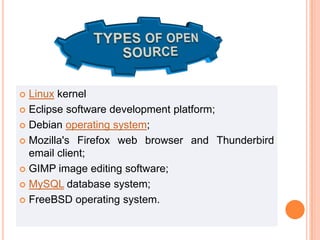
 Linux kernel
 Eclipse software development platform;
 Debian operating system;
 Mozilla's Firefox web browser and Thunderbird
email client;
 GIMP image editing software;
 MySQL database system;
 FreeBSD operating system.
REFERENCES
 http://en.wikipedia.org/wiki/List_of_software_license
s
 http://www.igcseict.info/theory/6/copy/
 http://www.gitam.edu/eresource/comp/gvr(os)/3.2.ht
m
 http://www.webopedia.com/TERM/S/shareware.htm
l
http://www.tutorialspoint.com/operating_system/os_
services.htm
THANKS FOR WATCHING ! ! !

Opeating system programs

  • 1.
  • 2.
    OPERATING SYSTEM  isa set of programs containing instructions that work together to coordinate all the activities among hardware resources.  Most operating perform similar functions that includes the following: starting and shutting down a computer  providing a user interface  managing programs
  • 3.
    Operating System memory coordinatingtasks configuring devices establishing an internet connection and other utilities, and automatically updating itself and certain utility programs.
  • 5.
    STAND ALONE OPERATINGSYSTEM  a complete Os that works on a desktop computer, notebook computer or mobile computing device.  are called client OS because they also work in conjunction with a server OS.
  • 6.
    EXAMPLES OF CURRENTLYUSE STAND ALONE OPERATING SYSTEM Windows 7 - Microsoft fastest, most efficient OS to date, offering quicker program start up, built in diagnostics, automatic recovery, improved security and others. Mac Os X - Macintosh OS has a standard for operating System ease of use and has been the model for most of the new GUI’s developed for non – Macintosh systems.
  • 7.
     LINUX –One of the fastest growing OS. Includes many programming languages and utility programs.  UNIX – is a multitasking OS. Several versions of this operating system exist, each slightly different. Although some versions of UNIX have a command line interface. Most versions of UNIX offer a graphical user interface.
  • 8.
    Types of OperatingSystem Programs
  • 9.
    REAL TIME a multitaskingoperating system that aims at executing real-time applications. often use specialized scheduling algorithms so that they can achieve a deterministic nature of behavior.  The main objective of real-time operating systems is their quick and predictable response to events. They have an event-driven or time-sharing design and often aspects of both. An event-driven system switches between tasks based on their priorities or external events while time-sharing operating systems switch tasks based on clock interrupts.
  • 10.
    Multi-user  allows multipleusers to access a computer system at the same time. Time- sharing systems and Internet servers can be classified as multi-user systems as they enable multiple-user access to a computer through the sharing of time. Single-user operating systems have only one user but may allow multiple programs to run at the same time.
  • 11.
    Multi-tasking vs. Single-Tasking This is the type of operating system most people use on their desktop and laptop computer today.  Microsoft Windows and Apple’s Mac OS platform are both example of operating system that will let a single user have several programs in operation at the same time.  For example, its entirely possible for a Windows user to be writing a note in a word processor while downloading a file from the internet while printing the text of an email message.
  • 12.
    Single User/Single Tasks This operating system is designed to manage the computer so that user can effectively do one thing at a time. Example: The Palm OS for palm handheld computer is a good example of modern single users, single tasks operating system.
  • 14.
    CONTROL PROGRAMS  Aprogram that enhances an operating system by creating an environment in which you can run other programs. Control programs generally provide a graphical interface and enable you to run several programs at once in different windows.  Control programs are also called operating environments.
  • 15.
  • 17.
    It provides programs, an environmentto execute Contains executable code for one or more services It provides users, services to execute the programs in a convenient manner created with the type "SERVICE_WIN32" SHARE_PROCESS contains code for more than one service, enabling them to share code
  • 18.
    Common Services Providedby Operating System
  • 19.
    Program Execution Loads a programinto memory. Executes the program. Handles program's execution. Provides a mechanism for process synchronization. Provides a mechanism for process communication.
  • 20.
    I/O Operation I/O operationmeans read or write operation with any file or any specific I/O device. Program may require any I/O device while running. Operating system provides the access to the required I/O device when required.
  • 21.
    FILE SYSTEM MANIPULATION Program needsto read a file or write a file. The operating system gives the permissio n to the program for operation on file. Permission varies from read- only, read- write, denied and so on. Operating System provides an interface to the user to create/dele te files. Operating System provides an interface to the user to create/dele te directories. Operating System provides an interface to create the backup of file system.
  • 22.
    COMMUNICATION Communication may beimplemented by two methods either by Shared Memory or by Message Passing. The both processes can be on the one computer or on different computer but are connected through computer network. Two processes often require data to be transferred between them.
  • 23.
    ERROR HANDLING OS constantlyremains aware of possible errors. OS takes the appropriate action to ensure correct and consistent computing.
  • 24.
    PROTECTION OS ensures thatall access to system resources is controlled. OS ensures that external I/O devices are protected from invalid access attempts. OS provides authentication feature for each user by means of a password.
  • 26.
    COPYRIGHT  protects theoriginal expression of ideas in tangible forms such as literature, music, drama and art. Copyright protection also extends to computer software. A work is automatically subject to copyright as soon as it is recorded in a tangible form.  Under copyright law, people must not:  Copy the software for other people  Lend the software to other people the software to other people  Install the software on a network when other users can access it (unless it is a special ‘network’ version
  • 27.
    SOFTWARE COPYRIGHT  allsoftware is protected by copyright-- even Linux (Linux just has a really broad license).  There is also a program called Official Copyright Software that helps creators through the process of registering their works.
  • 29.
    SOFTWARE LICENSE  alegal instrument (usually by way of contract law, with or without printed material) governing the use or redistribution of software.  Under United States copyright law all software is copyright protected, except material in the public domain.  A typical software license grants an end-user permission to use one or more copies of software in ways where such a use would otherwise potentially constitute copyright infringement of the software owner's exclusive rights under copyright law.
  • 30.
    EXAMPLES OF SOFTWARELICENSE  shrink wrap contract: an example of a license for which the originators maintain strict control over the software component is the Microsoft Windows Operating System software. This has helped Microsoft successfully gain a dominant position in the software market: Microsoft Licensing.  free software license: The GNU GPL is aimed at providing licenses with significant permissions and rights. There are restrictions in the license -- the licensee must pass on the receivthey provide the software. Once a piece of software is distributed under the GPL that released copy will always be available with the permissions and rights received.
  • 31.
  • 32.
    FREEWARE Copyrighted software givenaway for free by the author. Although it is available for free, the author retains the copyright, which means that you cannot do anything with it that is not expressly allowed by the author. Usually, the author allows people to use the software, but not sell it.
  • 33.
  • 35.
    SHAREWARE  Software distributedon the basis of an honor system. Most shareware is delivered free of charge, but the author usually requests that you pay a small fee if you like the program and use it regularly. By sending the small fee, you become registered with the producer so that you can receive service assistance and updates. You can copy shareware and pass it along to friends and colleagues, but they too are expected to pay a fee if they use the product.
  • 36.
     shareware isinexpensive because it is usually produced by a single programmer and is offered directly to customers. Thus, there are practically no packaging or advertising expenses. Note that shareware differs from public- domain in that shareware is copyrighted. This means that you cannot sell a shareware product as your own.
  • 37.
  • 39.
    A software iscomputer software that is distributed along with its source code - the code that is used to create the software - under a special software license. The license allows users to use, change and improve the software's source code, and to redistribute the software either before or after it has been modified.
  • 40.
     Linux kernel Eclipse software development platform;  Debian operating system;  Mozilla's Firefox web browser and Thunderbird email client;  GIMP image editing software;  MySQL database system;  FreeBSD operating system.
  • 41.
    REFERENCES  http://en.wikipedia.org/wiki/List_of_software_license s  http://www.igcseict.info/theory/6/copy/ http://www.gitam.edu/eresource/comp/gvr(os)/3.2.ht m  http://www.webopedia.com/TERM/S/shareware.htm l http://www.tutorialspoint.com/operating_system/os_ services.htm
  • 42.