B Y : I S A A C C A R T E R
Object-Oriented Analysis and
Design
WHAT HAVE I BEEN UP TOO?
• Started a Raspberry Pi Meetup for DC
• Currently working on a location
• Work at 5AM never ends
• Started up a book club here at 5AM
• Beginning to do development on Linux Mint
• You will learn a ton when you work on an open source
project
• I been doing some podcasting
DIFFERENT KIND OF JUG
• Not much code at all
• Going to be asking you guys a lot of questions.
• There is no right or wrong answer
• Provides us a chance to learn from each other.
• Which is why we are here
DESIGN PATTERNS AND ME
• I’ve reached that point where I think more about
the design of the project
• Many books written about OO programming and
design
• We are going to cover one tonight
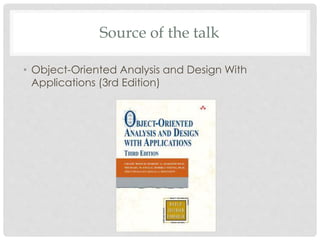
Source of the talk
• Object-Oriented Analysis and Design With
Applications (3rd Edition)
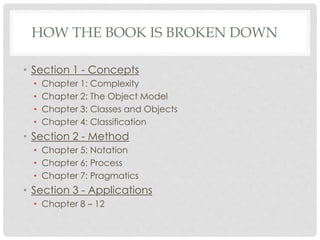
HOW THE BOOK IS BROKEN DOWN
• Section 1 - Concepts
• Chapter 1: Complexity
• Chapter 2: The Object Model
• Chapter 3: Classes and Objects
• Chapter 4: Classification
• Section 2 - Method
• Chapter 5: Notation
• Chapter 6: Process
• Chapter 7: Pragmatics
• Section 3 - Applications
• Chapter 8 – 12
QUESTION?
• When you think about OOAD, what are some things
that come to mind?
Chapter 1: Complexity
• Software is inherently complex
• The complexity of software often exceeds the brain’s
capacity
• Our job as a software engineer is to create the
illusion of simplicity
• Complex systems can be viewed by focusing on
either things or processes
QUESTION?
• What does good code look like?
• I can tell you what bad code is in small chunks, but
as an entire project as a whole or a system….how
can you tell what’s good and what’s bad?
CHAPTER 2: THE OBJECT MODEL
• Encompasses the principles of OO programming
• Encapsulation, Abstraction, Modularity, Hierarchy, Typing,
Concurrency, and Persistence
• Modularity is the property of a system that has
decomposed into a set of cohesive and loosely
coupled modules
• Typing is the enforcement of the class of an object
QUESTION?
• Are getters/setters evil?
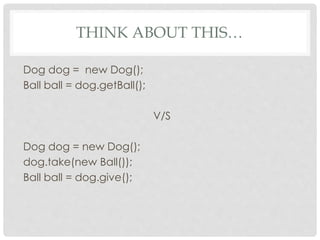
THINK ABOUT THIS…
Dog dog = new Dog();
Ball ball = dog.getBall();
V/S
Dog dog = new Dog();
dog.take(new Ball());
Ball ball = dog.give();
CHAPTER 3: CLASSES AND OBJECTS
• What is and What isn’t an object?
• Relationships are important among classes
• Multiplicity
• One-to-one, Many-to-many
• Inheritance
• Multiple Inheritance
• Role of Classes and Objects in Analysis and Design
• Identify the classes that form the vocab of the domain
• Create the structures for sets of objects to work together to
satisfy the requirements of the problem
QUESTION?
• Should every class have an interface?
CHAPTER 4: CLASSIFICATION
• How a class or object is named a fundamental issue
in OOAD
• This is how we discover what an object can do
QUESTION
• What’s some of issues that we run into when naming
an object or method?
• I constantly run into “writer’s block” when naming
something, how can I get around that problem?
CHAPTER 5: NOTATION
• UML Diagrams
• Broken down into two sections
• Structure Diagrams
• Behavior Diagrams
• Can also include Interaction Diagrams
• Many kinds of diagrams
• I have used…
• Package Diagram
• Use Case Diagram
• Sequence Diagram
• Activity Diagram
• Used them to help create a SAD for a project
QUESTION?
• Does anyone use UML diagrams in their daily work?
• Does anyone feel that UML diagrams are pointless?
CHAPTER 6: PROCESS
• Talked about how to create a solid development
process
• We have steps in place here at 5AM.
• Prior to development
• During development
• Post-development
CHAPTER 7: PRAGMATICS
• Planning
• We live and breath Scrum here at 5AM
• Tools
• Jenkins helps us create solid OO code
QUESTION
• What are some of the benefits of OO
development?
• What are some of the risks of OO development?
CHAPTERS 8 -12
• Each chapter sets the stage for a different scenario
and walks through the first 7 chapters on how to
implement each chapter
• Satellite-based Navigation system
• Traffic management system
• AI / Cryptanalysis system
• Weather monitoring station
• Vacation tracking system
IMHO OF THE BOOK
• Not really the best book over OOAD
• Five chapters dedicated to applying it, which made
them extremely hard to read
• Two chapters covering applying agile to OO
thinking
• I would still recommend reading it since there’s
nothing wrong with gaining more knowledge
SUMMARY
• Design, by nature, is a series of trade-offs
• Every choice has a good side and a bad side
• Make “informed” OO choices by the context of the
overall criteria, not because “of blind
programming”
SOURCES
• http://www.javaworld.com/article/2073723/core-
java/why-getter-and-setter-methods-are-
evil.html?page=2
• http://blog.shaunfinglas.co.uk/2015/04/getters-and-
setters-are-evil-redux.html
• http://www.amazon.com/Object-Oriented-
Analysis-Design-Applications-
3rd/dp/020189551X/ref=sr_1_2?s=books&ie=UTF8&qi
d=1434425605&sr=1-
2&keywords=object+oriented+analysis+and+design

OO design slide

  • 1.
    B Y :I S A A C C A R T E R Object-Oriented Analysis and Design
  • 2.
    WHAT HAVE IBEEN UP TOO? • Started a Raspberry Pi Meetup for DC • Currently working on a location • Work at 5AM never ends • Started up a book club here at 5AM • Beginning to do development on Linux Mint • You will learn a ton when you work on an open source project • I been doing some podcasting
  • 3.
    DIFFERENT KIND OFJUG • Not much code at all • Going to be asking you guys a lot of questions. • There is no right or wrong answer • Provides us a chance to learn from each other. • Which is why we are here
  • 4.
    DESIGN PATTERNS ANDME • I’ve reached that point where I think more about the design of the project • Many books written about OO programming and design • We are going to cover one tonight
  • 5.
    Source of thetalk • Object-Oriented Analysis and Design With Applications (3rd Edition)
  • 6.
    HOW THE BOOKIS BROKEN DOWN • Section 1 - Concepts • Chapter 1: Complexity • Chapter 2: The Object Model • Chapter 3: Classes and Objects • Chapter 4: Classification • Section 2 - Method • Chapter 5: Notation • Chapter 6: Process • Chapter 7: Pragmatics • Section 3 - Applications • Chapter 8 – 12
  • 7.
    QUESTION? • When youthink about OOAD, what are some things that come to mind?
  • 8.
    Chapter 1: Complexity •Software is inherently complex • The complexity of software often exceeds the brain’s capacity • Our job as a software engineer is to create the illusion of simplicity • Complex systems can be viewed by focusing on either things or processes
  • 9.
    QUESTION? • What doesgood code look like? • I can tell you what bad code is in small chunks, but as an entire project as a whole or a system….how can you tell what’s good and what’s bad?
  • 10.
    CHAPTER 2: THEOBJECT MODEL • Encompasses the principles of OO programming • Encapsulation, Abstraction, Modularity, Hierarchy, Typing, Concurrency, and Persistence • Modularity is the property of a system that has decomposed into a set of cohesive and loosely coupled modules • Typing is the enforcement of the class of an object
  • 11.
  • 12.
    THINK ABOUT THIS… Dogdog = new Dog(); Ball ball = dog.getBall(); V/S Dog dog = new Dog(); dog.take(new Ball()); Ball ball = dog.give();
  • 13.
    CHAPTER 3: CLASSESAND OBJECTS • What is and What isn’t an object? • Relationships are important among classes • Multiplicity • One-to-one, Many-to-many • Inheritance • Multiple Inheritance • Role of Classes and Objects in Analysis and Design • Identify the classes that form the vocab of the domain • Create the structures for sets of objects to work together to satisfy the requirements of the problem
  • 14.
    QUESTION? • Should everyclass have an interface?
  • 15.
    CHAPTER 4: CLASSIFICATION •How a class or object is named a fundamental issue in OOAD • This is how we discover what an object can do
  • 16.
    QUESTION • What’s someof issues that we run into when naming an object or method? • I constantly run into “writer’s block” when naming something, how can I get around that problem?
  • 17.
    CHAPTER 5: NOTATION •UML Diagrams • Broken down into two sections • Structure Diagrams • Behavior Diagrams • Can also include Interaction Diagrams • Many kinds of diagrams • I have used… • Package Diagram • Use Case Diagram • Sequence Diagram • Activity Diagram • Used them to help create a SAD for a project
  • 18.
    QUESTION? • Does anyoneuse UML diagrams in their daily work? • Does anyone feel that UML diagrams are pointless?
  • 19.
    CHAPTER 6: PROCESS •Talked about how to create a solid development process • We have steps in place here at 5AM. • Prior to development • During development • Post-development
  • 20.
    CHAPTER 7: PRAGMATICS •Planning • We live and breath Scrum here at 5AM • Tools • Jenkins helps us create solid OO code
  • 21.
    QUESTION • What aresome of the benefits of OO development? • What are some of the risks of OO development?
  • 22.
    CHAPTERS 8 -12 •Each chapter sets the stage for a different scenario and walks through the first 7 chapters on how to implement each chapter • Satellite-based Navigation system • Traffic management system • AI / Cryptanalysis system • Weather monitoring station • Vacation tracking system
  • 23.
    IMHO OF THEBOOK • Not really the best book over OOAD • Five chapters dedicated to applying it, which made them extremely hard to read • Two chapters covering applying agile to OO thinking • I would still recommend reading it since there’s nothing wrong with gaining more knowledge
  • 24.
    SUMMARY • Design, bynature, is a series of trade-offs • Every choice has a good side and a bad side • Make “informed” OO choices by the context of the overall criteria, not because “of blind programming”
  • 25.
    SOURCES • http://www.javaworld.com/article/2073723/core- java/why-getter-and-setter-methods-are- evil.html?page=2 • http://blog.shaunfinglas.co.uk/2015/04/getters-and- setters-are-evil-redux.html •http://www.amazon.com/Object-Oriented- Analysis-Design-Applications- 3rd/dp/020189551X/ref=sr_1_2?s=books&ie=UTF8&qi d=1434425605&sr=1- 2&keywords=object+oriented+analysis+and+design