Object‐Oriented Modeling 
and Design with UML
Subject Code :140703
Contents
Introduction
Object-oriented (OO) concept
OO characteristics
OO development
OO themes
Summary
SOFTWARE ENGINEERING
Introduction
• OO modeling and design is a way of thinking 
about problems using models organized 
around real world concepts
Introduction …
• Fundamental construct is the object, which 
combines both data structure and behavior
• OO modeling and design promotes
– Better understanding of requirements
• Analysis Design Implementation
object‐oriented notations & process
Contents
Introduction
Object-oriented (OO) concept
OO characteristics
OO development
OO themes
Summary
OO characteristics (1/4)
Identity
– Data is quantized into discrete, distinguishable
entities called objects
– Each object has is own inherent identity
• Two objects are distinct even if all their attribute values are
identical
– Each object has a unique handle by which it can be
referenced
• Handle in various ways such as an address, array index, or
artificial number
OO characteristics (2/4)
Classification
• Objects with the same data structure (attributes) and
behaviour (operations) are grouped into a class
• A Class is an abstraction that describes properties important
to an application and ignores the rest
•Each class describes an infinite set of individual objects
•An Object is an instance of a class
Polygon objects Polygon class
abstract Attributes Operations
into vertices draw
border color erase
fill color move
Objects and Classes
Examples for Class & Object
OO characteristics
Classification
• Objects with the same data structure (attributes) and
behaviour (operations) are grouped into a class
• A Class is an abstraction that describes properties important to
an application and ignores the rest
•Each class describes an infinite set of individual objects
Polygon objects Polygon class
abstract Attributes Operations
into vertices draw
border color erase
fill color move
An Object is an instance of a class
Derive the instances for the class
Attributes Operations/Methods
Class Object
Attributes Values Operations/Methods
? ?
OO characteristics(3/4)
Inheritance
Sharing of attributes and
operations (features) among
classes based on a hierarchical
relationship
• Super class has general
information that subclasses
refine and elaborate
• Each subclass incorporates,
or inherits, all the features of its
super class and adds its own
unique features
Greatly reduce repetition
•Ability to factor out common
features of several classes into a
super class
OO characteristics (4/4)
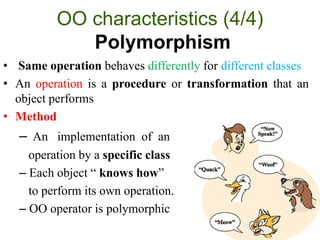
Polymorphism
• Same operation behaves differently for different classes
• An operation is a procedure or transformation that an
object performs
• Method
– An implementation of an
operation by a specific class
– Each object “ knows how”
to perform its own operation.
– OO operator is polymorphic
Contents
Introduction
Object-oriented (OO) concept
OO characteristics
OO development
OO themes
Summary
OO development (1/6)
• Essence of OO development
– Identification and organization of application concepts rather than their
final representation in programming language.
Modeling concepts, not implementation
– Focus on analysis and design
– Encourages software developers to work and think
– Should be identified, organized, and understood
• Premature focus on implementation restricts design choices
• Design flaws during implementation costs more and leads to
inferior product
– Conceptual process independent of a programming language (OO is 
fundamentally a way of thinking and not programming techniques.
OO development (2/6)
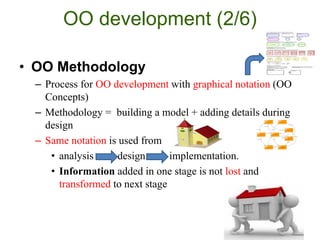
• OO Methodology
– Process for OO development with graphical notation (OO
Concepts)
– Methodology = building a model + adding details during
design
– Same notation is used from
• analysis design implementation.
• Information added in one stage is not lost and
transformed to next stage
Methodology Stages
• System Conception
• Analysis
• System Design
• Class Design
• Implementation
Methodology Stages
System conception (1/5)
s/w development begins with business analyst and formulate tentative
requirements
Analysis(2/5)
• Restates the requirements from system conception by constructing
models
• Analyst must work with the requestor to understand the problem
statements
• Analysis model (abstract) describes what to system must do,
and not how it will do.( no implementation decisions)
Domain model‐ description of all the module related to given problem
Application model‐ description about a specific task(visible to the user)
• Application experts who are not a
programmer can understand &
criticize good model
System Design(3/5)
• System architecture – solving the application problems
• System designer decides 
– what performance characteristics to optimize
– Choose a strategy of attacking the problems.
– Make tentative resource allocation.
Methodology Stages 
Class Design(4/5)
• Add details to the analysis model (based 
on system design strategy)
• Class designer elaborates both domain and 
application objects using the same OO concepts
& notation.
• Focus is to implement the data structure and 
algorithm.
Methodology Stages 
Implementation(5/5)
• Implementer translate class and relationship
Programming language, DB, H/W
• Programming should be straight forward (hard 
decision are already made)
• Follow good software engineering practice (S/M 
remains flexible & extensible)
OO development (3/6)
Modeling
A model is a simplification of reality
Abstraction for the purpose of understanding before
building it
Purpose
• Testing a physical entity before building it
• Communication with customers
• Visualization
• Reduction of complexity
Isolate those aspects which are important and suppress
the rest(unimportant)
Class 
State
Interaction
Design a System
For the objects in the system and
their relationship
For the life history of the object
For the interaction among the
objects
OO development (4/6)
Three models
Class model
• Function
• Describes the static structure of the object in the system –
identity, relationship to other object, attributes, operations
•“data” aspects of the system
• Provides context for state and interaction model
• Goal
• Capture important concepts of an application from the real
world
• Representation
• Class diagrams
• Generalization, aggregation
Nodes: Class
Arc: relationship B/W Classes
Graph
OO development (5/6)
Three models (Cont’d)
State model
• Function
• Describes objects’ time and sequencing of operation
• Goal
• Capture “control” aspect of system that describes the
sequences of operations that occur
• Representation
• State diagrams
Graph :
nodes-states ; arcs- transaction between states
OO development (6/6)
Three models (Cont’d)
Interaction model
• Function
• Describes interactions between objects
• Individual objects collaborate to achieve the behavior of the
whole system
• Goal
• Exchanges between objects and provides a holistic overview
of the operation of a system
• Representation
• Use cases, sequence diagrams, activity diagrams
Functionality of the system Interaction of the object
and their time sequence
Elaborates important
processing
Contents
Introduction
Object-oriented (OO) concept
OO characteristics
OO development
OO themes
Summary
OO themes (1/6)
Abstraction
•Focus on essential aspects of an application while ignoring
the details
•What an object is and does, before deciding how to
implement
• Preserves the freedom to make decision as long as
possible by Avoiding premature commitments to details
Just like a skeleton.
You can fit anything on
it you like.
Example
• A class called Animal. 
• It has properties like ears,colour, eyes but they are not defined.
• It has methods like Running(), Eating(), etc. but the method does not have 
any body
• all animals will have the above properties and methods but you decide 
how to do them. 
• sub class of the class Animal called Tiger. 
Color is yellow
running is very fast
color is black
running is very slow
OO themes (2/6)
Encapsulation
Separates the external aspects of an object from internal
implementation
Data structure and behaviour is encapsulated in a single
entity
Ensuring reliability and maintainability
• Information exchange is done by public interface among
objects
• Change internal data structure does not affect other
objects
Example
• capsule that the doctor gives us
• We just have to take the capsule to get better
• don't have to worry about
– what medicine is inside the capsule or
– how it will work on our body.
• user does not have to worry how this 
methods and properties work.
OO themes (3/6)
Combining data and behavior
Data structure hierarchy matches the operation
inheritance hierarchy
Is
data structure hierarchy
procedure hierarchy
Old approach
replaced
by
class hierarchy
OO approach
OO themes
Sharing (4/6)
No redundancy (Inheritance)
Reusability (tools- abstraction, inheritance, encapsulation)
Emphasis on the essence of an object (5/6)
Focus on what an object is
• Rather than how it is used
Synergy (6/6)
Identity, classification, polymorphism, inheritance
• Be clearer, more general and robust
Contents
Introduction
Object-oriented (OO) concept
OO characteristics
OO development
OO themes
Summary
Summary
Object-oriented development
Low cost in system maintenance
Adequate delivery on user’s requests
• Flexible and elastic in frequent system change
Reusability
Reliability
Make easier team working and communication

OOAD chapter 1