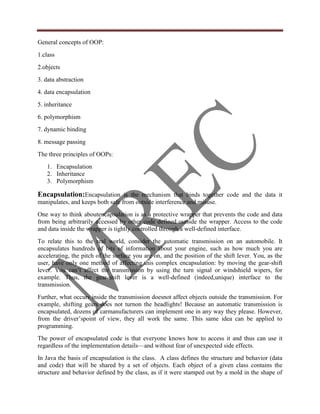
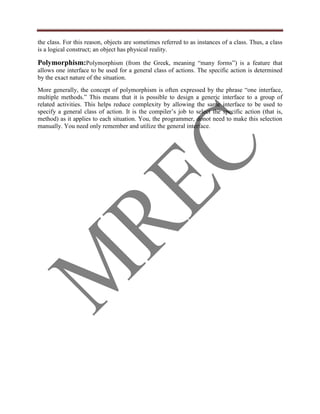
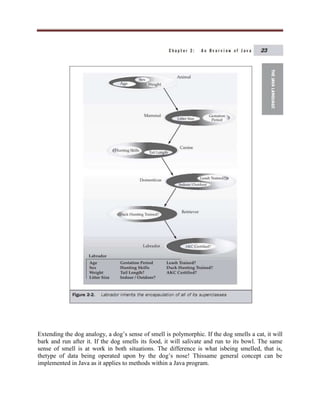
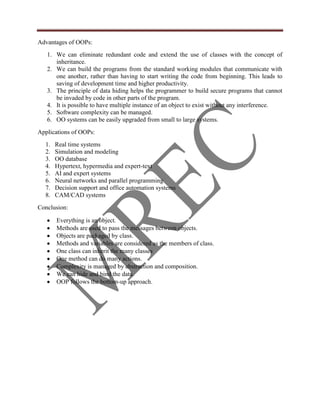
The document discusses object-oriented programming and several key concepts:
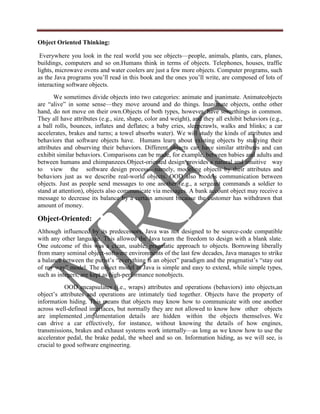
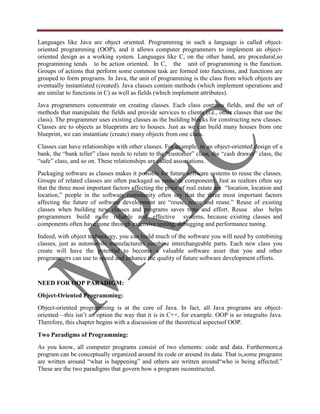
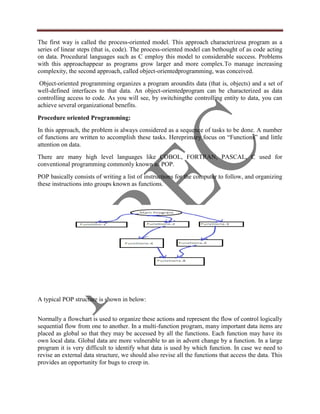
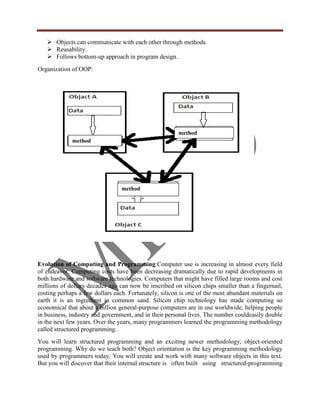
1) OOP organizes programs around objects and well-defined interfaces rather than procedural code. This improves modularity and reuse.
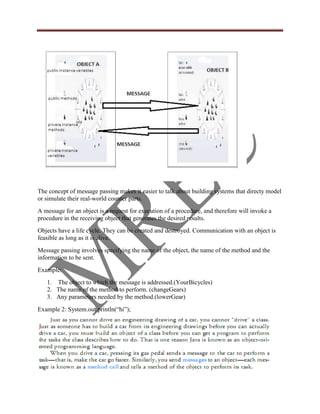
2) Objects encapsulate both data (attributes) and behaviors (methods) and communicate via messages. This mimics the real world.
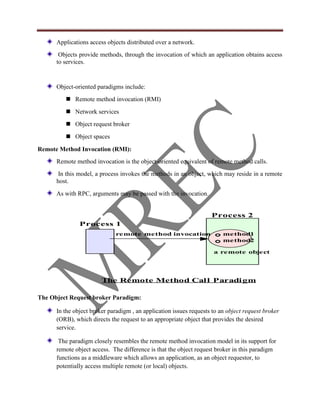
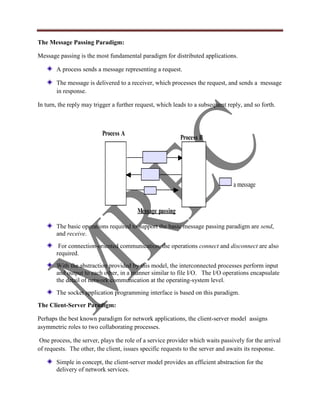
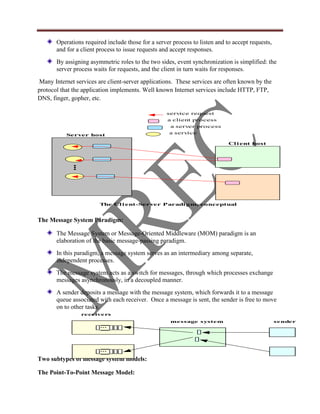
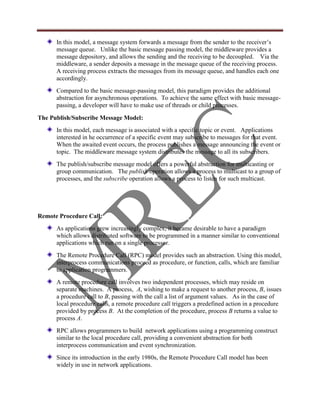
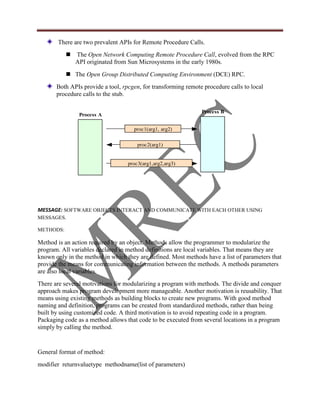
3) Distributed object systems allow objects to communicate across a network. Paradigms like remote method invocation, object request brokers, and object spaces define how this is implemented.




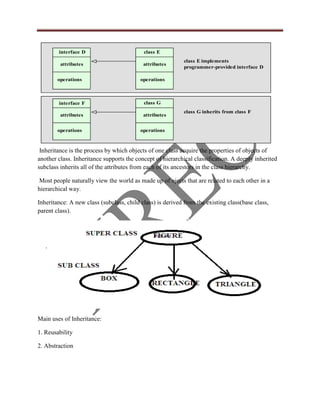
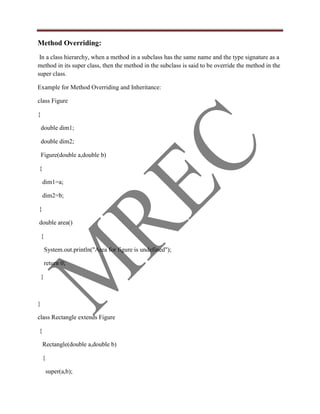
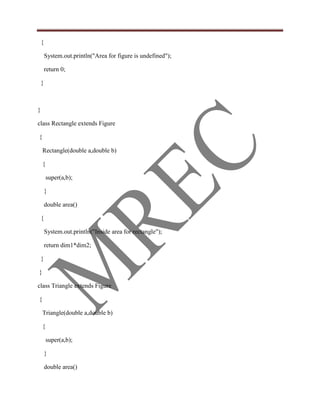
![}
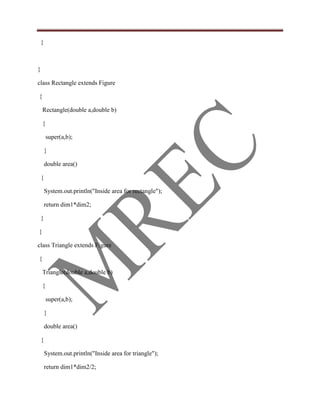
double area()
{
System.out.println("Inside area for rectangle");
return dim1*dim2;
}
}
class Triangle extends Figure
{
Triangle(double a,double b)
{
super(a,b);
}
double area()
{
System.out.println("Inside area for triangle");
return dim1*dim2/2;
}
}
class FindAreas
{
public static void main(String args[])
{
Figure f=new Figure(10,10);
Rectangle r=new Rectangle(9,5);](https://image.slidesharecdn.com/unit1jaava-130410113731-phpapp02/85/Unit1-jaava-23-320.jpg)
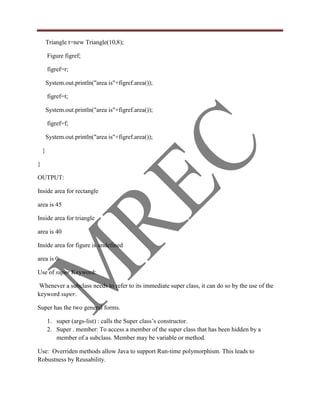
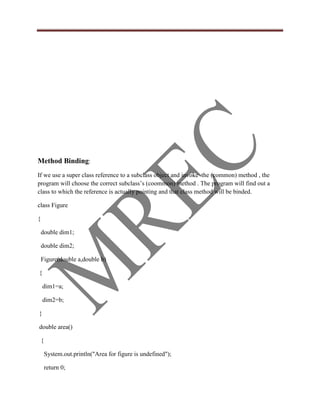
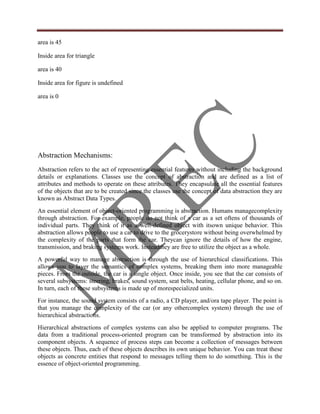
![}
}
class FindAreas
{
public static void main(String args[])
{
Figure f=new Figure(10,10);
Rectangle r=new Rectangle(9,5);
Triangle t=new Triangle(10,8);
Figure figref;
figref=r;
System.out.println("area is"+figref.area());
figref=t;
System.out.println("area is"+figref.area());
figref=f;
System.out.println("area is"+figref.area());
}
}
OUTPUT:
Inside area for rectangle
area is 45
Inside area for triangle
area is 40
Inside area for figure is undefined](https://image.slidesharecdn.com/unit1jaava-130410113731-phpapp02/85/Unit1-jaava-27-320.jpg)
![public class ExceptionDemo
{
public static void main(String args[])throws IOException
{
int subject[]={12,23,34,21};
try
{
System.out.println(subject[2]);
System.out.println("not okay");
}
catch(ArrayIndexOutOfBoundException e)
{
System.out.println("i caught the exception:"+e);
throw e;
}
finally
{
System.out.println("okay");
}
}
}
Output:
34
Not Okay okay](https://image.slidesharecdn.com/unit1jaava-130410113731-phpapp02/85/Unit1-jaava-30-320.jpg)
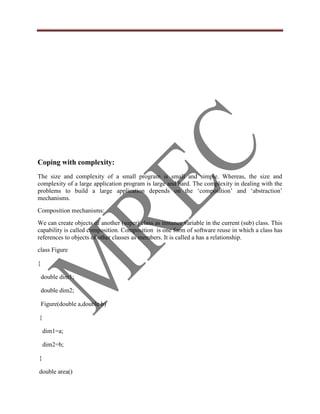
![{
System.out.println("Inside area for triangle");
return dim1*dim2/2;
}
}
class FindAreas
{
public static void main(String args[])
{
Figure f=new Figure(10,10);
Rectangle r=new Rectangle(9,5);
Triangle t=new Triangle(10,8);
//creating objects of one(super) class in another(sub) class:Composition
Figure figref;
figref=f;
System.out.println("area is"+figref.area());
figref=r;
System.out.println("area is"+figref.area());
figref=t;
System.out.println("area is"+figref.area());
}
}
OUTPUT:
Inside area for rectangle](https://image.slidesharecdn.com/unit1jaava-130410113731-phpapp02/85/Unit1-jaava-33-320.jpg)
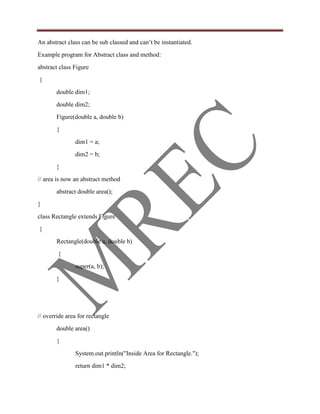
![}
}
class Triangle extends Figure
{
Triangle(double a, double b)
{
super(a, b);
}
// override area for right triangle
double area()
{
System.out.println("Inside Area for Triangle.");
return dim1 * dim2 / 2;
}
}
class AbstractAreas
{
public static void main(String args[])
{
// Figure f = new Figure(10, 10); // illegal now
Rectangle r = new Rectangle(9, 5);
Triangle t = new Triangle(10, 8);
Figure figref; // this is OK, no object is created
figref = r;
System.out.println("Area is " + figref.area());
figref = t;
System.out.println("Area is " + figref.area());](https://image.slidesharecdn.com/unit1jaava-130410113731-phpapp02/85/Unit1-jaava-37-320.jpg)