Working with big biomedical ontologies
Robert Stevens
BioHealth Informatics Group
University of Manchester
The message
• Ontologies authored in the Web Ontology Language
(OWL) can be tricky to author and understand
• But we’re starting to find ways of managing the
authoring and comprehension of these artefacts
– Natural language versions of class descriptions;
– Abstracting over ontologies to find “patterns” of axioms;
– Scripting not hand-crafting axioms – exploiting patterns;
– Making it easy to do the right thing – semantic
spreadsheets
– Hiding the ontology and hiding the OWL
The need for descriptions of data
• 27 millimetres
• Tail of 27 millimetres
• Mouse tail of 27 millimetres
• Mouse of strain x that is 28 days old, tail that is 27
millimetres
• Data is only as good as its metadata
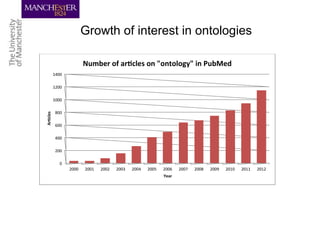
Growth of interest in ontologies
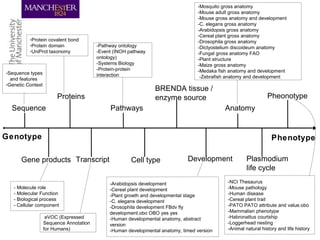
Genotype Phenotype
Sequence
Proteins
Gene products Transcript
Pathways
Cell type
BRENDA tissue /
enzyme source
Development
Anatomy
Pheonotype
Plasmodium
life cycle
-Sequence types
and features
-Genetic Context
- Molecule role
- Molecular Function
- Biological process
- Cellular component
-Protein covalent bond
-Protein domain
-UniProt taxonomy
-Pathway ontology
-Event (INOH pathway
ontology)
-Systems Biology
-Protein-protein
interaction
-Arabidopsis development
-Cereal plant development
-Plant growth and developmental stage
-C. elegans development
-Drosophila development FBdv fly
development.obo OBO yes yes
-Human developmental anatomy, abstract
version
-Human developmental anatomy, timed version
-Mosquito gross anatomy
-Mouse adult gross anatomy
-Mouse gross anatomy and development
-C. elegans gross anatomy
-Arabidopsis gross anatomy
-Cereal plant gross anatomy
-Drosophila gross anatomy
-Dictyostelium discoideum anatomy
-Fungal gross anatomy FAO
-Plant structure
-Maize gross anatomy
-Medaka fish anatomy and development
-Zebrafish anatomy and development
-NCI Thesaurus
-Mouse pathology
-Human disease
-Cereal plant trait
-PATO PATO attribute and value.obo
-Mammalian phenotype
-Habronattus courtship
-Loggerhead nesting
-Animal natural history and life history
eVOC (Expressed
Sequence Annotation
for Humans)
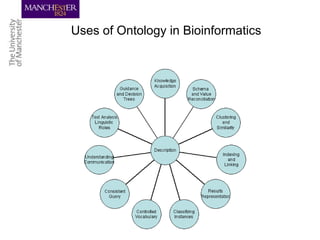
Uses of Ontology in Bioinformatics
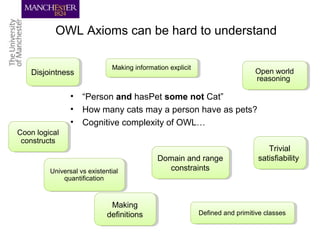
OWL Axioms can be hard to understand
• “Person and hasPet some not Cat”
• How many cats may a person have as pets?
• Cognitive complexity of OWL…
Making information explicitMaking information explicit
Universal vs existential
quantification
Universal vs existential
quantification
Defined and primitive classesDefined and primitive classes
DisjointnessDisjointness
Domain and range
constraints
Domain and range
constraints
Open world
reasoning
Open world
reasoning
Trivial
satisfiability
Trivial
satisfiability
Coon logical
constructs
Coon logical
constructs
Making
definitions
Making
definitions
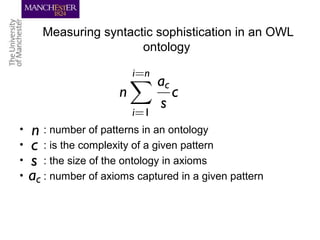
Measuring syntactic sophistication in an OWL
ontology
• : number of patterns in an ontology
• : is the complexity of a given pattern
• : the size of the ontology in axioms
• : number of axioms captured in a given pattern
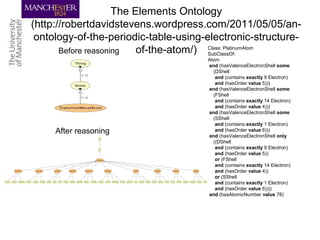
The Elements Ontology
(http://robertdavidstevens.wordpress.com/2011/05/05/an-
ontology-of-the-periodic-table-using-electronic-structure-
of-the-atom/)Before reasoning
After reasoning
Class: PlatinumAtom
SubClassOf:
Atom
and (hasValenceElectronShell some
(DShell
and (contains exactly 9 Electron)
and (hasOrder value 5)))
and (hasValenceElectronShell some
(FShell
and (contains exactly 14 Electron)
and (hasOrder value 4)))
and (hasValenceElectronShell some
(SShell
and (contains exactly 1 Electron)
and (hasOrder value 6)))
and (hasValenceElectronShell only
((DShell
and (contains exactly 9 Electron)
and (hasOrder value 5))
or (FShell
and (contains exactly 14 Electron)
and (hasOrder value 4))
or (SShell
and (contains exactly 1 Electron)
and (hasOrder value 6))))
and (hasAtomicNumber value 78)
How syntactically sophisticated are OWL
ontologies?
• 25% have an S-mesure of 1
• About 50% has an S-mesure of 2
• Then it sort of tails off
• (the previous slide’s ontology has an S mesaure of
580)
Why can an OWL ontology be complex?
• We have potentially syntactically (and semantically)
complex axioms, but most ontologies have axioms that
are more or less simple in terms of form
• We have cognitive coplexity of even simmple syntactic
constructs
• We have coplexity through size; lots and lots of simple
things become complex
• We also have to understand the domain description too
The consequence
• Is that OWL ontologies can be difficult to understand
So, what do we do about it?
• Complex for whom?
• For the developer
– Add comprehension tools; they have to interact with
OWL, so make it easier
• For an ontology user:
– Don’t show them the ontology!
Hide the ontology
• OWL is horrid to look at
• When being used in a tool by the ultimate users, it just
shouldn’t be seen
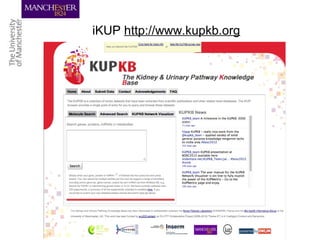
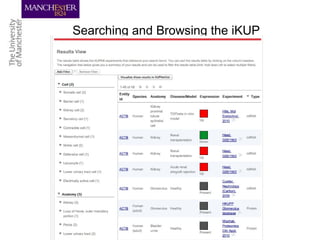
iKUP http://www.kupkb.org
Searching and Browsing the iKUP
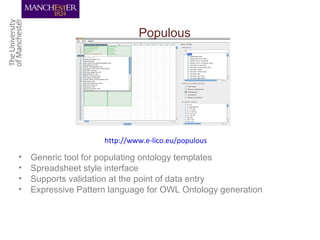
Populous
• Generic tool for populating ontology templates
• Spreadsheet style interface
• Supports validation at the point of data entry
• Expressive Pattern language for OWL Ontology generation
http://www.e-lico.eu/populous
Generating natural language from OWL
• An axiom is a sentence in OWL
• Transform it into natural language to give a familiar
form for reading (and for input…)
• Body hasPart some Head
• All bodies have at least one part that is a head….
• Bodies have heads….
• A body has part a head
• A body has part x, has part y, has part z, has part ….
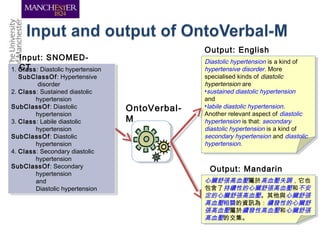
OntoVerbal-
M
Output: English
Diastolic hypertension is a kind of
hypertensive disorder. More
specialised kinds of diastolic
hypertension are
•sustained diastolic hypertension
and
•labile diastolic hypertension.
Another relevant aspect of diastolic
hypertension is that: secondary
diastolic hypertension is a kind of
secondary hypertension and diastolic
hypertension.
1. Class: Diastolic hypertension
SubClassOf: Hypertensive
disorder
2. Class: Sustained diastolic
hypertension
SubClassOf: Diastolic
hypertension
3. Class: Labile diastolic
hypertension
SubClassOf: Diastolic
hypertension
4. Class: Secondary diastolic
hypertension
SubClassOf: Secondary
hypertension
and
Diastolic hypertension
1. Class: Diastolic hypertension
SubClassOf: Hypertensive
disorder
2. Class: Sustained diastolic
hypertension
SubClassOf: Diastolic
hypertension
3. Class: Labile diastolic
hypertension
SubClassOf: Diastolic
hypertension
4. Class: Secondary diastolic
hypertension
SubClassOf: Secondary
hypertension
and
Diastolic hypertension
Input: SNOMED-
CT
心臟舒張高血壓屬於高血壓失調,它也
包含了持續性的心臟舒張高血壓和不安
定的心臟舒張高血壓。其他與心臟舒張
高血壓相關的資訊為:續發性的心臟舒
張高血壓屬於續發性高血壓和心臟舒張
高血壓的交集。
Output: Mandarin
OntoVerbal-
M
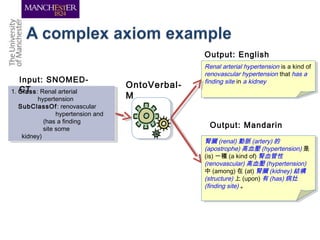
Output: English
Renal arterial hypertension is a kind of
renovascular hypertension that has a
finding site in a kidney
1. Class: Renal arterial
hypertension
SubClassOf: renovascular
hypertension and
(has a finding
site some
kidney)
1. Class: Renal arterial
hypertension
SubClassOf: renovascular
hypertension and
(has a finding
site some
kidney)
Input: SNOMED-
CT
腎臟 (renal) 動脈 (artery) 的
(apostrophe) 高血壓 (hypertension) 是
(is) 一種 (a kind of) 腎血管性
(renovascular) 高血壓 (hypertension)
中 (among) 在 (at) 腎臟 (kidney) 結構
(structure) 上 (upon) 有 (has) 病灶
(finding site) 。
Output: Mandarin
OntoVerbal
• Ontoverbal is a plugin for Protégé 4
• It generates natural language for classes in an ontology
• http://swatproject.org/demos.asp
• It groups axioms, aggregates repeating properties, organises
axiom types according to rhetorical structure theory, does some
msoothing of language
• People can round-trip back to OWL better than with human written
natural language
• Finds favour as a way of generating natural languaage definitions
• See also http://jamesmaloneebi.blogspot.co.uk/2012/06/ontology-
turing-test.html
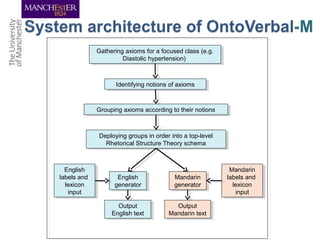
Gathering axioms for a focused class (e.g.
Diastolic hypertension)
Gathering axioms for a focused class (e.g.
Diastolic hypertension)
Identifying notions of axiomsIdentifying notions of axioms
Grouping axioms according to their notionsGrouping axioms according to their notions
Deploying groups in order into a top-level
Rhetorical Structure Theory schema
Deploying groups in order into a top-level
Rhetorical Structure Theory schema
Output
English text
Output
English text
English
generator
English
generator
English
labels and
lexicon
input
English
labels and
lexicon
input
Output
Mandarin text
Output
Mandarin text
Mandarin
generator
Mandarin
generator
Mandarin
labels and
lexicon
input
Mandarin
labels and
lexicon
input
Patterns in OWL ontologies
• Axioms (should) repeat themselves as patterns in an
ontology
• Patterns that represent accepted solutions to a
representation problem are design patterns
• A pattern doesn’t have to be a design pattern
• They can just be regularities in the ontology
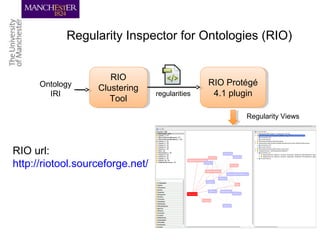
Regularity Inspector for Ontologies (RIO)
RIO
Clustering
Tool
RIO
Clustering
Tool
RIO Protégé
4.1 plugin
RIO Protégé
4.1 pluginregularities
Ontology
IRI
Regularity Views
RIO url:
http://riotool.sourceforge.net/
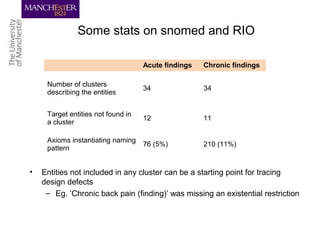
Examples of regularities in SNOMED-CT
• Regularities expressed as axioms with variables holding similar
entities:
– E.g. ?Chronic_finding = [Chronic pyonephrosis (disorder),
Chronic pneumothorax (disorder)]
1. Syntactic Regularity describing ‘Chronic findings’:
?Chronic_finding EquivalentTo ?Disorder and (RoleGroup some
(‘Clinical course (attribute)’ some ‘Chronic (qualifier value)’))
?Chronic_finding EquivalentTo ?Disorder and (RoleGroup some
(‘Clinical course (attribute)’ some ‘Chronic (qualifier value)’))
2. Syntactic Regularity describing ‘Acute findings’:
?Acute_finding EquivalentTo ?Disorder and (RoleGroup some
(‘Clinical course (attribute)’ some
'Sudden onset AND/OR short duration (qualifier value)'))
?Acute_finding EquivalentTo ?Disorder and (RoleGroup some
(‘Clinical course (attribute)’ some
'Sudden onset AND/OR short duration (qualifier value)'))
Some stats on snomed and RIO
• Entities not included in any cluster can be a starting point for tracing
design defects
– Eg. ’Chronic back pain (finding)’ was missing an existential restriction
Acute findings Chronic findings
Number of clusters
describing the entities
34 34
Target entities not found in
a cluster
12 11
Axioms instantiating naming
pattern
76 (5%) 210 (11%)
Summary of the message
• We’re getting more sophisticated in how we handle
OWL ontologies
Acknowledgements
• Simon Jupp
• Julie Klein
• Fennie Liang
• Donia Scott
• Eleni Mikroyannidi
• Azlinayati Manaf
• Sean Bechhofer

Working with big biomedical ontologies

  • 1.
    Working with bigbiomedical ontologies Robert Stevens BioHealth Informatics Group University of Manchester
  • 2.
    The message • Ontologiesauthored in the Web Ontology Language (OWL) can be tricky to author and understand • But we’re starting to find ways of managing the authoring and comprehension of these artefacts – Natural language versions of class descriptions; – Abstracting over ontologies to find “patterns” of axioms; – Scripting not hand-crafting axioms – exploiting patterns; – Making it easy to do the right thing – semantic spreadsheets – Hiding the ontology and hiding the OWL
  • 3.
    The need fordescriptions of data • 27 millimetres • Tail of 27 millimetres • Mouse tail of 27 millimetres • Mouse of strain x that is 28 days old, tail that is 27 millimetres • Data is only as good as its metadata
  • 4.
    Growth of interestin ontologies
  • 5.
    Genotype Phenotype Sequence Proteins Gene productsTranscript Pathways Cell type BRENDA tissue / enzyme source Development Anatomy Pheonotype Plasmodium life cycle -Sequence types and features -Genetic Context - Molecule role - Molecular Function - Biological process - Cellular component -Protein covalent bond -Protein domain -UniProt taxonomy -Pathway ontology -Event (INOH pathway ontology) -Systems Biology -Protein-protein interaction -Arabidopsis development -Cereal plant development -Plant growth and developmental stage -C. elegans development -Drosophila development FBdv fly development.obo OBO yes yes -Human developmental anatomy, abstract version -Human developmental anatomy, timed version -Mosquito gross anatomy -Mouse adult gross anatomy -Mouse gross anatomy and development -C. elegans gross anatomy -Arabidopsis gross anatomy -Cereal plant gross anatomy -Drosophila gross anatomy -Dictyostelium discoideum anatomy -Fungal gross anatomy FAO -Plant structure -Maize gross anatomy -Medaka fish anatomy and development -Zebrafish anatomy and development -NCI Thesaurus -Mouse pathology -Human disease -Cereal plant trait -PATO PATO attribute and value.obo -Mammalian phenotype -Habronattus courtship -Loggerhead nesting -Animal natural history and life history eVOC (Expressed Sequence Annotation for Humans)
  • 6.
    Uses of Ontologyin Bioinformatics
  • 7.
    OWL Axioms canbe hard to understand • “Person and hasPet some not Cat” • How many cats may a person have as pets? • Cognitive complexity of OWL… Making information explicitMaking information explicit Universal vs existential quantification Universal vs existential quantification Defined and primitive classesDefined and primitive classes DisjointnessDisjointness Domain and range constraints Domain and range constraints Open world reasoning Open world reasoning Trivial satisfiability Trivial satisfiability Coon logical constructs Coon logical constructs Making definitions Making definitions
  • 8.
    Measuring syntactic sophisticationin an OWL ontology • : number of patterns in an ontology • : is the complexity of a given pattern • : the size of the ontology in axioms • : number of axioms captured in a given pattern
  • 9.
    The Elements Ontology (http://robertdavidstevens.wordpress.com/2011/05/05/an- ontology-of-the-periodic-table-using-electronic-structure- of-the-atom/)Beforereasoning After reasoning Class: PlatinumAtom SubClassOf: Atom and (hasValenceElectronShell some (DShell and (contains exactly 9 Electron) and (hasOrder value 5))) and (hasValenceElectronShell some (FShell and (contains exactly 14 Electron) and (hasOrder value 4))) and (hasValenceElectronShell some (SShell and (contains exactly 1 Electron) and (hasOrder value 6))) and (hasValenceElectronShell only ((DShell and (contains exactly 9 Electron) and (hasOrder value 5)) or (FShell and (contains exactly 14 Electron) and (hasOrder value 4)) or (SShell and (contains exactly 1 Electron) and (hasOrder value 6)))) and (hasAtomicNumber value 78)
  • 10.
    How syntactically sophisticatedare OWL ontologies? • 25% have an S-mesure of 1 • About 50% has an S-mesure of 2 • Then it sort of tails off • (the previous slide’s ontology has an S mesaure of 580)
  • 11.
    Why can anOWL ontology be complex? • We have potentially syntactically (and semantically) complex axioms, but most ontologies have axioms that are more or less simple in terms of form • We have cognitive coplexity of even simmple syntactic constructs • We have coplexity through size; lots and lots of simple things become complex • We also have to understand the domain description too
  • 12.
    The consequence • Isthat OWL ontologies can be difficult to understand
  • 13.
    So, what dowe do about it? • Complex for whom? • For the developer – Add comprehension tools; they have to interact with OWL, so make it easier • For an ontology user: – Don’t show them the ontology!
  • 14.
    Hide the ontology •OWL is horrid to look at • When being used in a tool by the ultimate users, it just shouldn’t be seen
  • 15.
  • 16.
  • 17.
    Populous • Generic toolfor populating ontology templates • Spreadsheet style interface • Supports validation at the point of data entry • Expressive Pattern language for OWL Ontology generation http://www.e-lico.eu/populous
  • 18.
    Generating natural languagefrom OWL • An axiom is a sentence in OWL • Transform it into natural language to give a familiar form for reading (and for input…) • Body hasPart some Head • All bodies have at least one part that is a head…. • Bodies have heads…. • A body has part a head • A body has part x, has part y, has part z, has part ….
  • 19.
    OntoVerbal- M Output: English Diastolic hypertensionis a kind of hypertensive disorder. More specialised kinds of diastolic hypertension are •sustained diastolic hypertension and •labile diastolic hypertension. Another relevant aspect of diastolic hypertension is that: secondary diastolic hypertension is a kind of secondary hypertension and diastolic hypertension. 1. Class: Diastolic hypertension SubClassOf: Hypertensive disorder 2. Class: Sustained diastolic hypertension SubClassOf: Diastolic hypertension 3. Class: Labile diastolic hypertension SubClassOf: Diastolic hypertension 4. Class: Secondary diastolic hypertension SubClassOf: Secondary hypertension and Diastolic hypertension 1. Class: Diastolic hypertension SubClassOf: Hypertensive disorder 2. Class: Sustained diastolic hypertension SubClassOf: Diastolic hypertension 3. Class: Labile diastolic hypertension SubClassOf: Diastolic hypertension 4. Class: Secondary diastolic hypertension SubClassOf: Secondary hypertension and Diastolic hypertension Input: SNOMED- CT 心臟舒張高血壓屬於高血壓失調,它也 包含了持續性的心臟舒張高血壓和不安 定的心臟舒張高血壓。其他與心臟舒張 高血壓相關的資訊為:續發性的心臟舒 張高血壓屬於續發性高血壓和心臟舒張 高血壓的交集。 Output: Mandarin
  • 20.
    OntoVerbal- M Output: English Renal arterialhypertension is a kind of renovascular hypertension that has a finding site in a kidney 1. Class: Renal arterial hypertension SubClassOf: renovascular hypertension and (has a finding site some kidney) 1. Class: Renal arterial hypertension SubClassOf: renovascular hypertension and (has a finding site some kidney) Input: SNOMED- CT 腎臟 (renal) 動脈 (artery) 的 (apostrophe) 高血壓 (hypertension) 是 (is) 一種 (a kind of) 腎血管性 (renovascular) 高血壓 (hypertension) 中 (among) 在 (at) 腎臟 (kidney) 結構 (structure) 上 (upon) 有 (has) 病灶 (finding site) 。 Output: Mandarin
  • 21.
    OntoVerbal • Ontoverbal isa plugin for Protégé 4 • It generates natural language for classes in an ontology • http://swatproject.org/demos.asp • It groups axioms, aggregates repeating properties, organises axiom types according to rhetorical structure theory, does some msoothing of language • People can round-trip back to OWL better than with human written natural language • Finds favour as a way of generating natural languaage definitions • See also http://jamesmaloneebi.blogspot.co.uk/2012/06/ontology- turing-test.html
  • 22.
    Gathering axioms fora focused class (e.g. Diastolic hypertension) Gathering axioms for a focused class (e.g. Diastolic hypertension) Identifying notions of axiomsIdentifying notions of axioms Grouping axioms according to their notionsGrouping axioms according to their notions Deploying groups in order into a top-level Rhetorical Structure Theory schema Deploying groups in order into a top-level Rhetorical Structure Theory schema Output English text Output English text English generator English generator English labels and lexicon input English labels and lexicon input Output Mandarin text Output Mandarin text Mandarin generator Mandarin generator Mandarin labels and lexicon input Mandarin labels and lexicon input
  • 23.
    Patterns in OWLontologies • Axioms (should) repeat themselves as patterns in an ontology • Patterns that represent accepted solutions to a representation problem are design patterns • A pattern doesn’t have to be a design pattern • They can just be regularities in the ontology
  • 24.
    Regularity Inspector forOntologies (RIO) RIO Clustering Tool RIO Clustering Tool RIO Protégé 4.1 plugin RIO Protégé 4.1 pluginregularities Ontology IRI Regularity Views RIO url: http://riotool.sourceforge.net/
  • 25.
    Examples of regularitiesin SNOMED-CT • Regularities expressed as axioms with variables holding similar entities: – E.g. ?Chronic_finding = [Chronic pyonephrosis (disorder), Chronic pneumothorax (disorder)] 1. Syntactic Regularity describing ‘Chronic findings’: ?Chronic_finding EquivalentTo ?Disorder and (RoleGroup some (‘Clinical course (attribute)’ some ‘Chronic (qualifier value)’)) ?Chronic_finding EquivalentTo ?Disorder and (RoleGroup some (‘Clinical course (attribute)’ some ‘Chronic (qualifier value)’)) 2. Syntactic Regularity describing ‘Acute findings’: ?Acute_finding EquivalentTo ?Disorder and (RoleGroup some (‘Clinical course (attribute)’ some 'Sudden onset AND/OR short duration (qualifier value)')) ?Acute_finding EquivalentTo ?Disorder and (RoleGroup some (‘Clinical course (attribute)’ some 'Sudden onset AND/OR short duration (qualifier value)'))
  • 26.
    Some stats onsnomed and RIO • Entities not included in any cluster can be a starting point for tracing design defects – Eg. ’Chronic back pain (finding)’ was missing an existential restriction Acute findings Chronic findings Number of clusters describing the entities 34 34 Target entities not found in a cluster 12 11 Axioms instantiating naming pattern 76 (5%) 210 (11%)
  • 27.
    Summary of themessage • We’re getting more sophisticated in how we handle OWL ontologies
  • 28.
    Acknowledgements • Simon Jupp •Julie Klein • Fennie Liang • Donia Scott • Eleni Mikroyannidi • Azlinayati Manaf • Sean Bechhofer

Editor's Notes

  • #4 I want each bullet reveal in turn….
  • #6 This slide shows the number of articles on the keyword ontology in pubmed over the years 2000-2012. it’s exponential.
  • #9 Put this list in blobs around the text boxMaking information explicit Universal vs existential quantification Open world reasoning Domain and range constraints Trivial satisfiability defined and primitive classes Coon logical constructs Disjointness Making definitions
  • #11 Class TransitionMetalAtom before and after reasoning and description of platinum atom.
  • #27 The slide shows two dominant patterns describing two sets of terms; chronic and acute clinical findings (mainly disorders). RIO used the oppl vocabulary for expressing variables.
  • #28 The stats on the table are with respect to the detected regularities. The naming patterns were described in the previous slide; one for the chronic entities and one for the acute. E.g. 5% of the entities in that had the word acute in their label were actually instantiating a pattern on their axioms.