Network Virtualization:
Delivering on the Promises of SDN
Bruce Davie, Principal Engineer
2
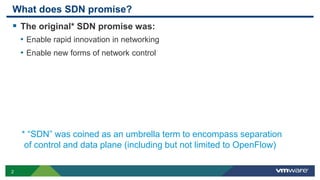
What does SDN promise?
 The original* SDN promise was:
• Enable rapid innovation in networking
• Enable new forms of network control
* “SDN” was coined as an umbrella term to encompass separation
of control and data plane (including but not limited to OpenFlow)
3
4
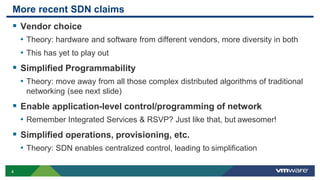
More recent SDN claims
 Vendor choice
• Theory: hardware and software from different vendors, more diversity in both
• This has yet to play out
 Simplified Programmability
• Theory: move away from all those complex distributed algorithms of traditional
networking (see next slide)
 Enable application-level control/programming of network
• Remember Integrated Services & RSVP? Just like that, but awesomer!
 Simplified operations, provisioning, etc.
• Theory: SDN enables centralized control, leading to simplification
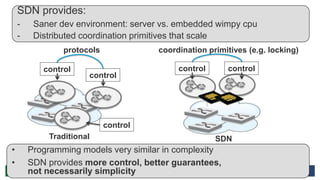
SDN provides:
- Saner dev environment: server vs. embedded wimpy cpu
- Distributed coordination primitives that scale
Traditional SDN
control
control
control
control control
coordination primitives (e.g. locking)protocols
• Programming models very similar in complexity
• SDN provides more control, better guarantees,
not necessarily simplicity
6
Does SDN simplify operations?
 Separation of control plane from data plane does not inherently
lead to operational simplification
• You still have the same number of devices to manage, the same amount of
network state
 Network Virtualization, however, is all about operational
simplification…
7
What Network Virtualization is
 Decoupling of the services provided by a (virtualized) network from
the physical network
 Virtual network is a “container” of network services (L2-L7)
provisioned by software
 Faithful reproduction of services provided by physical network
• Analogy to a VM – complete reproduction of physical machine (CPU, memory,
I/O, etc.)
8
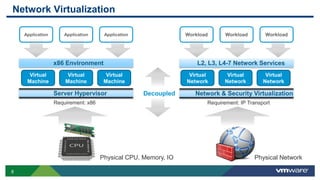
Network Virtualization
Server Hypervisor
Requirement: x86
Virtual
Machine
Virtual
Machine
Virtual
Machine
Application Application Application
x86 Environment
Network & Security Virtualization
Requirement: IP Transport
Virtual
Network
Virtual
Network
Virtual
Network
Workload Workload Workload
L2, L3, L4-7 Network Services
Decoupled
Physical NetworkPhysical CPU, Memory, IO
9
L2
L3
Virtual Network
L2
Open vSwitch
NVP Gateway
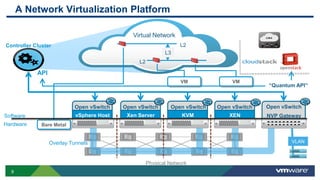
A Network Virtualization Platform
Physical Network
VMVM
Bare Metal
vSphere Host Xen Server KVM XEN
Open vSwitch Open vSwitch Open vSwitch Open vSwitch
Hardware
Software
“Quantum API”
Controller Cluster
API
VLANOverlay Tunnels
10
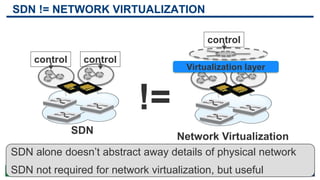
SDN != NETWORK VIRTUALIZATION
SDN
control control
Network Virtualization
!=
Virtualization layer
control
SDN alone doesn’t abstract away details of physical network
SDN not required for network virtualization, but useful
11
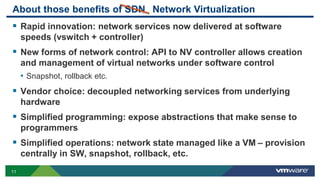
About those benefits of SDN
 Rapid innovation: network services now delivered at software
speeds (vswitch + controller)
 New forms of network control: API to NV controller allows creation
and management of virtual networks under software control
• Snapshot, rollback etc.
 Vendor choice: decoupled networking services from underlying
hardware
 Simplified programming: expose abstractions that make sense to
programmers
 Simplified operations: network state managed like a VM – provision
centrally in SW, snapshot, rollback, etc.
Network Virtualization
12
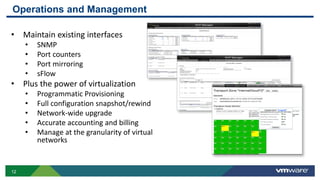
Operations and Management
• Maintain existing interfaces
• SNMP
• Port counters
• Port mirroring
• sFlow
• Plus the power of virtualization
• Programmatic Provisioning
• Full configuration snapshot/rewind
• Network-wide upgrade
• Accurate accounting and billing
• Manage at the granularity of virtual
networks
13
Conclusions
 SDN: a mechanism, not a panacea
 SDN != Network virtualization
 Network virtualization may use SDN, not strictly required
 Network virtualization delivers:
• Decoupling of network services from hardware
• Vendor choice
• Software innovation speed
• Application deployment times shrink from days to minutes
• Virtual networks managed programmatically, just like VMs

Network Virtualization: Delivering on the Promises of SDN

  • 3.
    Network Virtualization: Delivering onthe Promises of SDN Bruce Davie, Principal Engineer
  • 4.
    2 What does SDNpromise?  The original* SDN promise was: • Enable rapid innovation in networking • Enable new forms of network control * “SDN” was coined as an umbrella term to encompass separation of control and data plane (including but not limited to OpenFlow)
  • 5.
  • 6.
    4 More recent SDNclaims  Vendor choice • Theory: hardware and software from different vendors, more diversity in both • This has yet to play out  Simplified Programmability • Theory: move away from all those complex distributed algorithms of traditional networking (see next slide)  Enable application-level control/programming of network • Remember Integrated Services & RSVP? Just like that, but awesomer!  Simplified operations, provisioning, etc. • Theory: SDN enables centralized control, leading to simplification
  • 7.
    SDN provides: - Sanerdev environment: server vs. embedded wimpy cpu - Distributed coordination primitives that scale Traditional SDN control control control control control coordination primitives (e.g. locking)protocols • Programming models very similar in complexity • SDN provides more control, better guarantees, not necessarily simplicity
  • 8.
    6 Does SDN simplifyoperations?  Separation of control plane from data plane does not inherently lead to operational simplification • You still have the same number of devices to manage, the same amount of network state  Network Virtualization, however, is all about operational simplification…
  • 9.
    7 What Network Virtualizationis  Decoupling of the services provided by a (virtualized) network from the physical network  Virtual network is a “container” of network services (L2-L7) provisioned by software  Faithful reproduction of services provided by physical network • Analogy to a VM – complete reproduction of physical machine (CPU, memory, I/O, etc.)
  • 10.
    8 Network Virtualization Server Hypervisor Requirement:x86 Virtual Machine Virtual Machine Virtual Machine Application Application Application x86 Environment Network & Security Virtualization Requirement: IP Transport Virtual Network Virtual Network Virtual Network Workload Workload Workload L2, L3, L4-7 Network Services Decoupled Physical NetworkPhysical CPU, Memory, IO
  • 11.
    9 L2 L3 Virtual Network L2 Open vSwitch NVPGateway A Network Virtualization Platform Physical Network VMVM Bare Metal vSphere Host Xen Server KVM XEN Open vSwitch Open vSwitch Open vSwitch Open vSwitch Hardware Software “Quantum API” Controller Cluster API VLANOverlay Tunnels
  • 12.
    10 SDN != NETWORKVIRTUALIZATION SDN control control Network Virtualization != Virtualization layer control SDN alone doesn’t abstract away details of physical network SDN not required for network virtualization, but useful
  • 13.
    11 About those benefitsof SDN  Rapid innovation: network services now delivered at software speeds (vswitch + controller)  New forms of network control: API to NV controller allows creation and management of virtual networks under software control • Snapshot, rollback etc.  Vendor choice: decoupled networking services from underlying hardware  Simplified programming: expose abstractions that make sense to programmers  Simplified operations: network state managed like a VM – provision centrally in SW, snapshot, rollback, etc. Network Virtualization
  • 14.
    12 Operations and Management •Maintain existing interfaces • SNMP • Port counters • Port mirroring • sFlow • Plus the power of virtualization • Programmatic Provisioning • Full configuration snapshot/rewind • Network-wide upgrade • Accurate accounting and billing • Manage at the granularity of virtual networks
  • 15.
    13 Conclusions  SDN: amechanism, not a panacea  SDN != Network virtualization  Network virtualization may use SDN, not strictly required  Network virtualization delivers: • Decoupling of network services from hardware • Vendor choice • Software innovation speed • Application deployment times shrink from days to minutes • Virtual networks managed programmatically, just like VMs