AN ARTICLE PRESENTATION
Doing Business and Role of
Government for
Entrepreneurship Development
The Journal of Nepalese Business Studies Vol. VII No.1
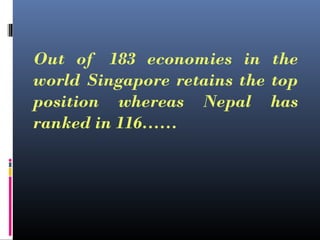
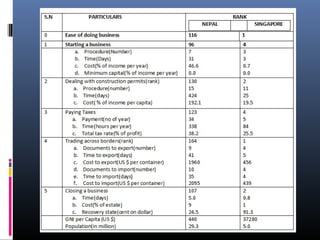
Out of 183 economies in the
world Singapore retains the top
position whereas Nepal has
ranked in 116……
BACKGROUND OF THE STUDY
It focuses on Nepal and its richness in
natural resources like water, mountain
peaks and herbs.
It focuses on lack of effective management,
planning, controlling and appropriate
business environment.
It also focuses on unemployment as a
macroeconomic problem.
Also, it focuses on poverty alleviation as the
major challenge and goal of the
government….
OBJECTIVE OF THE STUDY
 The prime objective of the study is to present the
current scenario of entrepreneurship development
and to understand major areas of regulation of the
government for doing business.
 Other objective is to introduce one village one product
(OVOP) and practice of OVOP in various countries.
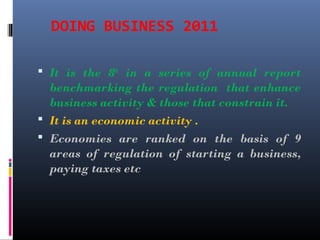
DOING BUSINESS 2011
 It is the 8th
in a series of annual report
benchmarking the regulation that enhance
business activity & those that constrain it.
 It is an economic activity .
 Economies are ranked on the basis of 9
areas of regulation of starting a business,
paying taxes etc
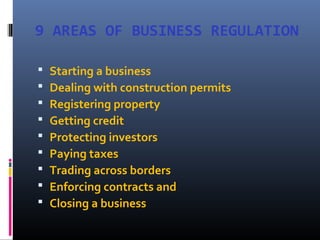
9 AREAS OF BUSINESS REGULATION
 Starting a business
 Dealing with construction permits
 Registering property
 Getting credit
 Protecting investors
 Paying taxes
 Trading across borders
 Enforcing contracts and
 Closing a business
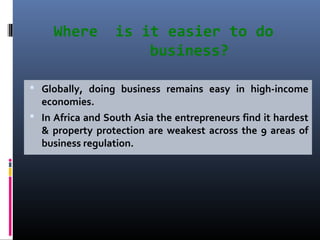
Where is it easier to do
business?
 Globally, doing business remains easy in high-income
economies.
 In Africa and South Asia the entrepreneurs find it hardest
& property protection are weakest across the 9 areas of
business regulation.
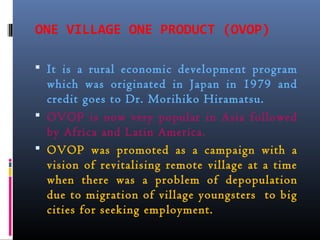
ONE VILLAGE ONE PRODUCT (OVOP)
 It is a rural economic development program
which was originated in Japan in 1979 and
credit goes to Dr. Morihiko Hiramatsu.
 OVOP is now very popular in Asia followed
by Africa and Latin America.
 OVOP was promoted as a campaign with a
vision of revitalising remote village at a time
when there was a problem of depopulation
due to migration of village youngsters to big
cities for seeking employment.
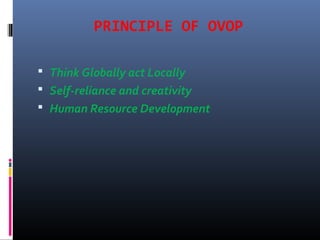
PRINCIPLE OF OVOP
 Think Globally act Locally
 Self-reliance and creativity
 Human Resource Development
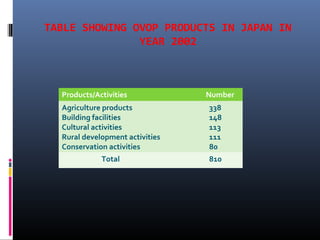
TABLE SHOWING OVOP PRODUCTS IN JAPAN IN
YEAR 2002
Products/Activities Number
Agriculture products
Building facilities
Cultural activities
Rural development activities
Conservation activities
338
148
113
111
80
Total 810
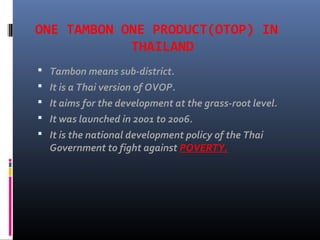
ONE TAMBON ONE PRODUCT(OTOP) IN
THAILAND
 Tambon means sub-district.
 It is a Thai version of OVOP.
 It aims for the development at the grass-root level.
 It was launched in 2001 to 2006.
 It is the national development policy of the Thai
Government to fight against POVERTY.
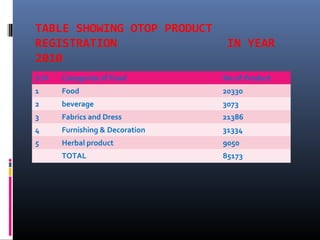
TABLE SHOWING OTOP PRODUCT
REGISTRATION IN YEAR
2010
S.N Categories of Food No of Product
1 Food 20330
2 beverage 3073
3 Fabrics and Dress 21386
4 Furnishing & Decoration 31334
5 Herbal product 9050
TOTAL 85173
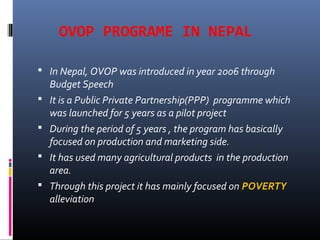
OVOP PROGRAME IN NEPAL
 In Nepal, OVOP was introduced in year 2006 through
Budget Speech
 It is a Public Private Partnership(PPP) programme which
was launched for 5 years as a pilot project
 During the period of 5 years , the program has basically
focused on production and marketing side.
 It has used many agricultural products in the production
area.
 Through this project it has mainly focused on POVERTY
alleviation
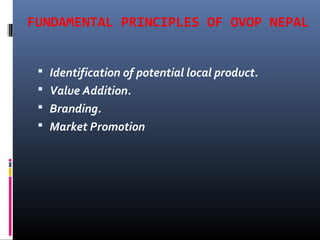
FUNDAMENTAL PRINCIPLES OF OVOP NEPAL
 Identification of potential local product.
 Value Addition.
 Branding.
 Market Promotion
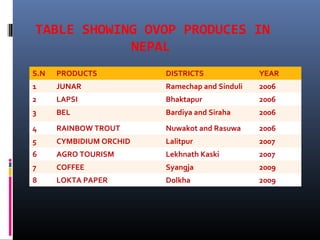
TABLE SHOWING OVOP PRODUCES IN
NEPAL
S.N PRODUCTS DISTRICTS YEAR
1 JUNAR Ramechap and Sinduli 2006
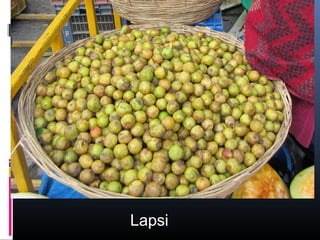
2 LAPSI Bhaktapur 2006
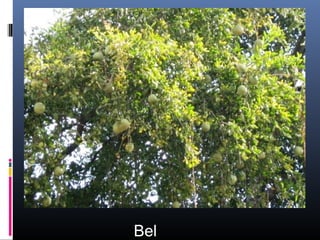
3 BEL Bardiya and Siraha 2006
4 RAINBOW TROUT Nuwakot and Rasuwa 2006
5 CYMBIDIUM ORCHID Lalitpur 2007
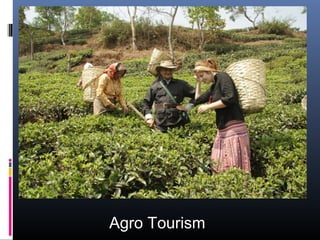
6 AGRO TOURISM Lekhnath Kaski 2007
7 COFFEE Syangja 2009
8 LOKTA PAPER Dolkha 2009
Junar
Lapsi
Bel
Rainbow Trout
Cymbidium Orchid
Agro Tourism
Coffee
Lokta Paper
CONCLUSION
 Through OVOP, local resources, skill and human
resources can be utilized and produce quality good and
services which can be sold in local market, national and
international market and generate revenue and reduce
unemployment problem.
 Government should be able to provide sound business
environment , appropriate rules and regulation for
security of investment , appropriate strategies and
policies for production of good and services……….
PRESENTED BY:-
 POOJA DEV
 BARUN KHADKA
One village one product

One village one product

  • 1.
    AN ARTICLE PRESENTATION DoingBusiness and Role of Government for Entrepreneurship Development The Journal of Nepalese Business Studies Vol. VII No.1
  • 2.
    Out of 183economies in the world Singapore retains the top position whereas Nepal has ranked in 116……
  • 3.
    BACKGROUND OF THESTUDY It focuses on Nepal and its richness in natural resources like water, mountain peaks and herbs. It focuses on lack of effective management, planning, controlling and appropriate business environment. It also focuses on unemployment as a macroeconomic problem. Also, it focuses on poverty alleviation as the major challenge and goal of the government….

  • 4.
    OBJECTIVE OF THESTUDY  The prime objective of the study is to present the current scenario of entrepreneurship development and to understand major areas of regulation of the government for doing business.  Other objective is to introduce one village one product (OVOP) and practice of OVOP in various countries.
  • 5.
    DOING BUSINESS 2011 It is the 8th in a series of annual report benchmarking the regulation that enhance business activity & those that constrain it.  It is an economic activity .  Economies are ranked on the basis of 9 areas of regulation of starting a business, paying taxes etc
  • 6.
    9 AREAS OFBUSINESS REGULATION  Starting a business  Dealing with construction permits  Registering property  Getting credit  Protecting investors  Paying taxes  Trading across borders  Enforcing contracts and  Closing a business
  • 7.
    Where is iteasier to do business?  Globally, doing business remains easy in high-income economies.  In Africa and South Asia the entrepreneurs find it hardest & property protection are weakest across the 9 areas of business regulation.
  • 9.
    ONE VILLAGE ONEPRODUCT (OVOP)  It is a rural economic development program which was originated in Japan in 1979 and credit goes to Dr. Morihiko Hiramatsu.  OVOP is now very popular in Asia followed by Africa and Latin America.  OVOP was promoted as a campaign with a vision of revitalising remote village at a time when there was a problem of depopulation due to migration of village youngsters to big cities for seeking employment.
  • 10.
    PRINCIPLE OF OVOP Think Globally act Locally  Self-reliance and creativity  Human Resource Development
  • 11.
    TABLE SHOWING OVOPPRODUCTS IN JAPAN IN YEAR 2002 Products/Activities Number Agriculture products Building facilities Cultural activities Rural development activities Conservation activities 338 148 113 111 80 Total 810
  • 12.
    ONE TAMBON ONEPRODUCT(OTOP) IN THAILAND  Tambon means sub-district.  It is a Thai version of OVOP.  It aims for the development at the grass-root level.  It was launched in 2001 to 2006.  It is the national development policy of the Thai Government to fight against POVERTY.
  • 13.
    TABLE SHOWING OTOPPRODUCT REGISTRATION IN YEAR 2010 S.N Categories of Food No of Product 1 Food 20330 2 beverage 3073 3 Fabrics and Dress 21386 4 Furnishing & Decoration 31334 5 Herbal product 9050 TOTAL 85173
  • 14.
    OVOP PROGRAME INNEPAL  In Nepal, OVOP was introduced in year 2006 through Budget Speech  It is a Public Private Partnership(PPP) programme which was launched for 5 years as a pilot project  During the period of 5 years , the program has basically focused on production and marketing side.  It has used many agricultural products in the production area.  Through this project it has mainly focused on POVERTY alleviation
  • 15.
    FUNDAMENTAL PRINCIPLES OFOVOP NEPAL  Identification of potential local product.  Value Addition.  Branding.  Market Promotion
  • 16.
    TABLE SHOWING OVOPPRODUCES IN NEPAL S.N PRODUCTS DISTRICTS YEAR 1 JUNAR Ramechap and Sinduli 2006 2 LAPSI Bhaktapur 2006 3 BEL Bardiya and Siraha 2006 4 RAINBOW TROUT Nuwakot and Rasuwa 2006 5 CYMBIDIUM ORCHID Lalitpur 2007 6 AGRO TOURISM Lekhnath Kaski 2007 7 COFFEE Syangja 2009 8 LOKTA PAPER Dolkha 2009
  • 17.
  • 18.
  • 19.
  • 20.
  • 21.
  • 22.
  • 23.
  • 24.
  • 25.
    CONCLUSION  Through OVOP,local resources, skill and human resources can be utilized and produce quality good and services which can be sold in local market, national and international market and generate revenue and reduce unemployment problem.  Government should be able to provide sound business environment , appropriate rules and regulation for security of investment , appropriate strategies and policies for production of good and services……….
  • 26.
    PRESENTED BY:-  POOJADEV  BARUN KHADKA