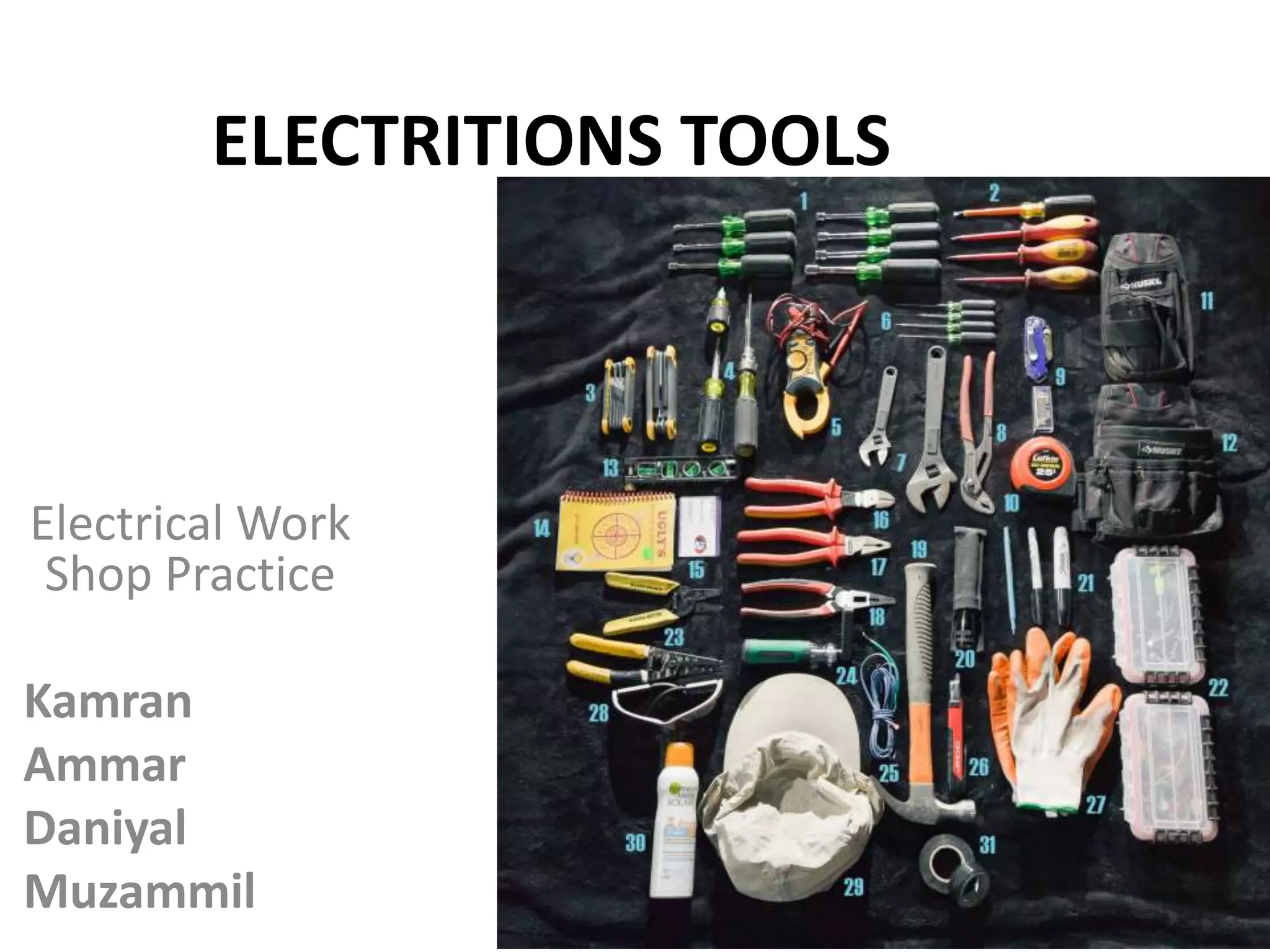
ELECTRITIONS TOOLS
Electrical Work
Shop Practice
Kamran
Ammar
Daniyal
Muzammil
Vidoe
Power Meters
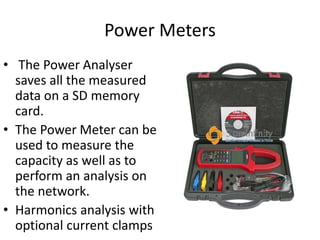
• The Power Analyser
saves all the measured
data on a SD memory
card.
• The Power Meter can be
used to measure the
capacity as well as to
perform an analysis on
the network.
• Harmonics analysis with
optional current clamps
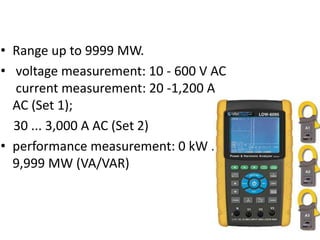
• Range up to 9999 MW.
• voltage measurement: 10 - 600 V AC
current measurement: 20 -1,200 A
AC (Set 1);
30 ... 3,000 A AC (Set 2)
• performance measurement: 0 kW ...
9,999 MW (VA/VAR)
Clamp Meter
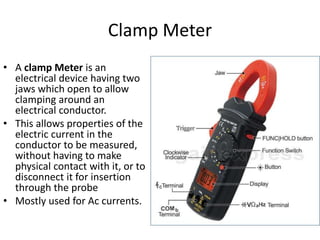
• A clamp Meter is an
electrical device having two
jaws which open to allow
clamping around an
electrical conductor.
• This allows properties of the
electric current in the
conductor to be measured,
without having to make
physical contact with it, or to
disconnect it for insertion
through the probe
• Mostly used for Ac currents.
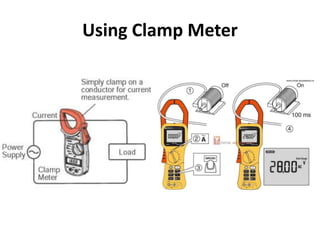
Using Clamp Meter
Line Tester
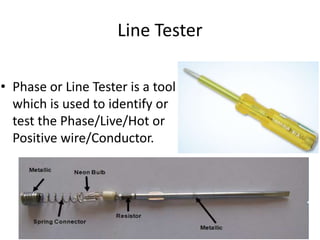
• Phase or Line Tester is a tool
which is used to identify or
test the Phase/Live/Hot or
Positive wire/Conductor.
Continuity Tester
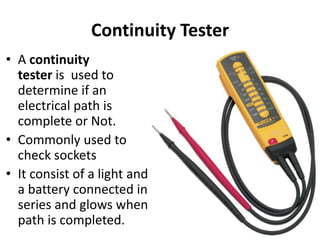
• A continuity
tester is used to
determine if an
electrical path is
complete or Not.
• Commonly used to
check sockets
• It consist of a light and
a battery connected in
series and glows when
path is completed.
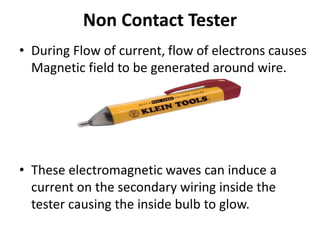
Non Contact Tester
• During Flow of current, flow of electrons causes
Magnetic field to be generated around wire.
• These electromagnetic waves can induce a
current on the secondary wiring inside the
tester causing the inside bulb to glow.
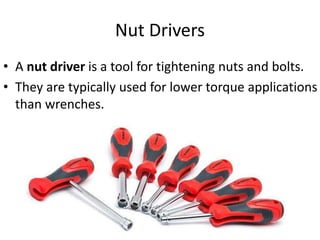
Nut Drivers
• A nut driver is a tool for tightening nuts and bolts.
• They are typically used for lower torque applications
than wrenches.
Drills And Its Types
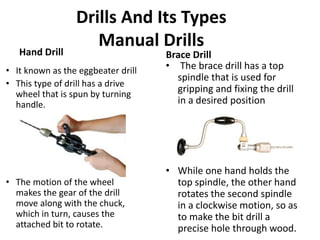
Manual DrillsHand Drill Brace Drill
• The brace drill has a top
spindle that is used for
gripping and fixing the drill
in a desired position
• While one hand holds the
top spindle, the other hand
rotates the second spindle
in a clockwise motion, so as
to make the bit drill a
precise hole through wood.
• It known as the eggbeater drill
• This type of drill has a drive
wheel that is spun by turning
handle.
• The motion of the wheel
makes the gear of the drill
move along with the chuck,
which in turn, causes the
attached bit to rotate.
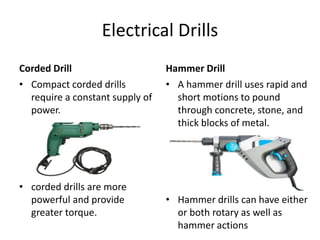
Electrical Drills
Corded Drill
• Compact corded drills
require a constant supply of
power.
• corded drills are more
powerful and provide
greater torque.
Hammer Drill
• A hammer drill uses rapid and
short motions to pound
through concrete, stone, and
thick blocks of metal.
• Hammer drills can have either
or both rotary as well as
hammer actions
Cordless Drills
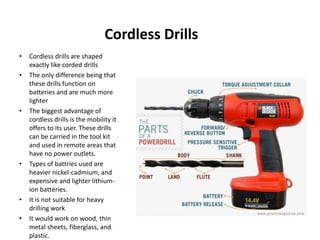
• Cordless drills are shaped
exactly like corded drills
• The only difference being that
these drills function on
batteries and are much more
lighter
• The biggest advantage of
cordless drills is the mobility it
offers to its user. These drills
can be carried in the tool kit
and used in remote areas that
have no power outlets.
• Types of battries used are
heavier nickel-cadmium, and
expensive and lighter lithium-
ion batteries.
• It is not suitable for heavy
drilling work
• It would work on wood, thin
metal sheets, fiberglass, and
plastic.
Basic Internal Structure of a Drill
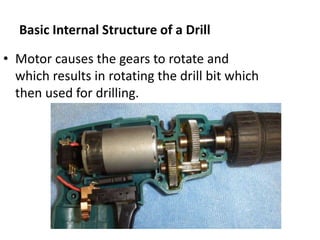
• Motor causes the gears to rotate and
which results in rotating the drill bit which
then used for drilling.
Adjustable Can Light / Speaker Hole Saws
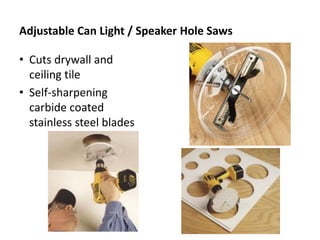
• Cuts drywall and
ceiling tile
• Self-sharpening
carbide coated
stainless steel blades
Temperature Controlled Soldering Iron
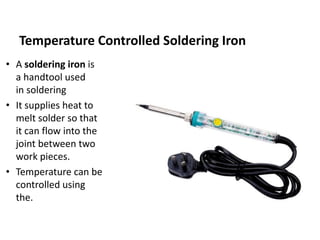
• A soldering iron is
a handtool used
in soldering
• It supplies heat to
melt solder so that
it can flow into the
joint between two
work pieces.
• Temperature can be
controlled using
the.
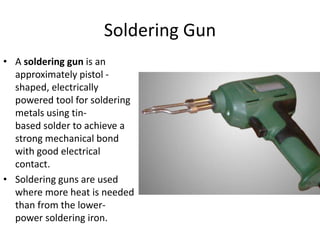
Soldering Gun
• A soldering gun is an
approximately pistol -
shaped, electrically
powered tool for soldering
metals using tin-
based solder to achieve a
strong mechanical bond
with good electrical
contact.
• Soldering guns are used
where more heat is needed
than from the lower-
power soldering iron.
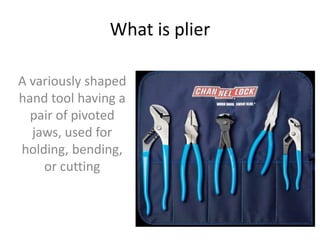
What is plier
A variously shaped
hand tool having a
pair of pivoted
jaws, used for
holding, bending,
or cutting
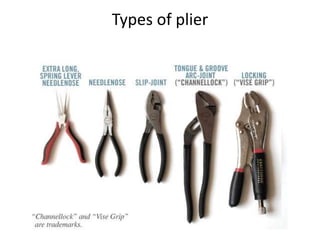
Types of plier
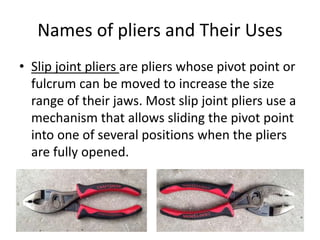
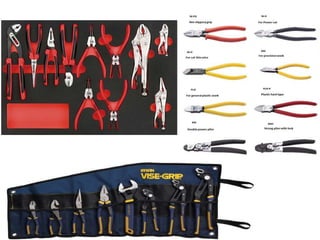
Names of pliers and Their Uses
• Slip joint pliers are pliers whose pivot point or
fulcrum can be moved to increase the size
range of their jaws. Most slip joint pliers use a
mechanism that allows sliding the pivot point
into one of several positions when the pliers
are fully opened.
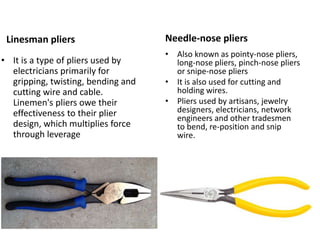
Linesman pliers
• It is a type of pliers used by
electricians primarily for
gripping, twisting, bending and
cutting wire and cable.
Linemen's pliers owe their
effectiveness to their plier
design, which multiplies force
through leverage
Needle-nose pliers
• Also known as pointy-nose pliers,
long-nose pliers, pinch-nose pliers
or snipe-nose pliers
• It is also used for cutting and
holding wires.
• Pliers used by artisans, jewelry
designers, electricians, network
engineers and other tradesmen
to bend, re-position and snip
wire.
Crimping is joining 2 pieces of metal or other ductile material (usually a wire and a metal plate)
by deforming one or both of them to hold the other. The bend or deformity is called the crimp.
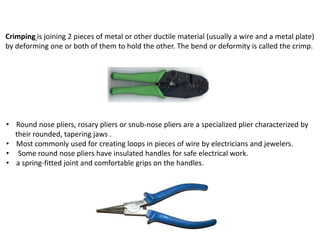
• Round nose pliers, rosary pliers or snub-nose pliers are a specialized plier characterized by
their rounded, tapering jaws .
• Most commonly used for creating loops in pieces of wire by electricians and jewelers.
• Some round nose pliers have insulated handles for safe electrical work.
• a spring-fitted joint and comfortable grips on the handles.
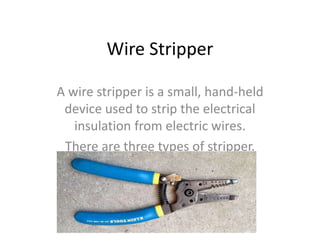
Wire Stripper
A wire stripper is a small, hand-held
device used to strip the electrical
insulation from electric wires.
There are three types of stripper.
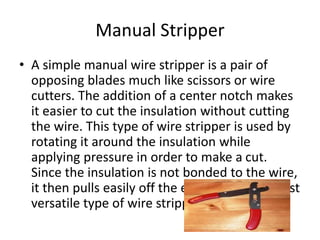
Manual Stripper
• A simple manual wire stripper is a pair of
opposing blades much like scissors or wire
cutters. The addition of a center notch makes
it easier to cut the insulation without cutting
the wire. This type of wire stripper is used by
rotating it around the insulation while
applying pressure in order to make a cut.
Since the insulation is not bonded to the wire,
it then pulls easily off the end. This is the most
versatile type of wire stripper.
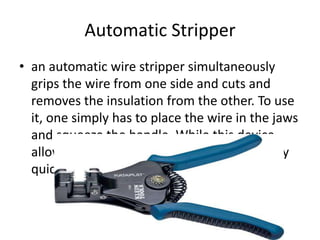
Automatic Stripper
• an automatic wire stripper simultaneously
grips the wire from one side and cuts and
removes the insulation from the other. To use
it, one simply has to place the wire in the jaws
and squeeze the handle. While this device
allows even a novice to strip most wires very
quickly
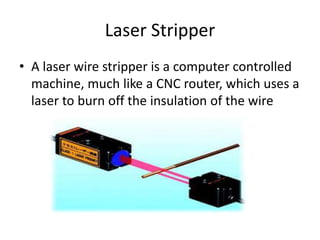
Laser Stripper
• A laser wire stripper is a computer controlled
machine, much like a CNC router, which uses a
laser to burn off the insulation of the wire
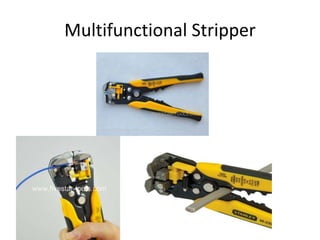
Multifunctional Stripper
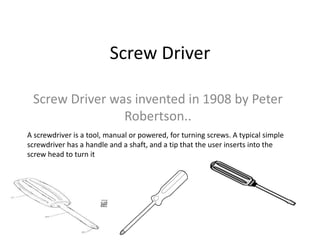
Screw Driver
Screw Driver was invented in 1908 by Peter
Robertson..
A screwdriver is a tool, manual or powered, for turning screws. A typical simple
screwdriver has a handle and a shaft, and a tip that the user inserts into the
screw head to turn it
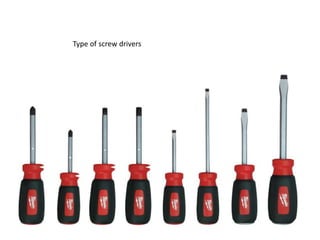
Type of screw drivers
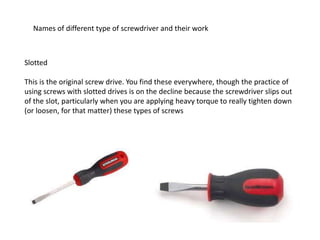
Names of different type of screwdriver and their work
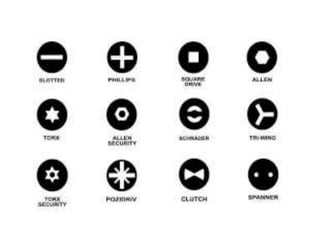
Slotted
This is the original screw drive. You find these everywhere, though the practice of
using screws with slotted drives is on the decline because the screwdriver slips out
of the slot, particularly when you are applying heavy torque to really tighten down
(or loosen, for that matter) these types of screws
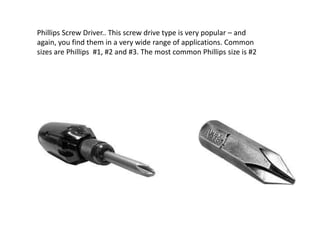
Phillips Screw Driver.. This screw drive type is very popular – and
again, you find them in a very wide range of applications. Common
sizes are Phillips #1, #2 and #3. The most common Phillips size is #2
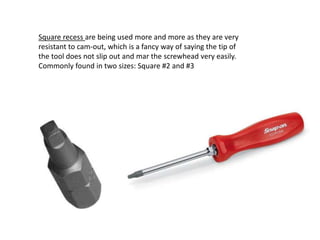
Square recess are being used more and more as they are very
resistant to cam-out, which is a fancy way of saying the tip of
the tool does not slip out and mar the screwhead very easily.
Commonly found in two sizes: Square #2 and #3
What is tool?
A tool is an object used to perform
work..
How dangerous are tools?
• Tools kill or injuries thousands of workers each
ear .
• Less dramatic accident injuries and main
construction workers every day .
• Many injuries happen because tools where:
• 1) Modified
• 2) Defective and
• 3)Use improperly
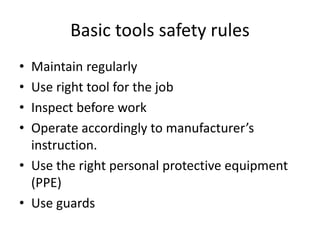
Basic tools safety rules
• Maintain regularly
• Use right tool for the job
• Inspect before work
• Operate accordingly to manufacturer’s
instruction.
• Use the right personal protective equipment
(PPE)
• Use guards
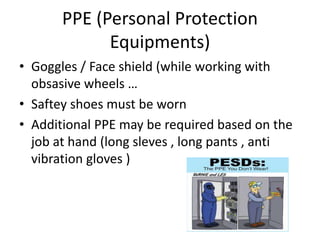
PPE (Personal Protection
Equipments)
• Goggles / Face shield (while working with
obsasive wheels …
• Saftey shoes must be worn
• Additional PPE may be required based on the
job at hand (long sleves , long pants , anti
vibration gloves )
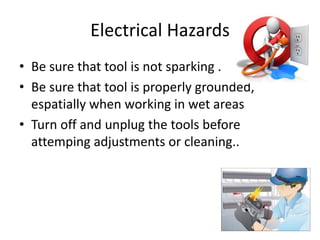
Electrical Hazards
• Be sure that tool is not sparking .
• Be sure that tool is properly grounded,
espatially when working in wet areas
• Turn off and unplug the tools before
attemping adjustments or cleaning..
Electrical workshop

Electrical workshop

  • 1.
    ELECTRITIONS TOOLS Electrical Work ShopPractice Kamran Ammar Daniyal Muzammil
  • 2.
  • 3.
    Power Meters • ThePower Analyser saves all the measured data on a SD memory card. • The Power Meter can be used to measure the capacity as well as to perform an analysis on the network. • Harmonics analysis with optional current clamps
  • 4.
    • Range upto 9999 MW. • voltage measurement: 10 - 600 V AC current measurement: 20 -1,200 A AC (Set 1); 30 ... 3,000 A AC (Set 2) • performance measurement: 0 kW ... 9,999 MW (VA/VAR)
  • 5.
    Clamp Meter • Aclamp Meter is an electrical device having two jaws which open to allow clamping around an electrical conductor. • This allows properties of the electric current in the conductor to be measured, without having to make physical contact with it, or to disconnect it for insertion through the probe • Mostly used for Ac currents.
  • 6.
  • 7.
    Line Tester • Phaseor Line Tester is a tool which is used to identify or test the Phase/Live/Hot or Positive wire/Conductor.
  • 8.
    Continuity Tester • Acontinuity tester is used to determine if an electrical path is complete or Not. • Commonly used to check sockets • It consist of a light and a battery connected in series and glows when path is completed.
  • 9.
    Non Contact Tester •During Flow of current, flow of electrons causes Magnetic field to be generated around wire. • These electromagnetic waves can induce a current on the secondary wiring inside the tester causing the inside bulb to glow.
  • 10.
    Nut Drivers • Anut driver is a tool for tightening nuts and bolts. • They are typically used for lower torque applications than wrenches.
  • 11.
    Drills And ItsTypes Manual DrillsHand Drill Brace Drill • The brace drill has a top spindle that is used for gripping and fixing the drill in a desired position • While one hand holds the top spindle, the other hand rotates the second spindle in a clockwise motion, so as to make the bit drill a precise hole through wood. • It known as the eggbeater drill • This type of drill has a drive wheel that is spun by turning handle. • The motion of the wheel makes the gear of the drill move along with the chuck, which in turn, causes the attached bit to rotate.
  • 12.
    Electrical Drills Corded Drill •Compact corded drills require a constant supply of power. • corded drills are more powerful and provide greater torque. Hammer Drill • A hammer drill uses rapid and short motions to pound through concrete, stone, and thick blocks of metal. • Hammer drills can have either or both rotary as well as hammer actions
  • 13.
    Cordless Drills • Cordlessdrills are shaped exactly like corded drills • The only difference being that these drills function on batteries and are much more lighter • The biggest advantage of cordless drills is the mobility it offers to its user. These drills can be carried in the tool kit and used in remote areas that have no power outlets. • Types of battries used are heavier nickel-cadmium, and expensive and lighter lithium- ion batteries. • It is not suitable for heavy drilling work • It would work on wood, thin metal sheets, fiberglass, and plastic.
  • 14.
    Basic Internal Structureof a Drill • Motor causes the gears to rotate and which results in rotating the drill bit which then used for drilling.
  • 15.
    Adjustable Can Light/ Speaker Hole Saws • Cuts drywall and ceiling tile • Self-sharpening carbide coated stainless steel blades
  • 16.
    Temperature Controlled SolderingIron • A soldering iron is a handtool used in soldering • It supplies heat to melt solder so that it can flow into the joint between two work pieces. • Temperature can be controlled using the.
  • 17.
    Soldering Gun • Asoldering gun is an approximately pistol - shaped, electrically powered tool for soldering metals using tin- based solder to achieve a strong mechanical bond with good electrical contact. • Soldering guns are used where more heat is needed than from the lower- power soldering iron.
  • 18.
    What is plier Avariously shaped hand tool having a pair of pivoted jaws, used for holding, bending, or cutting
  • 19.
  • 20.
    Names of pliersand Their Uses • Slip joint pliers are pliers whose pivot point or fulcrum can be moved to increase the size range of their jaws. Most slip joint pliers use a mechanism that allows sliding the pivot point into one of several positions when the pliers are fully opened.
  • 21.
    Linesman pliers • Itis a type of pliers used by electricians primarily for gripping, twisting, bending and cutting wire and cable. Linemen's pliers owe their effectiveness to their plier design, which multiplies force through leverage Needle-nose pliers • Also known as pointy-nose pliers, long-nose pliers, pinch-nose pliers or snipe-nose pliers • It is also used for cutting and holding wires. • Pliers used by artisans, jewelry designers, electricians, network engineers and other tradesmen to bend, re-position and snip wire.
  • 22.
    Crimping is joining2 pieces of metal or other ductile material (usually a wire and a metal plate) by deforming one or both of them to hold the other. The bend or deformity is called the crimp. • Round nose pliers, rosary pliers or snub-nose pliers are a specialized plier characterized by their rounded, tapering jaws . • Most commonly used for creating loops in pieces of wire by electricians and jewelers. • Some round nose pliers have insulated handles for safe electrical work. • a spring-fitted joint and comfortable grips on the handles.
  • 24.
    Wire Stripper A wirestripper is a small, hand-held device used to strip the electrical insulation from electric wires. There are three types of stripper.
  • 25.
    Manual Stripper • Asimple manual wire stripper is a pair of opposing blades much like scissors or wire cutters. The addition of a center notch makes it easier to cut the insulation without cutting the wire. This type of wire stripper is used by rotating it around the insulation while applying pressure in order to make a cut. Since the insulation is not bonded to the wire, it then pulls easily off the end. This is the most versatile type of wire stripper.
  • 26.
    Automatic Stripper • anautomatic wire stripper simultaneously grips the wire from one side and cuts and removes the insulation from the other. To use it, one simply has to place the wire in the jaws and squeeze the handle. While this device allows even a novice to strip most wires very quickly
  • 27.
    Laser Stripper • Alaser wire stripper is a computer controlled machine, much like a CNC router, which uses a laser to burn off the insulation of the wire
  • 28.
  • 29.
    Screw Driver Screw Driverwas invented in 1908 by Peter Robertson.. A screwdriver is a tool, manual or powered, for turning screws. A typical simple screwdriver has a handle and a shaft, and a tip that the user inserts into the screw head to turn it
  • 30.
  • 31.
    Names of differenttype of screwdriver and their work Slotted This is the original screw drive. You find these everywhere, though the practice of using screws with slotted drives is on the decline because the screwdriver slips out of the slot, particularly when you are applying heavy torque to really tighten down (or loosen, for that matter) these types of screws
  • 32.
    Phillips Screw Driver..This screw drive type is very popular – and again, you find them in a very wide range of applications. Common sizes are Phillips #1, #2 and #3. The most common Phillips size is #2
  • 33.
    Square recess arebeing used more and more as they are very resistant to cam-out, which is a fancy way of saying the tip of the tool does not slip out and mar the screwhead very easily. Commonly found in two sizes: Square #2 and #3
  • 35.
    What is tool? Atool is an object used to perform work..
  • 36.
    How dangerous aretools? • Tools kill or injuries thousands of workers each ear . • Less dramatic accident injuries and main construction workers every day . • Many injuries happen because tools where: • 1) Modified • 2) Defective and • 3)Use improperly
  • 37.
    Basic tools safetyrules • Maintain regularly • Use right tool for the job • Inspect before work • Operate accordingly to manufacturer’s instruction. • Use the right personal protective equipment (PPE) • Use guards
  • 38.
    PPE (Personal Protection Equipments) •Goggles / Face shield (while working with obsasive wheels … • Saftey shoes must be worn • Additional PPE may be required based on the job at hand (long sleves , long pants , anti vibration gloves )
  • 39.
    Electrical Hazards • Besure that tool is not sparking . • Be sure that tool is properly grounded, espatially when working in wet areas • Turn off and unplug the tools before attemping adjustments or cleaning..