“OMICS IN CROP IMPROVEMENT”
Presented by
Gautham S
MSc. (Ag) Ist Year
Department of Genetics and Plant Breeding
1
֍ OMICS – Comprehensive analysis of the biological system.
֍ Large-scale biology – “OMICS” – Revolution in
screening traits and develop novel improved organisms.
֍ Beyond basic nutrition and the development of functional
foods- for enhanced health quality.
Source : Mochida and Shinozaki, 2010
2
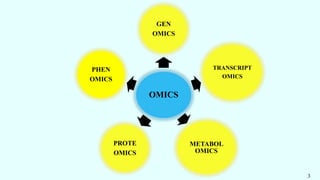
OMICS
GEN
OMICS
TRANSCRIPT
OMICS
METABOL
OMICS
PROTE
OMICS
PHEN
OMICS
3
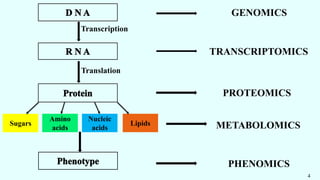
GENOMICS
TRANSCRIPTOMICS
PROTEOMICS
Transcription
Translation
Lipids
Nucleic
acids
Amino
acids
Sugars METABOLOMICS
PHENOMICS
4
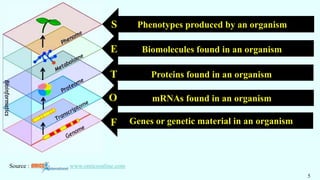
Phenotypes produced by an organism
Biomolecules found in an organism
Proteins found in an organism
mRNAs found in an organism
Genes or genetic material in an organism
S
E
T
O
F
5
Source : www.omicsonline.com
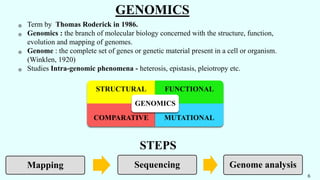
GENOMICS
֍ Term by Thomas Roderick in 1986.
֍ Genomics : the branch of molecular biology concerned with the structure, function,
evolution and mapping of genomes.
֍ Genome : the complete set of genes or genetic material present in a cell or organism.
(Winklen, 1920)
֍ Studies Intra-genomic phenomena - heterosis, epistasis, pleiotropy etc.
STRUCTURAL FUNCTIONAL
COMPARATIVE MUTATIONAL
GENOMICS
6
Mapping Sequencing Genome analysis
STEPS
Genome Mapping
֍ Methods used to identify the locus of a gene and the distances between genes.
֍ Given by Alfred Sturtvent (1915) in Drosophila melanogaster.
֍ Traits mapped : Morphological Characters, Productivity traits, Resistance Traits,
Quality Traits, Agronomic Traits, Special Characters.
֍ To study linkage and recombination.
֍ In India, by the Depart of Biotechnology [DBT] and ICAR.
֍ Done in rice, wheat, maize, chick pea, banana, tomato, Brassica, etc.
7
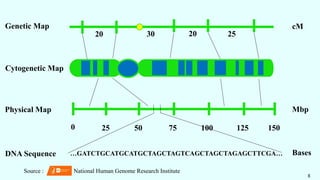
MAPPING
GENETIC
MAP
CYTOGENETIC
MAP
PHYSICAL
MAP
8
0 150
125
100
75
50
25
Mbp
cM
20 20
30 25
Genetic Map
Physical Map
Cytogenetic Map
DNA Sequence …GATCTGCATGCATGCTAGCTAGTCAGCTAGCTAGAGCTTCGA… Bases
Source : National Human Genome Research Institute
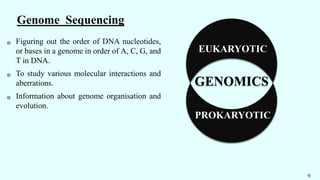
Genome Sequencing
֍ Figuring out the order of DNA nucleotides,
or bases in a genome in order of A, C, G, and
T in DNA.
֍ To study various molecular interactions and
aberrations.
֍ Information about genome organisation and
evolution.
GENOMICS
EUKARYOTIC
PROKARYOTIC
9
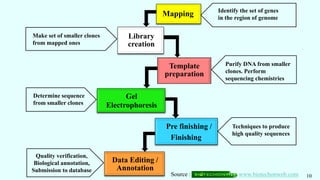
Mapping
Library
creation
Template
preparation
Gel
Electrophoresis
Pre finishing /
Finishing
Data Editing /
Annotation
‘
Make set of smaller clones
from mapped ones
Quality verification,
Biological annotation,
Submission to database
Identify the set of genes
in the region of genome
Purify DNA from smaller
clones. Perform
sequencing chemistries
Determine sequence
from smaller clones
Techniques to produce
high quality sequences
10
Source : www.biotechonweb.com
A
P
P
L
I
C
A
T
I
O
N
S
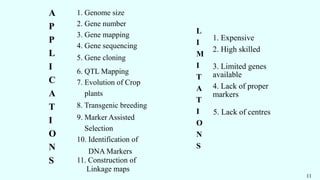
1. Genome size
2. Gene number
3. Gene mapping
4. Gene sequencing
5. Gene cloning
6. QTL Mapping
7. Evolution of Crop
plants
8. Transgenic breeding
9. Marker Assisted
Selection
10. Identification of
DNA Markers
11. Construction of
Linkage maps
L
I
M
I
T
A
T
I
O
N
S
1. Expensive
2. High skilled
3. Limited genes
available
4. Lack of proper
markers
5. Lack of centres
11
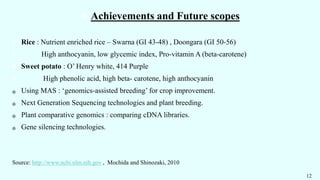
 Achievements and Future scopes
 Rice : Nutrient enriched rice – Swarna (GI 43-48) , Doongara (GI 50-56)
 High anthocyanin, low glycemic index, Pro-vitamin A (beta-carotene)
 Sweet potato : O’ Henry white, 414 Purple
 High phenolic acid, high beta- carotene, high anthocyanin
֍ Using MAS : ‘genomics-assisted breeding’ for crop improvement.
֍ Next Generation Sequencing technologies and plant breeding.
֍ Plant comparative genomics : comparing cDNA libraries.
֍ Gene silencing technologies.
Source: http://www.ncbi.nlm.nih.gov , Mochida and Shinozaki, 2010
12
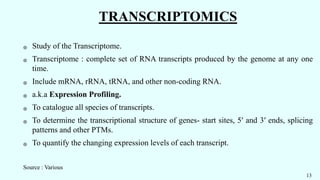
TRANSCRIPTOMICS
֍ Study of the Transcriptome.
֍ Transcriptome : complete set of RNA transcripts produced by the genome at any one
time.
֍ Include mRNA, rRNA, tRNA, and other non-coding RNA.
֍ a.k.a Expression Profiling.
֍ To catalogue all species of transcripts.
֍ To determine the transcriptional structure of genes- start sites, 5′ and 3′ ends, splicing
patterns and other PTMs.
֍ To quantify the changing expression levels of each transcript.
Source : Various
13
14
Source : National Human Genome Research Institute
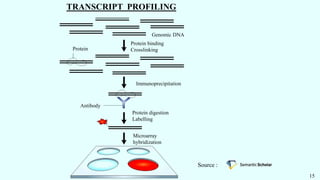
TRANSCRIPT PROFILING
15
Source :
Genomic DNA
Protein binding
Crosslinking
Protein
Immunoprecipitation
Protein digestion
Labelling
Microarray
hybridization
Antibody
16
Applications and Scope
1. Screening target genes
2. Predict gene function
3. Comparative transcriptomics helps in pattern of selection
4. Role of comparative safety assessment of plant products (GMO)
5. Identification of gene involving in stress
6. Understanding symbiotic association
7. Determination of pathogenicity function and Host pathogen interactions
8. Dissection of food quality traits
9. Expression of QTL isolation.
Source : American Chemical Society, 2014
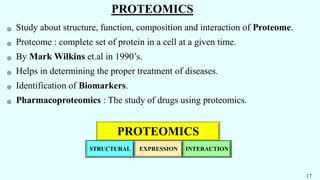
PROTEOMICS
֍ Study about structure, function, composition and interaction of Proteome.
֍ Proteome : complete set of protein in a cell at a given time.
֍ By Mark Wilkins et.al in 1990’s.
֍ Helps in determining the proper treatment of diseases.
֍ Identification of Biomarkers.
֍ Pharmacoproteomics : The study of drugs using proteomics.
PROTEOMICS
STRUCTURAL EXPRESSION INTERACTION
17
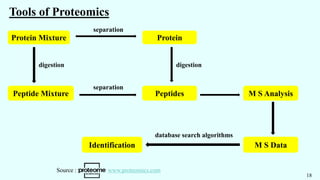
Tools of Proteomics
Peptide Mixture
Protein Mixture Protein
Peptides M S Analysis
M S Data
Identification
separation
separation
digestion digestion
database search algorithms
18
Source : www.proteomics.com
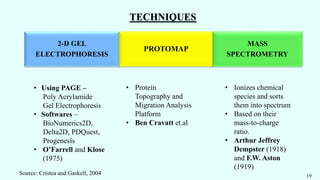
TECHNIQUES
2-D GEL
ELECTROPHORESIS
PROTOMAP
MASS
SPECTROMETRY
• Using PAGE –
Poly Acrylamide
Gel Electrophoresis
• Softwares –
BioNumerics2D,
Delta2D, PDQuest,
Progenesis
• O’Farrell and Klose
(1975)
• Protein
Topography and
Migration Analysis
Platform
• Ben Cravatt et.al
19
• Ionizes chemical
species and sorts
them into spectrum
• Based on their
mass-to-charge
ratio.
• Arthur Jeffrey
Dempster (1918)
and F.W. Aston
(1919)
Source: Cristea and Gaskell, 2004
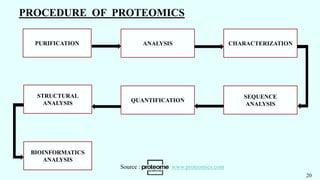
PURIFICATION
SEQUENCE
ANALYSIS
QUANTIFICATION
ANALYSIS CHARACTERIZATION
STRUCTURAL
ANALYSIS
BIOINFORMATICS
ANALYSIS
PROCEDURE OF PROTEOMICS
20
Source : www.proteomics.com
Applications and Scope
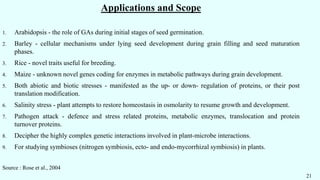
1. Arabidopsis - the role of GAs during initial stages of seed germination.
2. Barley - cellular mechanisms under lying seed development during grain filling and seed maturation
phases.
3. Rice - novel traits useful for breeding.
4. Maize - unknown novel genes coding for enzymes in metabolic pathways during grain development.
5. Both abiotic and biotic stresses - manifested as the up- or down- regulation of proteins, or their post
translation modification.
6. Salinity stress - plant attempts to restore homeostasis in osmolarity to resume growth and development.
7. Pathogen attack - defence and stress related proteins, metabolic enzymes, translocation and protein
turnover proteins.
8. Decipher the highly complex genetic interactions involved in plant-microbe interactions.
9. For studying symbioses (nitrogen symbiosis, ecto- and endo-mycorrhizal symbiosis) in plants.
Source : Rose et al., 2004
21
METABOLOMICS
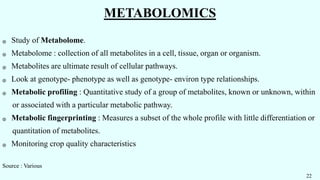
֍ Study of Metabolome.
֍ Metabolome : collection of all metabolites in a cell, tissue, organ or organism.
֍ Metabolites are ultimate result of cellular pathways.
֍ Look at genotype- phenotype as well as genotype- environ type relationships.
֍ Metabolic profiling : Quantitative study of a group of metabolites, known or unknown, within
or associated with a particular metabolic pathway.
֍ Metabolic fingerprinting : Measures a subset of the whole profile with little differentiation or
quantitation of metabolites.
֍ Monitoring crop quality characteristics
Source : Various
22
1. Metabolite Extraction 2. Chromatography 3. Mass Spectrometry 4. Data Analysis
[ Rapid Enzyme Quenching ] [ Separation ] [ Specificity ] [ Metabolite identification ]
Cell & Tissues
Leaves & other organs
Cold organic
solvents
Grinding
Weighing
Samples
23
Source : www.metabolon.com
 Applications and Scope
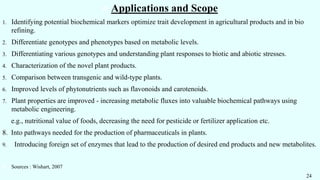
1. Identifying potential biochemical markers optimize trait development in agricultural products and in bio
refining.
2. Differentiate genotypes and phenotypes based on metabolic levels.
3. Differentiating various genotypes and understanding plant responses to biotic and abiotic stresses.
4. Characterization of the novel plant products.
5. Comparison between transgenic and wild-type plants.
6. Improved levels of phytonutrients such as flavonoids and carotenoids.
7. Plant properties are improved - increasing metabolic fluxes into valuable biochemical pathways using
metabolic engineering.
e.g., nutritional value of foods, decreasing the need for pesticide or fertilizer application etc.
8. Into pathways needed for the production of pharmaceuticals in plants.
9. Introducing foreign set of enzymes that lead to the production of desired end products and new metabolites.
 Sources : Wishart, 2007
24
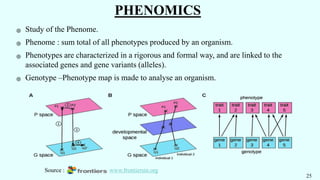
PHENOMICS
֍ Study of the Phenome.
֍ Phenome : sum total of all phenotypes produced by an organism.
֍ Phenotypes are characterized in a rigorous and formal way, and are linked to the
associated genes and gene variants (alleles).
֍ Genotype –Phenotype map is made to analyse an organism.
25
Source : www.frontiersin.org
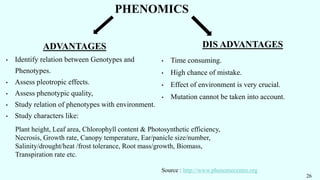
PHENOMICS
ADVANTAGES
• Identify relation between Genotypes and
Phenotypes.
• Assess pleotropic effects.
• Assess phenotypic quality,
• Study relation of phenotypes with environment.
• Study characters like:
DIS ADVANTAGES
• Time consuming.
• High chance of mistake.
• Effect of environment is very crucial.
• Mutation cannot be taken into account.
26
Source : http://www.phenomecentre.org
Plant height, Leaf area, Chlorophyll content & Photosynthetic efficiency,
Necrosis, Growth rate, Canopy temperature, Ear/panicle size/number,
Salinity/drought/heat /frost tolerance, Root mass/growth, Biomass,
Transpiration rate etc.
REFERENCES
1. Aslam, B., 2017, Proteomics: Technologies and Their Applications.
2. Benkeblia, N., 2014, Omics Technologies and Crop Improvement, CRC Press
3. Horgan and Kenny, 2011, ‘Omic’ technologies: genomics, transcriptomics, proteomics and metabolomics.
4. Kumar, S. V., 2012, Proteomics in Agriculture.
5. Mochida and Shinozaki, 2010, Genomics and Bioinformatics Resources for Crop Improvement.
6. Nawar, A., 2013, Proteomics : A biotechnology tool for crop improvement.
7. Setia, R. C., 2018, The Omics technologies and Crop improvement.
8. Wishart, D., 2007, Current Progress in computational metabolomics.
9. https://en.wikipedia.org/wiki
10. https://www.biotecharticles.com/Agriculture-Article/Role-of-Omics-in-Crop-Improvement
11. https://www.genome.gov
12. https://www.metabolon.com
13. https://www.ncbi.nlm.nih.gov/pmc/articles/PMC4714296
14. https://www.omicsonline.org 27
28

OMICS in Crop Improvement.pptx

  • 1.
    “OMICS IN CROPIMPROVEMENT” Presented by Gautham S MSc. (Ag) Ist Year Department of Genetics and Plant Breeding 1
  • 2.
    ֍ OMICS –Comprehensive analysis of the biological system. ֍ Large-scale biology – “OMICS” – Revolution in screening traits and develop novel improved organisms. ֍ Beyond basic nutrition and the development of functional foods- for enhanced health quality. Source : Mochida and Shinozaki, 2010 2
  • 3.
  • 4.
  • 5.
    Phenotypes produced byan organism Biomolecules found in an organism Proteins found in an organism mRNAs found in an organism Genes or genetic material in an organism S E T O F 5 Source : www.omicsonline.com
  • 6.
    GENOMICS ֍ Term byThomas Roderick in 1986. ֍ Genomics : the branch of molecular biology concerned with the structure, function, evolution and mapping of genomes. ֍ Genome : the complete set of genes or genetic material present in a cell or organism. (Winklen, 1920) ֍ Studies Intra-genomic phenomena - heterosis, epistasis, pleiotropy etc. STRUCTURAL FUNCTIONAL COMPARATIVE MUTATIONAL GENOMICS 6 Mapping Sequencing Genome analysis STEPS
  • 7.
    Genome Mapping ֍ Methodsused to identify the locus of a gene and the distances between genes. ֍ Given by Alfred Sturtvent (1915) in Drosophila melanogaster. ֍ Traits mapped : Morphological Characters, Productivity traits, Resistance Traits, Quality Traits, Agronomic Traits, Special Characters. ֍ To study linkage and recombination. ֍ In India, by the Depart of Biotechnology [DBT] and ICAR. ֍ Done in rice, wheat, maize, chick pea, banana, tomato, Brassica, etc. 7 MAPPING GENETIC MAP CYTOGENETIC MAP PHYSICAL MAP
  • 8.
    8 0 150 125 100 75 50 25 Mbp cM 20 20 3025 Genetic Map Physical Map Cytogenetic Map DNA Sequence …GATCTGCATGCATGCTAGCTAGTCAGCTAGCTAGAGCTTCGA… Bases Source : National Human Genome Research Institute
  • 9.
    Genome Sequencing ֍ Figuringout the order of DNA nucleotides, or bases in a genome in order of A, C, G, and T in DNA. ֍ To study various molecular interactions and aberrations. ֍ Information about genome organisation and evolution. GENOMICS EUKARYOTIC PROKARYOTIC 9
  • 10.
    Mapping Library creation Template preparation Gel Electrophoresis Pre finishing / Finishing DataEditing / Annotation ‘ Make set of smaller clones from mapped ones Quality verification, Biological annotation, Submission to database Identify the set of genes in the region of genome Purify DNA from smaller clones. Perform sequencing chemistries Determine sequence from smaller clones Techniques to produce high quality sequences 10 Source : www.biotechonweb.com
  • 11.
    A P P L I C A T I O N S 1. Genome size 2.Gene number 3. Gene mapping 4. Gene sequencing 5. Gene cloning 6. QTL Mapping 7. Evolution of Crop plants 8. Transgenic breeding 9. Marker Assisted Selection 10. Identification of DNA Markers 11. Construction of Linkage maps L I M I T A T I O N S 1. Expensive 2. High skilled 3. Limited genes available 4. Lack of proper markers 5. Lack of centres 11
  • 12.
     Achievements andFuture scopes  Rice : Nutrient enriched rice – Swarna (GI 43-48) , Doongara (GI 50-56)  High anthocyanin, low glycemic index, Pro-vitamin A (beta-carotene)  Sweet potato : O’ Henry white, 414 Purple  High phenolic acid, high beta- carotene, high anthocyanin ֍ Using MAS : ‘genomics-assisted breeding’ for crop improvement. ֍ Next Generation Sequencing technologies and plant breeding. ֍ Plant comparative genomics : comparing cDNA libraries. ֍ Gene silencing technologies. Source: http://www.ncbi.nlm.nih.gov , Mochida and Shinozaki, 2010 12
  • 13.
    TRANSCRIPTOMICS ֍ Study ofthe Transcriptome. ֍ Transcriptome : complete set of RNA transcripts produced by the genome at any one time. ֍ Include mRNA, rRNA, tRNA, and other non-coding RNA. ֍ a.k.a Expression Profiling. ֍ To catalogue all species of transcripts. ֍ To determine the transcriptional structure of genes- start sites, 5′ and 3′ ends, splicing patterns and other PTMs. ֍ To quantify the changing expression levels of each transcript. Source : Various 13
  • 14.
    14 Source : NationalHuman Genome Research Institute
  • 15.
    TRANSCRIPT PROFILING 15 Source : GenomicDNA Protein binding Crosslinking Protein Immunoprecipitation Protein digestion Labelling Microarray hybridization Antibody
  • 16.
    16 Applications and Scope 1.Screening target genes 2. Predict gene function 3. Comparative transcriptomics helps in pattern of selection 4. Role of comparative safety assessment of plant products (GMO) 5. Identification of gene involving in stress 6. Understanding symbiotic association 7. Determination of pathogenicity function and Host pathogen interactions 8. Dissection of food quality traits 9. Expression of QTL isolation. Source : American Chemical Society, 2014
  • 17.
    PROTEOMICS ֍ Study aboutstructure, function, composition and interaction of Proteome. ֍ Proteome : complete set of protein in a cell at a given time. ֍ By Mark Wilkins et.al in 1990’s. ֍ Helps in determining the proper treatment of diseases. ֍ Identification of Biomarkers. ֍ Pharmacoproteomics : The study of drugs using proteomics. PROTEOMICS STRUCTURAL EXPRESSION INTERACTION 17
  • 18.
    Tools of Proteomics PeptideMixture Protein Mixture Protein Peptides M S Analysis M S Data Identification separation separation digestion digestion database search algorithms 18 Source : www.proteomics.com
  • 19.
    TECHNIQUES 2-D GEL ELECTROPHORESIS PROTOMAP MASS SPECTROMETRY • UsingPAGE – Poly Acrylamide Gel Electrophoresis • Softwares – BioNumerics2D, Delta2D, PDQuest, Progenesis • O’Farrell and Klose (1975) • Protein Topography and Migration Analysis Platform • Ben Cravatt et.al 19 • Ionizes chemical species and sorts them into spectrum • Based on their mass-to-charge ratio. • Arthur Jeffrey Dempster (1918) and F.W. Aston (1919) Source: Cristea and Gaskell, 2004
  • 20.
  • 21.
    Applications and Scope 1.Arabidopsis - the role of GAs during initial stages of seed germination. 2. Barley - cellular mechanisms under lying seed development during grain filling and seed maturation phases. 3. Rice - novel traits useful for breeding. 4. Maize - unknown novel genes coding for enzymes in metabolic pathways during grain development. 5. Both abiotic and biotic stresses - manifested as the up- or down- regulation of proteins, or their post translation modification. 6. Salinity stress - plant attempts to restore homeostasis in osmolarity to resume growth and development. 7. Pathogen attack - defence and stress related proteins, metabolic enzymes, translocation and protein turnover proteins. 8. Decipher the highly complex genetic interactions involved in plant-microbe interactions. 9. For studying symbioses (nitrogen symbiosis, ecto- and endo-mycorrhizal symbiosis) in plants. Source : Rose et al., 2004 21
  • 22.
    METABOLOMICS ֍ Study ofMetabolome. ֍ Metabolome : collection of all metabolites in a cell, tissue, organ or organism. ֍ Metabolites are ultimate result of cellular pathways. ֍ Look at genotype- phenotype as well as genotype- environ type relationships. ֍ Metabolic profiling : Quantitative study of a group of metabolites, known or unknown, within or associated with a particular metabolic pathway. ֍ Metabolic fingerprinting : Measures a subset of the whole profile with little differentiation or quantitation of metabolites. ֍ Monitoring crop quality characteristics Source : Various 22
  • 23.
    1. Metabolite Extraction2. Chromatography 3. Mass Spectrometry 4. Data Analysis [ Rapid Enzyme Quenching ] [ Separation ] [ Specificity ] [ Metabolite identification ] Cell & Tissues Leaves & other organs Cold organic solvents Grinding Weighing Samples 23 Source : www.metabolon.com
  • 24.
     Applications andScope 1. Identifying potential biochemical markers optimize trait development in agricultural products and in bio refining. 2. Differentiate genotypes and phenotypes based on metabolic levels. 3. Differentiating various genotypes and understanding plant responses to biotic and abiotic stresses. 4. Characterization of the novel plant products. 5. Comparison between transgenic and wild-type plants. 6. Improved levels of phytonutrients such as flavonoids and carotenoids. 7. Plant properties are improved - increasing metabolic fluxes into valuable biochemical pathways using metabolic engineering. e.g., nutritional value of foods, decreasing the need for pesticide or fertilizer application etc. 8. Into pathways needed for the production of pharmaceuticals in plants. 9. Introducing foreign set of enzymes that lead to the production of desired end products and new metabolites.  Sources : Wishart, 2007 24
  • 25.
    PHENOMICS ֍ Study ofthe Phenome. ֍ Phenome : sum total of all phenotypes produced by an organism. ֍ Phenotypes are characterized in a rigorous and formal way, and are linked to the associated genes and gene variants (alleles). ֍ Genotype –Phenotype map is made to analyse an organism. 25 Source : www.frontiersin.org
  • 26.
    PHENOMICS ADVANTAGES • Identify relationbetween Genotypes and Phenotypes. • Assess pleotropic effects. • Assess phenotypic quality, • Study relation of phenotypes with environment. • Study characters like: DIS ADVANTAGES • Time consuming. • High chance of mistake. • Effect of environment is very crucial. • Mutation cannot be taken into account. 26 Source : http://www.phenomecentre.org Plant height, Leaf area, Chlorophyll content & Photosynthetic efficiency, Necrosis, Growth rate, Canopy temperature, Ear/panicle size/number, Salinity/drought/heat /frost tolerance, Root mass/growth, Biomass, Transpiration rate etc.
  • 27.
    REFERENCES 1. Aslam, B.,2017, Proteomics: Technologies and Their Applications. 2. Benkeblia, N., 2014, Omics Technologies and Crop Improvement, CRC Press 3. Horgan and Kenny, 2011, ‘Omic’ technologies: genomics, transcriptomics, proteomics and metabolomics. 4. Kumar, S. V., 2012, Proteomics in Agriculture. 5. Mochida and Shinozaki, 2010, Genomics and Bioinformatics Resources for Crop Improvement. 6. Nawar, A., 2013, Proteomics : A biotechnology tool for crop improvement. 7. Setia, R. C., 2018, The Omics technologies and Crop improvement. 8. Wishart, D., 2007, Current Progress in computational metabolomics. 9. https://en.wikipedia.org/wiki 10. https://www.biotecharticles.com/Agriculture-Article/Role-of-Omics-in-Crop-Improvement 11. https://www.genome.gov 12. https://www.metabolon.com 13. https://www.ncbi.nlm.nih.gov/pmc/articles/PMC4714296 14. https://www.omicsonline.org 27
  • 28.