© 2009 South-Western, a part of Cengage Learning, all rights reserved
C H A P T E R
Oligopoly
Microeonomics
P R I N C I P L E S O F
N. Gregory Mankiw
Premium PowerPoint Slides
by Ron Cronovich
17
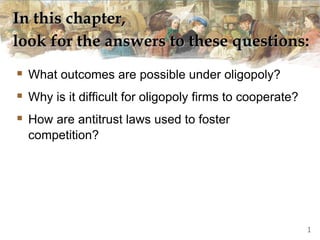
In this chapter,
look for the answers to these questions:
 What outcomes are possible under oligopoly?
 Why is it difficult for oligopoly firms to cooperate?
 How are antitrust laws used to foster
competition?
1
OLIGOPOLY 2
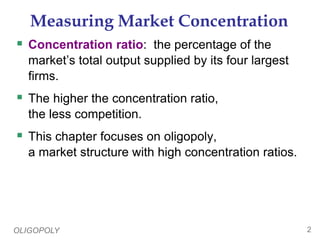
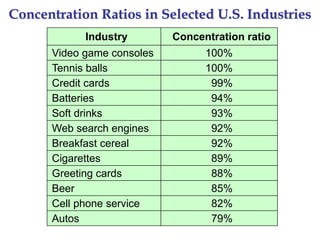
Measuring Market Concentration
 Concentration ratio: the percentage of the
market’s total output supplied by its four largest
firms.
 The higher the concentration ratio,
the less competition.
 This chapter focuses on oligopoly,
a market structure with high concentration ratios.
Concentration Ratios in Selected U.S. Industries
Industry Concentration ratio
Video game consoles 100%
Tennis balls 100%
Credit cards 99%
Batteries 94%
Soft drinks 93%
Web search engines 92%
Breakfast cereal 92%
Cigarettes 89%
Greeting cards 88%
Beer 85%
Cell phone service 82%
Autos 79%
OLIGOPOLY 4
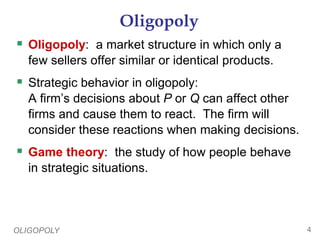
Oligopoly
 Oligopoly: a market structure in which only a
few sellers offer similar or identical products.
 Strategic behavior in oligopoly:
A firm’s decisions about P or Q can affect other
firms and cause them to react. The firm will
consider these reactions when making decisions.
 Game theory: the study of how people behave
in strategic situations.
OLIGOPOLY 5
P Q
$0 140
5 130
10 120
15 110
20 100
25 90
30 80
35 70
40 60
45 50
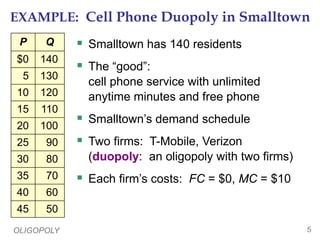
EXAMPLE: Cell Phone Duopoly in Smalltown
 Smalltown has 140 residents
 The “good”:
cell phone service with unlimited
anytime minutes and free phone
 Smalltown’s demand schedule
 Two firms: T-Mobile, Verizon
(duopoly: an oligopoly with two firms)
 Each firm’s costs: FC = $0, MC = $10
OLIGOPOLY 6
50
45
60
40
70
35
80
30
90
25
100
20
110
15
120
10
130
5
140
$0
Q
P
1,750
1,800
1,750
1,600
1,350
1,000
550
0
–650
–1,400
Profit
500
600
700
800
900
1,000
1,100
1,200
1,300
$1,400
Cost
2,250
2,400
2,450
2,400
2,250
2,000
1,650
1,200
650
$0
Revenue
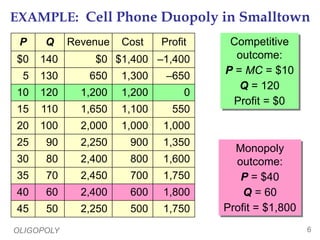
EXAMPLE: Cell Phone Duopoly in Smalltown
Competitive
outcome:
P = MC = $10
Q = 120
Profit = $0
Monopoly
outcome:
P = $40
Q = 60
Profit = $1,800
OLIGOPOLY 7
EXAMPLE: Cell Phone Duopoly in Smalltown
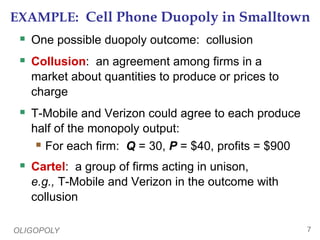
 One possible duopoly outcome: collusion
 Collusion: an agreement among firms in a
market about quantities to produce or prices to
charge
 T-Mobile and Verizon could agree to each produce
half of the monopoly output:
 For each firm: Q = 30, P = $40, profits = $900
 Cartel: a group of firms acting in unison,
e.g., T-Mobile and Verizon in the outcome with
collusion
A C T I V E L E A R N I N G 1
Collusion vs. self-interest
8
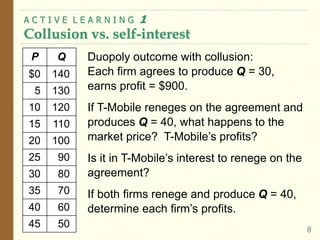
Duopoly outcome with collusion:
Each firm agrees to produce Q = 30,
earns profit = $900.
If T-Mobile reneges on the agreement and
produces Q = 40, what happens to the
market price? T-Mobile’s profits?
Is it in T-Mobile’s interest to renege on the
agreement?
If both firms renege and produce Q = 40,
determine each firm’s profits.
P Q
$0 140
5 130
10 120
15 110
20 100
25 90
30 80
35 70
40 60
45 50
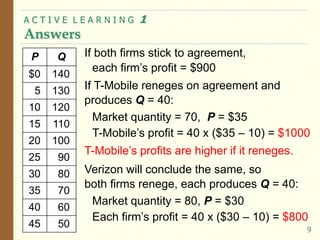
If both firms stick to agreement,
each firm’s profit = $900
If T-Mobile reneges on agreement and
produces Q = 40:
Market quantity = 70, P = $35
T-Mobile’s profit = 40 x ($35 – 10) = $1000
T-Mobile’s profits are higher if it reneges.
Verizon will conclude the same, so
both firms renege, each produces Q = 40:
Market quantity = 80, P = $30
Each firm’s profit = 40 x ($30 – 10) = $800
A C T I V E L E A R N I N G 1
Answers
9
P Q
$0 140
5 130
10 120
15 110
20 100
25 90
30 80
35 70
40 60
45 50
OLIGOPOLY 10
Collusion vs. Self-Interest
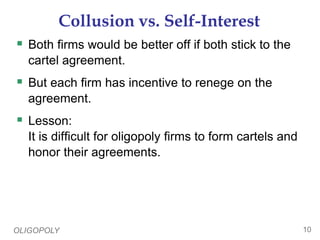
 Both firms would be better off if both stick to the
cartel agreement.
 But each firm has incentive to renege on the
agreement.
 Lesson:
It is difficult for oligopoly firms to form cartels and
honor their agreements.
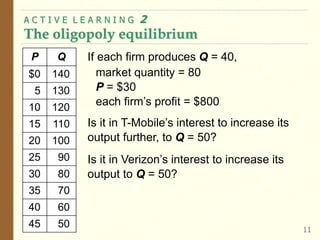
If each firm produces Q = 40,
market quantity = 80
P = $30
each firm’s profit = $800
Is it in T-Mobile’s interest to increase its
output further, to Q = 50?
Is it in Verizon’s interest to increase its
output to Q = 50?
A C T I V E L E A R N I N G 2
The oligopoly equilibrium
11
P Q
$0 140
5 130
10 120
15 110
20 100
25 90
30 80
35 70
40 60
45 50
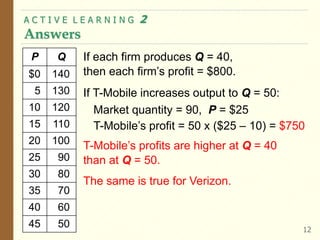
If each firm produces Q = 40,
then each firm’s profit = $800.
If T-Mobile increases output to Q = 50:
Market quantity = 90, P = $25
T-Mobile’s profit = 50 x ($25 – 10) = $750
T-Mobile’s profits are higher at Q = 40
than at Q = 50.
The same is true for Verizon.
A C T I V E L E A R N I N G 2
Answers
12
P Q
$0 140
5 130
10 120
15 110
20 100
25 90
30 80
35 70
40 60
45 50
OLIGOPOLY 13
The Equilibrium for an Oligopoly
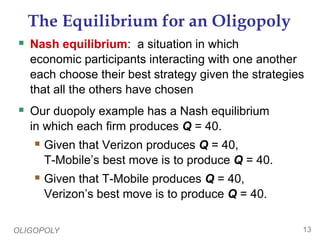
 Nash equilibrium: a situation in which
economic participants interacting with one another
each choose their best strategy given the strategies
that all the others have chosen
 Our duopoly example has a Nash equilibrium
in which each firm produces Q = 40.
 Given that Verizon produces Q = 40,
T-Mobile’s best move is to produce Q = 40.
 Given that T-Mobile produces Q = 40,
Verizon’s best move is to produce Q = 40.
OLIGOPOLY 14
A Comparison of Market Outcomes
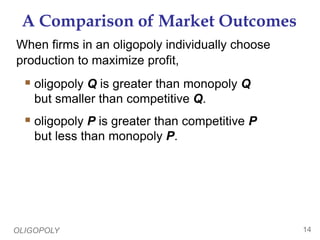
When firms in an oligopoly individually choose
production to maximize profit,
 oligopoly Q is greater than monopoly Q
but smaller than competitive Q.
 oligopoly P is greater than competitive P
but less than monopoly P.
OLIGOPOLY 15
The Output & Price Effects
 Increasing output has two effects on a firm’s profits:
 Output effect:
If P > MC, selling more output raises profits.
 Price effect:
Raising production increases market quantity,
which reduces market price and reduces profit
on all units sold.
 If output effect > price effect,
the firm increases production.
 If price effect > output effect,
the firm reduces production.
OLIGOPOLY 16
The Size of the Oligopoly
 As the number of firms in the market increases,
 the price effect becomes smaller
 the oligopoly looks more and more like a
competitive market
 P approaches MC
 the market quantity approaches the socially
efficient quantity
Another benefit of international trade:
Trade increases the number of firms competing,
increases Q, brings P closer to marginal cost
OLIGOPOLY 17
Game Theory
 Game theory helps us understand oligopoly and
other situations where “players” interact and
behave strategically.
 Dominant strategy: a strategy that is best
for a player in a game regardless of the
strategies chosen by the other players
 Prisoners’ dilemma: a “game” between
two captured criminals that illustrates
why cooperation is difficult even when it is
mutually beneficial
OLIGOPOLY 18
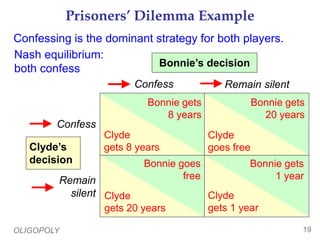
Prisoners’ Dilemma Example
 The police have caught Bonnie and Clyde,
two suspected bank robbers, but only have
enough evidence to imprison each for 1 year.
 The police question each in separate rooms,
offer each the following deal:
 If you confess and implicate your partner,
you go free.
 If you do not confess but your partner implicates
you, you get 20 years in prison.
 If you both confess, each gets 8 years in prison.
OLIGOPOLY 19
Prisoners’ Dilemma Example
Confess Remain silent
Confess
Remain
silent
Bonnie’s decision
Clyde’s
decision
Bonnie gets
8 years
Clyde
gets 8 years
Bonnie gets
20 years
Bonnie gets
1 year
Bonnie goes
free
Clyde
goes free
Clyde
gets 1 year
Clyde
gets 20 years
Confessing is the dominant strategy for both players.
Nash equilibrium:
both confess
OLIGOPOLY 20
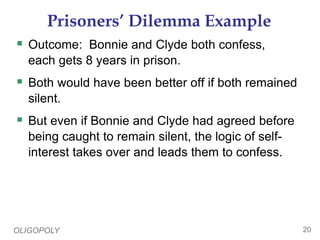
Prisoners’ Dilemma Example
 Outcome: Bonnie and Clyde both confess,
each gets 8 years in prison.
 Both would have been better off if both remained
silent.
 But even if Bonnie and Clyde had agreed before
being caught to remain silent, the logic of self-
interest takes over and leads them to confess.
OLIGOPOLY 21
Oligopolies as a Prisoners’ Dilemma
 When oligopolies form a cartel in hopes
of reaching the monopoly outcome,
they become players in a prisoners’ dilemma.
 Our earlier example:
 T-Mobile and Verizon are duopolists in
Smalltown.
 The cartel outcome maximizes profits:
Each firm agrees to serve Q = 30 customers.
 Here is the “payoff matrix” for this example…
OLIGOPOLY 22
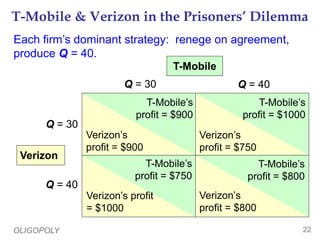
T-Mobile & Verizon in the Prisoners’ Dilemma
Q = 30 Q = 40
Q = 30
Q = 40
T-Mobile
Verizon
T-Mobile’s
profit = $900
Verizon’s
profit = $900
T-Mobile’s
profit = $1000
T-Mobile’s
profit = $800
T-Mobile’s
profit = $750
Verizon’s
profit = $750
Verizon’s
profit = $800
Verizon’s profit
= $1000
Each firm’s dominant strategy: renege on agreement,
produce Q = 40.
The players: American Airlines and United Airlines
The choice: cut fares by 50% or leave fares alone
 If both airlines cut fares,
each airline’s profit = $400 million
 If neither airline cuts fares,
each airline’s profit = $600 million
 If only one airline cuts its fares,
its profit = $800 million
the other airline’s profits = $200 million
Draw the payoff matrix, find the Nash equilibrium.
A C T I V E L E A R N I N G 3
The “fare wars” game
23
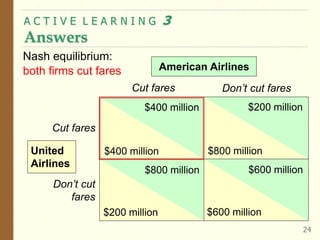
A C T I V E L E A R N I N G 3
Answers
24
Nash equilibrium:
both firms cut fares
Cut fares Don’t cut fares
Cut fares
Don’t cut
fares
American Airlines
United
Airlines
$600 million
$600 million
$200 million
$800 million
$800 million
$200 million
$400 million
$400 million
OLIGOPOLY 25
Other Examples of the Prisoners’ Dilemma
Ad Wars
Two firms spend millions on TV ads to steal
business from each other. Each firm’s ad
cancels out the effects of the other,
and both firms’ profits fall by the cost of the ads.
Organization of Petroleum Exporting Countries
Member countries try to act like a cartel, agree to
limit oil production to boost prices & profits.
But agreements sometimes break down
when individual countries renege.
OLIGOPOLY 26
Other Examples of the Prisoners’ Dilemma
Arms race between military superpowers
Each country would be better off if both disarm,
but each has a dominant strategy of arming.
Common resources
All would be better off if everyone conserved
common resources, but each person’s dominant
strategy is overusing the resources.
OLIGOPOLY 27
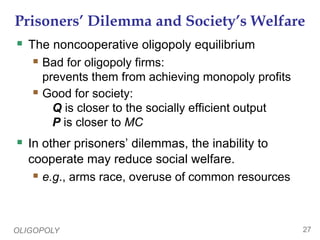
Prisoners’ Dilemma and Society’s Welfare
 The noncooperative oligopoly equilibrium
 Bad for oligopoly firms:
prevents them from achieving monopoly profits
 Good for society:
Q is closer to the socially efficient output
P is closer to MC
 In other prisoners’ dilemmas, the inability to
cooperate may reduce social welfare.
 e.g., arms race, overuse of common resources
OLIGOPOLY 28
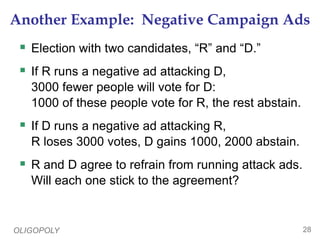
Another Example: Negative Campaign Ads
 Election with two candidates, “R” and “D.”
 If R runs a negative ad attacking D,
3000 fewer people will vote for D:
1000 of these people vote for R, the rest abstain.
 If D runs a negative ad attacking R,
R loses 3000 votes, D gains 1000, 2000 abstain.
 R and D agree to refrain from running attack ads.
Will each one stick to the agreement?
OLIGOPOLY 29
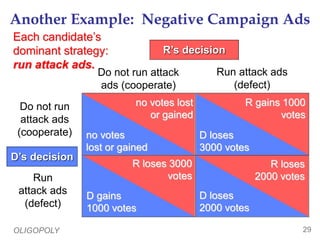
Another Example: Negative Campaign Ads
Do not run attack
ads (cooperate)
R’s decision
D’s decision
no votes lost
or gained
no votes
lost or gained
R gains 1000
votes
R loses
2000 votes
R loses 3000
votes
D loses
3000 votes
D loses
2000 votes
D gains
1000 votes
Each candidate’s
dominant strategy:
run attack ads.
Run attack ads
(defect)
Do not run
attack ads
(cooperate)
Run
attack ads
(defect)
OLIGOPOLY 30
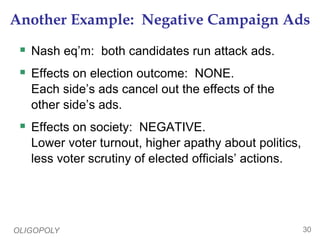
Another Example: Negative Campaign Ads
 Nash eq’m: both candidates run attack ads.
 Effects on election outcome: NONE.
Each side’s ads cancel out the effects of the
other side’s ads.
 Effects on society: NEGATIVE.
Lower voter turnout, higher apathy about politics,
less voter scrutiny of elected officials’ actions.
OLIGOPOLY 31
Why People Sometimes Cooperate
 When the game is repeated many times,
cooperation may be possible.
 These strategies may lead to cooperation:
 If your rival reneges in one round,
you renege in all subsequent rounds.
 “Tit-for-tat”
Whatever your rival does in one round
(whether renege or cooperate),
you do in the following round.
OLIGOPOLY 32
Public Policy Toward Oligopolies
 Recall one of the Ten Principles from Chap.1:
Governments can sometimes
improve market outcomes.
 In oligopolies, production is too low and prices
are too high, relative to the social optimum.
 Role for policymakers:
Promote competition, prevent cooperation
to move the oligopoly outcome closer to
the efficient outcome.
OLIGOPOLY 33
Restraint of Trade and Antitrust Laws
 Sherman Antitrust Act (1890):
Forbids collusion between competitors
 Clayton Antitrust Act (1914):
Strengthened rights of individuals damaged by
anticompetitive arrangements between firms
OLIGOPOLY 34
Controversies Over Antitrust Policy
 Most people agree that price-fixing agreements
among competitors should be illegal.
 Some economists are concerned that
policymakers go too far when using antitrust laws
to stifle business practices that are not
necessarily harmful, and may have legitimate
objectives.
 We consider three such practices…
OLIGOPOLY 35
1. Resale Price Maintenance (“Fair Trade”)
 Occurs when a manufacturer imposes lower limits
on the prices retailers can charge.
 Is often opposed because it appears to reduce
competition at the retail level.
 Yet, any market power the manufacturer has
is at the wholesale level; manufacturers do not
gain from restricting competition at the retail level.
 The practice has a legitimate objective:
preventing discount retailers from free-riding
on the services provided by full-service retailers.
OLIGOPOLY 36
2. Predatory Pricing
 Occurs when a firm cuts prices to prevent entry
or drive a competitor out of the market,
so that it can charge monopoly prices later.
 Illegal under antitrust laws, but hard for the courts
to determine when a price cut is predatory and
when it is competitive & beneficial to consumers.
 Many economists doubt that predatory pricing is a
rational strategy:
 It involves selling at a loss, which is extremely
costly for the firm.
 It can backfire.
OLIGOPOLY 37
3. Tying
 Occurs when a manufacturer bundles two products
together and sells them for one price (e.g., Microsoft
including a browser with its operating system)
 Critics argue that tying gives firms more market
power by connecting weak products to strong ones.
 Others counter that tying cannot change market
power: Buyers are not willing to pay more for two
goods together than for the goods separately.
 Firms may use tying for price discrimination,
which is not illegal, and which sometimes
increases economic efficiency.
OLIGOPOLY 38
CONCLUSION
 Oligopolies can end up looking like monopolies
or like competitive markets, depending on the
number of firms and how cooperative they are.
 The prisoners’ dilemma shows how difficult it is
for firms to maintain cooperation, even when
doing so is in their best interest.
 Policymakers use the antitrust laws to regulate
oligopolists’ behavior. The proper scope of these
laws is the subject of ongoing controversy.
CHAPTER SUMMARY
 Oligopolists can maximize profits if they form a
cartel and act like a monopolist.
 Yet, self-interest leads each oligopolist to a higher
quantity and lower price than under the monopoly
outcome.
 The larger the number of firms, the closer will be
the quantity and price to the levels that would
prevail under competition.
39
CHAPTER SUMMARY
 The prisoners’ dilemma shows that self-interest
can prevent people from cooperating, even when
cooperation is in their mutual interest. The logic of
the prisoners’ dilemma applies in many situations.
 Policymakers use the antitrust laws to prevent
oligopolies from engaging in anticompetitive
behavior such as price-fixing. But the application
of these laws is sometimes controversial.
40

micro-ch17-presentation.ppt mankiw micro

  • 1.
    © 2009 South-Western,a part of Cengage Learning, all rights reserved C H A P T E R Oligopoly Microeonomics P R I N C I P L E S O F N. Gregory Mankiw Premium PowerPoint Slides by Ron Cronovich 17
  • 2.
    In this chapter, lookfor the answers to these questions:  What outcomes are possible under oligopoly?  Why is it difficult for oligopoly firms to cooperate?  How are antitrust laws used to foster competition? 1
  • 3.
    OLIGOPOLY 2 Measuring MarketConcentration  Concentration ratio: the percentage of the market’s total output supplied by its four largest firms.  The higher the concentration ratio, the less competition.  This chapter focuses on oligopoly, a market structure with high concentration ratios.
  • 4.
    Concentration Ratios inSelected U.S. Industries Industry Concentration ratio Video game consoles 100% Tennis balls 100% Credit cards 99% Batteries 94% Soft drinks 93% Web search engines 92% Breakfast cereal 92% Cigarettes 89% Greeting cards 88% Beer 85% Cell phone service 82% Autos 79%
  • 5.
    OLIGOPOLY 4 Oligopoly  Oligopoly:a market structure in which only a few sellers offer similar or identical products.  Strategic behavior in oligopoly: A firm’s decisions about P or Q can affect other firms and cause them to react. The firm will consider these reactions when making decisions.  Game theory: the study of how people behave in strategic situations.
  • 6.
    OLIGOPOLY 5 P Q $0140 5 130 10 120 15 110 20 100 25 90 30 80 35 70 40 60 45 50 EXAMPLE: Cell Phone Duopoly in Smalltown  Smalltown has 140 residents  The “good”: cell phone service with unlimited anytime minutes and free phone  Smalltown’s demand schedule  Two firms: T-Mobile, Verizon (duopoly: an oligopoly with two firms)  Each firm’s costs: FC = $0, MC = $10
  • 7.
  • 8.
    OLIGOPOLY 7 EXAMPLE: CellPhone Duopoly in Smalltown  One possible duopoly outcome: collusion  Collusion: an agreement among firms in a market about quantities to produce or prices to charge  T-Mobile and Verizon could agree to each produce half of the monopoly output:  For each firm: Q = 30, P = $40, profits = $900  Cartel: a group of firms acting in unison, e.g., T-Mobile and Verizon in the outcome with collusion
  • 9.
    A C TI V E L E A R N I N G 1 Collusion vs. self-interest 8 Duopoly outcome with collusion: Each firm agrees to produce Q = 30, earns profit = $900. If T-Mobile reneges on the agreement and produces Q = 40, what happens to the market price? T-Mobile’s profits? Is it in T-Mobile’s interest to renege on the agreement? If both firms renege and produce Q = 40, determine each firm’s profits. P Q $0 140 5 130 10 120 15 110 20 100 25 90 30 80 35 70 40 60 45 50
  • 10.
    If both firmsstick to agreement, each firm’s profit = $900 If T-Mobile reneges on agreement and produces Q = 40: Market quantity = 70, P = $35 T-Mobile’s profit = 40 x ($35 – 10) = $1000 T-Mobile’s profits are higher if it reneges. Verizon will conclude the same, so both firms renege, each produces Q = 40: Market quantity = 80, P = $30 Each firm’s profit = 40 x ($30 – 10) = $800 A C T I V E L E A R N I N G 1 Answers 9 P Q $0 140 5 130 10 120 15 110 20 100 25 90 30 80 35 70 40 60 45 50
  • 11.
    OLIGOPOLY 10 Collusion vs.Self-Interest  Both firms would be better off if both stick to the cartel agreement.  But each firm has incentive to renege on the agreement.  Lesson: It is difficult for oligopoly firms to form cartels and honor their agreements.
  • 12.
    If each firmproduces Q = 40, market quantity = 80 P = $30 each firm’s profit = $800 Is it in T-Mobile’s interest to increase its output further, to Q = 50? Is it in Verizon’s interest to increase its output to Q = 50? A C T I V E L E A R N I N G 2 The oligopoly equilibrium 11 P Q $0 140 5 130 10 120 15 110 20 100 25 90 30 80 35 70 40 60 45 50
  • 13.
    If each firmproduces Q = 40, then each firm’s profit = $800. If T-Mobile increases output to Q = 50: Market quantity = 90, P = $25 T-Mobile’s profit = 50 x ($25 – 10) = $750 T-Mobile’s profits are higher at Q = 40 than at Q = 50. The same is true for Verizon. A C T I V E L E A R N I N G 2 Answers 12 P Q $0 140 5 130 10 120 15 110 20 100 25 90 30 80 35 70 40 60 45 50
  • 14.
    OLIGOPOLY 13 The Equilibriumfor an Oligopoly  Nash equilibrium: a situation in which economic participants interacting with one another each choose their best strategy given the strategies that all the others have chosen  Our duopoly example has a Nash equilibrium in which each firm produces Q = 40.  Given that Verizon produces Q = 40, T-Mobile’s best move is to produce Q = 40.  Given that T-Mobile produces Q = 40, Verizon’s best move is to produce Q = 40.
  • 15.
    OLIGOPOLY 14 A Comparisonof Market Outcomes When firms in an oligopoly individually choose production to maximize profit,  oligopoly Q is greater than monopoly Q but smaller than competitive Q.  oligopoly P is greater than competitive P but less than monopoly P.
  • 16.
    OLIGOPOLY 15 The Output& Price Effects  Increasing output has two effects on a firm’s profits:  Output effect: If P > MC, selling more output raises profits.  Price effect: Raising production increases market quantity, which reduces market price and reduces profit on all units sold.  If output effect > price effect, the firm increases production.  If price effect > output effect, the firm reduces production.
  • 17.
    OLIGOPOLY 16 The Sizeof the Oligopoly  As the number of firms in the market increases,  the price effect becomes smaller  the oligopoly looks more and more like a competitive market  P approaches MC  the market quantity approaches the socially efficient quantity Another benefit of international trade: Trade increases the number of firms competing, increases Q, brings P closer to marginal cost
  • 18.
    OLIGOPOLY 17 Game Theory Game theory helps us understand oligopoly and other situations where “players” interact and behave strategically.  Dominant strategy: a strategy that is best for a player in a game regardless of the strategies chosen by the other players  Prisoners’ dilemma: a “game” between two captured criminals that illustrates why cooperation is difficult even when it is mutually beneficial
  • 19.
    OLIGOPOLY 18 Prisoners’ DilemmaExample  The police have caught Bonnie and Clyde, two suspected bank robbers, but only have enough evidence to imprison each for 1 year.  The police question each in separate rooms, offer each the following deal:  If you confess and implicate your partner, you go free.  If you do not confess but your partner implicates you, you get 20 years in prison.  If you both confess, each gets 8 years in prison.
  • 20.
    OLIGOPOLY 19 Prisoners’ DilemmaExample Confess Remain silent Confess Remain silent Bonnie’s decision Clyde’s decision Bonnie gets 8 years Clyde gets 8 years Bonnie gets 20 years Bonnie gets 1 year Bonnie goes free Clyde goes free Clyde gets 1 year Clyde gets 20 years Confessing is the dominant strategy for both players. Nash equilibrium: both confess
  • 21.
    OLIGOPOLY 20 Prisoners’ DilemmaExample  Outcome: Bonnie and Clyde both confess, each gets 8 years in prison.  Both would have been better off if both remained silent.  But even if Bonnie and Clyde had agreed before being caught to remain silent, the logic of self- interest takes over and leads them to confess.
  • 22.
    OLIGOPOLY 21 Oligopolies asa Prisoners’ Dilemma  When oligopolies form a cartel in hopes of reaching the monopoly outcome, they become players in a prisoners’ dilemma.  Our earlier example:  T-Mobile and Verizon are duopolists in Smalltown.  The cartel outcome maximizes profits: Each firm agrees to serve Q = 30 customers.  Here is the “payoff matrix” for this example…
  • 23.
    OLIGOPOLY 22 T-Mobile &Verizon in the Prisoners’ Dilemma Q = 30 Q = 40 Q = 30 Q = 40 T-Mobile Verizon T-Mobile’s profit = $900 Verizon’s profit = $900 T-Mobile’s profit = $1000 T-Mobile’s profit = $800 T-Mobile’s profit = $750 Verizon’s profit = $750 Verizon’s profit = $800 Verizon’s profit = $1000 Each firm’s dominant strategy: renege on agreement, produce Q = 40.
  • 24.
    The players: AmericanAirlines and United Airlines The choice: cut fares by 50% or leave fares alone  If both airlines cut fares, each airline’s profit = $400 million  If neither airline cuts fares, each airline’s profit = $600 million  If only one airline cuts its fares, its profit = $800 million the other airline’s profits = $200 million Draw the payoff matrix, find the Nash equilibrium. A C T I V E L E A R N I N G 3 The “fare wars” game 23
  • 25.
    A C TI V E L E A R N I N G 3 Answers 24 Nash equilibrium: both firms cut fares Cut fares Don’t cut fares Cut fares Don’t cut fares American Airlines United Airlines $600 million $600 million $200 million $800 million $800 million $200 million $400 million $400 million
  • 26.
    OLIGOPOLY 25 Other Examplesof the Prisoners’ Dilemma Ad Wars Two firms spend millions on TV ads to steal business from each other. Each firm’s ad cancels out the effects of the other, and both firms’ profits fall by the cost of the ads. Organization of Petroleum Exporting Countries Member countries try to act like a cartel, agree to limit oil production to boost prices & profits. But agreements sometimes break down when individual countries renege.
  • 27.
    OLIGOPOLY 26 Other Examplesof the Prisoners’ Dilemma Arms race between military superpowers Each country would be better off if both disarm, but each has a dominant strategy of arming. Common resources All would be better off if everyone conserved common resources, but each person’s dominant strategy is overusing the resources.
  • 28.
    OLIGOPOLY 27 Prisoners’ Dilemmaand Society’s Welfare  The noncooperative oligopoly equilibrium  Bad for oligopoly firms: prevents them from achieving monopoly profits  Good for society: Q is closer to the socially efficient output P is closer to MC  In other prisoners’ dilemmas, the inability to cooperate may reduce social welfare.  e.g., arms race, overuse of common resources
  • 29.
    OLIGOPOLY 28 Another Example:Negative Campaign Ads  Election with two candidates, “R” and “D.”  If R runs a negative ad attacking D, 3000 fewer people will vote for D: 1000 of these people vote for R, the rest abstain.  If D runs a negative ad attacking R, R loses 3000 votes, D gains 1000, 2000 abstain.  R and D agree to refrain from running attack ads. Will each one stick to the agreement?
  • 30.
    OLIGOPOLY 29 Another Example:Negative Campaign Ads Do not run attack ads (cooperate) R’s decision D’s decision no votes lost or gained no votes lost or gained R gains 1000 votes R loses 2000 votes R loses 3000 votes D loses 3000 votes D loses 2000 votes D gains 1000 votes Each candidate’s dominant strategy: run attack ads. Run attack ads (defect) Do not run attack ads (cooperate) Run attack ads (defect)
  • 31.
    OLIGOPOLY 30 Another Example:Negative Campaign Ads  Nash eq’m: both candidates run attack ads.  Effects on election outcome: NONE. Each side’s ads cancel out the effects of the other side’s ads.  Effects on society: NEGATIVE. Lower voter turnout, higher apathy about politics, less voter scrutiny of elected officials’ actions.
  • 32.
    OLIGOPOLY 31 Why PeopleSometimes Cooperate  When the game is repeated many times, cooperation may be possible.  These strategies may lead to cooperation:  If your rival reneges in one round, you renege in all subsequent rounds.  “Tit-for-tat” Whatever your rival does in one round (whether renege or cooperate), you do in the following round.
  • 33.
    OLIGOPOLY 32 Public PolicyToward Oligopolies  Recall one of the Ten Principles from Chap.1: Governments can sometimes improve market outcomes.  In oligopolies, production is too low and prices are too high, relative to the social optimum.  Role for policymakers: Promote competition, prevent cooperation to move the oligopoly outcome closer to the efficient outcome.
  • 34.
    OLIGOPOLY 33 Restraint ofTrade and Antitrust Laws  Sherman Antitrust Act (1890): Forbids collusion between competitors  Clayton Antitrust Act (1914): Strengthened rights of individuals damaged by anticompetitive arrangements between firms
  • 35.
    OLIGOPOLY 34 Controversies OverAntitrust Policy  Most people agree that price-fixing agreements among competitors should be illegal.  Some economists are concerned that policymakers go too far when using antitrust laws to stifle business practices that are not necessarily harmful, and may have legitimate objectives.  We consider three such practices…
  • 36.
    OLIGOPOLY 35 1. ResalePrice Maintenance (“Fair Trade”)  Occurs when a manufacturer imposes lower limits on the prices retailers can charge.  Is often opposed because it appears to reduce competition at the retail level.  Yet, any market power the manufacturer has is at the wholesale level; manufacturers do not gain from restricting competition at the retail level.  The practice has a legitimate objective: preventing discount retailers from free-riding on the services provided by full-service retailers.
  • 37.
    OLIGOPOLY 36 2. PredatoryPricing  Occurs when a firm cuts prices to prevent entry or drive a competitor out of the market, so that it can charge monopoly prices later.  Illegal under antitrust laws, but hard for the courts to determine when a price cut is predatory and when it is competitive & beneficial to consumers.  Many economists doubt that predatory pricing is a rational strategy:  It involves selling at a loss, which is extremely costly for the firm.  It can backfire.
  • 38.
    OLIGOPOLY 37 3. Tying Occurs when a manufacturer bundles two products together and sells them for one price (e.g., Microsoft including a browser with its operating system)  Critics argue that tying gives firms more market power by connecting weak products to strong ones.  Others counter that tying cannot change market power: Buyers are not willing to pay more for two goods together than for the goods separately.  Firms may use tying for price discrimination, which is not illegal, and which sometimes increases economic efficiency.
  • 39.
    OLIGOPOLY 38 CONCLUSION  Oligopoliescan end up looking like monopolies or like competitive markets, depending on the number of firms and how cooperative they are.  The prisoners’ dilemma shows how difficult it is for firms to maintain cooperation, even when doing so is in their best interest.  Policymakers use the antitrust laws to regulate oligopolists’ behavior. The proper scope of these laws is the subject of ongoing controversy.
  • 40.
    CHAPTER SUMMARY  Oligopolistscan maximize profits if they form a cartel and act like a monopolist.  Yet, self-interest leads each oligopolist to a higher quantity and lower price than under the monopoly outcome.  The larger the number of firms, the closer will be the quantity and price to the levels that would prevail under competition. 39
  • 41.
    CHAPTER SUMMARY  Theprisoners’ dilemma shows that self-interest can prevent people from cooperating, even when cooperation is in their mutual interest. The logic of the prisoners’ dilemma applies in many situations.  Policymakers use the antitrust laws to prevent oligopolies from engaging in anticompetitive behavior such as price-fixing. But the application of these laws is sometimes controversial. 40