The  Ancien Régime Geography and History Department IES  Fray   Pedro de Urbina
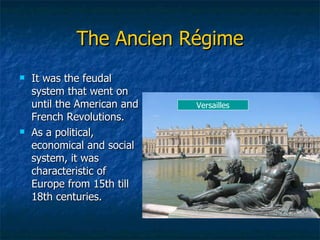
The Ancien Régime It was the feudal system that went on until the American and French Revolutions. As a political, economical and social system, it was characteristic of Europe from 15th till 18th centuries. Versailles
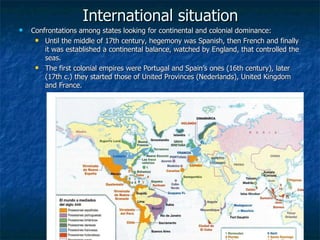
International situation Confrontations among states looking for continental and colonial dominance: Until the middle of 17th century, hegemony was Spanish, then French and finally it was established a continental balance, watched by England, that controlled the seas. The first colonial empires were Portugal and Spain’s ones (16th century), later (17th c.) they started those of United Provinces ( Nederlands ), United Kingdom and France.
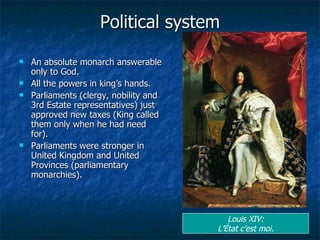
Political system An absolute monarch answerable only to God. All the powers in king’s hands. Parliaments (clergy, nobility and 3rd Estate representatives) just approved new taxes (King called them only when he had need for). Parliaments were stronger in United Kingdom and United Provinces (parliamentary monarchies ). Louis XIV: L’État c’est moi.
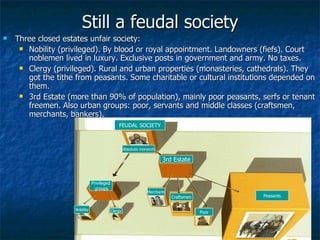
Still a feudal society Three closed estates unfair society: Nobility (privileged). By blood or royal appointment. Landowners (fiefs). Court noblemen lived in luxury. Exclusive posts in government and army. No taxes. Clergy (privileged). Rural and urban properties (monasteries, cathedrals). They got the tithe from peasants. Some charitable or cultural institutions depended on them. 3rd Estate (more than 90% of population), mainly poor peasants, serfs or tenant freemen. Also urban groups: poor, servants and middle classes (craftsmen, merchants, bankers). Poor Craftsmen Merchants 3rd Estate Peasants Privileged groups Nobility Clergy  FEUDAL SOCIETY Absolute monarch
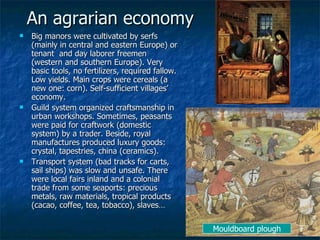
An agrarian economy Big manors were cultivated by serfs (mainly in central and eastern Europe) or tenant  and day laborer freemen (western and southern Europe). Very basic tools, no fertilizers, required fallow. Low yields. Main crops were cereals (a new one: corn). Self-sufficient villages’ economy. Guild system organized craftsmanship in urban workshops. Sometimes, peasants were paid for craftwork (domestic system) by a trader. Beside, royal manufactures produced luxury goods: crystal, tapestries, china (ceramics). Transport system (bad tracks for carts, sail ships) was slow and unsafe. There were local fairs inland and a colonial trade from some seaports: precious metals, raw materials, tropical products (cacao, coffee, tea, tobacco), slaves… Mouldboard  plough
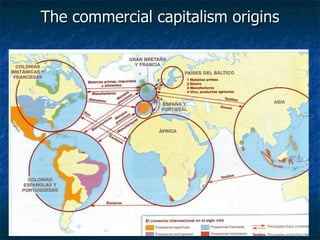
The commercial capitalism origins
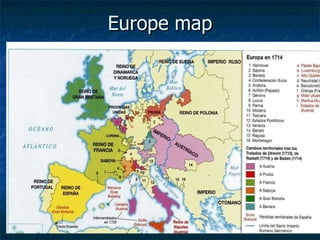
Europe map
Criticizing and reforming  Ancien  Régime: Enlightenment  (La Ilustración)   Reason was advocated as the primary source and legitimacy for authority. Fight against tradition, ignorance and superstition. They promoted scientific development and public education. Faith in human progress and personal merit, search for happiness. New economic theories:  physiocracy  (Quesnay), capitalism (A. Smith). Intellectuals and philosophers criticized absolutism and estate society, establishing the bases of a new political and social system: liberalism (people’s sovereignty, separation of powers, individual rights). They were tolerant in religion but anticlerical. Most of them were masons (secret society). The Encyclopedia (Diderot,  D’Alembert ) spread these ideas. Voltaire, Montesquieu, Rousseau,  Jovellanos. Some kings became enlightened despots. Quesnay A. Smith Diderot D’Alembert Jovellanos Montesquieu, Voltaire  and  Rousseau

The Ancien Régime

  • 1.
    The AncienRégime Geography and History Department IES Fray Pedro de Urbina
  • 2.
    The Ancien RégimeIt was the feudal system that went on until the American and French Revolutions. As a political, economical and social system, it was characteristic of Europe from 15th till 18th centuries. Versailles
  • 3.
    International situation Confrontationsamong states looking for continental and colonial dominance: Until the middle of 17th century, hegemony was Spanish, then French and finally it was established a continental balance, watched by England, that controlled the seas. The first colonial empires were Portugal and Spain’s ones (16th century), later (17th c.) they started those of United Provinces ( Nederlands ), United Kingdom and France.
  • 4.
    Political system Anabsolute monarch answerable only to God. All the powers in king’s hands. Parliaments (clergy, nobility and 3rd Estate representatives) just approved new taxes (King called them only when he had need for). Parliaments were stronger in United Kingdom and United Provinces (parliamentary monarchies ). Louis XIV: L’État c’est moi.
  • 5.
    Still a feudalsociety Three closed estates unfair society: Nobility (privileged). By blood or royal appointment. Landowners (fiefs). Court noblemen lived in luxury. Exclusive posts in government and army. No taxes. Clergy (privileged). Rural and urban properties (monasteries, cathedrals). They got the tithe from peasants. Some charitable or cultural institutions depended on them. 3rd Estate (more than 90% of population), mainly poor peasants, serfs or tenant freemen. Also urban groups: poor, servants and middle classes (craftsmen, merchants, bankers). Poor Craftsmen Merchants 3rd Estate Peasants Privileged groups Nobility Clergy FEUDAL SOCIETY Absolute monarch
  • 6.
    An agrarian economyBig manors were cultivated by serfs (mainly in central and eastern Europe) or tenant and day laborer freemen (western and southern Europe). Very basic tools, no fertilizers, required fallow. Low yields. Main crops were cereals (a new one: corn). Self-sufficient villages’ economy. Guild system organized craftsmanship in urban workshops. Sometimes, peasants were paid for craftwork (domestic system) by a trader. Beside, royal manufactures produced luxury goods: crystal, tapestries, china (ceramics). Transport system (bad tracks for carts, sail ships) was slow and unsafe. There were local fairs inland and a colonial trade from some seaports: precious metals, raw materials, tropical products (cacao, coffee, tea, tobacco), slaves… Mouldboard plough
  • 7.
  • 8.
  • 9.
    Criticizing and reforming Ancien Régime: Enlightenment (La Ilustración) Reason was advocated as the primary source and legitimacy for authority. Fight against tradition, ignorance and superstition. They promoted scientific development and public education. Faith in human progress and personal merit, search for happiness. New economic theories: physiocracy (Quesnay), capitalism (A. Smith). Intellectuals and philosophers criticized absolutism and estate society, establishing the bases of a new political and social system: liberalism (people’s sovereignty, separation of powers, individual rights). They were tolerant in religion but anticlerical. Most of them were masons (secret society). The Encyclopedia (Diderot, D’Alembert ) spread these ideas. Voltaire, Montesquieu, Rousseau, Jovellanos. Some kings became enlightened despots. Quesnay A. Smith Diderot D’Alembert Jovellanos Montesquieu, Voltaire and Rousseau