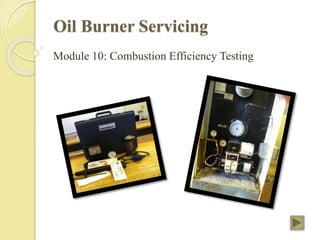
Oil Burner Servicing
Module 10: Combustion Efficiency Testing
Why Combustion Testing?
 The purpose of the testing is to see
how well the unit is using the fuel
 The testing benefits the customer
 Should be performed once a year with
routine service
Table of Contents
◦ Light Off
◦ Draft
◦ Smoke
◦ CO2
◦ Stack Temperature and Net Temperature
◦ Efficiency
◦ Combustion Test Report
◦ Typical Readings
◦ Conclusion
◦ Self Test
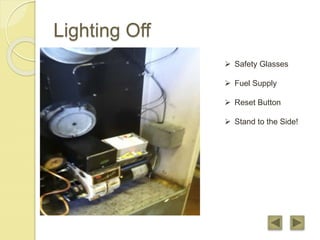
Lighting Off
 Safety Glasses
 Fuel Supply
 Reset Button
 Stand to the Side!
Draft
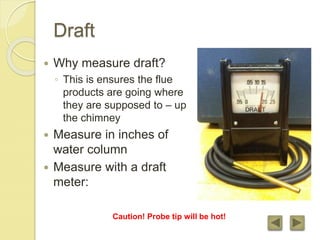
 Why measure draft?
◦ This is ensures the flue
products are going where
they are supposed to – up
the chimney
 Measure in inches of
water column
 Measure with a draft
meter:
Caution! Probe tip will be hot!
Draft:
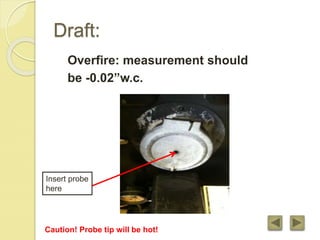
Overfire: measurement should
be -0.02”w.c.
Insert probe
here
Caution! Probe tip will be hot!
Draft
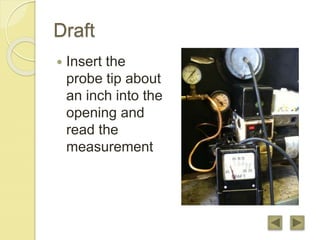
 Insert the
probe tip about
an inch into the
opening and
read the
measurement
Draft
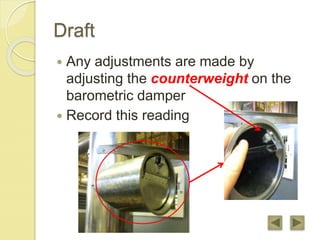
 Any adjustments are made by
adjusting the counterweight on the
barometric damper
 Record this reading
Smoke
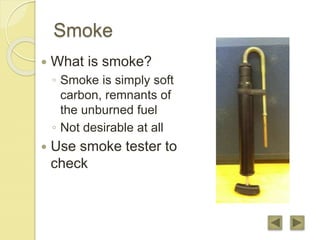
 What is smoke?
◦ Smoke is simply soft
carbon, remnants of
the unburned fuel
◦ Not desirable at all
 Use smoke tester to
check
Smoke
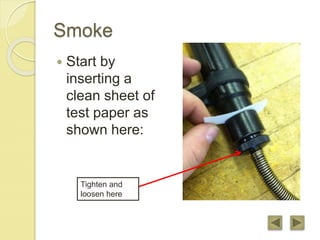
 Start by
inserting a
clean sheet of
test paper as
shown here:
Tighten and
loosen here
Smoke
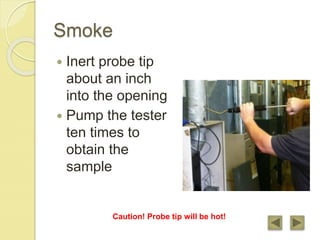
 Inert probe tip
about an inch
into the opening
 Pump the tester
ten times to
obtain the
sample
Caution! Probe tip will be hot!
Smoke
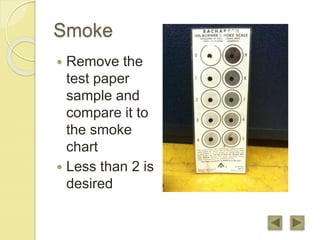
 Remove the
test paper
sample and
compare it to
the smoke
chart
 Less than 2 is
desired
Smoke
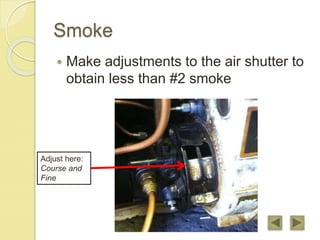
 Make adjustments to the air shutter to
obtain less than #2 smoke
Adjust here:
Course and
Fine
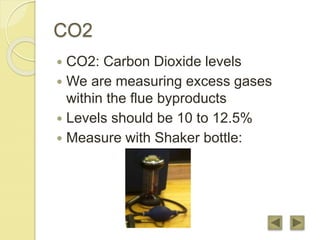
CO2
 CO2: Carbon Dioxide levels
 We are measuring excess gases
within the flue byproducts
 Levels should be 10 to 12.5%
 Measure with Shaker bottle:
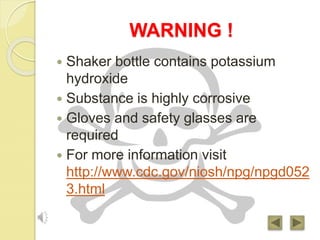
WARNING !
 Shaker bottle contains potassium
hydroxide
 Substance is highly corrosive
 Gloves and safety glasses are
required
 For more information visit
http://www.cdc.gov/niosh/npg/npgd052
3.html
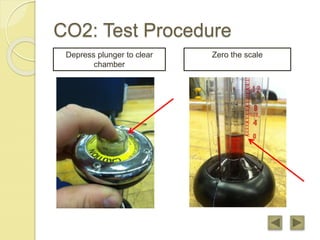
CO2: Test Procedure
Depress plunger to clear
chamber
Zero the scale
CO2: Test Procedure
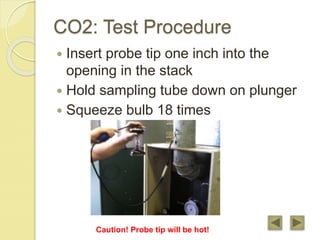
 Insert probe tip one inch into the
opening in the stack
 Hold sampling tube down on plunger
 Squeeze bulb 18 times
Caution! Probe tip will be hot!
CO2: Test Procedure
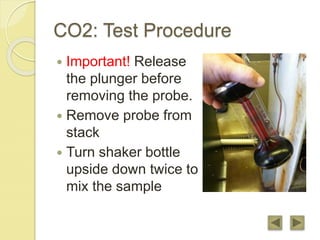
 Important! Release
the plunger before
removing the probe.
 Remove probe from
stack
 Turn shaker bottle
upside down twice to
mix the sample
CO2: Test Procedure
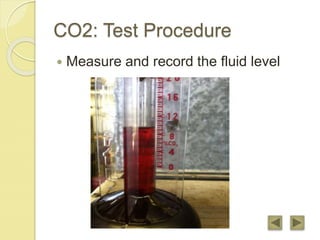
 Measure and record the fluid level
Stack and Net Temperatures
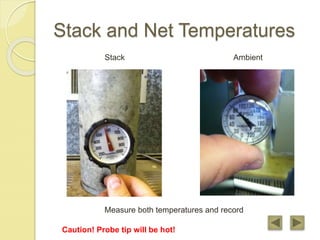
 The stack temperature is the
measured temperature in the stack
 The ambient temperature is the
temperature of the surrounding area
(room temperature)
 The net temperature is the stack
temperature minus the ambient
temperature.
Stack and Net Temperatures
Stack Ambient
Measure both temperatures and record
Caution! Probe tip will be hot!
Stack and Net Temperatures
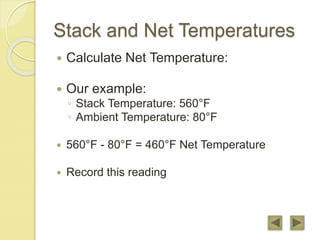
 Calculate Net Temperature:
 Our example:
◦ Stack Temperature: 560°F
◦ Ambient Temperature: 80°F
 560°F - 80°F = 460°F Net Temperature
 Record this reading
Efficiency
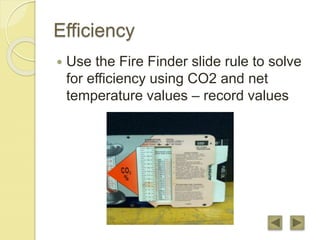
 Use the Fire Finder slide rule to solve
for efficiency using CO2 and net
temperature values – record values
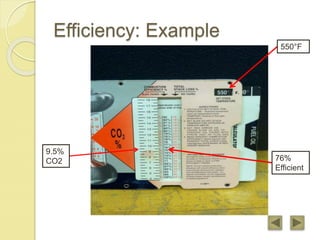
Efficiency: Example
9.5%
CO2
550°F
76%
Efficient
Combustion Testing Report
 Compile data from testing into a report
for customer and your records
 Click on the following link to see an
example of a combustion testing
report:
 http://donibartley.jimdo.com/combustio
n-testing-report-form/
Typical Readings
 Oil-fired power burners*:
• O2 — (flame retention) 3-6%.
• CO2 — 10-12.5%.
• Stack temp — 60-79% AFUE 400˚ to 600˚F
• Stack temp — 80-plus AFUE 330˚ to 450˚F
• Stack temp — 90-plus AFUE less than
125˚F
• Draft — -0.02 inch wc overfire.
• Draft (stack) — -02 inch wc/0.04 inch wc.
• Smoke spot — #0-#1.
 * Always follow manufacturers
recommendations
Conclusion
 The combustion testing procedures you just
learned about are designed to be performed by
a professional
 Your next step will be conducting hands-on training
in a laboratory environment under the supervision
of a trained professional
 Now let’s test your knowledge you have acquired
about combustion testing:
QUIZ
Quiz
 Question 1:
At what location would you make any adjustments to
the draft of an oil burner during combustion testing?
A
B
C
D
Air shutter
Barometric damper
Pressure regulator
Indoor fan motor
Next
Question
That is Correct!
Next
Question
Back to
Question
Incorrect. Try Again.
Back to
Question
Next
Question
Incorrect. Try Again.
Back to
Question
Next
Question
Incorrect. Try Again.
Back to
Question
Next
Question
Quiz
 Question 2:
What is the name of the dangerous substance found
in the aqueous solution in the CO2 shaker bottle?
A
B
C
D
Potassium chloride
Potassium sulfate
Potassium hydroxide
Potassium nitride
Next
Question
Previous
Question
That is Correct!
Next
Question
Back to
Question
Incorrect. Try Again.
Back to
Question
Next
Question
Incorrect. Try Again.
Back to
Question
Next
Question
Incorrect. Try Again.
Back to
Question
Next
Question
Quiz
 Question 3:
How many times should you pump the smoke tester
during a sample?
A
B
C
D
10
18
16
12
Next
Question
Previous
Question
That is Correct!
Next
Question
Back to
Question
Incorrect. Try Again.
Back to
Question
Next
Question
Incorrect. Try Again.
Back to
Question
Next
Question
Incorrect. Try Again.
Back to
Question
Next
Question
Quiz
 Question 4:
What two values are used to solve for efficiency?
A
B
C
D
Stack temperature and smoke number
CO2 and Draft
Net Temperature and CO2
Draft and smoke number
Table of
Contents
Previous
Question
That is Correct!
Table of
Contents
Incorrect. Try Again.
Back to
Question
Incorrect. Try Again.
Back to
Question
Incorrect. Try Again.
Back to
Question

Oil burner servicing, combustion efficiency testing cbt 2